
The right contest mix is mostly cash games and single-entry small-field tournaments, with only a thin slice going to massive-field GPPs. Cap any single slate at about 10% of your bankroll, and hold single large-field entries to 1-2%. Cash rewards a high floor; GPPs reward ceiling and leverage, so treat contest selection as its own skill, separate from lineup building.
TL;DR:
- Focus most of your bankroll on cash games and single-entry contests, limiting large-field GPP exposure to 1-2 percent per slate.
- Adjust lineup strategies based on contest type, emphasizing median and consistency for cash games, and ceiling and leverage for GPPs.
- Prioritize smaller field and capped entry pools like single-entry or three-max to reduce competition and improve your chances of winning.
- Always check contest economics before lock, including rake, overlay, and payout structure, to identify the most profitable options.
- Follow a disciplined routine, including setting bankroll caps, filtering contest pools, and doing sanity checks to make better contest decisions.
Table of Contents
- What Is a Contest Selection Strategy?
- Cash Vs GPP: What Each Format Asks Your Lineup to Do
- Field Size and Entry Limits: How SE, 3-Max, 20-Max and MME Change Your Edge
- Rake, Overlay, and Contest Quality: The Economics Before Lock
- Bankroll Sizing: Percent Rules That Keep Variance From Killing Your Roll
- How to Choose: One Checklist of Questions and Red Flags to Run on Every Entry Screen
- Practical Pre-Lock Routine: Step-by-Step Contest-Selection Checklist
- Tweener Lens: Contest Selection Applied to Fantasy Tennis and Why Tweener Fits
- A Habit Worth Testing This Week
- Practice Contest Selection Where Tennis Fans Actually Compete
- Sources
What Is a Contest Selection Strategy?
A contest selection strategy is the set of rules you use to decide which pools to enter, how many lineups to put in each, and how much of your bankroll to risk on a given slate. Most DFS players obsess over projections and player pools but skip this step entirely, then wonder why a solid lineup keeps losing money — checking your contest shapes on Football Planet can help reveal optimal pools for your skill set. The fix usually isn't a better lineup. It's a better contest.
- Allocation: put roughly 60-70% of your action into cash games and single-entry contests, 20-30% into small or medium GPPs, and a small slice, no more than 10%, into large-field tournaments.
- Sizing: keep total exposure on one slate near 10% of your bankroll, and never put more than 1-2% into a single massive-field entry.
- Entry-screen checks: rake percentage, current field size versus the cap, single-entry versus multi-entry, and whether the prize pool shows signs of overlay.
Run those checks before you build a single lineup. It changes what you build.
Cash Vs GPP: What Each Format Asks Your Lineup to Do
Cash games and GPPs are not the same game wearing different jerseys. Cash formats, head-to-heads, 50/50s, double-ups, pay out roughly half the field, so they reward a high floor and punish variance. You want the safest, most projectable players, not the boom-or-bust names.
GPPs flip that logic. Large-field tournaments are top-heavy, often paying 20% or less of entrants, so they reward ceiling outcomes, correlated stacks, and low-owned leverage plays that separate you from a crowded field. A player projected for a modest median but a huge 90th-percentile outcome is often a better GPP piece than a safer name with less spread.
The practical consequence: you should be weighting projections differently by format. Cash lineups lean on median projection and consistency; GPP lineups lean on ceiling, ownership leverage, and correlation between teammates or matchups. The common mistake is building one "best" lineup and firing it into every contest type available. That lineup is rarely optimal for both jobs, because the jobs are different. A cash-safe build usually has too little upside to separate in a 10,000-entry GPP, and a leverage-heavy GPP build usually has too much variance to survive a 50/50.
Field Size and Entry Limits: How SE, 3-Max, 20-Max and MME Change Your Edge
Field size and entry caps decide how much competition you're actually facing, and it matters more than most players think. Giant tournaments with unlimited entries, the Milly Maker style pools, are effectively lottery tickets for most players, because a handful of sharps firing 100+ correlated lineups soak up a disproportionate share of the winning outcomes.
Single-entry contests solve that problem directly. When every player gets exactly one lineup, volume can't bury you, which tends to make single-entry pools softer and more winnable for a disciplined recreational or semi-pro player. That's also why single-entry contests carry some of the best risk-adjusted returns for smaller bankrolls.
Three-max and 20-max contests sit in between. They let a mid-size player leverage a few correlated builds without opening the floodgates to mass-entry regulars running 150 lineups. A reasonable approach: run single-entry and 3-max as your GPP core, reserve MME for a small budget where you genuinely have three or four distinct, defensible builds, not just variations on one idea. Learn more about how these tournament formats work before you commit real money to any of them.
Rake, Overlay, and Contest Quality: The Economics Before Lock
Rake is the site's cut of every entry fee, and it's the quiet tax that decides whether your edge survives contact with reality. Typical rake runs around 10-15%, meaning a $10 double-up might only pay out $9 in total value per dollar wagered before anyone's skill even enters the equation.
Overlay flips that math in your favor. When a guaranteed prize pool doesn't fill, the site covers the difference, so the effective payout structure gets better than the stated rake would suggest. Check the entry screen close to lock. If registration is thin and the prize is guaranteed, that's a real signal worth chasing.
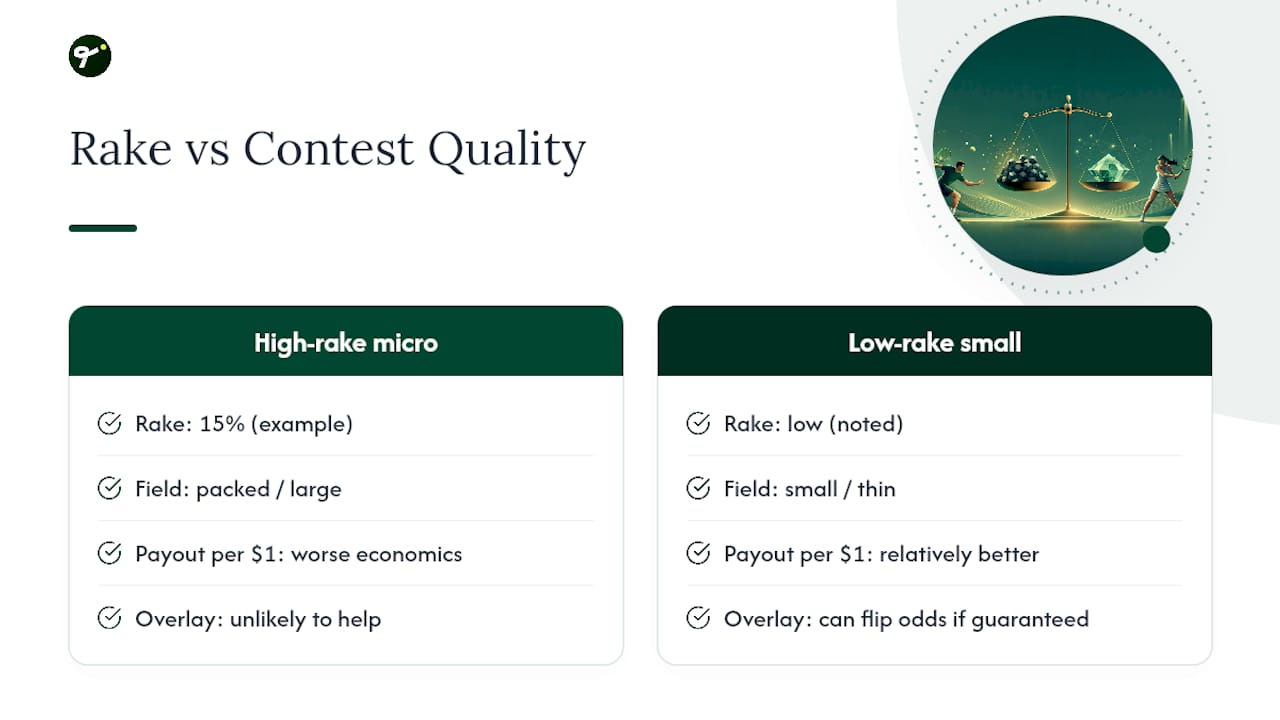
Skip the trap of high-rake micro-stakes contests just because the buy-in feels safe. A $1 contest with 15% rake and a packed field is worse economics than a $20 low-rake small-field pool, even though the second one feels riskier on paper.
Bankroll Sizing: Percent Rules That Keep Variance From Killing Your Roll
Bankroll sizing is the difference between surviving a bad month and busting out of the game entirely. Professional DFS players typically keep any single slate to about 10% of their total bankroll, spread across several contests rather than one big swing.
Pro Tip: If your bankroll is $500, that's roughly $50 in total slate exposure, not $50 on one contest. Split it across two or three cash games and a couple of small GPPs instead of one entry.
For single large-field GPP entries specifically, cap each one at 1-2% of your roll. On a $1,000 bankroll, that's $10 to $20 per massive-field entry, no matter how good the slate looks. This discipline isn't about being conservative for its own sake. It's what lets a real edge compound over a full season instead of getting erased by one unlucky Sunday, or one bad clay-court slate.
How to Choose: One Checklist of Questions and Red Flags to Run on Every Entry Screen
Before you touch a lineup, decide what you're actually optimizing for. Bankroll growth and entertainment call for different contest mixes, and conflating the two is how disciplined players talk themselves into a $500 GPP they can't afford to lose.
- What's my goal for this slate? Growth means cash and single-entry GPPs; entertainment means you can afford a speculative large-field flier.
- What's the rake? Anything north of 15% needs a real overlay to justify the entry.
- What's the field size and entry cap? Prefer single-entry or 3-max over unlimited MME when your bankroll is under four figures.
- Is there overlay? Check the guaranteed prize pool against current entries close to lock.
- What's the payout shape? Top-heavy structures need leverage; flatter structures reward the safest build.
Red flags: high rake stacked on tiny buy-ins, ownership projections that look suspiciously bloated on a chalk favorite, and entry lists showing the same handful of usernames firing dozens of lineups. On a mid-size Sunday slate, that checklist might steer you away from a $25 unlimited-entry GPP loaded with sharps and into a $10 single-entry tournament with a thinner, softer field instead.
Practical Pre-Lock Routine: Step-by-Step Contest-Selection Checklist
Run this in order, every time, until it's automatic.
- Set your slate bankroll. Calculate 10% of your total roll and treat that as the hard ceiling for this slate's action.
- Filter your contest pool. Prioritize single-entry contests, small-field GPPs, and low-rake cash games; flag anything showing overlay potential.
- Allocate entries. Split the slate budget using your percent rules: the bulk into cash and single-entry, a capped 1-2% slice into any single large-field GPP.
- Sanity check before you commit. Confirm the payout table, rake percentage, and max-entry limits one more time before locking your lineups.
This is exactly the kind of workflow worth building into a repeatable habit, and it pairs well with a broader fantasy sports betting workflow if you're managing bankroll across multiple sports.
Tweener Lens: Contest Selection Applied to Fantasy Tennis and Why Tweener Fits
Tennis slates behave differently than stick-and-ball sports. Fewer matches, surface-dependent form, and best-of-three or best-of-five variance mean small-field and single-entry contests surface constantly, since fields simply never balloon the way NFL Sunday slates do. That structural quirk favors exactly the contest mix this guide recommends.
Tweener's free mode lets you test contest selection with virtual coins before risking cash, while cash mode and private leagues of up to nine friends give you the single-entry, small-field environment where a real H2H and surface edge actually shows up. Check the tennis-specific tournament strategy breakdown for the lineup side of this equation.
A Habit Worth Testing This Week
No unlimited-entry pools, no exceptions. Track every result in a spreadsheet, not your memory. The gap between what you thought you were doing and what the numbers actually show is usually the most useful thing you'll learn all month.
— Nathan
Practice Contest Selection Where Tennis Fans Actually Compete
Tennis still doesn't have its own Fanduel or DraftKings, and that gap is exactly what Tweener fills for fans who want a real DFS experience built around ATP and WTA matches instead of generic team sports. You get the same contest-selection decisions covered here, format, field size, rake, bankroll sizing, but applied to surfaces, head-to-head records, and Grand Slam draws instead of box scores.
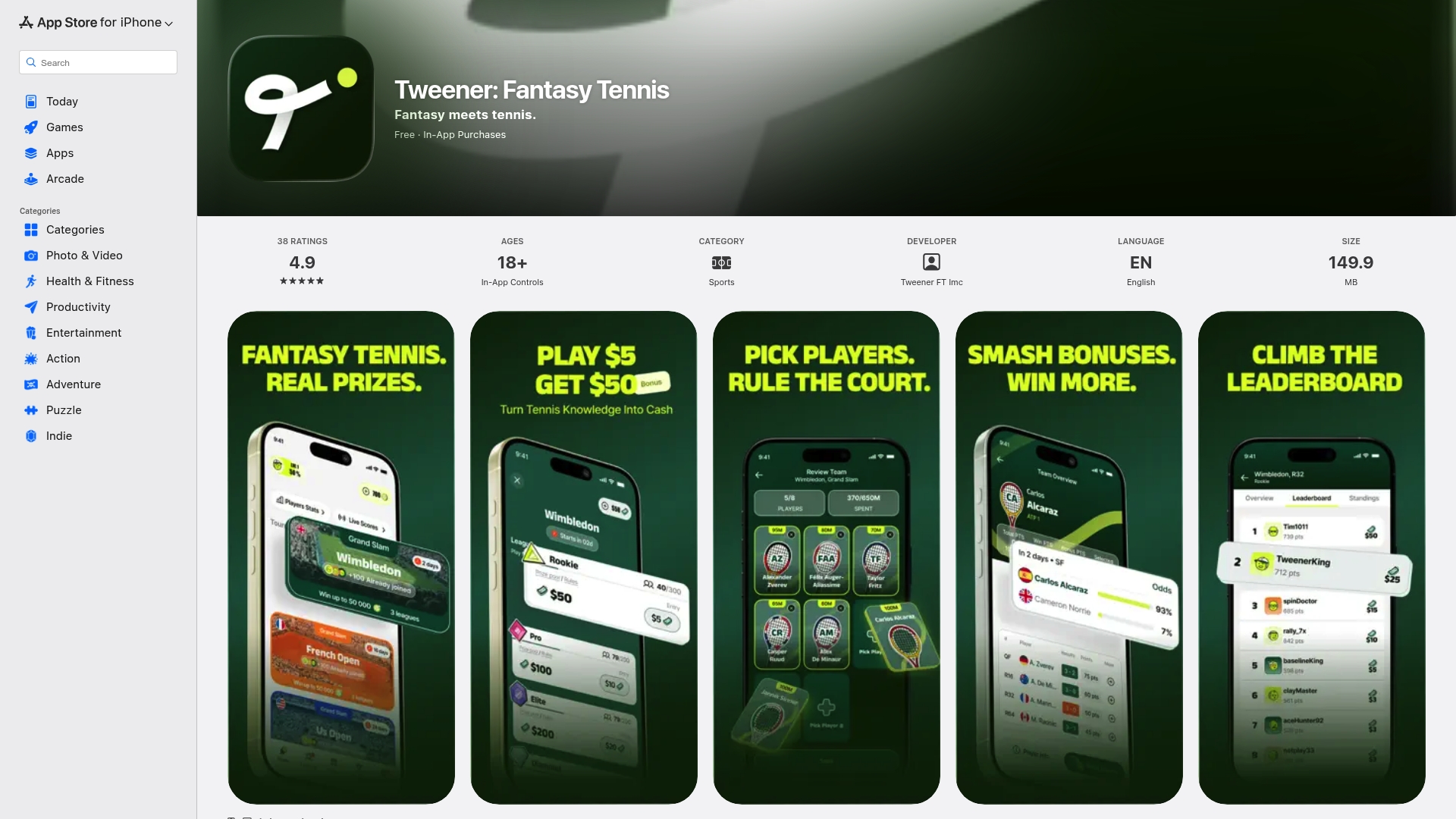
Start in free mode with virtual coins to test your contest mix risk-free, then move into cash mode or a private league with up to nine friends once you've found an allocation that works. If you're ready to put these bankroll rules into practice on a real tennis slate, download Tweener and set your first slate cap before the next Grand Slam draw drops.
Sources
- Fantasy 101: DFS bankroll management and game selection — Pitcher List
- DFS Contest Selection: Cash Vs. GPP, Field Size & Bankroll — Stokastic
- Levitan’s DFS Game Selection: Which Contests To Play — Establish The Run