

TL;DR:
- A disciplined fantasy sports betting workflow integrates data collection, projections, lineup construction, and bankroll management. Following all these steps together reduces losses caused by oversight and emotional decisions. AI models provide initial rankings but require human judgment and real-time updates to maximize success.
A fantasy sports betting workflow is a repeatable, disciplined process that combines bankroll management, predictive modeling, and lineup construction to improve your results over time. Without a structured approach, even skilled players bleed money to variance and emotional decisions. The best daily fantasy sports (DFS) players treat each contest like a professional trader treats a market: with rules, data, and defined risk limits. This guide breaks down every phase of an effective betting process for fantasy sports, from data collection to contest selection, so you can compete with a real edge.
What are the key components of a fantasy sports betting workflow?
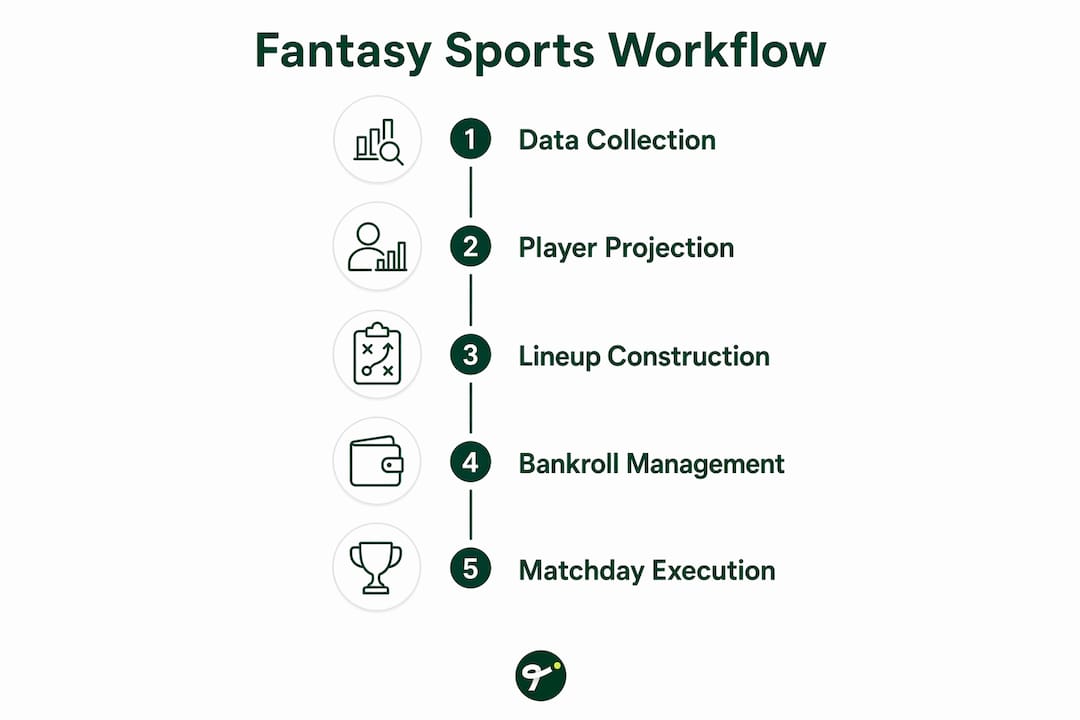
A complete fantasy sports betting workflow has four core phases: data acquisition, player projection, lineup construction, and bankroll management. Skipping any one of these phases is the most common reason disciplined players still lose money. Each phase feeds the next, and the whole system only works when all parts run together.
The four phases in detail:
-
Data acquisition and cleaning. Raw data from box scores, injury reports, and usage metrics is the foundation. Predictive modeling in fantasy sports follows five structured phases: data acquisition, cleaning, feature engineering, train/test split by season, and model validation. Dirty data produces bad projections, so cleaning comes before any analysis.
-
Feature engineering and projection. This is where raw stats become useful signals. Snap counts, target share, serve percentages, and head-to-head records on specific surfaces all become model inputs. The goal is to build player projections that reflect actual expected output, not just recent hype.
-
Lineup construction. Projections alone do not win contests. You need to translate projections into lineups that fit salary caps, target the right contest type, and apply strategic concepts like stacking and leverage. Winning lineup strategies require matching your construction approach to the specific contest format.
-
Bankroll management. Experts recommend limiting daily risk to 2–5% of your total bankroll, with a hard ceiling of 10%. That range exists because DFS variance is real. Even a correct process produces losing days, and you need enough bankroll to survive them.
Each phase requires its own checklist and review step. Players who treat these as one blended task tend to cut corners under time pressure.
How to integrate predictive analytics and AI into your fantasy betting workflow
Predictive analytics is the engine of any serious fantasy sports prediction workflow. The models that matter most are regression models, machine learning classifiers, and ensemble methods that combine multiple signals into a single projection. The specific model type matters less than the quality of the data you feed it.

Fresh data inputs drive model accuracy. Snap counts, usage rates, injury designations, and lineup confirmations all change close to game time. A projection built on Tuesday data is already stale by Saturday. Live data updates your model inputs in real time, which is the difference between a projection that reflects reality and one that reflects last week's news.
What to look for in model outputs:
- Projected points with uncertainty ranges. A player projected at 38 points with a wide range is more volatile than one projected at 35 with a tight range. Knowing the uncertainty helps you decide where to take risk.
- Ownership projections. Low-owned players with high upside are the core of tournament strategy. High-owned players are safer for cash games.
- Correlation scores. In sports where player performance is linked, such as a tennis player's serve percentage affecting their match win probability, correlation data tells you which players to stack.
AI projections work best as starting points, not final decisions. Models cannot read a coach's press conference or know that a player is nursing a wrist injury that has not yet hit the injury report. Human judgment fills that gap. The best workflow uses AI to generate an initial ranking, then applies contextual review before locking any lineup.
Pro Tip: Set a hard deadline for AI projection review, at least 90 minutes before lock. Anything that changes after that point gets a manual check, not a full model rerun.
What are best practices for matchday lineup management in fantasy sports?
Matchday execution separates players who understand theory from players who actually win. An effective matchday workflow covers four steps: reviewing lineup rules and salary caps, running a lineup optimizer, checking late-breaking news, and making final manual adjustments. Each step has a defined time window.
-
Review lineup rules and salary caps. Confirm the scoring system, roster requirements, and any contest-specific rules before you build. A lineup that violates a salary cap or roster spot rule gets disqualified, regardless of how good the projections are.
-
Run your lineup optimizer. Optimizers generate lineups based on projected points and salary constraints. Use them to produce a set of candidate lineups, not a single final answer. Most experienced players generate 10–20 optimizer outputs and then select and modify from that pool.
-
Check injuries, weather, and betting lines. Betting lines carry information. A player whose team is a large underdog faces a different game script than one on a heavy favorite. Weather affects outdoor sports directly. Injury reports change within hours of game time. Roster management requires checking all three sources as close to lock as possible.
-
Apply stacking and leverage concepts. Stacking means pairing correlated players so that a strong performance by one boosts the other. In NFL DFS, quarterback stacking with primary receivers is the highest-correlation lineup technique for maximizing ceiling. In tennis DFS on Tweener, stacking means building around players with favorable draws and strong surface records. Leverage means selecting lower-owned, high-upside players to differentiate your lineup from the field. Both concepts apply across sports.
Pro Tip: Never submit your final lineup more than 10 minutes before lock. The most valuable information always arrives last.
How to manage bankroll and contest selection for sustainable fantasy betting success
Bankroll discipline is the single most important factor in long-term DFS profitability. DFS rewards systematic, analytic play over emotional decisions, but even the best system fails without strict risk controls. The math is simple: if you overexpose your bankroll on a bad day, you cannot play the next day.
Core bankroll and contest selection rules:
-
Limit daily exposure to 2–5% of your total bankroll. This range accounts for the natural variance in DFS outcomes. A 10% hard max applies only to players with a proven edge and a large enough sample to trust their win rate.
-
Diversify between cash games and tournaments. Cash games reward floor stability and consistent scoring. GPP tournaments reward ceiling and leverage. Running both contest types on the same slate spreads your risk and gives you exposure to different payout structures.
-
Never chase losses. A losing day is data, not a signal to double your entry fees. Chasing losses is the fastest way to blow through a bankroll that took months to build. Set a daily loss limit before you play, and stop when you hit it.
-
Track every contest result. A spreadsheet with entry fees, contest type, lineup used, and final result is the minimum tracking setup. Without records, you cannot identify which parts of your workflow are working and which need adjustment. Prize structure awareness also shapes which contests deserve your largest entries.
Iterating your workflow based on tracked results is what separates a professional process from a hobby. Review your results weekly, not just after big wins or bad beats.
Key Takeaways
A disciplined fantasy sports betting workflow built on data, defined risk limits, and structured matchday execution produces better results than any single player pick or gut call.
| Point | Details |
|---|---|
| Four-phase workflow | Data acquisition, projection, lineup construction, and bankroll management must all run together. |
| AI as a starting point | Use model outputs to generate initial rankings, then validate with real-world news before locking lineups. |
| Daily risk limits | Cap daily exposure at 2–5% of your total bankroll to survive variance and stay in the game. |
| Contest diversification | Mix cash games for floor stability with GPP tournaments for ceiling and leverage plays. |
| Matchday execution | Check injuries, betting lines, and ownership projections within 90 minutes of lineup lock. |
Why discipline beats talent in fantasy sports betting
The hardest lesson I learned playing DFS seriously is that talent for picking players is almost irrelevant without a system behind it. I spent two seasons convinced I had a genuine edge in reading matchups, and I did. But I kept giving that edge back through poor bankroll decisions and emotional lineup changes made five minutes before lock.
The workflow is not glamorous. Cleaning data, tracking results in a spreadsheet, and sticking to a 3% daily risk limit feels like accounting, not sports. But that accounting is exactly what separates players who grind out consistent returns from players who have a great month and then blow it in a single bad weekend.
The other thing I have come to believe strongly: AI projections are a tool, not an oracle. I have seen lineups built entirely on model output miss badly because the model did not know a key player was dealing with a nagging injury that never made the official report. The role of projections is to reduce bias and give you a structured starting point. Your job is to apply the context the model cannot see.
Tennis DFS is a particularly interesting case because the sport's individual nature makes correlation and surface data more predictive than in team sports. A player's record on clay at Roland Garros tells you more than almost any other single variable. That kind of sport-specific insight is where human judgment adds the most value on top of any model.
— Nathan
Tweener brings structure to your fantasy tennis workflow
Tweener is built for the kind of analytical tennis fan who wants a real competitive edge, not just a place to watch scores.
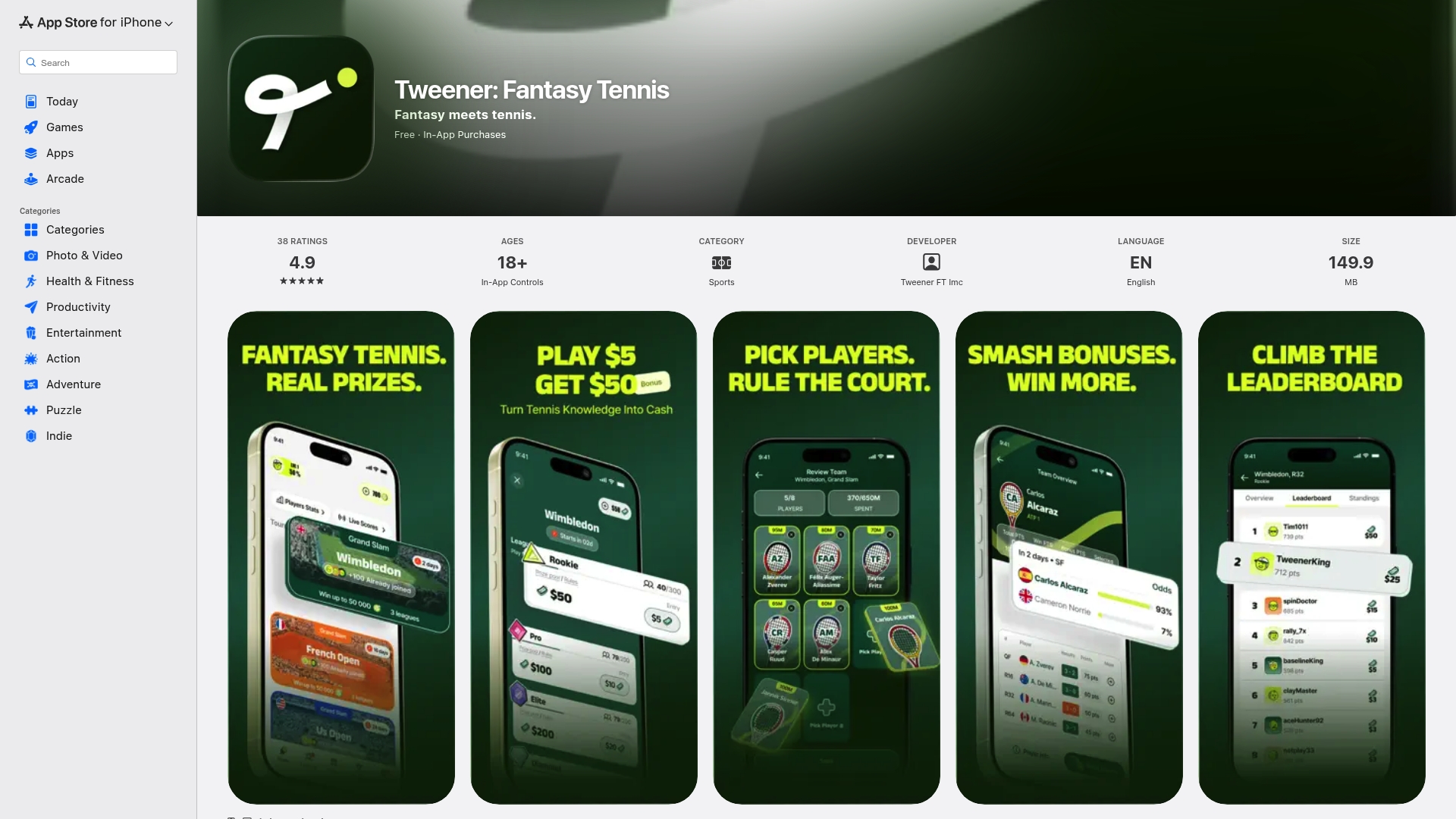
The platform lets you build fantasy teams from real ATP and WTA players, compete in public leagues or private leagues with up to 9 friends, and earn points based on live match results across actual tournaments. The free mode uses virtual coins redeemable for gift cards, while the cash mode lets you enter paid contests for real-money payouts where permitted. For players who take their fantasy tennis strategy seriously, Tweener is the closest thing tennis has to a dedicated DFS platform. Join Tweener and put your workflow to the test.
FAQ
What is a fantasy sports betting workflow?
A fantasy sports betting workflow is a repeatable process covering data collection, player projection, lineup construction, and bankroll management. It replaces gut-based decisions with a disciplined, step-by-step system.
How much of my bankroll should I risk per day in DFS?
Experts recommend limiting daily risk to 2–5% of your total bankroll, with a hard maximum of 10%. This range accounts for the natural variance in DFS outcomes and keeps you in the game through losing stretches.
What is the difference between cash games and GPP tournaments in DFS?
Cash games reward consistent, high-floor lineups, while GPP tournaments reward high-ceiling, differentiated lineups. A balanced contest selection strategy includes both types to spread risk across different payout structures.
How does stacking work in fantasy sports?
Stacking means selecting correlated players so that a strong performance by one boosts your overall lineup score. In NFL DFS, pairing a quarterback with his primary receivers is the most common and highest-correlation stacking technique.
When should I override AI projections in my lineup?
Override AI projections when real-world news, such as a late injury update, a coaching change, or a weather report, contradicts what the model assumed. AI projections are starting points, and human judgment handles the context models cannot process.