

TL;DR:
- Fantasy app formats include cash games, GPP tournaments, group stages, knockout brackets, and pick'em contests. Cash games reward stability, while GPPs emphasize high-ceiling picks for big wins. Choosing the right format depends on your risk tolerance, knowledge, and goals.
The most popular tournament formats for fantasy apps are cash games, guaranteed prize pools (GPPs), round robin group stages, knockout brackets, and pick'em contests. Each format shapes how you compete, how prizes get distributed, and what lineup strategy wins. Understanding these structures is the difference between playing blind and playing with a real edge. Fantasy sports players who master fantasy tournament formats consistently outperform those who apply a single approach across every contest type.
1. What are the popular tournament formats for fantasy apps?
Fantasy app competition styles fall into two broad categories: cash games and tournaments. Cash games reward consistency. Tournaments reward upside. Every other format, including group stages, brackets, and pick'em contests, sits somewhere on that spectrum between low variance and high ceiling.

DFS contests split primarily into cash games and GPPs, each with distinct payout structures and strategic demands. That split defines how you build your roster, how much risk you take, and what a winning week actually looks like. Knowing which format you are entering before you set your lineup is the single most important habit you can build.
2. Cash games: the foundation of steady fantasy competition
Cash games are the most consistent format in fantasy apps. They pay roughly the top 50% of entrants at close to a 2x return, meaning you only need to beat half the field to profit. That structure rewards stable, high-floor lineups over flashy, boom-or-bust picks.
The two most common cash game types are:
- Head-to-head (H2H): You compete against one opponent. Win the matchup, double your entry fee.
- 50/50s: Half the field wins, half loses. Your score just needs to clear the median.
- Double-ups: Similar to 50/50s but with slightly different field sizes and payout thresholds.
- Multipliers: Pay out a fixed multiple to a set percentage of the field, often the top 33%.
Cash game strategy centers on lineup stability over ceiling. You want players who produce reliably every week, not players who might explode but also might score zero. In tennis fantasy, that means picking ATP or WTA players who are deep into a draw, playing on their best surface, and facing favorable opponents in early rounds.
Pro Tip: Limit your cash game exposure to no more than 60% of your total bankroll. Variance still exists even in low-variance formats, and protecting your bankroll keeps you in the game long enough to profit.
3. How GPP tournaments work and why they attract competitive players
Guaranteed prize pool (GPP) tournaments are large-field contests where prizes concentrate at the top. GPPs pay the top 15–25% of entrants, with the biggest payouts going to the top 1–3 finishers. A $5 entry can return hundreds or thousands of dollars if your lineup hits.
That top-heavy structure changes everything about how you build a roster. GPP strategy demands:
- High-ceiling picks: Choose players with upside, even if they carry risk.
- Differentiated lineups: Avoid the most popular picks to separate your score from the field.
- Stacking and correlation: In sports where multiple players from one team or match can score together, stack them.
- Variance tolerance: Accept that most GPP entries lose. The goal is occasional big wins, not consistent small profits.
Advanced players craft distinct rosters for cash games and GPPs, never using the same lineup across both. In tennis fantasy, a GPP lineup might include a lower-ranked player facing a seeded opponent with a history of early exits on clay. The risk is real. So is the reward.
Pro Tip: Enter multiple GPP lineups with small variations rather than one large entry. This spreads your exposure across different outcomes without multiplying your total spend.
4. Group stage and bracket formats: structure and progression
Group stage and knockout bracket formats add a layer of progression that single-contest formats lack. They are the backbone of season-long fantasy leagues and many app-based tournament competitions.
Round robin group stages
Round robin formats involve each team playing every other team in the group one or more times. Your total record across all matchups determines whether you advance. This structure rewards consistency over a full slate of games, not just one lucky week.
Round robins work well in private leagues where you know your opponents. They create ongoing rivalries and give every player a chance to recover from a bad week before elimination.
Knockout brackets
Bracket formats create single-elimination or double-elimination paths. Lose a matchup and you are out, or you drop to a consolation bracket. The tension of elimination makes brackets the most exciting format for casual players.
| Feature | Round robin | Knockout bracket |
|---|---|---|
| Elimination risk | Low (multiple games) | High (one loss can end run) |
| Best for | Skill-based competition | High-stakes excitement |
| Engagement length | Extended across full group | Short, intense bursts |
| Comeback potential | Strong | Limited in single elimination |
Tournament format selection directly impacts community engagement by varying competitive intensity. Brackets drive short-term excitement. Round robins build longer-term investment.
5. Why pick'em and player prop contests are growing fast
Pick'em formats are the fastest-growing contest style in fantasy apps. They strip away roster construction entirely and ask one simple question: which player or team wins, scores more, or performs better? Binary predictions lower the skill floor and make the format accessible to players who find traditional fantasy intimidating.
Major apps use pick'em formats driven by binary predictions to attract new users. The growth is driven by simplicity. You do not need to understand salary caps, waiver wires, or lineup optimization. You just pick.
Key pick'em and player prop contest types include:
- Higher/lower props: Predict whether a player exceeds or falls short of a stat threshold.
- Head-to-head player props: Pick which of two players performs better in a specific stat.
- Survivor picks: Choose one winner per round. Pick wrong once and you are eliminated.
- Parlay-style pick'em: Chain multiple picks together for a multiplied payout.
Pick'em formats simplify fantasy sports for casual audiences, creating real opportunities for new player acquisition. For tennis fans, this translates directly: predicting whether Carlos Alcaraz wins more games than Jannik Sinner in a given round is a genuine skill call, not a coin flip, if you know their head-to-head record and surface stats.
6. How to choose the best format for your fantasy app goals
The right format depends on three things: your risk tolerance, your available time, and your knowledge depth. No single format is objectively best. Each serves a different player type.
Use this framework to match format to goal:
- New to fantasy apps: Start with pick'em or 50/50 cash games. Both limit downside and teach you how scoring works.
- Consistent, analytical player: Cash games and head-to-head contests reward the players who do their homework every week.
- Competitive and willing to lose short-term for big wins: GPP tournaments are your format. Accept variance and play for the top prize.
- Social player competing with friends: Private round robin leagues or bracket competitions create the most engagement within a known group.
Satellite tournaments provide a path from casual to high-stakes play. They act as entry ladders, letting you win your way into bigger contests rather than paying a large entry fee directly. This is one of the most underused tools for players who want to compete at a higher level without overextending their budget.
Pro Tip: Try at least two different format types during the same tournament week. Playing a cash game and a GPP simultaneously teaches you how differently you need to think about the same set of players.
Entry fees shape your format strategy as much as the format itself. A $1 GPP and a $20 cash game demand completely different approaches to risk, even if the sport and players are identical.
Key takeaways
The most effective fantasy app players match their format choice to their risk tolerance and knowledge depth, not just their sport preference.
| Point | Details |
|---|---|
| Cash games reward consistency | Build high-floor lineups and target 50/50s or H2H contests for steady returns. |
| GPPs require differentiation | Use low-owned, high-ceiling picks and accept variance as part of the strategy. |
| Brackets drive short-term excitement | Knockout formats create urgency and are best for casual or social competition. |
| Pick'em lowers the entry barrier | Binary prediction formats attract new players and require no roster construction. |
| Satellite tournaments build progression | Use qualifier contests to win entries into bigger events without large upfront costs. |
Format fit matters more than format popularity
The debate over which fantasy tournament format is "best" misses the point entirely. I have watched analytical players grind cash games profitably for years while hating GPPs. I have also seen casual fans win big GPP payouts on their first week because they picked a 40-to-1 longshot who ran deep in a Grand Slam draw.
The format that fits your knowledge and temperament is the one you will play consistently. Consistency is what builds skill. Beginners often mistake applying one lineup strategy across contest types, and that single error costs more than any bad pick. A GPP lineup entered into a cash game is almost always a losing lineup. The reverse is equally true.
What I find genuinely interesting about tennis fantasy specifically is that the sport's format mirrors the contest types almost perfectly. A Grand Slam draw is a bracket. A round-robin ATP Finals group is, literally, a round robin. Playing Tweener during Wimbledon and thinking in bracket terms is not just strategic. It is the most natural way to watch the sport. The contest formats in tennis fantasy reward players who understand how draws unfold, not just who the top-ranked player is.
Experiment deliberately. Play a pick'em contest during one tournament, a private league bracket with friends during the next, and a GPP during a Grand Slam. You will learn more about your own risk tolerance in three weeks than you would in a year of reading strategy guides.
— Nathan
Tweener brings these formats to tennis fantasy
Tweener is the only high-quality fantasy tennis app built around real ATP and WTA tournament results. While most fantasy sports platforms ignore tennis entirely, Tweener puts the sport at the center, with public leagues, private leagues for up to 9 friends, and both free and cash competition modes.
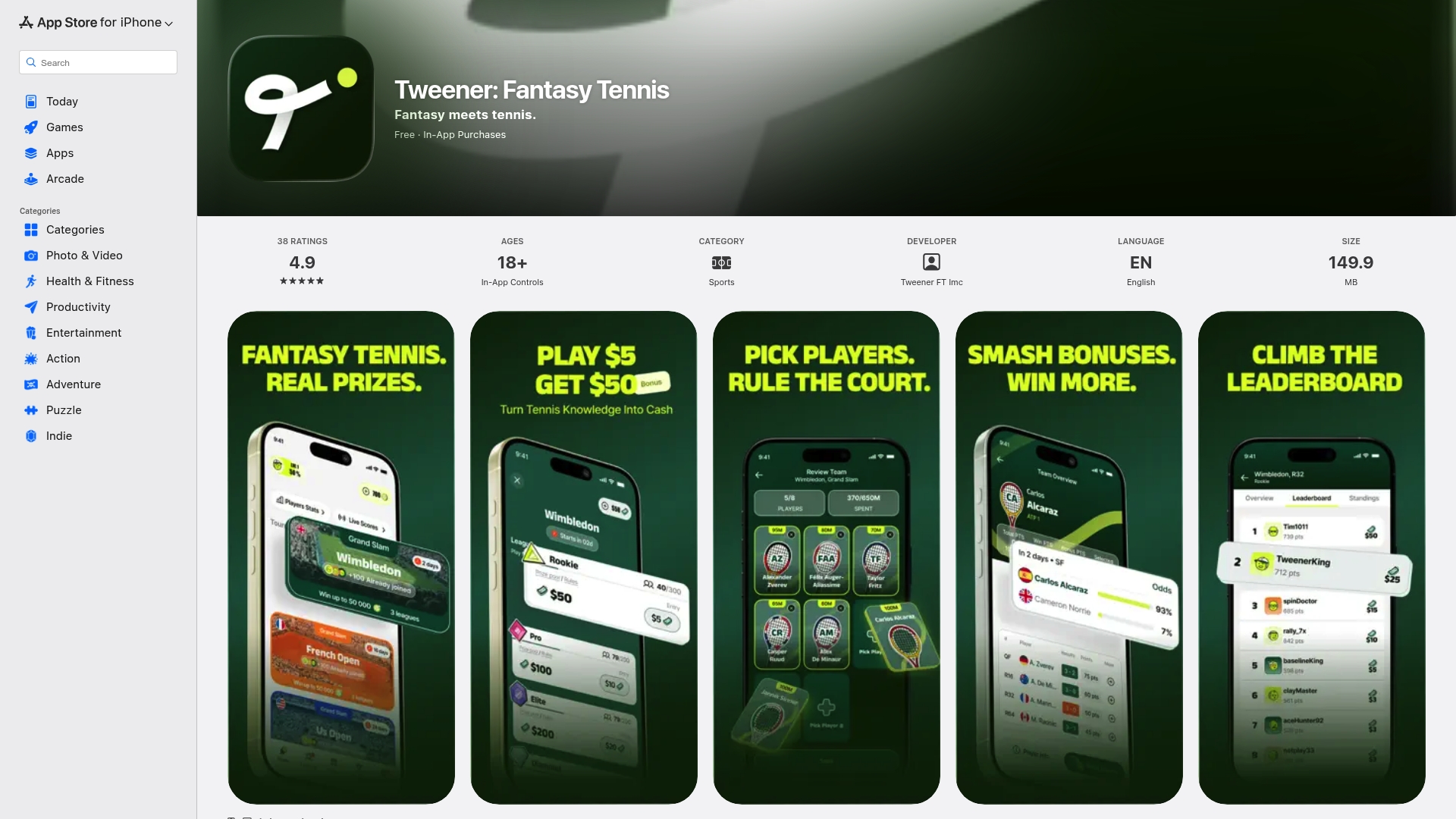
Whether you prefer the steady grind of head-to-head matchups or the high-stakes excitement of large-field tournaments during a Grand Slam, Tweener gives you a format that fits. The app's stats-based scoring rewards players who study surface performance, head-to-head records, and draw positioning. That is real skill, not luck. Play Tweener and compete in fantasy tennis the way it was meant to be played.
FAQ
What are the most common fantasy app tournament formats?
The most common formats are cash games (50/50s and head-to-head), GPP tournaments, round robin group stages, knockout brackets, and pick'em contests. Each offers a different payout structure and requires a different lineup strategy.
How do cash games differ from GPP tournaments?
Cash games pay roughly the top 50% of entrants at close to a 2x return, rewarding stable lineups. GPPs pay the top 15–25% with top-heavy prizes, rewarding high-ceiling, differentiated rosters.
Are pick'em contests a good format for beginners?
Pick'em formats are the best starting point for new players. They require no roster construction and use simple binary predictions, making them accessible without sacrificing genuine skill expression.
What is a satellite tournament in fantasy apps?
A satellite tournament is a qualifier contest where winners earn entry into a larger, higher-stakes event. Satellites act as entry ladders, letting players compete at higher levels without paying large entry fees upfront.
Which fantasy tournament format works best for private leagues?
Round robin group stages and knockout brackets work best for private leagues. Round robins reward consistent performance over multiple matchups, while brackets create elimination-style excitement that works well in small, social groups.