

All fantasy sports winnings count as taxable federal income, whether you play DraftKings, FanDuel, or a tennis-focused app like Tweener. The single biggest shift for 2026 is that the 1099-MISC reporting threshold jumped from $600 to $2,000 in net profit, but that number is about when a platform must issue you a form. It has nothing to do with whether the IRS considers the money yours to report.
TL;DR:
- The IRS classifies fantasy sports winnings as wagering income, with deductions limited to the amount of gains starting in 2026 due to a 90% loss deduction cap.
- Platforms are now required to issue Form 1099-MISC only if net winnings exceed $2,000, lowering the reporting threshold from $600.
- Accurate recordkeeping of contest history, deposits, withdrawals, and prize payouts across platforms is essential to avoid errors and streamline tax filing.
- Most recreational players report income on Schedule 1 and cannot deduct losses beyond their gains, while professional players file Schedule C with higher audit risks.
- Platform withholding applies only in specific cases with large payouts and high multipliers, but estimated tax payments remain necessary for tax compliance.
Table of Contents
- Fantasy Sports Taxes: The Checklist to Run Before You File
- How the IRS Actually Classifies Fantasy Sports Activity
- Which Forms Apply and When You'll See Them
- When Platforms Must Withhold, and How Estimated Taxes Fit In
- Deductions, Professional Status, and the 2026 Trade-Off
- Reconciling Platform Statements Without Losing Your Mind
- State Tax Rules Vary More Than You'd Expect
- Three Real Scenarios and How Each One Files
- When It's Time to Bring in a Tax Professional
- A Tennis Fan's Take on Getting Your Records Right
- Sources
Fantasy Sports Taxes: The Checklist to Run Before You File
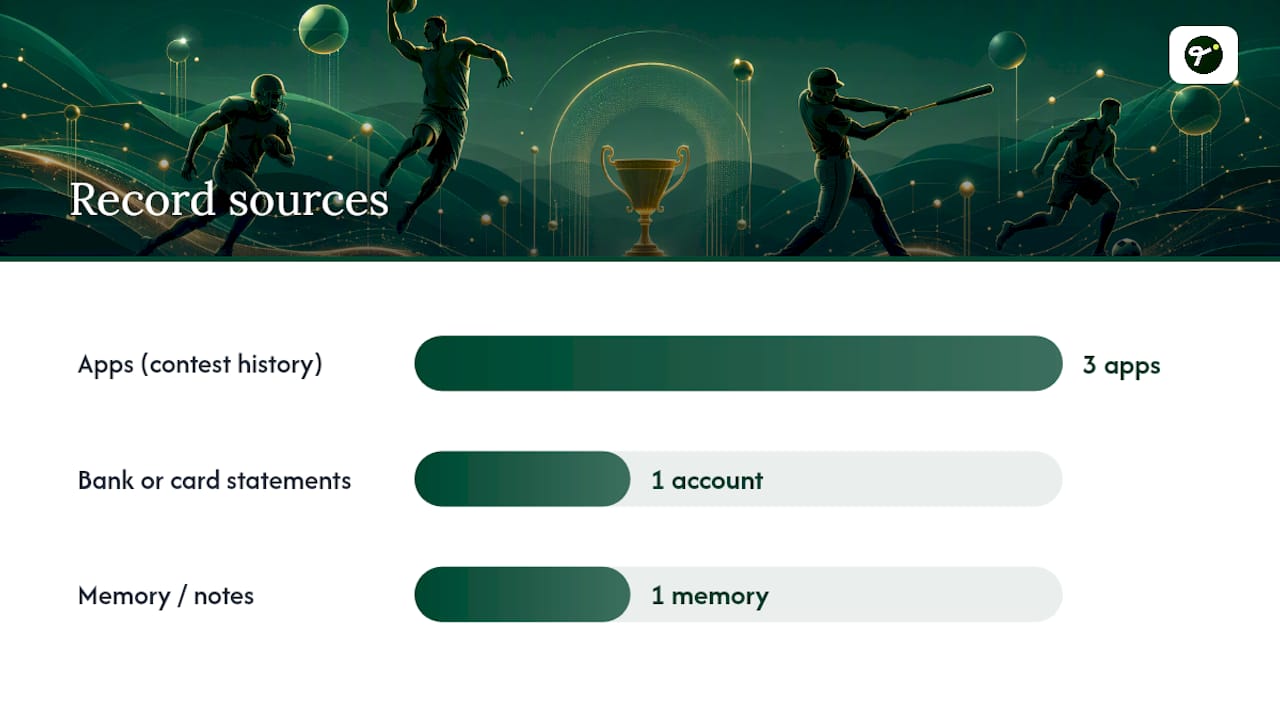
Before you touch a tax form, get your records in order. Fantasy sports taxes trip people up not because the math is hard, but because the documentation is scattered across three apps, a bank account, and a memory of "I think I won around $4,000 last year."
Work through this in order:
- Export every platform's full-year statement. Most apps let you pull contest-by-contest history. Do this in January, not April, while it's still easy to find.
- Pull your bank or card statements covering deposits and withdrawals tied to those platforms. This is your cross-check against what the app claims you netted.
- Separate gross prizes from entry fees. You need both numbers, not just the platform's "net" figure, because gross winnings and losses get treated differently depending on how you file.
- Flag any single payout near $5,000 or larger. If withholding applies, you want to know now, not when you're staring at a form in March.
- Ask yourself if you played like a business. Consistent volume, research time, and a profit motive can push you toward professional filing status, which changes your entire deduction picture.
Pro Tip: Set a recurring monthly reminder to download your contest history. Platforms don't always keep years of data easily accessible, and rebuilding a full season from memory in April is close to impossible.
If you play tennis-specific fantasy contests during Grand Slam season, this matters even more. A two-week Australian Open run with a private league against nine friends generates a lot of individual contest data fast, and that data is exactly what the IRS expects you to reconcile at filing time.
How the IRS Actually Classifies Fantasy Sports Activity
The IRS doesn't have a special "fantasy sports" tax category. It treats daily fantasy sports transactions as wagering under Section 165(d) of the tax code, the same provision that governs casino and sportsbook winnings.
IRS memoranda conclude that DFS entry fees function as wagering payments and that DFS transactions meet the legal definition of wagering under Section 165(d).
That classification has a real consequence: it caps how much you can deduct in losses. Under the wagering rules laid out in IRS Topic No. 419, you can only deduct wagering losses up to the amount of your wagering gains. You can't use a bad fantasy season to offset your salary income, and starting in the 2026 tax year, a new wrinkle makes this even tighter.
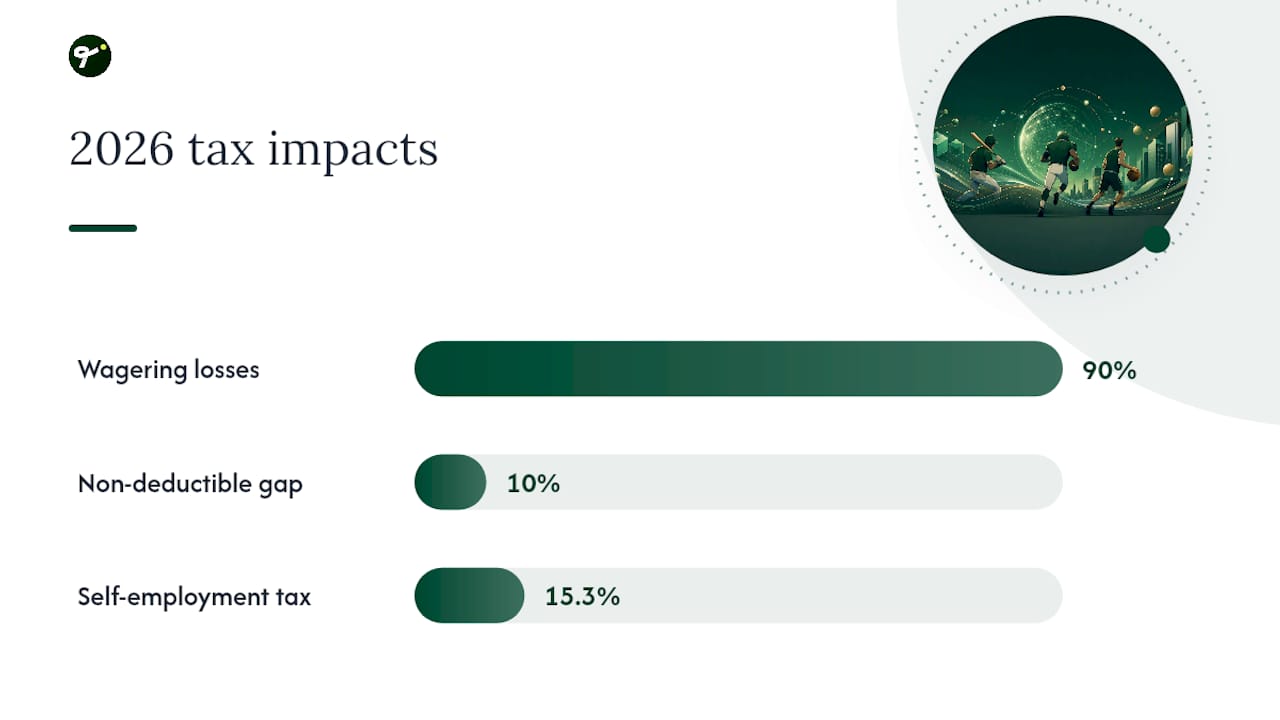
The One Big Beautiful Bill Act introduced a 90% cap on wagering loss deductions starting in the 2026 tax year. In practice, that means if you won $10,000 across the year but also lost $10,000 in other contests, you can only deduct $9,000 of those losses, not the full amount. You end up owing tax on $1,000 of income you never actually kept. Practitioners have started calling this "phantom income," and it's arguably the most consequential change for recreational players this year, more so than the threshold jump.
Here's the number that matters most from that change: a cap on deductible wagering losses, limiting them to less than the full amount, applied for the first time in the 2026 tax year, according to Monaco CPA's fantasy sports tax analysis.
State tax law adds another layer. Some states mirror the federal wagering framework exactly. Others classify daily fantasy sports as skill-based contest income rather than gambling, which can change how losses offset gains at the state level even when your federal return treats everything under §165(d). Don't assume your state follows the federal script.
Which Forms Apply and When You'll See Them
Four forms show up in fantasy sports taxes, and each one triggers under different conditions. Knowing which one you might receive, and when you might receive none at all, keeps you from either overreporting or underreporting on Form 1040.
Form 1099-MISC is what most DFS platforms use to report net profit for the year. For 2026, the threshold for a platform to issue this form rose from $600 to $2,000 in net winnings, under updated IRS guidance. If you netted $1,800 across the year, you likely won't get a form, but you still owe tax on that $1,800.
Form 1099-K applies when a third-party payment processor, not the platform itself, moves your funds. The federal threshold for 1099-K reporting sits at $20,000 and 200 transactions. This form reports gross payment volume, not net profit, which is exactly why it can look alarming even when your actual taxable gain is much smaller.
Form W-2G is the sportsbook-style form, and it applies to wagering transactions that meet the $2,000 and 300-times-the-wager threshold, per the instructions for Forms W-2G and 5754. Most fantasy sports contests don't structure payouts this way, but high-multiplier tournament formats can trigger it.
Schedule 1 vs. Schedule C determines where the income lands on your actual return, and this choice matters more than which 1099 you got.
| Filing status | Where reported | Deduction access | Extra tax exposure |
|---|---|---|---|
| Recreational player | Schedule 1, Form 1040, as other income | Wagering losses only, capped at 90% of gains (2026) | None beyond ordinary income tax |
| Professional player | Schedule C | Broader business expense deductions | Self-employment tax on net profit |
Most players, including nearly everyone playing casual private leagues during a Slam with friends, fall into the recreational category and use Schedule 1, following the standard practice described by OddsReference's DFS tax guide. Professional status is the exception, not the default, and claiming it without the activity to back it up invites scrutiny.
When Platforms Must Withhold, and How Estimated Taxes Fit In
Withholding on fantasy sports payouts isn't automatic. It kicks in under a specific dual condition: the payout must exceed $5,000 above the wager amount, and the total payout must equal at least 300 times what you wagered.
When both conditions are met, the platform is required to withhold a flat federal rate percentage of the payout, per IRS withholding instructions. A $10 entry that turns into a $6,000 win on a single contest could easily trigger this. A $500 entry into a high-stakes tennis contest that pays out $8,000 would not, because the multiplier falls short of 300 times.
Separately, backup withholding applies if you haven't provided a valid Taxpayer Identification Number to the platform. That's typically a 24% withholding trigger regardless of the payout size, and it's an easy problem to avoid: keep your tax information current on every platform you use.
Here's where players get tripped up. Withholding is a credit against your total tax bill, not a final settlement. If the platform withheld 24% but your actual marginal rate is 32% once that income stacks on top of your day job salary, you'll owe the difference at filing time, and possibly a penalty if you didn't pay enough throughout the year.
That's where estimated taxes come in:
- Calculate your expected total fantasy sports income for the year, netting wins against allowable losses under the 90% cap.
- Add that to your other income to see if it pushes you into a higher bracket.
- Compare your withholding and estimated payments to the safe harbor, generally 90% of this year's tax liability or 100% to 110% of last year's, depending on your income level.
- Make quarterly estimated payments if you're short, due in April, June, September, and January.
Skipping this step is how a big single tournament win in June turns into an unpleasant surprise in April, plus an underpayment penalty on top of the tax itself.
Deductions, Professional Status, and the 2026 Trade-Off
Recreational players face a hard ceiling on what they can deduct. Under Section 165(d), wagering losses only offset wagering gains, and as of 2026, only 90% of those losses count. If you're a casual player who wins big in one tournament and loses steadily in smaller contests the rest of the year, that 10% gap is real money you'll pay tax on without ever holding it.
Professional status, filed through Schedule C, works differently and comes with real trade-offs:
- Broader deductions. Research subscriptions, stats tools, travel to live events, and even a portion of your internet bill can qualify as legitimate business expenses.
- Self-employment tax. Schedule C profit gets hit with an additional 15.3% self-employment tax on top of ordinary income tax, which often erases the benefit of those extra deductions.
- Documentation burden. The IRS expects to see consistent time logs, strategy notes, and a businesslike approach showing genuine profit-seeking intent, according to IRS trade-or-business guidance.
- Audit exposure. Aggressive professional-status claims without supporting behavior are a known audit trigger. If you play three contests a month, don't file Schedule C.
The net effect is that claiming professional status because you had one great year is usually the wrong call. Access to expense deductions sounds appealing until the self-employment tax bill arrives, and the documentation standard is higher than most casual players expect.
Pro Tip: Track your fantasy sports time the same way a freelancer tracks billable hours. If you're ever questioned on professional status, a dated log showing research time, contest entries, and strategy notes is worth more than any argument you could make after the fact.
Understanding entry-fee mechanics helps here too, since how entry fees get tracked directly affects your net profit calculation on either filing path.
Reconciling Platform Statements Without Losing Your Mind
Every platform calculates "net" a little differently, and that inconsistency is where most reporting errors start. Some use a cumulative net method, subtracting entry fees continuously across the season. Others report gross prize money and expect you to separately track fees. If you deduct entry fees a second time on top of a platform's already-net figure, you're double-dipping, and that's a flag an IRS review would catch quickly, per PLR-154316-03's discussion of platform reporting methods.
Here's a reconciliation process that works regardless of how many platforms you play on:
- Export full contest history from every platform you used during the tax year.
- Build a simple ledger, one row per contest, showing entry fee, prize won, and net result.
- Total the net figure per platform and compare it against any 1099-MISC or 1099-K you received.
- Cross-check against bank deposits and withdrawals to confirm the money actually moved the way the statements claim.
- Flag discrepancies immediately rather than guessing. Timing differences between when a contest ended and when a payout posted can shift income between tax years.
When numbers don't match, request a detailed statement from the platform's support team and keep that correspondence with your tax records. If you're comparing figures from something like a fantasy tennis payout structure, understanding how prize pools split against entry fees makes the reconciliation math far more intuitive. A partner resource like Betsyscore's records database can also help you verify historical results if a platform's own export looks incomplete.
State Tax Rules Vary More Than You'd Expect
Federal rules give you one framework. Your state might give you a completely different one, and this is a step players skip constantly because they assume state taxes just mirror the federal return.
- Some states treat DFS as skill-based prize income rather than gambling, which can change how losses offset gains at the state level.
- New Jersey, for example, permits certain same-year loss offsets within a wagering category, a structure that doesn't exist uniformly across every state.
- States with no income tax (Florida, Texas, Nevada, among others) sidestep the issue entirely for state purposes, but you still owe federal tax regardless of where you live.
- Legality and tax treatment are separate questions. A state can permit cash-mode fantasy contests while still applying its own distinct tax rules to the winnings.
If you play across state lines, whether because you moved mid-year or because a platform operates differently depending on jurisdiction, check your state's legal and regulatory status alongside your state revenue department's specific guidance before assuming federal rules cover you completely.
Three Real Scenarios and How Each One Files
Numbers make this concrete faster than rules do. Here's how three common player situations actually play out on a return.
The multi-platform scenario is the one that catches people off guard most often. Each platform only tracks its own activity. The IRS doesn't care how many apps you spread your play across. It cares about your total taxable income, and that's a number only you can assemble.
When It's Time to Bring in a Tax Professional
Some situations are worth paying a CPA to handle, and recognizing the warning signs early saves both money and stress.
Consider getting help if any of these apply to you:
- You're playing across three or more platforms with enough volume that manual reconciliation feels unmanageable.
- You're seriously considering professional status and want your documentation reviewed before you file, not after an audit letter arrives.
- You've received an IRS notice referencing a mismatch between reported income and what a 1099 shows.
- Your platform statements don't reconcile no matter how many times you run the numbers.
When you sit down with a tax professional, bring your full platform statements, bank records showing deposits and withdrawals, contest-level exports, receipts for any expenses you're claiming, and a written log of time spent if you're pursuing professional status. A good CPA won't just file the return. They'll tell you whether recreational or professional filing actually saves you money in your specific situation, which isn't always the obvious answer.
A Tennis Fan's Take on Getting Your Records Right
Fantasy tennis has a quirk that other fantasy sports don't: the action is compressed. A Grand Slam runs two weeks, and if you're in a private league with friends, you might enter a dozen contests before the third round even wraps up. That density is exactly why sloppy recordkeeping catches up with tennis players faster than it does with, say, a season-long fantasy football roster.
My honest take, after working through how these rules actually apply: most recreational tennis fantasy players aren't at real audit risk. That's not an IRS problem. That's a spreadsheet problem.
Tweener's exportable contest history exists for exactly this reason. When you can pull a clean breakdown of entry fees against prizes for every private league you ran during a Slam, reconciliation stops being guesswork. Good recordkeeping doesn't just protect you in an audit. It's how you find deductions you'd otherwise miss.
If you're building out fantasy contests around this year's Slam calendar, you can download Tweener and see how contest-level detail is tracked from the first pick.
— Nathan
This article is general information, not a substitute for advice from a qualified financial advisor. Consult a qualified financial professional about your own circumstances before acting on anything here.
Sources
- IRS technical memo: Applicability of Section 165(d) to Daily Fantasy Sports Transactions
- Fantasy Sports Taxes 2026: DFS, Leagues & the Trophy Tax | Monaco CPA