

When a player withdraws, your fantasy score depends entirely on one thing: whether you set an alternate before the lineup locked. With an alternate in place, that slot fills automatically and scores fresh points; without one, you're stuck with a zero or a partial line from whatever the withdrawn player completed. The single move that matters most right now is confirming your alternates and checking your lineup lock time before the next round starts.
TL;DR:
- Setting and ranking alternate players before lineup lock is crucial, as some platforms automatically fill vacant slots, while others require manual intervention.
- Withdrawal timing impacts scoring: withdrawals before play begins usually result in zero points, while mid-match retirements often yield partial credit based on completed stats.
- Stat corrections and official score revisions can occur up to seven days after a match, potentially altering fantasy results in close matchups or tight standings.
- League rules and platform-specific policies on stat corrections and late adjustments vary; managers should verify these details before finalizing lineups or entering cash contests.
- Using a consistent pre-match routine, including setting alternates and monitoring withdrawals, significantly reduces the risk of scoring damage from unexpected player withdrawals.
Table of Contents
- How Withdrawals Fantasy Scoring Rules Handle Alternates
- How Platforms Handle Withdrawals and Scoring Corrections
- Timing and Deadlines for Scoring Changes
- Commissioner Adjustments: Power, Pitfalls, and Best Practices
- Manager Playbook: Reducing the Damage From Withdrawals
- Worked Examples: The Math Behind a Withdrawal
- How Tweener Handles Retirements and Withdrawals
- A Manager's Take: What a Bad Withdrawal Actually Teaches You
- Manage Withdrawals Like a Pro With Tweener
- Official Rules and Analytics Resources Worth Bookmarking
- Sources
How Withdrawals Fantasy Scoring Rules Handle Alternates
The fastest way to protect a fantasy roster from a withdrawal is understanding exactly what an alternate does and doesn't do. Get this wrong, and you'll watch a zero sit in your lineup while a perfectly good replacement player sits unused on your bench.
An alternate is a designated backup you assign to a specific roster slot before matches begin. A bench elevation happens when a reserve player automatically moves into a starting slot, usually triggered by a withdrawal, retirement, or a no-show. The difference between automatic substitution and manual substitution is who pulls the trigger: automatic systems swap the player the moment a withdrawal is confirmed in official data, while manual systems wait for you to make the change yourself, often with a deadline attached.
The order matters as much as the setup. Most platforms let you rank your alternates, so if your top singles pick withdraws, the system checks alternate one first, then alternate two, and so on until it finds someone still active in the draw. Skip this step and even a well built roster can leave a slot empty.
Platform behavior varies more than most managers expect. Some contest formats auto-fill vacated slots the instant a withdrawal posts to the official feed. Others require you to manually swap in a bench player, and if you miss the window, that slot simply scores zero for the round. A smaller category of formats, especially single-entry knockout contests, offers no alternates at all, treating a withdrawal as a straight loss of that roster spot. None of this is universal, so treat it as a spectrum, not a rule.
Before any lineup locks, run through this:
- Assign an alternate to every starting slot, not just your riskiest picks.
- Rank your alternates in the order you'd actually want them to activate.
- Check your contest's specific lineup deadline, since it can differ from the match start time.
- Open your app and confirm the lineup actually saved, since a missed save is the most common unforced error.
- Recheck 30 minutes before lock if a withdrawal rumor is circulating, because official confirmations often lag social media chatter.
Community discussion backs this up: threads discussing alternates scoring points after a withdrawal consistently show that managers who preset alternates come out ahead, while those who didn't are left arguing about what "should" have happened. Setup beats hindsight every time.
How Platforms Handle Withdrawals and Scoring Corrections
Whether you get full points, partial points, or nothing at all comes down to one distinction: did the player complete any part of the match before withdrawing, or did they scratch before it started? Completed play generally earns partial credit for every stat recorded up to that point. A withdrawal before the match even begins usually means zero, because there's no performance data to score against.
That difference explains a lot of the confusion fantasy managers run into. If a player retires in the third set of a tennis match, the platform typically scores whatever aces, break points, and games were logged before the retirement. If that same player pulls out the day before the match with an injury, there's nothing to score. Same word, "withdrawal," two completely different outcomes for your lineup.
Stat corrections are the other half of this puzzle. Official statisticians review match data after the fact and sometimes revise it, catching a missed ace, a misattributed break point, or a scoring error in the official feed. Fantasy platforms rely on these official feeds, and when the underlying statistics change, your fantasy points can change with them. The NFL's own scoring support page confirms this pattern in a different sport: official statisticians revise game data after review, and fantasy scores update accordingly whenever that happens.
Pro Tip: Don't assume a final score is actually final. Treat the day or two after a match as a monitoring window, especially in a close matchup where a single corrected stat could swing the result.
Here's a fact that surprises a lot of new managers: ESPN states outright that post-game stat corrections can appear up to seven days after a game. That's a full week where your "final" score isn't necessarily final. Tennis platforms don't always publish an identical window, but the underlying mechanism, official data getting revised after the fact, applies across sports.
Before you assume you know how your league handles this, check your platform's own rules for:
- Whether there's a published stat-corrections page or policy statement
- How long the finalization window is before results are locked for good
- Whether corrections can flip a head-to-head matchup result after the fact
- Whether corrections apply retroactively to season standings or only to that round
Two quick scenarios show why this matters in practice. In the first, your starter wins in straight sets, the match is scored, and two days later a corrected ace count bumps your total by four points, nothing dramatic, but enough to flip a tight head-to-head. In the second, your starter retires mid-match with a leg injury; you get partial credit for the completed games, and a day later the official stat feed corrects a break-point count from that partial performance, adjusting your score again before the correction window closes.
Timing and Deadlines for Scoring Changes
The most important number here is seven: that's how many days ESPN's own scoring policy allows for post-game corrections in its ecosystem, and it's a useful benchmark even outside football. Every sport and every platform can set its own window, so treat seven days as a reference point, not a universal law.
What that window means practically is this: your matchup can look decided on Sunday night and shift by Wednesday. Analysts who build fantasy tools generally treat the first week after play as an unavoidable uncertainty period, especially for anything decided by a slim margin. If your league is heading into a playoff round or a cash payout, that uncertainty window is exactly when you want to be paying closest attention, not scrolling past notifications.
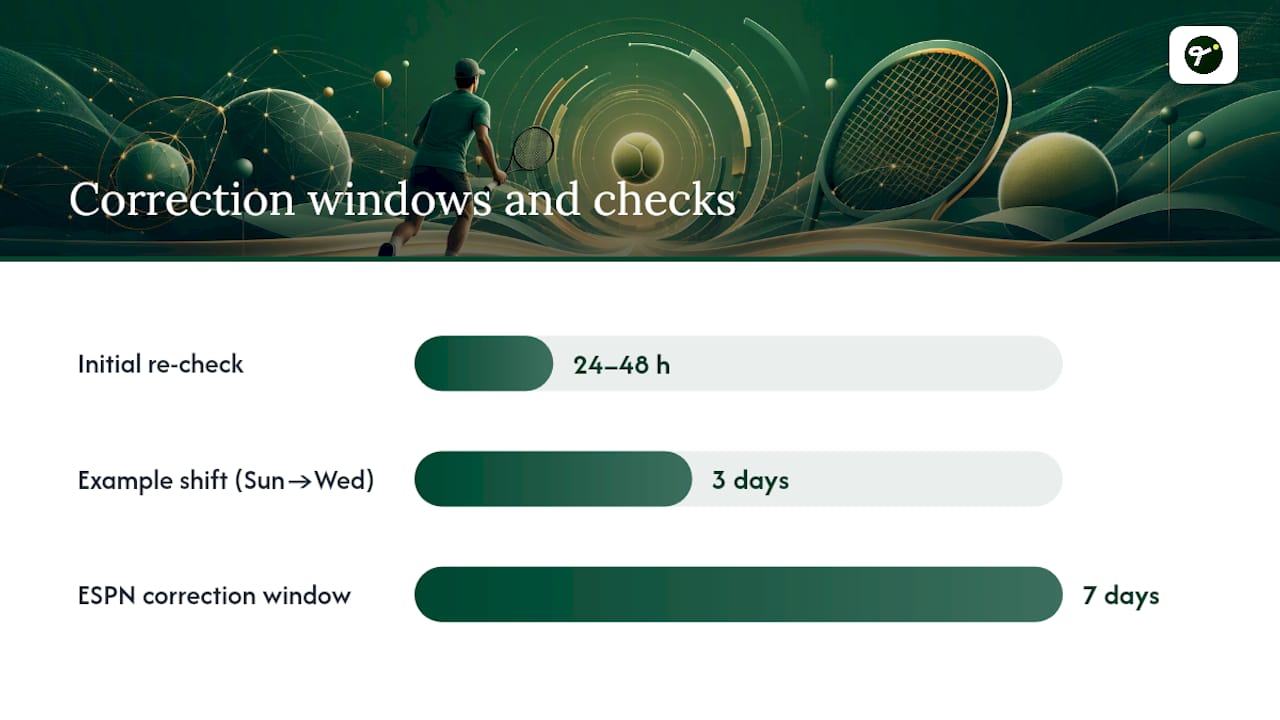
Platforms don't treat every correction the same way once results are marked final. A correction that lands inside the stated window typically gets applied and standings update. A correction that surfaces after finalization, once payouts have gone out or a bracket has advanced, often doesn't get retroactively applied at all, because the platform has already closed the books on that round. That's a meaningful distinction if you're playing for real money: the window isn't just a technical detail, it's the line between "this could still change" and "this is locked forever."
Practical steps for staying ahead of correction windows:
- Check your final score again 24 to 48 hours after a match, not just immediately after it ends.
- Read your platform's specific finalization language before entering a cash contest, since payout timing depends on it.
- If you're a league commissioner, write the correction window into your own league rules so members know what to expect.
- Flag any match with a retirement or injury scratch for a second look, since these are the results most likely to see a later correction.
Commissioner Adjustments: Power, Pitfalls, and Best Practices
League commissioners in most fantasy formats have access to a manual score adjustment tool, and it's one of the most misused features in the entire game. Used correctly, it fixes genuine errors. Used carelessly, it creates disputes that outlast the season.
Platforms like MyFantasyLeague offer tools such as a Player Score Adjuster, which lets a commissioner manually enter a point delta for a specific player and week, along with a written explanation and a history that can be deleted or reviewed. The tool itself is simple. The judgment required to use it well is not.
The biggest pitfall is double-credit. For example, if a commissioner manually adjusts a player's score to account for a pending stat correction and the official correction is later applied, the player may receive credit twice for the same change. ESPN's support documentation warns that manual League Manager adjustments can cause double-credit if not reversed after an official correction.
Here's how to avoid it:
- Never make a manual adjustment for a stat correction that might still be pending in the official feed. Wait out the correction window first.
- Write down the exact reason for every adjustment, including the date and the source you're relying on.
- Set a rule that any manual adjustment gets automatically reviewed, and reversed if needed, once the platform's official correction posts.
- Keep an audit trail everyone in the league can see, not just the commissioner.
Pro Tip: Copy this into your league rules document: "Manual score adjustments require a written explanation, are reviewed within 48 hours of any official stat correction, and will be reversed if they duplicate a correction already applied by the platform." Something that specific stops arguments before they start.
Manager Playbook: Reducing the Damage From Withdrawals
The managers who consistently avoid withdrawal disasters aren't lucky. They've built habits that catch problems before lineup lock, not after.
Before matches start, run a short pre-lock routine: verify every alternate is set, confirm your actual lineup deadline for that specific contest (not just the match start time), and turn on withdrawal or injury alerts if your app offers them. A five-minute check the morning of a tournament round catches most preventable losses.
When you're drafting or building a roster, depth is your real insurance policy. In tennis specifically, players who compete across multiple tournament rounds and multiple surfaces tend to give you more usable data and fewer surprise scratches than players coming off recent injury layoffs. A winning lineup strategy built around participation stability, not just raw ranking, holds up better across a full tournament draw.
During the tournament, prioritize waiver claims on players who just got a walkover into the next round, since a walkover win often means fresh legs and a favorable rest advantage heading into their next match. Keep one or two emergency roster spots open specifically for late-breaking withdrawal news, and think through contingency swaps before you need them, not while you're panicking five minutes before lock.
Decision heuristics that actually work:
- If a player is officially listed as "doubtful" and you have a strong alternate ready, bench them. The downside of missing a great performance is smaller than the downside of a zero.
- If a player is merely "questionable" with no clear injury history and your alternate is weak, it's often better to ride it out.
- Never leave a slot unfilled by choice. An average alternate beats an empty roster spot in every scoring format.
- Treat any retirement rumor as real until officially denied. Fantasy platforms move on confirmed withdrawals, not speculation, but you should plan around the risk anyway.
Worked Examples: The Math Behind a Withdrawal
Numbers make this concrete. Here's how three common withdrawal situations actually play out in fantasy scoring.
Example A: Alternate fills before play begins. Your starter withdraws the morning of the match with a wrist injury, before a single point is played. Your preset alternate automatically fills that slot. That alternate then wins their actual match, recording 8 aces, 3 break points converted, and a straight-sets victory, worth 42 fantasy points under a typical tennis scoring system. Your matchup total simply includes those 42 points as if that alternate had been your starter all along.
Example B: Mid-match retirement. Your starter wins the first set 6-4, then retires early in the second set with cramping. The completed first set gets scored: 4 aces, 1 break point converted, a set win, worth 18 points under partial-credit rules. Two days later, an official stat correction adds a missed ace to the box score, bumping your total from 18 to 20 points. That correction lands inside the platform's stated window, so it applies automatically.
Example C: No alternate set. Your starter withdraws before the match and you never assigned a backup. That slot scores zero for the round, full stop, no partial credit and no automatic fill. In a tight matchup, that single empty slot is often the entire difference between winning and losing your round.
| Scenario | Alternate set? | Points scored | Correction applied? |
|---|---|---|---|
| A: Pre-match withdrawal | Yes | 42 (full alternate performance) | No correction needed |
| B: Mid-match retirement | N/A (starter played) | 18, later corrected to 20 | Yes, ace count corrected |
| C: Pre-match withdrawal | No | 0 | No correction possible, no data scored |
The caveat that applies to every one of these examples: exact point values, correction windows, and whether partial credit even exists depend entirely on your specific platform's rules. Analysts who build custom scoring tools generally recommend recalculating your projections under your league's actual scoring format before assuming any example transfers directly to your contest, since a scoring tweak as small as how break points are weighted can shift these numbers meaningfully.
How Tweener Handles Retirements and Withdrawals
Tweener is built around real ATP and WTA tournament results, with both free coin-based leagues and cash contests where legally permitted, plus private leagues you can run with up to nine friends for a Grand Slam. That structure means withdrawal handling isn't an afterthought, it's built into how the app tracks live matches from the start.
When a player retires or withdraws mid-tournament, Tweener's scoring pulls from verified match statistics as they're officially recorded, applying the same completed-play logic covered above: points earned before a retirement count, and anything after doesn't. The full breakdown of how fantasy tennis points are calculated walks through exactly which stats feed your score and how ATP and WTA data flows into the app. For the specific mechanics of retirement scenarios, Tweener's retirement scoring checklist covers the six points managers ask about most, and it's worth reading before your next tournament draft rather than after a confusing scoring surprise. If you want the underlying data pipeline, how official statistics get collected explains where that verified information originates before it ever reaches your lineup.
This piece was researched and written by Nathan, who covers fantasy tennis strategy and scoring mechanics for the Tweener blog. For platform-specific interface steps, like exactly where the alternate settings live in the current app version, check Tweener's in-app help pages directly, since UI details change between tournament releases faster than editorial content can track.
A Manager's Take: What a Bad Withdrawal Actually Teaches You
The withdrawal that taught me the most wasn't even a big one. A mid-tier player retired down two sets in a Masters event I'd barely paid attention to, and because I'd left that alternate slot unranked, the system had nobody to slot in. That single empty spot cost more in a tight private league than any bad draft pick I made all tournament. It wasn't the withdrawal that hurt. It was the twenty seconds I didn't spend ranking a backup a week earlier.
Do: rank every alternate before the tournament starts, even for players you're confident won't withdraw.
Don't: assume a "healthy" seed is immune to a walkover or a late scratch. Injuries in tennis show up on short notice more than in almost any other sport.
— Nathan
Manage Withdrawals Like a Pro With Tweener
Everything covered above, alternates, lineup deadlines, verified stat corrections, gets built directly into how Tweener's private leagues and cash contests run. Set your alternate order once, and Tweener's automatic fill handles the rest if a starter withdraws mid-tournament, so you're not refreshing a browser tab hoping you remembered to make a manual swap in time.
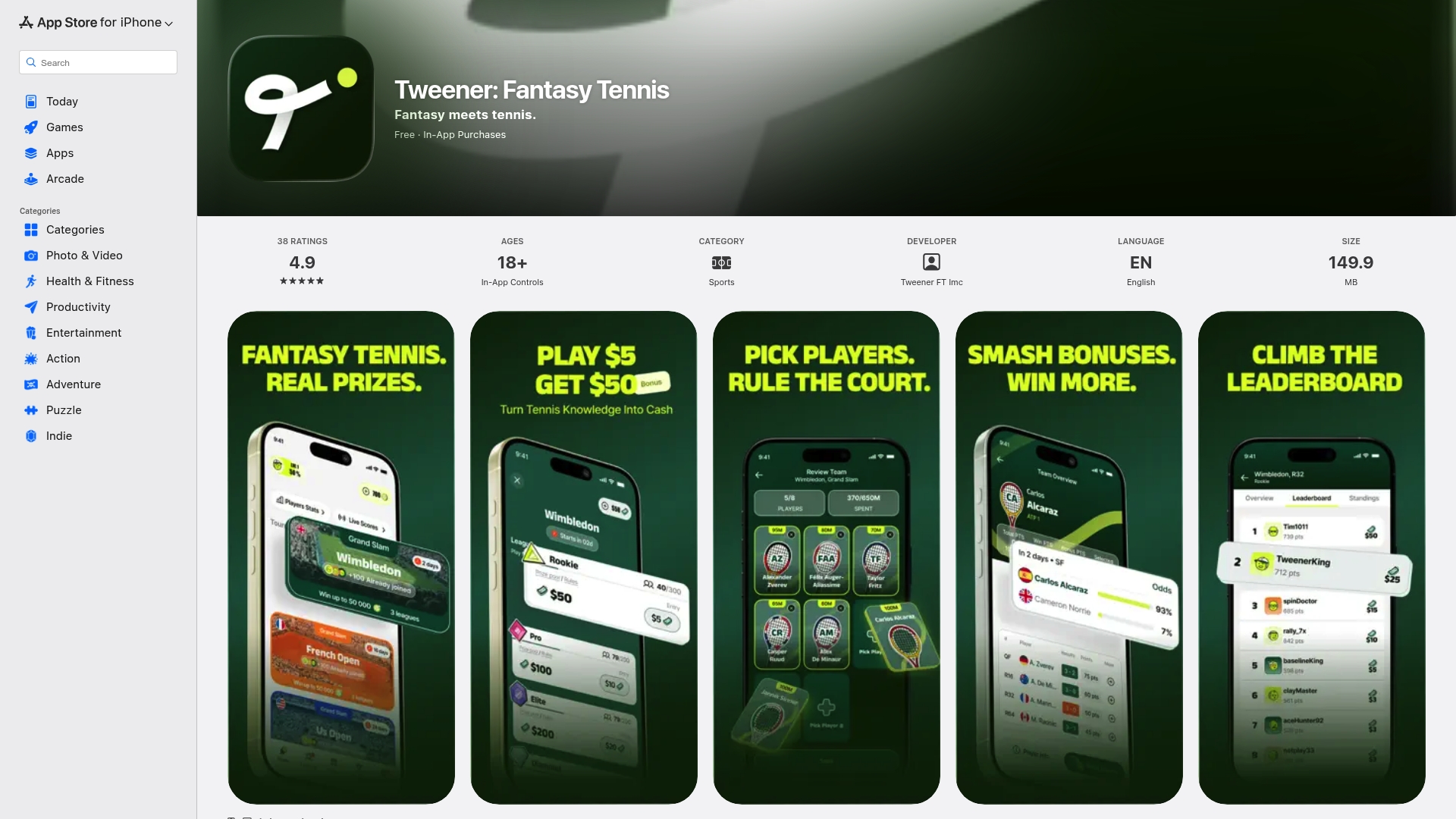
Where Tweener actually separates itself from watching tennis passively, or leaving your fantasy strategy to guesswork, is the depth: real ATP and WTA stats, head-to-head history, and surface-specific form feed every scoring decision, giving analytical fans an actual edge instead of a coin flip. Grand Slam private leagues let you run a contest with up to nine friends using the same real-money-optional structure, free coins if you're just testing strategy, cash contests if you want the stakes to matter, where your local rules allow it. If withdrawals have burned you before, the fix starts with better setup, not luck. Download the Tweener app and set your alternates before the next tournament draw locks.
Official Rules and Analytics Resources Worth Bookmarking
- ESPN's Scoring & Stat Corrections page explains correction windows and the double-credit risk in plain terms.
- The NFL's scoring support article shows how official statistician revisions flow into fantasy scores in a different sport, useful for comparing correction mechanics.
- Custom scoring value adjustment guidance walks through when a scoring change is big enough to justify rebuilding your rankings.
- Projection adjustment methodology covers the mechanical steps for converting raw stat forecasts into your league's actual point values.
- MyFantasyLeague's Score Adjuster documentation details a real commissioner adjustment tool and its audit trail.
- MDGamblingHelp offers support resources if cash contest play ever stops feeling like fun and starts feeling like a problem.
Sources
- Scoring & Stat Corrections – ESPN Fan Support
- Scoring – NFL
- Custom Scoring Value Adjustments: Calibrating Rankings to Your League
- Adjusting projections for custom fantasy scoring systems
- MyFantasyLeague support: Create New Score Adjustments