

Most fantasy platforms pay you for whatever a player did before they retired, but exact settlement depends entirely on the operator's fine print. The single rule that matters most: whether a market is treated as "played" once the first point begins. Before lock, check that phrasing in the rules, and line up a bench option in case your player doesn't finish.
TL;DR:
- Most platforms award full accrued stats when a player retires mid-match, but some void markets if the match did not reach a normal conclusion.
- Retirements are considered a "played" match if the first point of a set or game has begun, affecting how partial results are scored.
- Building a lineup with diverse match exposure and monitoring injury signals can reduce the impact of retirement risk on your fantasy scores.
- In tournament play, early retirements can significantly alter overall standings, especially in private leagues with cumulative scoring.
- Checking platform rules before the event and adjusting your roster accordingly is crucial to managing retirement-related losses effectively.
Table of Contents
- What retirement scoring means for your fantasy points
- How fantasy platforms actually handle retirements
- How retirement rules translate into actual fantasy points
- Managing retirement risk before it costs you a matchup
- Tweener's approach to retirement scoring
- What partial matches do to your player performance stats
- How often retirements actually happen, and why it matters
- Why retirements can flip your league standings
- Adjusting your lineup when a player retires mid-tournament
- Bookmark these pages before your next tournament
- The retirement conversation fantasy tennis still gets wrong
- Play the format built for managers who actually track this stuff
- Sources
What retirement scoring means for your fantasy points
Retirement scoring is the term for how a platform settles your fantasy points when a match ends early because a player can't continue. It sits inside a bigger category of tennis outcomes that fantasy managers need to tell apart cleanly, because each one gets handled differently at settlement.
A walkover means the match never started at all. One player withdraws before the first point is struck, usually because of an injury discovered during warmup or a late medical scratch. Walkovers generally void any per-point or per-set markets tied to that match, because there's no data to score.
A retirement is different: the match started, and then stopped. The scoreline freezes at the moment the player quits, and it gets logged in the official record with the score at stoppage, labeled "ret." That distinction is why retirements are recorded as played matches while walkovers aren't, and it's the reason most fantasy stats accrued before the stoppage still count.
Withdrawal and default round out the list:
- Withdrawal typically refers to a player pulling out before a match or tournament round, functioning much like a walkover for scoring purposes.
- Default happens when a player is disqualified mid match, often for a code violation or unsportsmanlike conduct, and it's scored similarly to a retirement since the match was underway.
Getting these four terms straight matters because rules pages use them precisely, and misreading "walkover" as "retirement" can cost you a settlement dispute.
How fantasy platforms actually handle retirements
There are two broad rule families, and almost every platform you'll play on falls into one or the other.
- Award accrued stats. The platform pays you for whatever the player produced up to the retirement point. Aces, break points, games won, all of it counts as final. Nothing more accrues after the stoppage, but nothing you already earned gets erased either.
- Require natural conclusion. Certain markets only pay out if the match (or the specific set/game in question) reaches its normal end. If a retirement interrupts that, the market voids rather than settles on a partial number.
DraftKings is a clean example of the first family. Its rules state that in the event of a retirement, both players are awarded fantasy points for all statistics accrued up until the point of the retirement. No asterisks, no partial credit haircut. Whatever happened on court before the retirement is what you get paid on.
Underdog operates on a related but more nuanced standard built around the idea of a "played" market. Its scoring rules explain that a set or game is considered played once the first point has begun, which means a set that's already underway when a retirement hits can still be graded. But projections tied to an outcome that never resolved, like a games-played total for a set that never finished, get voided instead of guessed at.
Quick statistic to remember: the "first point begun" test is the single cleanest predictor of whether a sub-market survives a retirement is this: if the first point of that set or game was struck, treat it as live data. If not, treat it as void.
Watch for these edge cases specifically:
- Retirements mid-tiebreak, where some platforms treat the tiebreak itself as one continuous "game" and others don't.
- Retirements that happen seconds after a set finishes but before the next one starts, which can create ambiguity about whether the next set counts as "begun."
- Pre-match retirements announced after lineups lock but before the first point, which most platforms treat as a walkover rather than a retirement for scoring purposes.
How retirement rules translate into actual fantasy points
Knowing the rule family is one thing. Knowing exactly which stat categories survive a retirement is what actually helps you build a lineup.
- Match win/loss: counted as final. The advancing player gets the win credit, and retirements change head-to-head records where walkovers typically don't.
- Sets completed: any set that finished normally counts in full. A set in progress at the moment of retirement is usually scored based on games won up to that point, not projected to a hypothetical final score.
- Games won/lost: counted as accrued, following the "award accrued stats" logic most platforms default to.
- Aces, double faults, winners, break points: these tally exactly as they happened. There's no reduction or extrapolation.
- Total games or sets projections: these are the markets most likely to void, since the final number was never reached.
Here's a worked example. Say your player is up 6-4, 3-1 when they retire with a leg injury. Under an "award accrued stats" rule, you'd be credited with one completed set (6-4), plus three games won and one game lost in the second set, plus every ace, break point, and winner logged across both sets. A market betting on "total games in the match" would likely void, since nobody knows what the final tally would've been.
| Stat Category | Typical Treatment at Retirement |
|---|---|
| Match result | Counted as final win for advancing player |
| Completed sets | Counted in full |
| In-progress set games | Counted as accrued |
| Aces / double faults | Counted as accrued |
| Total match games projection | Often voided |
When you're projecting points for a lineup, model retirement risk as a probability that shaves your player's ceiling rather than a coin flip that zeroes them out entirely. A player who retires up two sets to love still banks plenty of fantasy value before the walk-off.
Managing retirement risk before it costs you a matchup
You can't predict every retirement, but you can stop pretending they're rare enough to ignore. Build your roster with that reality baked in.
- Diversify match exposure. Don't stack three players from the same half of the draw or the same grueling five-setter. If one goes down, you want redundancy elsewhere in your lineup.
- Screen for recent injury flags. A player who pulled out of their last tournament or played through a visible knee brace carries more retirement risk than one coming off a clean run. Treat that history as data, not gossip.
- Keep bench depth stocked with players who have byes or easier early matchups. An alternate who's fresh and lightly favored is a better hedge than one who's also grinding through a marathon draw.
- Run a six-point pre-lock checklist: confirm no late scratch, check the injury report, verify the surface suits your player's known issues (clay tends to punish bad knees harder than hard courts), scan recent retirement history, check travel and back-to-back tournament load, and confirm your alternates are actually eligible to swap in.
- Use in-play tools where the platform allows it. Some formats support swapping or cashing out live; if yours does, treat a visible medical timeout as your cue to act, not a reason to wait and hope.
Building a winning DFS strategy means treating retirement risk as a structural part of roster construction, the same way you'd account for a tough surface matchup or a brutal travel schedule.
Pro Tip: Track medical timeouts during a tournament's early rounds. A player who takes an MTO in round one and still wins is a legitimate retirement risk in round two, even if the box score looks fine.
Tweener's approach to retirement scoring
Tweener ties every fantasy point directly to official ATP and WTA match logs, so when a retirement happens, your accrued stats settle against the actual on-court record rather than a vague summary. That's the same transparent logic covered in how fantasy tennis points get calculated on Tweener's own scoring pages, and it's what keeps disputes rare.
Nathan's working checklist for retirement-proofing a roster:
- Check the injury report the morning of, not the night before.
- Keep one flexible bench spot open specifically for retirement coverage.
- In private leagues, agree on tiebreak rules for retirement scenarios before the tournament starts, not after a dispute happens.
- Re-check your lineup after the draw releases, since brutal early matchups raise retirement odds for both players.
| Situation | Manager Action |
|---|---|
| Injury flag on a rostered player | Bench them before lock if a clean alternate exists |
| Retirement mid-match | Accept accrued stats; don't expect a refund |
| Ambiguous "played" market | Check platform rules before assuming a payout |
What partial matches do to your player performance stats
A retirement creates what statisticians call a left-censored data point: you know what happened up to the stoppage, but you don't know what would've happened after. That distinction matters more than most fantasy managers realize when they're building season-long projections instead of just reacting to one match day.
If you're tracking a player's per-match aces or break points won for future lineup decisions, a truncated match skews the average downward for rate stats that depend on total games played, but it doesn't touch counting stats like total aces recorded, since those are accurate regardless of how the match ended. The fix is straightforward: normalize by games or sets actually played, not by an assumed full match length.
For projection purposes, treat a retirement as a signal to widen your variance estimate for that player going forward, not just a one-off blip. A player who's retired twice in the last month carries a real elevated risk of doing it again, and a good roster model should reduce their expected match-completion probability accordingly rather than scoring their last outing at face value. This is exactly the kind of adjustment that separates a manager who reacts to one bad week from one who's actually pricing risk correctly heading into the next tournament.
How often retirements actually happen, and why it matters
Retirements aren't a rare fluke you can safely ignore when building a roster. They show up often enough across a full ATP or WTA season, especially in best-of-five men's matches and in the brutal heat of summer hard-court swings, that treating retirement risk as background noise is a mistake serious managers can't afford to make.
Grand Slam events tend to see a noticeable cluster of retirements in the first week, when depth-chart players who fought through qualifying or a tough five-set opener start breaking down physically. Clay season carries its own pattern, with knee and ankle issues showing up more from the sliding movement the surface demands. If you're drafting for Roland Garros the same way you'd draft for a hard-court event, you're underpricing that risk.
The fantasy scoring impact compounds across a tournament. A single retirement in round one might cost you a few projected points from one player. A retirement in the middle of a private league's tournament-long contest, especially one tied to a player you've built your whole roster strategy around, can swing your final standing entirely. That's the real reason retirement awareness belongs in your draft-day thinking, not just your live-scoring reactions.
Why retirements can flip your league standings
A single retirement rarely changes the outcome of a head-to-head fantasy matchup by much when it's early in a tournament. Late in a tournament, in a private league where your final standing hinges on cumulative points across multiple rounds, it can flip everything.
Picture a private league of nine friends competing across a full Grand Slam. Two managers are separated by four points heading into the semifinals, and both have a stake in the same player. If that player retires up a set and a break, the manager who drafted them early banks solid accrued points, while the manager counting on a deep run loses out on everything past that moment. That's not bad luck so much as it's the format working exactly as designed: rewarding the manager who read the risk correctly.
Tie-break scenarios get messier. Some private leagues resolve ties with a secondary stat like total aces or break points converted, both of which are still fully valid numbers even after a retirement, since those stats accrued and settled normally. Others use total games won, which can look artificially low for a manager whose player retired early despite dominating the match. If your league uses a tie-break rule, confirm it treats retirement-shortened stat lines fairly before the tournament starts, not after a dispute lands in your group chat.
Adjusting your lineup when a player retires mid-tournament
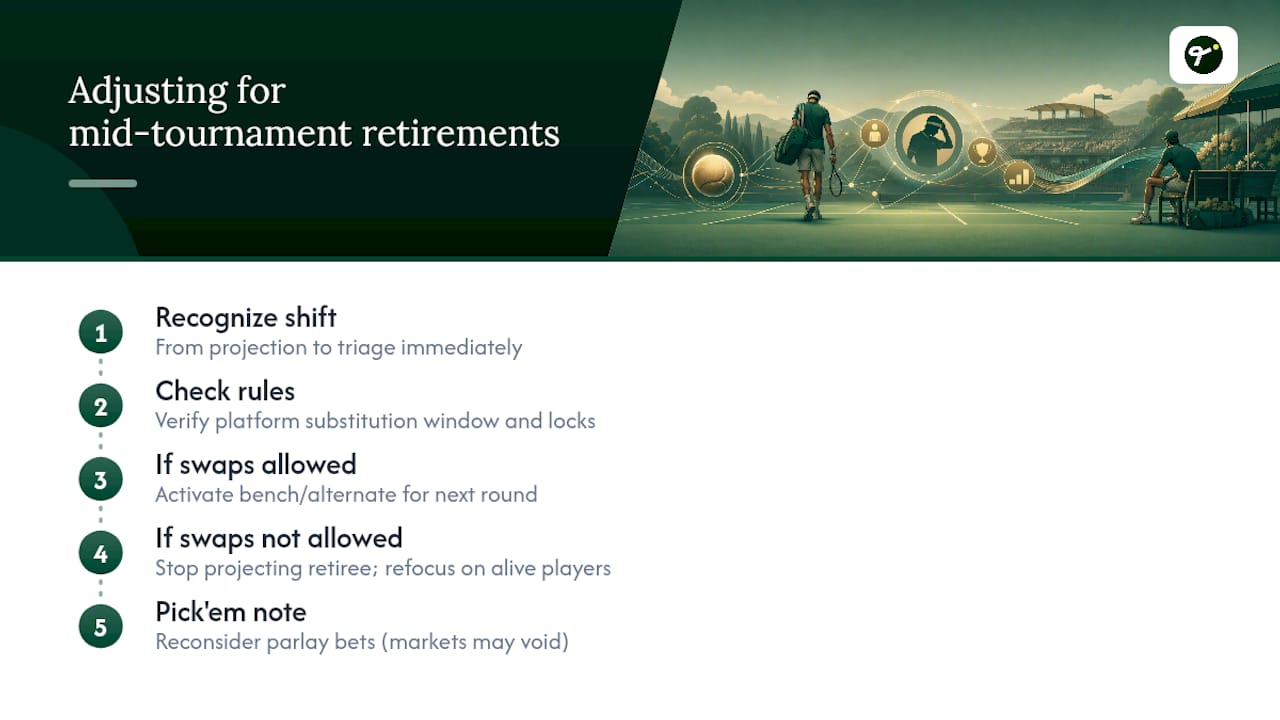
The moment a retirement hits, your job shifts from projection to triage. In season-long or tournament-long formats, that usually means activating a bench player or alternate for the next round, provided your league rules allow a swap after a retirement rather than locking your entire roster for the event's duration.
Check your platform's substitution window first. Some formats let you swap injured or eliminated players before the next round's lock; others freeze your roster the moment the tournament begins. If your draft strategy already accounted for depth at every position, this is where that groundwork pays off, since you'll have a viable replacement ready instead of scrambling.
If your format doesn't allow swaps, shift your strategy for future rounds instead. Stop projecting further points from the retired player and reallocate your attention to players still alive in the draw who can realistically make a deep run. In pick'em or prediction-style formats, this also means reconsidering any parlay-style picks that depended on your retired player's later matches, since those markets typically void rather than pay out on a hypothetical.
The best in-tournament adjustment habit is simple: check injury news every morning during a Slam, not just before your own matches start. A medical timeout you spot early gives you a head start on your bench decision that a same-day scramble never will.
Bookmark these pages before your next tournament
Before your next lock, spend five minutes confirming the exact wording each platform uses. Bookmark DraftKings' rules and scoring page and Underdog's tennis scoring explainer, and search each for "retirement" and "played" specifically.
- Check your platform's own help center for identical phrasing before assuming another operator's rule applies to you.
- For advanced stat modeling, MatchSuite's tournament statistics guidance covers how clean result labeling supports better projection work.
- If a settlement looks wrong, contact platform support directly with the match ID and timestamp rather than assuming it's an error.
The retirement conversation fantasy tennis still gets wrong
Most fantasy content treats retirements as bad luck, a coin flip you either dodge or don't. That framing misses the point entirely. Retirement risk is measurable. Certain players carry it more than others, certain surfaces and rounds concentrate it, and certain rule structures punish you harder for ignoring it than others.
The conventional advice, "just draft the best player available," falls apart the moment you're staring at a five-set qualifier grinding through his third match in four days on a hard court in July. That's not a value pick anymore. That's a variance bomb, and treating it otherwise is how managers lose leagues they should've won.
What I'd prioritize first, before anything else in a draft: read your platform's actual settlement language for retirements before the tournament starts, not after your first dispute. Most managers never do this, and it's the cheapest edge available in the entire game. Everything else, bench depth, injury screening, tie-break awareness, only matters once you know exactly how your points get counted when a match ends early.
— Nathan
Play the format built for managers who actually track this stuff
Tweener is built for fantasy fans who want the DraftKings-style depth of a real DFS product, applied to a sport that's never had one. Every point traces back to the official ATP and WTA match log, so when a retirement hits, you know exactly what you're owed instead of guessing at vague settlement language.
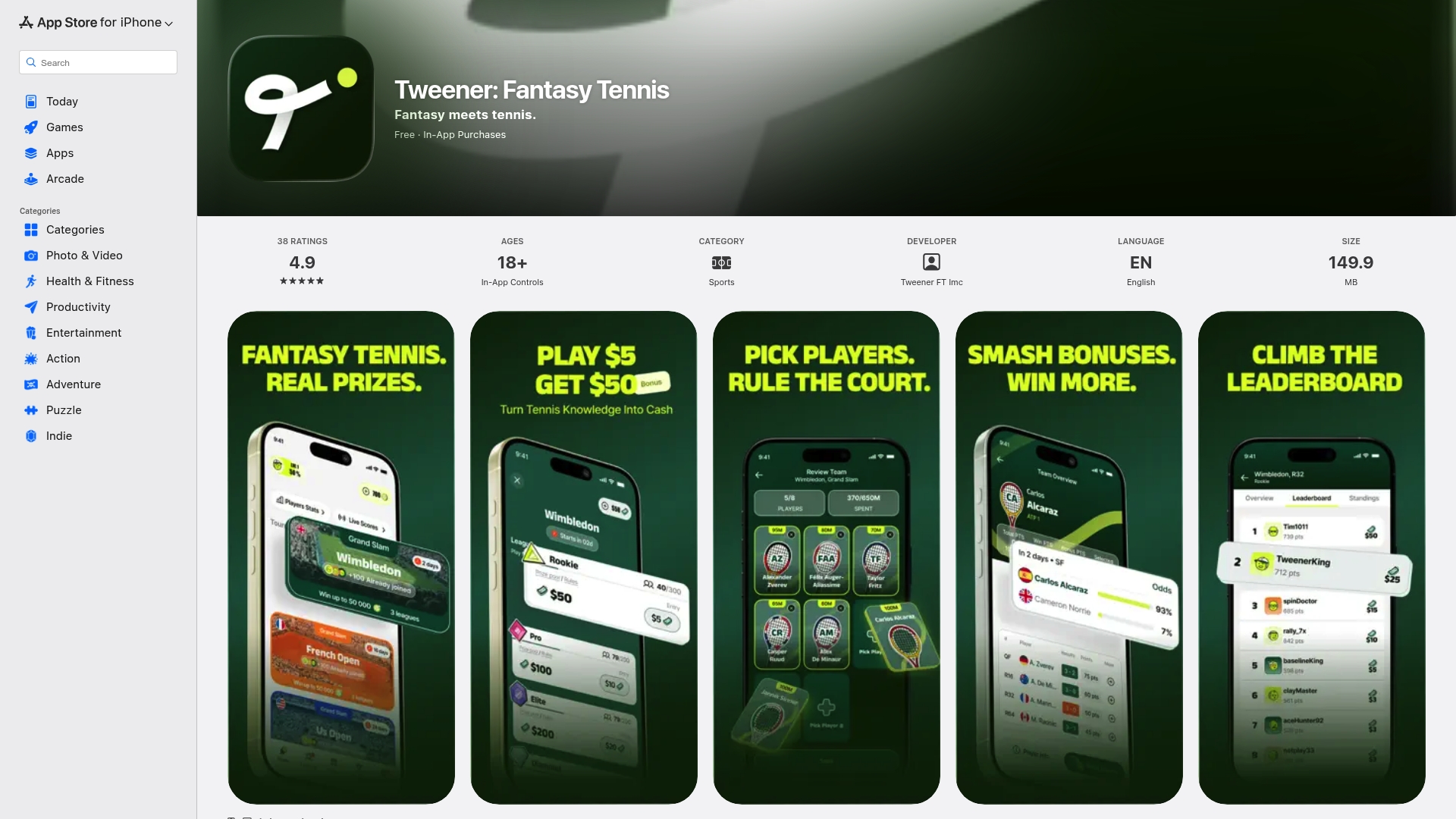
You can build private leagues around a single Grand Slam, draft on stats instead of gut feel, and compete in either free coin-based contests or real-money cash contests where it's legally available. If you've read this far, you already think about tennis the way Tweener's scoring system is built for: surfaces, form, head-to-head history, and yes, retirement risk, all treated as data rather than noise. Download the app and set your first roster before the next tournament locks.