
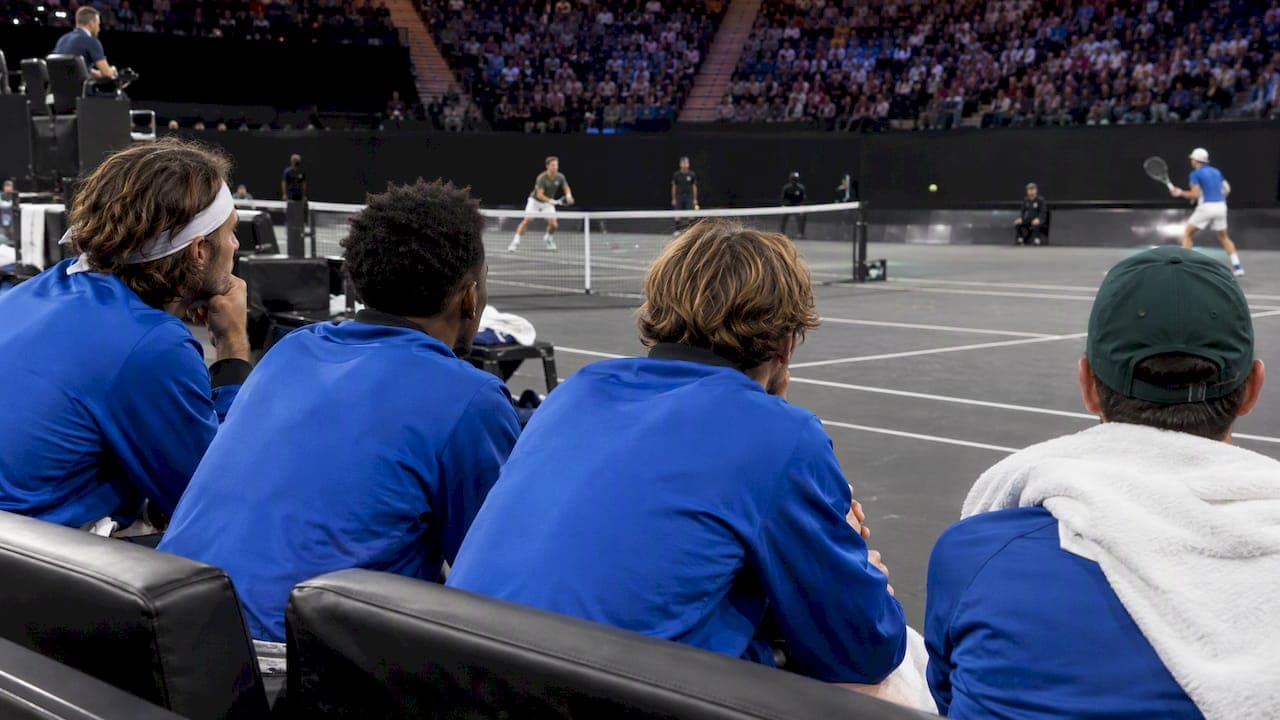
There is no standard, full-scale Laver Cup fantasy game the way there is for the Grand Slams. Fans still want to play it, so they build their own: a pick'em sheet with friends, a spreadsheet, a group chat with a points system. This guide gives you the scoring math, the selection quirks and the strategy for doing that well. It also shows how the same thinking carries over to fantasy tennis you can play all season.
The short version: the Laver Cup is a team event with lopsided point values, captain-driven lineups and 10-point tiebreakers instead of third sets. Those three features break most of the habits fantasy players bring from regular tournaments.
TL;DR
- The Laver Cup is 24 points across five sessions, and the first team to 13 wins. Friday matches are worth 1 point, Saturday 2 and Sunday 3.
- Half of each roster is chosen by the captains, so ranking alone does not tell you who plays.
- A Sunday win is worth triple a Friday win. Build any pick'em or fantasy scoring around that, or you will misprice the whole weekend.
- Doubles skill and 10-point tiebreak nerve matter more here than season-long hard-court numbers.
- Between Laver Cups, you can apply the same skills in tennis fantasy leagues built on real ATP and WTA results.
Table of Contents
- Is there a Laver Cup fantasy game?
- How Laver Cup scoring works
- Who actually plays: captain's picks and the ranking trap
- Why the Laver Cup breaks normal fantasy logic
- A weekend game plan
- Build your own Laver Cup pool: a simple rule set
- From one weekend to a whole season
- Where Tweener fits
- Our perspective: strategy beats luck, but only if you respect the format
- FAQ
- Sources
Is there a Laver Cup fantasy game?
Not in the way Grand Slam fantasy exists. The Laver Cup is one weekend, with 12 men's players and 12 scheduled matches. That is a thin pool for a classic salary-cap game. Most Laver Cup "fantasy" is therefore informal: office pools, bracket-style predictions and friend leagues with house rules.
That is not a bad thing. A small field makes every pick matter, and it rewards the fan who actually watched the matches rather than the one who memorized the rankings. If you run your own pool, the scoring should mirror the real event, which is where most home-made games go wrong.
How Laver Cup scoring works
The event is five sessions over three days. According to the official event guide, there is a day and night session on Friday and Saturday, then a single day session on Sunday. The first team to 13 points takes the cup, out of 24 available.
The weighting is what changes strategy:
| Day | Points per match win | Sessions |
|---|---|---|
| Friday | 1 | Day and night |
| Saturday | 2 | Day and night |
| Sunday | 3 | Day only |
A third set is replaced by a 10-point match tiebreak when the players split the first two sets. That one detail turns many matches into coin flips decided by a handful of points, and it favors a particular type of player.
If your pool awards one point for every winner regardless of day, you are not playing the Laver Cup. You are playing a different, flatter game. Weight your scoring 1-2-3 and the weekend suddenly has a shape: early matches set the table, Sunday decides everything.

Who actually plays: captain's picks and the ranking trap
Each team has six players. The Laver Cup says the top three ranked players in each region earn automatic spots, using the ATP singles rankings on the Monday after Roland-Garros. The captains choose the other three.
That has a direct consequence for anyone picking. Captains can favor current form, a better fit for the indoor court or personal chemistry. A lower-ranked player can end up more valuable than a higher-ranked one who does not suit the lineup.
The 2026 edition at The O2 in London showed how that mix looks. Team Europe's roster included Alexander Zverev, Carlos Alcaraz, Casper Ruud and Rafael Jódar under captain Yannick Noah. Team World, captained by Andre Agassi, included Ben Shelton and Alex de Minaur. Europe won 13-5.
The lesson is that you cannot know the lineup order in advance. Captains decide who plays each session, and that is why the decisions made before play can matter as much as anything on court.
What to check before you lock picks
- Who the captains named, and which spots were automatic versus discretionary.
- Who has played recently, and on what surface. The 2026 event was indoor hard.
- Whether the captains have shown a pattern of saving their best players for Sunday.
- Any injury or fatigue news from the first session.
Why the Laver Cup breaks normal fantasy logic
In a regular tournament, a player is playing for themselves, with their own bracket path and their own best-of-three or best-of-five. Here, the format means previous tournament form is often secondary to suitability for a team setting and short matches. We would not go as far as saying stats do not matter. We would say stats need a filter.
Doubles ability
Doubles is part of the Laver Cup, and the tiebreak format rewards players who are comfortable with quick, high-pressure points. A strong doubles résumé is a useful signal that someone can handle a compressed match. Look for good returners and confident volleyers, not only baseline specialists.

The 10-point tiebreak
The ATP's event overview describes a three-day team competition in which six European players face six from the rest of the world. Because matches shorten when a third set becomes a tiebreak, serve quality and nerve count for more. Ask yourself:
- Does the player hold serve at a high rate on indoor hard?
- Has the player won decisive tiebreaks or deciding sets in the past year?
- Does the player handle a loud, partisan crowd?
None of those has a single number attached, so build your own mini-profile. That is the fun of it.
Chemistry is real, but it is not a spreadsheet column
Players who are usually rivals share a bench and cheer for each other. Some thrive in it. Some do not. Treat this as a tiebreaker between two otherwise equal picks, never as your primary reason.
A weekend game plan
Friday: low stakes, high information
A win is worth one point. Use Friday to gather information about who looks sharp, which captain is rotating and whether anyone is carrying a physical issue. If your pool lets you adjust picks between sessions, hold your strongest conviction for later.
Saturday: the pivot
Two points per win means the middle of the weekend is where leads are built. This is also when captains tend to commit to the players who look most dangerous. Their role is to guide lineups and strategy, so watch their choices.
Sunday: triple value
A Sunday win is worth three points. The 2025 final day in San Francisco illustrated how much can hang on a single match: Taylor Fritz beat Alexander Zverev to clinch the cup for Team World, which finished 15-9 under new captain Agassi. A fantasy pool that treats that match like any Friday match is badly misjudging it.
If you can only put real thought into one session, make it Sunday. If your pool allows only one set of picks for the weekend, favor players likely to be in the Sunday lineup, meaning your team's stars and the captains' trusted players.
Build your own Laver Cup pool: a simple rule set
If you want to run a pool with friends, this structure mirrors the real event and keeps arguments to a minimum:
- Pick the winner of each match before each session begins.
- Weight by day: 1 point Friday, 2 Saturday, 3 Sunday, matching the real scoring.
- Add a tiebreak bonus. One extra point if you call a match that goes to a 10-point tiebreak.
- Predict the final score. Closest to the real margin breaks ties.
- Set a lock time at the start of each session, and stick to it.
Keep it for fun and bragging rights. If you want something with real structure and money on the line, that belongs in a platform that is legally set up for it, not a group chat.
From one weekend to a whole season
The skills you build for the Laver Cup are the same ones that win in season-long fantasy tennis: reading draws, weighing surface, judging form, and knowing when a ranking misleads. We have written about each, and these are the best next reads:
- How to choose tennis players for fantasy leagues
- Tennis match prediction: 7 strategies for fantasy wins
- Fantasy tennis tips: build a winning lineup
- How to make real-time fantasy picks in tennis
Where Tweener fits
Tweener is a mobile fantasy app built only for tennis. You pick real ATP and WTA players, and your points depend on how they perform in actual matches during real tournaments. There are two modes: Draft Mode and Pick'em Mode, so you can play the way you like to read a draw.
You can play free with virtual coins, which you earn through gameplay and other in-app activities and can redeem for rewards such as gift cards. A cash mode, with paid contests and real-money payouts, is available only where legally permitted, which currently means select US states. For Grand Slams, you can set up a private league and compete with up to nine friends.
We do not claim a dedicated Laver Cup contest is running at any given time. What we offer is the place to use the same analytical habits across the tour. Download the app and try a free league first.
Our perspective: strategy beats luck, but only if you respect the format
We built Tweener because tennis fans have never had a proper equivalent of the daily fantasy products that football and basketball fans take for granted. The sport is rich in data: head-to-head records, surface splits, form over the last few weeks, serve and return numbers. Almost nobody uses that data in a game.
The Laver Cup is the perfect stress test. It looks like a showcase, and a casual fan sees six stars against six stars. An analytical fan sees weighted points, captain's picks, doubles and 10-point tiebreaks. The edge comes from understanding how the scoring works and how it differs from the tour, not from picking the highest-ranked name.
That is also why we think of fantasy tennis as a skill game. Betting asks you to beat a price. Fantasy asks you to build the best lineup under the rules of the contest, and to understand those rules better than the person across from you. When the rules shift, as they do every September, the person who adapts wins.
One caution from us: if you play for cash anywhere, only do it where it is legal, set a budget you can lose and treat it as entertainment. Free play is a perfectly good way to sharpen your instincts first.
— Nathan
FAQ
How do you get chosen for the Laver Cup?
The top three ranked players from Europe and from the rest of the world, based on ATP singles rankings on the Monday after Roland-Garros, get automatic invitations. The remaining three places on each team are filled by the captains. That is why form, fit and chemistry can matter as much as ranking.
Is there fantasy for tennis?
Yes. Fantasy tennis lets you pick real players and score points from their real results, and games exist for Grand Slams and tour events through the season. Tweener is a tennis-only app with free and cash modes, with cash play limited to where it is legal. For a primer, see our guide to tennis fantasy prediction games.
How does Laver Cup scoring work?
There are 24 points available across five sessions. Wins are worth 1 point on Friday, 2 on Saturday and 3 on Sunday, and the first team to 13 points wins. If the first two sets are split, a 10-point tiebreak replaces the third.
Who won the most recent Laver Cup?
Team Europe won the 2026 edition at The O2 in London, beating Team World 13-5. Team World had won the year before in San Francisco, 15-9.
Sources
- Laver Cup: History
- Laver Cup: FAQs
- Laver Cup: Event Guide 2026
- Laver Cup: How the Laver Cup Works
- ATP Tour: Laver Cup teams, dates, history and all you need to know
- ATP Tour: Taylor Fritz beats Alexander Zverev to clinch Laver Cup for Team World
- Wikipedia: 2026 Laver Cup
- Laver Cup 2026 schedule, format and scoring explained