

Yes: fantasy tennis exists, and the fastest way to try it is joining a free beginner contest or private league on a tennis-specific app like Tweener. Beginners typically start in draft mode or pick'em mode, picking real ATP and WTA players and earning points from their actual match results. Skip the learning curve by starting in free play before risking any money.
TL;DR:
- Draft mode requires balancing players under a salary cap, while pick'em asks for match or round predictions; scoring rules vary by platform.
- Aces, set wins, and match victories can outweigh ranking, so an unseeded player with strong counting stats may outscore a top seed.
- Prioritize players likely to advance and suited to the court surface, then check recent form, head to head results, and injury news before lineup lock.
- Beginner contests can build familiarity over your first 5 to 10 entries; paid contest legality varies by state, so check local rules before depositing.
Table of Contents
- What fantasy tennis is and the formats you'll see
- How scoring typically works
- How to join or set up a beginner-friendly league
- Simple beginner strategy: picking players and managing a lineup
- Why Tweener is a helpful place for beginners
- Quick glossary: common fantasy tennis terms
- Why fantasy tennis is worth trying
- Try Tweener: download and start with a free beginner contest
- FAQ
- Sources
What fantasy tennis is and the formats you'll see
Fantasy tennis turns real match outcomes into points for the roster you build. Instead of guessing a winner and walking away, you track how your picks perform across aces, sets, and match wins throughout a tournament.
Two formats dominate the space:
- Draft mode: you build a roster under a salary cap, balancing stars like Jannik Sinner or Iga Świątek against cheaper players who still rack up stats.
- Pick'em mode: you predict match winners or round outcomes without managing a cap, which makes it the simpler entry point for a first contest.
Contests also split by duration and privacy. Tournament-long contests run through an entire Grand Slam or Masters 1000 event, while daily fantasy (DFS) contests reset match by match. Most apps let you join open public leagues against strangers or create a private league with friends, and our draft strategy guide breaks down roster construction in more detail.
How scoring typically works
Scoring converts what happens on court into a point total. Common scoring events include:
- Match win
- Set win
- Aces served
- Double faults (usually a point deduction)
- Break points converted
- Bagels (winning a set 6-0)
Platforms vary on the details: some add upset bonuses when a lower seed beats a higher one, others apply per-game scoring instead of per-set, and penalty weights for double faults differ from app to app. Our points calculation guide walks through a full platform ruleset.
Here's a simplified worked example. Say a player wins 6-3, 3-6, 6-4 with 12 aces and 2 double faults. Under a typical scoring sheet, that's one match win, two set wins, 12 ace points, and a small deduction for the double faults, landing well above a player who lost in straight sets despite serving more aces.

Fantasy scoring often rewards counting stats like aces and set dominance rather than ranking alone, which means a player ranked outside the top 50 can outscore a top-10 seed in a single contest, according to a tennis DFS scoring breakdown.
How to join or set up a beginner-friendly league
Finding your first contest is straightforward. Check app stores for tennis-specific fantasy apps, browse tennis forums and social groups during Grand Slam weeks, or look for tournament-branded fantasy pages that go live before each major event.
The basic path:
- Create an account on a tennis-focused app.
- Choose a public beginner contest or start a private league and invite friends.
- Confirm roster lock times before the tournament begins.
When comparing contests, favor free entries or ones explicitly labeled for beginners. Registrant rules from the New York State Gaming Commission require operators to offer contests limited to beginner contestants and to provide resources that help new players learn contest mechanics, so these safeguards are not just a courtesy, they're often a regulatory requirement.
Paid contest legality varies by state, so check any platform's disclosures before depositing money.
Pro Tip: Stick to beginner-labeled contests for your first 5 to 10 entries so you learn the scoring system before facing experienced opponents.
Simple beginner strategy: picking players and managing a lineup
Good fantasy tennis strategy starts with match volume. A player deep in a draw plays more matches, which means more chances to accumulate points, so prioritize players likely to advance rather than only the biggest names.
- Favor players whose game suits the surface, since a clay-court grinder and a grass-court server score very differently depending on the event.
- Target value picks who rack up counting stats like aces and service holds even if their ranking is modest, since scoring often favors these stats over rankings.
- Mix top seeds with value plays instead of loading an entire roster with favorites, which spreads your risk across the draw.
- Check head-to-head history and recent form before locking a lineup, since a player's overall ranking can hide a bad matchup.
- Watch injury reports right up to lock time, since a late scratch can sink an otherwise solid roster.
Most contests lock lineups once a round begins, but tournament-long formats often allow swaps between rounds. Our lineup-building guide covers swap timing in more depth.
Why Tweener is a helpful place for beginners
We offer a mobile fantasy sports app built specifically around professional tennis, letting you build teams of real ATP and WTA players and compete based on live match results.
Two play modes make it easy to start without pressure: free mode uses virtual coins that you can earn through gameplay and redeem for rewards, and cash mode lets you deposit money to enter paid contests for real payouts where legally permitted.
Our blog content supports that learning curve directly, including guides like 'Tennis Fantasy Prediction Games: Your 2026 Winning Guide' and our draft strategy walkthrough. A practical first step: download the app, join a beginner contest in free mode, or start a private league for the next Grand Slam.

Quick glossary: common fantasy tennis terms
A handful of terms show up constantly once you start playing:
- Ace: an unreturned serve, a core scoring stat in nearly every format.
- Bagel: winning a set 6-0.
- Breadstick: winning a set 6-1.
- Salary cap: the budget limit in draft mode that forces roster tradeoffs.
- Draft: building a roster under a cap, as opposed to picking match winners.
- Pick'em: predicting match or round outcomes without a salary cap.
- Lineup lock: the deadline after which roster changes are no longer allowed.
- DFS: daily fantasy sports, contests that reset match by match rather than running a full tournament.
- Upset bonus: extra points some platforms award when a lower seed beats a higher one.
Our terms guide covers additional vocabulary in more depth, and the TennisDB glossary defines advanced metrics like Elo ratings and surface splits that experienced players use to evaluate talent beyond ranking.
Why fantasy tennis is worth trying
Watching a match changes once you have a roster riding on it. A routine first-round win suddenly matters because your value pick just served eight aces, and a surface shift from hard court to clay stops being trivia and starts being strategy.
Tennis rewards this kind of attention more than most sports, since surface, form, and head-to-head history genuinely swing outcomes. Try a free contest and see how fast the sport looks different.
— Nathan
Try Tweener: download and start with a free beginner contest
Our platform is built around two formats, so you can pick the entry point that matches how you like to engage with a match: cap-based roster building or straightforward predictions. Both run in free mode with virtual coins, and cash contests are available where legally permitted.
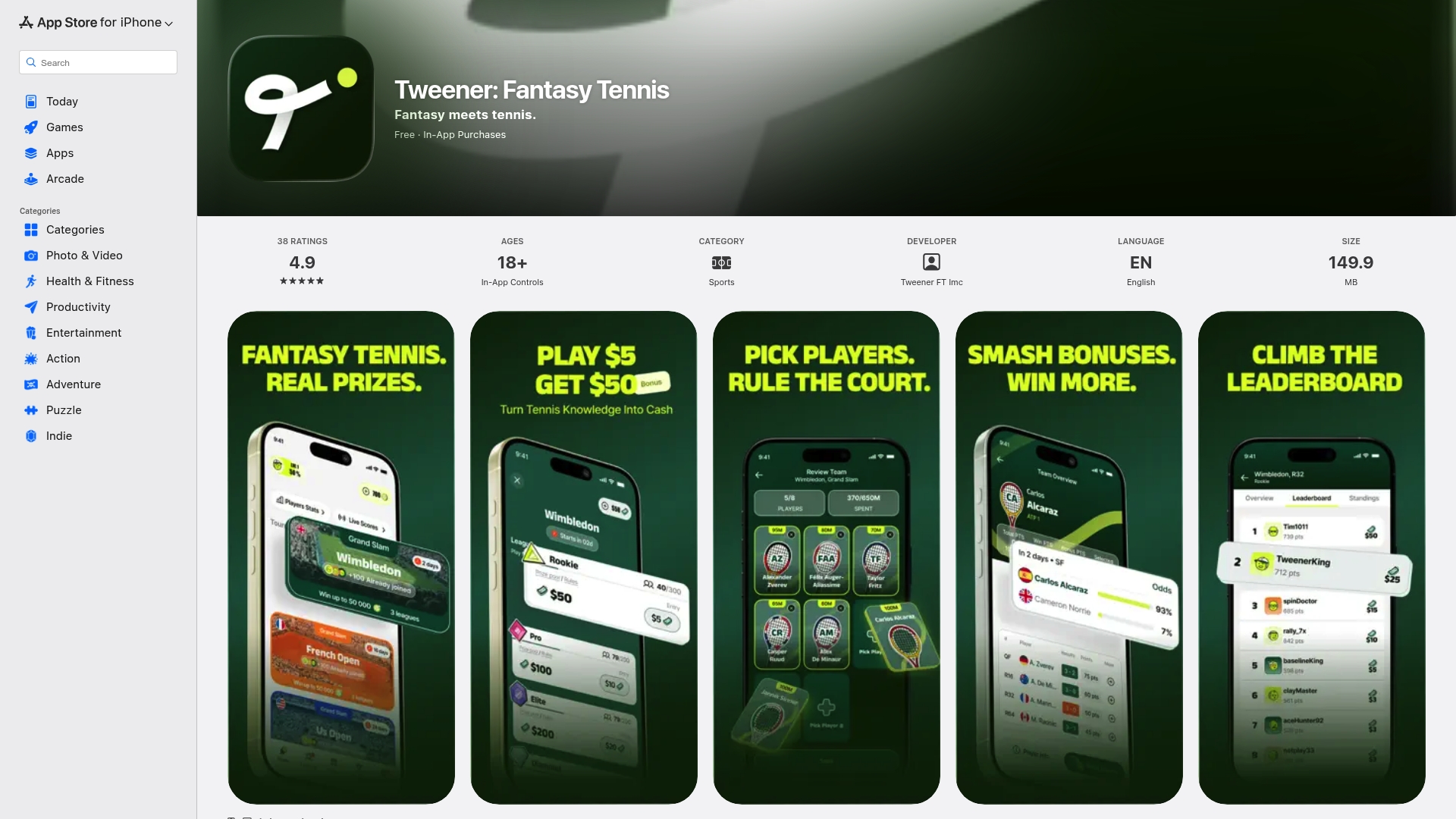
Download the app and join a beginner contest during the next tournament, or set up a private league for up to nine friends around the next Grand Slam. Start with our Draft Mode and Pick'em Mode landing page, or go straight to the app download to get playing before the next round starts.
FAQ
Is there a fantasy league for tennis?
Yes, fantasy tennis leagues exist on dedicated apps where you draft or predict outcomes for real ATP and WTA players. Tennis-specific platforms like Tweener run both free and paid contests tied to live tournament results.
What are some fun tennis games for beginners?
Pick'em formats are the easiest starting point since you simply predict match winners without managing a salary cap. Beginner-labeled contests and free-coin modes let new players learn scoring without financial risk.
What are the 10 basic rules of tennis?
Tennis scoring runs through points, games, and sets, with a player needing four points to win a game (win by two) and typically six games to win a set. Matches are decided by winning two of three sets, or three of five in men's Grand Slam play, with faults, lets, and tiebreaks governing edge cases during games.
Is ATP Fantasy an app?
The ATP Tour itself does not operate a standalone fantasy app under that name; fantasy tennis is primarily offered through independent platforms built specifically for the format. Tennis-focused apps like Tweener license real ATP and WTA player data to power their own draft and pick'em contests.
Is paid fantasy tennis legal?
Legality for paid, skill-based fantasy contests varies significantly by state. New York's courts have recognized registered interactive fantasy sports as skill-based competitions distinct from gambling under state law, but legal treatment differs elsewhere, so check your state's rules and a platform's disclosures before entering paid contests.
Sources
- Court of Appeals of New York decision on interactive fantasy sports (Mar 2022)
- NY State Gaming Commission rules, Chapter VI — Interactive Fantasy Sports (updated 2023-10)
- Tennis DFS scoring guide — FTN Fantasy
- TennisDB glossary — terms, metrics & abbreviations