

Fantasy tennis rewards preparation more than luck. Before you lock your lineup, run through these core checklist items every week:
- Player serve and return stats by surface — ace rate, first-serve percentage, break points saved
- Injury and withdrawal news — ATP and WTA withdrawal lists update daily; missing one can cost you a starter
- Budget headroom — your 100-credit cap forces trade-offs; know exactly where every credit is allocated
- Projected points vs. cost — the ratio, not the raw ranking, is what separates winning rosters from average ones
- Bonus Ball assignment — confirm which starter gets the doubler before the deadline, not after
- Alternates depth — alternates often outscore starters when late withdrawals hit, so treat them as real picks, not afterthoughts
- Surface and draw conditions — clay, grass, and hard courts produce entirely different statistical profiles; a top-10 player on hard can be a liability on clay
Pro Tip: Prioritize ace rate and break-point conversion rate as your two leading predictive markers. Players averaging 12+ aces per match and holding serve above 75% consistently deliver high fantasy ceilings regardless of their ATP or WTA ranking.
Table of Contents
- How do you build a winning fantasy tennis team from scratch?
- Why does team selection drive almost every fantasy tennis outcome?
- How Tweener gives fantasy tennis fans a real competitive edge
- What does a smart in-tournament management checklist look like?
- Key Takeaways
How do you build a winning fantasy tennis team from scratch?
The process is sequential. Skip a step and you'll feel it in the standings by Thursday.
- Pull surface-specific stats first. Filter ATP and WTA data by the current tournament surface. A player's season average means little if half those matches were on a different surface. Focus on recent surface-specific matches for a reliable read.
- Rank by value, not name recognition. Calculate projected points divided by credit cost. A 250-event specialist priced at 8 credits who project 45 points beats a 15-credit name projecting 60 points every time.
- Build your core around two or three chalk picks. These are the high-ranked, high-floor players who almost always advance deep. They anchor your budget and your floor.
- Fill the remaining slots with value picks. Value-based drafting targets players whose projected output exceeds their price — the players the field underweights because they lack a famous name.
- Assign Bonus Ball to your highest-upside starter. Not your safest pick. The player with the best draw, strong surface form, and momentum deserves the doubler.
- Set alternates with withdrawal risk in mind. Pick players from the same draw bracket as your most injury-prone starters so the alternate actually enters the tournament.
- Cross-check injury news one final time before lock. A single late scratch can unravel a well-built team.
Here's how a sample valuation might look for a hard-court Masters event:
| Player | Credit Cost | Projected Points | Value Ratio |
|---|---|---|---|
| Top-5 seed (chalk) | 18 | — | — |
| Unseeded specialist | 8 | — | — |
| Rising qualifier | 5 | — | — |
| Alternate pick | 4 | 22 | — |

The unseeded specialist and the qualifier both outperform on a per-credit basis. That's where leagues are won.
Why does team selection drive almost every fantasy tennis outcome?
Short answer: because almost nothing else does. Team selection accounts for approximately 80–100% of variance in fantasy tennis results. Chip timing matters, but it amplifies a good roster — it can't rescue a bad one.
That insight captures something most casual players miss: chasing the highest-ranked player is a trap. A world No. 3 facing a brutal draw on an unfavorable surface is a liability at 18 credits. A No. 22 seed with a soft draw on their best surface at 9 credits is a weapon.
Surface adaptation is where predictive analytics earns its keep. Clay specialists like Carlos Alcaraz and Iga Świątek carry entirely different fantasy profiles at Roland Garros than at Wimbledon. Grass-court serve metrics — service points won above 70%, high ace counts — predict fantasy output far better than overall ranking during the June–July swing. Momentum matters too. Rolling form over the last 4–6 weeks on the relevant surface outperforms static season averages, especially at 250 and 500 events where sample sizes per surface are small.
Injury frequency in professional tennis is high enough that alternates regularly become decisive. Late walkovers, mid-tournament retirements, and precautionary withdrawals happen at nearly every event. Managers who treat alternates as genuine scoring assets rather than insurance policies hold a structural edge over the field.
How Tweener gives fantasy tennis fans a real competitive edge
Tweener is the closest thing American tennis fans have to a dedicated fantasy tennis platform built for serious players. Think of it as the Fanduel of tennis — except the edge comes from reading a draw and understanding surface splits, not from picking a sport you barely follow.
Key features worth knowing:
- Free and cash modes — compete with virtual coins redeemable for gift cards, or enter paid contests for real-money payouts where permitted
- Live scoring — points update in real time as ATP and WTA matches progress
- Private leagues — create a league with up to 9 friends for Grand Slam tournaments and compete across the full draw
- Bonus Ball and chip mechanics — Bonus Ball doubles one starter's points; Triple Bounce triples that effect; Swing Switch lets you adapt your roster mid-tournament
- Public leagues — join open contests against the broader Tweener community
The game rules lay out exactly how credits, chips, and scoring interact, which is worth reading before your first draft. The strategic depth is real: budget management, chip timing, and surface awareness all feed into outcomes in ways that pure luck can't replicate.
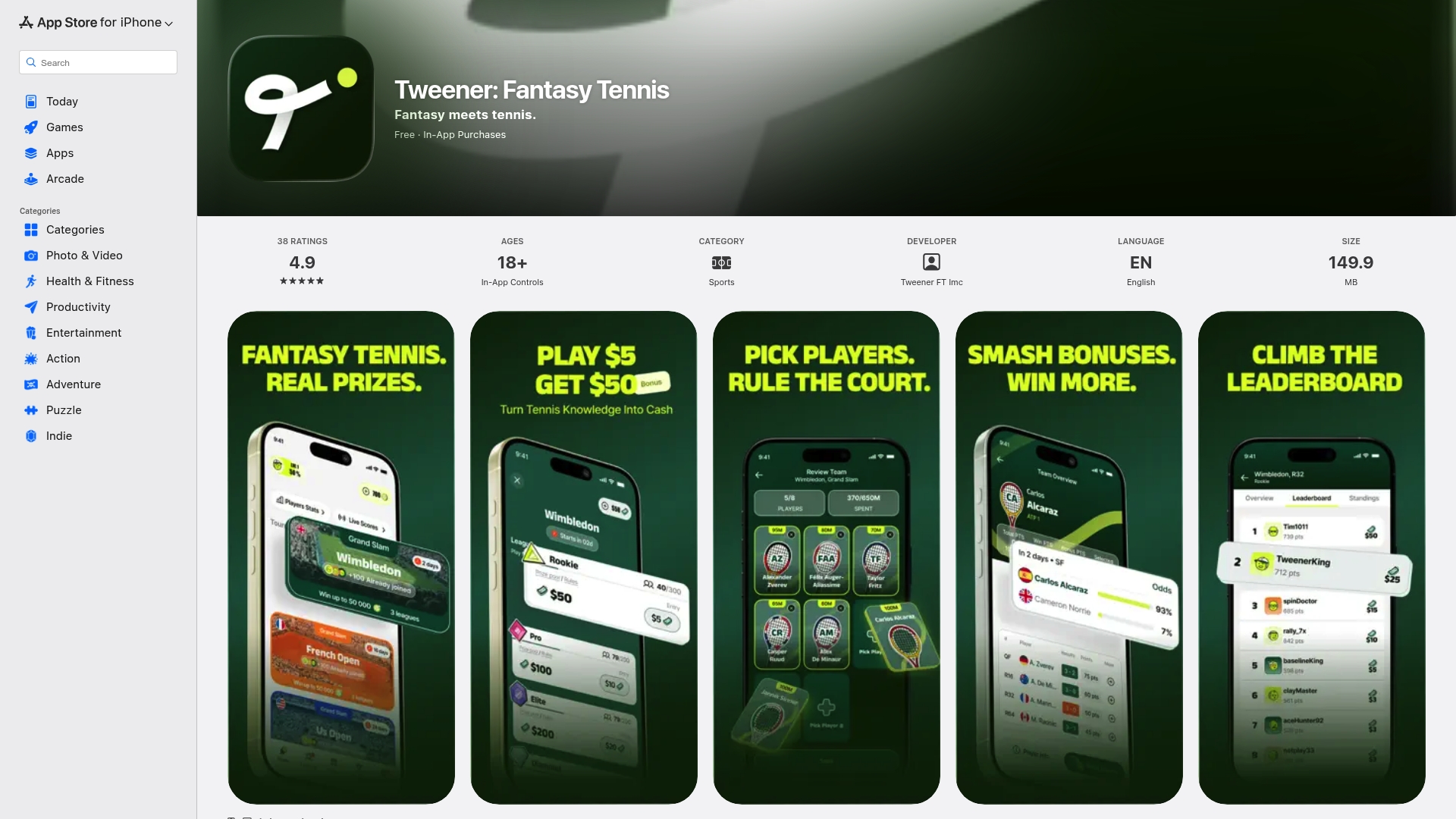
Play fantasy tennis the way it deserves to be played. Download Tweener and compete in your first league today.
What does a smart in-tournament management checklist look like?
Building the team is half the work. Managing it through a two-week Grand Slam or a packed Masters week is where most players lose ground.
- Check fitness and injury reports daily. ATP and WTA medical timeouts, post-match press conferences, and official withdrawal lists all signal risk before your lineup locks.
- Monitor recent form, not just results. A player who won in three tight sets may be carrying fatigue into the next round. A player who bageled their opponent is carrying momentum.
- Track head-to-head records for upcoming matchups. Some players own specific opponents regardless of ranking. H2H data on a particular surface is especially predictive.
- Use Swing Switch at surface transitions, not before. The clay-to-grass swing in late May and June is the highest-leverage moment to deploy a roster change. Burning it on a minor form dip wastes the chip.
- Watch live scoring and adjust your Bonus Ball logic. If your assigned Bonus Ball player retires in the second set, knowing your alternate's scoring position in real time lets you make faster decisions.
- Plan for dual-event weeks. When the ATP or WTA calendar runs two simultaneous tournaments, player availability splits across draws. Knowing which event your picks entered is basic but often overlooked.
Pro Tip: Save chips for key pivot weeks — especially the clay-to-grass transition and the hard-court swing into the US Open Series. Using a Swing Switch or Triple Bounce at a high-stakes moment yields far more leverage than deploying it incrementally across low-stakes early rounds.
The fantasy lineup checklist framework applies every week: stats, surface, fitness, draw, chips. Run it consistently and the compounding effect shows up in your league standings by the end of a Grand Slam.
Key Takeaways
Smart fantasy tennis management comes down to one principle: value over reputation, applied consistently from draft day through the final round.
| Point | Details |
|---|---|
| Team selection dominates outcomes | Team selection accounts for approximately 80 to 100% of variance in fantasy tennis results. |
| Value ratio beats name recognition | Divide projected points by credit cost; the unseeded specialist often outperforms the chalk pick per credit. |
| Alternates are real scoring assets | Late withdrawals are common in ATP and WTA events; alternates frequently decide league outcomes. |
| Surface context changes everything | A player ranked top-10 overall can be a liability on the wrong surface; filter stats by surface before every draft. |
| Save chips for high-leverage moments | Deploying Swing Switch or Triple Bounce at surface transitions yields more impact than incremental weekly use. |