
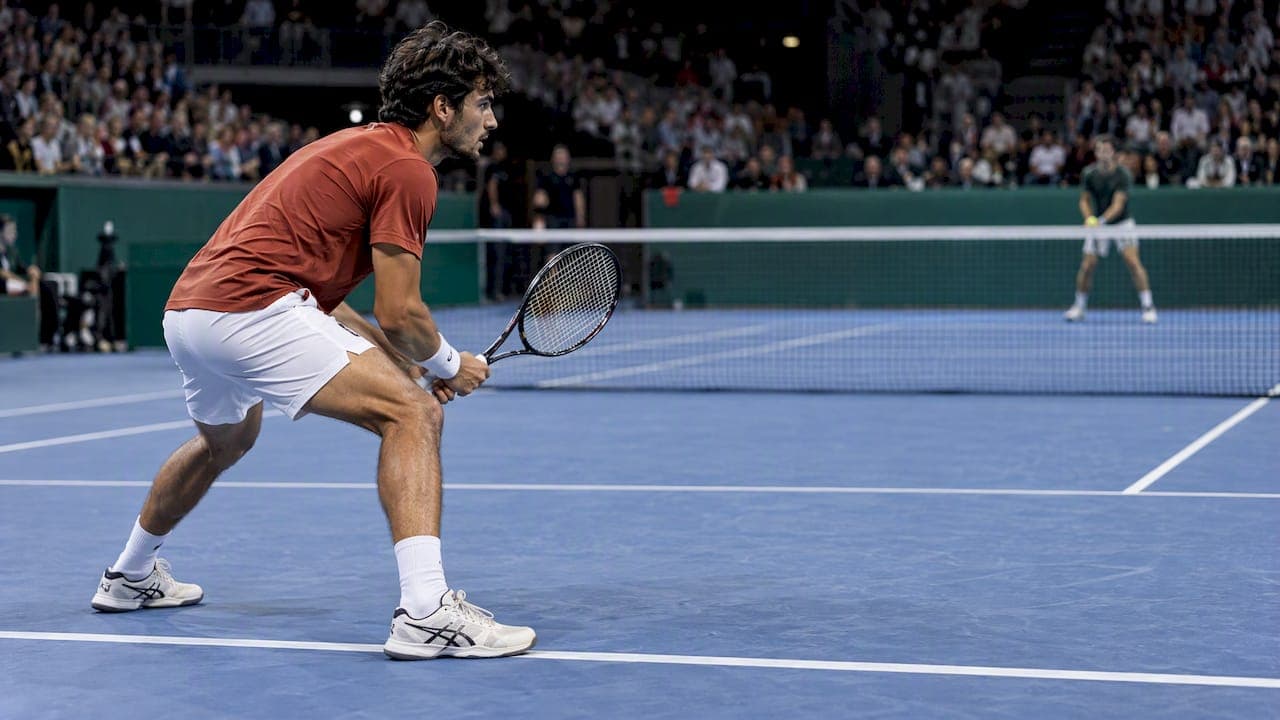
Davis Cup fantasy is a different game from fantasy tennis at a Grand Slam. Nobody can promise you a given player will take the court, because captains choose who plays singles and doubles, and a tie can end before every match is played. This guide covers the 2026 format, the Final 8 field heading to Bologna, and a practical way to build a roster around those risks.
One caution first. Most dedicated fantasy tennis games are built around tour events, so a Davis Cup-specific contest is hard to find. Check what is actually on offer before you plan around it. The approach below works for any Davis Cup contest, a friends-only pool included, and carries over to the tour events where fantasy tennis is easier to find.
TL;DR
- The 2026 Final 8 runs November 24-29 in Bologna, Italy, as a straight knockout. Each tie is played in one day.
- Lineups are the hidden variable. Captains decide who plays singles and doubles, so the player with the best ranking is not always the best pick.
- Dead matches and early finishes make high-floor players more valuable than risky stars who may never get a full slate.
- Rankings tell you less than surface, form, and how a player performs in team ties.
- In the US, real-money fantasy contests are regulated state by state, so confirm your state before you put money down.
Table of Contents
- What makes Davis Cup fantasy different
- The 2026 format, in plain terms
- Who is in the 2026 Final 8
- A five-step process for building your roster
- Rankings are a weak guide here
- Managing risk when lineups can change
- Is it legal to play for cash in the US?
- Where Tweener fits in
- Our perspective
- A pre-tie checklist
- FAQ
- Sources
What makes Davis Cup fantasy different
A Grand Slam draw is set weeks ahead. You know your player's path, his likely opponents, and roughly when he plays. The Davis Cup gives you none of that certainty. Nations name their lineups close to the tie, and captains have the final say on who plays which rubber (a rubber is one match within a tie).
That shifts your homework. At the US Open you study matchups. At the Davis Cup you first study availability and captain habits, then matchups. A top-10 player who is nursing a minor injury might play one singles rubber or none, while a player ranked 80 spots lower might play singles and doubles on the same day.
There is also the team factor. Reporting on the format notes that players with strong national ties or a record in team ties often outperform their rankings in the Davis Cup's charged atmosphere, though you should treat that as a tendency and not a rule.
The 2026 format, in plain terms
The 2026 competition starts with Qualifiers, a first round in February and a second round in September. It ends with the Final 8 in Bologna, according to the LTA's beginner's guide. The Qualifiers are played as best-of-five rubbers over two days. The Final 8 is a straight knockout where each tie is best-of-three rubbers on a single day.
The official Davis Cup format page describes the Final 8 tie as two singles and one doubles. It also notes that 157 nations entered in 2025, which makes it the largest annual international team competition in sport.
Here is what that means for a fantasy player:
| Stage | Format | What it rewards |
|---|---|---|
| Qualifiers | Best-of-five rubbers, two days | Volume. More matches mean more chances to score. |
| Final 8 | Best-of-three rubbers, one day | Leverage. Few matches, so every rubber counts, and a tie can finish early. |
The LTA piece also explains why the two formats feel so different on screen. A two-day Qualifier gives a captain room to change his plan after day one. A single-day knockout does not.
Who is in the 2026 Final 8

The field is set. According to Tennisnerd's qualifier roundup, the eight teams are Italy, Germany, Spain, Great Britain, Austria, Canada, South Korea and Czechia. Italy qualified automatically as defending champions and hosts, having won the cup in each of the past three editions.
The same report offers a few useful lessons in how lineups behave:
- Germany beat Croatia 3-1 in Halle. Alexander Zverev won two singles rubbers, including a straight-sets win over Dino Prizmic on the Sunday. Kevin Krawietz and Tim Puetz won the doubles in between. A top player who plays every available rubber is a fantasy gift.
- Great Britain swept Ecuador 4-0 in London without several of its biggest names, including Jack Draper and Cameron Norrie. Toby Samuel and Arthur Fery won the singles, and Henry Patten and Neal Skupski took the doubles. A deep roster can cover for missing stars, and a roster built only around a headline name would have scored nothing.
- Austria beat Belgium 3-1 in Vienna. Jurij Rodionov won both of his singles, including a 7-6(6), 6-3 win over Zizou Bergs. A player outside the elite tier delivered the decisive points.
Three different stories, one pattern: the stars are not always there, and the rubber winners are not always the best-known names. Confirm every final lineup against the official announcement before the first ball.
A five-step process for building your roster
The same process works whether you are filling out a contest entry, running a private pool with friends, or just trying to follow the weekend with a stake in it.
- Confirm the lineups. Read each team's official nomination as soon as it is released. If a player is not named, he is not an option. Do not assume a star will play both singles slots.
- Identify the singles pair. Most ties have two singles slots per team, so the number 1 and number 2 singles players are where the points are. A third man on the roster rarely matters unless there is an injury.
- Treat doubles as its own market. Many fantasy players ignore the doubles rubber. In a best-of-three tie it is often the deciding match, so the doubles pair can be worth more than a singles player on a weak side.
- Check the surface. The host nation picks the court. A clay specialist on a home clay court is a different proposition from the same player on a fast indoor hard court.
- Pick for floor, not just ceiling. When the tie is settled early, remaining matches can be shortened or skipped. Players in the first rubbers get the most reliable playing time.
Why floor matters more than you think
A Rotogrinders primer on tennis DFS is a good starting point on scoring and roster basics for daily fantasy tennis. Its logic carries over: you want players who are very likely to play a full match and score regardless of the result. In a Final 8 tie, a player in rubber one of a best-of-three is guaranteed a match if the tie goes ahead. A player in rubber three might never walk on court.
That is why a first-rubber singles player on a mid-ranked team can be a safer play than a higher-ranked player slotted into a possible dead rubber.
Rankings are a weak guide here
A lot of casual players go wrong by treating the Davis Cup like a tour event. The same Rotogrinders article stresses that you should study how a player is actually performing, and not lean on name value. In team ties the useful signals are different:
- Surface record on the specific court. Not the player's overall hard-court record, but the speed of the court in Bologna and how he has done on similar indoor surfaces.
- Recent form. The Final 8 comes late in the season, after a long grind. Look at the last four to six weeks, including any retirements and any time off.
- Head-to-head. In a knockout tie you will often know in advance which two players are likely to meet. A lopsided head-to-head record is worth more than a ranking gap.
- Team-tie history. Some players lift in Davis Cup and some shrink. Their record in earlier ties is a legitimate data point, not a hunch.
- Fatigue. A player who just won a major, as Zverev did at the US Open this year, may be fully motivated or may be running on empty. Check his schedule since.
A worked example
Imagine two players you are choosing between for a singles spot. Player A is ranked 12th, is probably the number one singles player for his country, but has played a long run of tour events and has a poor record on indoor hard courts. Player B is ranked 55th, is the number two singles player, has won both of his team-tie singles matches this year on a similar surface, and has a favorable head-to-head against the likely opponent.
On rankings alone Player A wins. On the factors that matter in a one-day knockout, Player B may be the better pick. This is the kind of call that separates a thoughtful roster from a lazy one. It is also why we say fantasy tennis rewards the analytical fan.
Managing risk when lineups can change
Fantasy players often treat a Davis Cup entry like a tour-event entry and ignore volatility. Three habits help.
Diversify across teams. If your roster has three players from one nation and the captain rests one, or the tie ends 2-0, your whole lineup suffers at once. Spread picks across the likely winners.
Read the tie, not just the player. If one team is a heavy favorite, the underdog's second singles player may never play a deciding rubber. The favorite's players are more likely to play, but the outcome of the tie also shapes who sees the court.
Size your entries sensibly. If you play for money anywhere, set a budget for the weekend and keep to it. Our own guide to the risks of fantasy sports betting for tennis players goes through how to set limits. If gambling stops being fun, contact the National Problem Gambling Helpline at 1-800-GAMBLER.
Is it legal to play for cash in the US?
It depends on your state. Legal analysis from a law firm that advises on this area says fantasy sports are generally outside federal UIGEA restrictions and are permitted in roughly 80% of US states, though some states require operator licenses. The same analysis says pure skill contests may also be offered, but providers often restrict access in certain places because the legal definitions are unsettled. That article dates from 2021, so check your state's current rules and the operator's list of eligible states before you deposit anything. If you are unsure, a lawyer who works in gaming law can tell you where you stand.
Free play has no such restriction, which makes it a good place to practice a Davis Cup approach with no money involved.
Where Tweener fits in
We built Tweener around tennis because general fantasy platforms treat it as an afterthought. It is a mobile app where you build fantasy teams from real ATP and WTA players and score points from live match results. You can join public leagues or set up a private league with friends. For Grand Slams, that means a private league of up to 10 people (you plus up to 9 friends). There are two ways to play: Draft Mode and Pick'em Mode.
There are also two kinds of play. The free mode uses virtual coins that you earn through gameplay and other in-app activities, and the coins can be redeemed for rewards such as gift cards. The cash mode lets you deposit money to enter paid contests for real payouts, where legally permitted, and it is available only in select US states.
We do not want to overpromise on the Davis Cup specifically: contest availability follows the tennis calendar, so check the app for what is live. What we can say is that the skills in this guide, from reading lineups to weighing surface and form, are the ones that pay off across every event. You can see the modes and get started on Tweener, or download the app directly.

Our perspective
We get asked often why there is no "Davis Cup fantasy" that feels like a proper game. Part of the answer is that the format is awkward. Lineups arrive late, ties end early, and the stars come and go. That makes it hard to build a clean product on top.
But the same awkwardness is what makes it interesting to someone who likes data. If every player played every match, fantasy tennis would be a ranking exercise. Because captains decide, because surfaces vary, and because a nation's best player can be missing, the edge goes to the fan who does the reading. That is why we treat fantasy tennis as a skill game, closer to a puzzle than a coin flip, and why we built Tweener for people who enjoy the puzzle.
If you want to sharpen the broader toolkit, these are the pieces we would start with: how to optimize your fantasy tennis picks, our guide to building winning tennis lineups, and our look at daily fantasy tennis strategies.
— Nathan
A pre-tie checklist
Run through this before every Davis Cup session, and it will save you from the most common mistakes:
- Have both teams named their lineups, and have you read the official release?
- Who is the number one and number two singles player for each side?
- What is the court surface and speed, and who chose it?
- Is any star coming off an injury, a long trip, or a big title run?
- Is the tie lopsided enough that the third rubber may never be played?
- Is your roster spread across more than one nation?
- Are you comfortable with what you are risking, if anything?
If you want more checklists like this, our essential tennis fan checklists cover other parts of the season.
FAQ
Is there an official Davis Cup fantasy game?
We have not found a widely used, dedicated Davis Cup fantasy game in the US, and what is available changes by season. The simplest route is a private pool with friends, where you agree on scoring rules and pick from the named lineups. For tour events, a dedicated app like Tweener gives you structured leagues, and you can check the app for what is live.
When is the 2026 Davis Cup Final 8?
The Final 8 runs November 24-29, 2026, at the SuperTennis Arena in Bologna, Italy, according to Tennisnerd. The eight teams are Italy, Germany, Spain, Great Britain, Austria, Canada, South Korea and Czechia. Ties are best-of-three rubbers played in one day.
Why do Davis Cup fantasy results swing so much?
The main reasons are lineup control and match count. Captains choose who plays, and a tie can be settled before the final rubber, so some players score nothing. Pick players in the early rubbers and spread your roster across teams to reduce that risk.
Can I play fantasy tennis for real money in the US?
In many states, yes, but the rules are set state by state. Legal commentary says fantasy sports are permitted in roughly 80% of states, and some require operator licenses. Tweener's cash mode is available only in select US states, so check the app for your location, and use free mode if cash play is not available to you.
Sources
- Davis Cup 2026: Beginner's guide to format and teams, LTA
- Format, Davis Cup official site
- Davis Cup Final 8 Set: Bologna Field Confirmed, Tennisnerd
- How to Play and Win at Tennis DFS, Rotogrinders
- Real-Money Skill Gaming in the U.S., Artaev at Law
- 2021 Davis Cup Finals, Grokipedia