

Three WTA fantasy lineup ideas you can use right now: an anchor-led cash roster built around Iga Swiatek and Aryna Sabalenka for a reliable floor; a GPP/contrarian roster that fades one chalk player in favor of a low-owned attacker like Ons Jabeur or Jasmine Paolini; and a budget Grand Slam roster that saves salary on one mid-tier pick to stack two premium anchors with a value fifth slot. These are the three core WTA fantasy team strategies, and the rest of this guide explains exactly how to build, adjust, and lock each one.
- Cash roster (floor-first): Iga Swiatek, Aryna Sabalenka, Ons Jabeur, Jasmine Paolini, + one mid-tier value pick. Swiatek and Sabalenka anchor the floor; Jabeur and Paolini add ceiling without sacrificing matchup safety.
- GPP/contrarian roster: Aryna Sabalenka, Jasmine Paolini, + three low-owned attackers from favorable draw sections. Fade Swiatek when her ownership projects above moderate levels and redirect salary to two undervalued players.
- Budget/Grand Slam roster: Iga Swiatek + one premium anchor + two mid-tier attackers + one budget value pick. Preserves salary for the top two slots while the fifth player costs minimum salary.
Pro Tip: In GPP contests, check projected ownership before locking.
Key Takeaways
Building competitive WTA fantasy lineups comes down to one repeatable process: anchor for floor, attack for ceiling, and let ownership data determine when to copy the field and when to differentiate.
| Point | Details |
|---|---|
| Anchor selection | Use Swiatek on clay and Sabalenka on hard as primary anchors; prioritize break-conversion over serve stats on WTA. |
| Ownership rules | Mirror chalk in cash games; fade players above 35% projected ownership in GPPs for leverage. |
| Stacking triggers | Stack two players from the same match only when both surface and playing styles project a long, break-heavy match. |
| Surface adjustments | Weight recent form (last 4–6 weeks) over career surface records, especially after injury returns. |
| Tweener platform | Tweener supports 5-player WTA contests, private Grand Slam leagues, and free and cash modes to apply these strategies in-app. |
Table of Contents
- How do you build a 5-player WTA roster from scratch?
- When should you copy the field and when should you differentiate?
- When does game-stacking actually help your WTA lineup?
- How do surface and tournament tier change your WTA lineup?
- Five ready-made WTA lineups you can copy right now
- Salary-cap hacks, last-minute checks, and what to lock
- How do cash games and GPP formats change who you pick?
- What do expert practitioners actually recommend for WTA lineups?
- How does opponent difficulty change your lineup strategy?
- Tweener is where these WTA lineups come to life
- Sources
How do you build a 5-player WTA roster from scratch?
The optimal construction for most WTA fantasy lineups is one to two anchors for floor stability plus two to three attackers for ceiling, with the exact split shifting based on whether you're playing cash or a tournament/GPP format.
What anchors are and who qualifies
Anchors are players with a high scoring floor: they win matches, hold serve at a reasonable rate, and rarely produce a zero. On the WTA tour, surface form and recent match results matter more than ranking alone when identifying true anchors. Iga Swiatek on clay is the clearest example in women's tennis — her break-conversion rate and baseline dominance on red dirt make her a near-automatic cash-game anchor at Roland Garros or any clay WTA 1000. Aryna Sabalenka fills the same role on hard courts, where her serve-return combination and aggressive baseline game produce consistent point totals even in tight matches.
What to look for in an anchor:
- Strong surface-specific win rate over the last 8–12 weeks
- High hold percentage and above-average break-conversion rate
- A draw that avoids top-five opponents until at least the quarterfinals
- Salary that fits without gutting the rest of your roster
What attackers are and who fits the profile
Attackers are the players who can win you a GPP. They carry more variance — they might score 10 points or 40 — but their ceiling is high enough to separate your lineup from the field. Jasmine Paolini is a textbook attacker profile: aggressive return game, capable of breaking top players, and often priced below the true anchors despite her ability to go deep in draws. Ons Jabeur, when healthy and on a surface that suits her game, offers similar upside at potentially lower ownership than Swiatek or Sabalenka.
The anchor/attacker/game-stack framework gives you a repeatable process for every tournament. Here's the practical checklist:
- Pull last-5-match results for every player in your price range
- Filter by surface (eliminate players with poor records on the current surface)
- Check the draw for each candidate — early-round matchup difficulty matters
- Assign anchor or attacker role based on floor vs ceiling profile
- Allocate roughly 60–65% of salary to anchors, the remainder to attackers and value picks
- Verify salary balance leaves at least a small buffer for last-minute pivots
Pro Tip: On the WTA, prioritize return and break metrics over serve stats when evaluating anchors. WTA break rates run higher than ATP, so a player who breaks frequently and holds reliably is worth more than a big server who can't convert return games.
When should you copy the field and when should you differentiate?
Ownership strategy depends on contest type and payout structure — full stop. In cash games (head-to-head, 50/50), copying the field's chalk picks is often the right call. In GPP tournaments, mirroring the field caps your ceiling and makes it nearly impossible to finish in the top spots.
Cash games: chalk is your friend
In cash formats, you're trying to beat roughly half the field. The players projected at high ownership are usually high-owned for good reason — they have the best matchups, the best recent form, and the safest floors. If she wins and you don't have her, you're already behind.
Blend two to three chalk anchors with one or two mid-tier picks that the field isn't universally on. That combination gives you the floor to cash while the mid-tier picks provide a small edge when they outperform expectations.
GPP tournaments: differentiation is leverage
To finish first, your lineup needs to look different from the winning lineup — and the winning lineup almost never looks like the field average.
If Paolini goes deep and the chalk players exit early, your lineup separates from the field immediately.
Ownership threshold rule of thumb: In GPPs, consider fading any player projected above 35% ownership in favor of a comparable attacker projected below 15%. The floor difference is usually smaller than it looks, but the ceiling difference can be enormous.
When does game-stacking actually help your WTA lineup?
Game-stacking — picking two players from the same match — can be a high-efficiency play on WTA when the match is projected to go long, because total-games scoring drives volume points in most fantasy formats. A three-set clay battle between two baseliners generates far more scorable events (games won, breaks, holds) than a 6-2, 6-1 blowout.

Two stack scenarios worth knowing
Clay grinder vs clay grinder: Two heavy baseliners on a slow clay surface is the ideal stacking scenario. Expect long rallies, frequent breaks, and three sets. Both players accumulate games-won points even in a loss, and the winner racks up break-point conversions. A stack of the two players in this match type can outscore a single-player approach by a wide margin when the match goes the distance.
Even matchup on slow hard court: Similar logic applies on slow hard courts (think Australian Open baseline conditions). When two return-heavy players meet and neither has a dominant serve, break frequency rises and match length extends. Stacking both players captures the volume scoring regardless of who wins.
Risks and how to manage them
- Correlation risk: If both stacked players underperform (one retires, one has an off day), your entire lineup suffers simultaneously.
- Draw exposure: Stacking players from the same draw section means a single upset can eliminate both your picks before the later rounds.
- Cross-stack overload: Stacking more than one match in a 5-player lineup leaves you with almost no independent scoring legs.
Mitigate by diversifying your stack across different draw sections. If you stack one match, make sure your remaining three players come from separate parts of the draw. Limit yourself to one game-stack per lineup in most formats.
Pro Tip: *To identify likely long matches, cross-reference surface (clay or slow hard), both players' average match lengths over their last six matches, and their break rates.
How do surface and tournament tier change your WTA lineup?
The core adjustment principle: surface determines which player traits to prioritize, and tournament tier determines how deep your roster needs to be. A lineup built for Roland Garros clay looks meaningfully different from one built for a grass-court WTA 250.
Surface checklist
Clay: Prioritize break-conversion rate, endurance, and baseline consistency. Long matches favor players who can sustain intensity across three sets. Swiatek is the obvious anchor; look for attackers with strong clay records and high return-game win rates.
Hard courts: Balance power and serve-return efficiency. Hard courts reward players who can hold serve reliably AND break when opportunities arise. Sabalenka's combination of serve power and aggressive return game makes her a top hard-court anchor. On faster hard courts, serve metrics matter more; on slower ones, return metrics take over.
Grass: Ace potential and serve-return quickness become the dominant factors. Grass rewards big servers and players who can handle fast, low-bouncing balls. Anchors on grass are often different players than your clay or hard-court anchors — check grass-specific win rates, not career records.
Tournament-tier adjustments
- Grand Slams (best-of-three for women): Depth matters. Players need stamina across seven matches, so weight recent fitness and match-load data. Late-round performance history at Slams is a real differentiator.
- WTA 1000s: Top anchors dominate more predictably here. Draws are deeper but the field is smaller than Slams, so chalk anchors like Swiatek and Sabalenka win at a higher rate.
- WTA 500s and 250s: Underdog upside increases. Smaller fields mean lower-ranked players reach later rounds more often, making contrarian attackers more valuable. Budget rosters work well at this tier.
Pro Tip: Weight recent form (last 4–6 weeks) more heavily than career surface records, especially after a player returns from injury or a long break. A player with a great clay record who hasn't played in six weeks is a risk, not an anchor.
Five ready-made WTA lineups you can copy right now
These five rosters cover the main contest types. Player names reflect current top-tier WTA talent; adjust for draw position and salary constraints in your specific contest. Social proof confirms that 5-player WTA fantasy formats are widely used and these roster shapes match what experienced players circulate.
Lineup 1: Cash (floor-first)
Iga Swiatek / Aryna Sabalenka / Ons Jabeur / Jasmine Paolini / mid-tier value pick
Two elite anchors plus two proven attackers with a budget fifth slot. This roster wins cash games when Swiatek and Sabalenka perform to expectation — which they do at a high rate on their preferred surfaces. Jabeur and Paolini add ceiling without introducing excessive variance. Ownership will be moderate to high; that's fine for cash.
Swap: If Jabeur is injured or withdrawn, replace with a surface-appropriate mid-tier player from a favorable draw section.
Lineup 2: GPP/contrarian
Keep Sabalenka as your one chalk anchor, then build around three attackers from favorable draw sections at low ownership. This lineup loses more often than the cash roster — that's the point. When it hits, it separates from the field by 20–30 points.
Swap: On clay, consider a low-owned clay specialist from outside the top 20 as one of your three attackers.
Lineup 3: Grand Slam budget
Iga Swiatek / Aryna Sabalenka / two mid-tier attackers / minimum-salary value pick
Spend up on the top two slots and compress the bottom three. At Grand Slams, Swiatek and Sabalenka are worth the premium because they're likely to play six or seven matches. The minimum-salary fifth player is a calculated risk — she only needs to win one or two rounds to generate positive value.
Lineup 4: Game-stack special
Two players from a projected long match (clay or slow hard) / Iga Swiatek / two value picks
Stack the two players most likely to play a three-set grinder, then anchor with Swiatek for floor. The two value picks come from separate draw sections to limit correlation risk. This roster has a higher variance ceiling than the cash lineup and works best in mid-size GPP fields.
Lineup 5: Contrarian budget (WTA 250/500)
One top-10 anchor / Jasmine Paolini / three low-owned attackers from outside the top 30
At smaller tournaments, the draw opens up for lower-ranked players. Three attackers from outside the top 30 at low ownership can produce massive GPP scores when even one goes deep. Keep one reliable anchor for floor; Paolini provides the middle-tier ceiling.
Salary-cap hacks, last-minute checks, and what to lock
The top priority before lock: verify no scratches or injury news within 30 minutes of lineup lock and confirm your salary is fully allocated. A withdrawn player who stays in your lineup scores zero — that's an unforced error that ends cash-game runs.
Last-minute action checklist
- Check injury and withdrawal news — WTA withdrawals happen frequently; check the tournament's official draw sheet and reliable tennis news sources within 30 minutes of lock.
- Confirm salary balance — leaving more than a dollar or two on the table is wasted value; reallocate to the highest-priced available upgrade.
- Review ownership exposure — if you're in multiple GPP contests, make sure you're not running identical lineups everywhere. Vary at least one attacker slot across entries.
- Run a correlation scan — confirm your game-stack players are still in the same match and haven't been redrawn or withdrawn.
- Check weather (outdoor tournaments) — wind and extreme heat affect WTA matches significantly, often extending match length and increasing break frequency.
Salary-cap hacks
Spend down at the fifth slot in cash games when no obvious value exists at mid-salary. The savings let you upgrade one of your anchor slots to the premium tier. On the flip side, in GPP formats, spending the minimum on one attacker to afford two premium anchors is often worth it — the attacker's ceiling at minimum salary can still be substantial if her draw is favorable.
Pro Tip: Always leave $100–200 in salary slack (or the equivalent in your platform's currency) until 45 minutes before lock. Late withdrawals and lineup changes happen, and having room to pivot without rebuilding your entire roster saves you from scrambling.
How do cash games and GPP formats change who you pick?
Format changes strategy: cash rewards floor, GPP rewards ceiling and leverage. That's the rule, and it flows directly into which scoring categories you prioritize when selecting players.
Scoring categories and what drives points
Most WTA fantasy formats score on some combination of:
- Wins (the biggest single point source in most formats)
- Games won (volume scoring — rewards players who win sets convincingly)
- Breaks of serve (high-value events; WTA break rates run higher than ATP, making this category especially important)
- Aces (smaller contribution on WTA than ATP, but still relevant on grass and fast hard)
- Double-fault penalties (negative points; avoid players with high double-fault rates)
WTA matches show higher break rates and more volatility than ATP, which shifts fantasy priorities toward return aggression and break-conversion. A player who breaks serve frequently and wins long matches accumulates points across multiple categories simultaneously — wins, games won, and breaks all fire in the same match.
A return specialist on WTA can outscore a pure server by a significant margin in formats that reward breaks. A player who wins 6-4, 7-5 with four breaks of serve scores more than a player who wins 6-3, 6-2 with two breaks, even though the second player's scoreline looks more dominant.
Format-specific pick rules
- Cash games: Two anchors minimum, prefer players with high hold rates and break-conversion above tour average, avoid players with double-fault tendencies.
- GPP/tournament: Prioritize attackers with high break-conversion and return aggression; accept lower hold rates in exchange for ceiling; target low-owned players in favorable draw sections.
- Tournament mode strategy diverges meaningfully from cash — the scoring ceiling matters more than the floor once you're past the first few rounds.
What do expert practitioners actually recommend for WTA lineups?
The practitioner consensus on WTA fantasy lineups aligns tightly with the framework in this guide: anchors plus attackers plus selective stacking, with ownership decisions driven by contest type. That's not a coincidence — it's the structure that experienced lineup builders converge on after enough reps.
Six rules of thumb from the research
- Weight recent surface form over career records. A player's last 4–6 weeks on the current surface predicts performance better than her three-year surface win rate, especially after injury returns.
- Prioritize return and break metrics on WTA. Because WTA break rates run higher than ATP, return-game dominance is a stronger predictor of fantasy scoring than serve dominance.
- Use the draw as a filter, not an afterthought. A top-20 player facing a top-five opponent in round two is a bust risk regardless of ranking. Matchup analysis should happen before salary allocation.
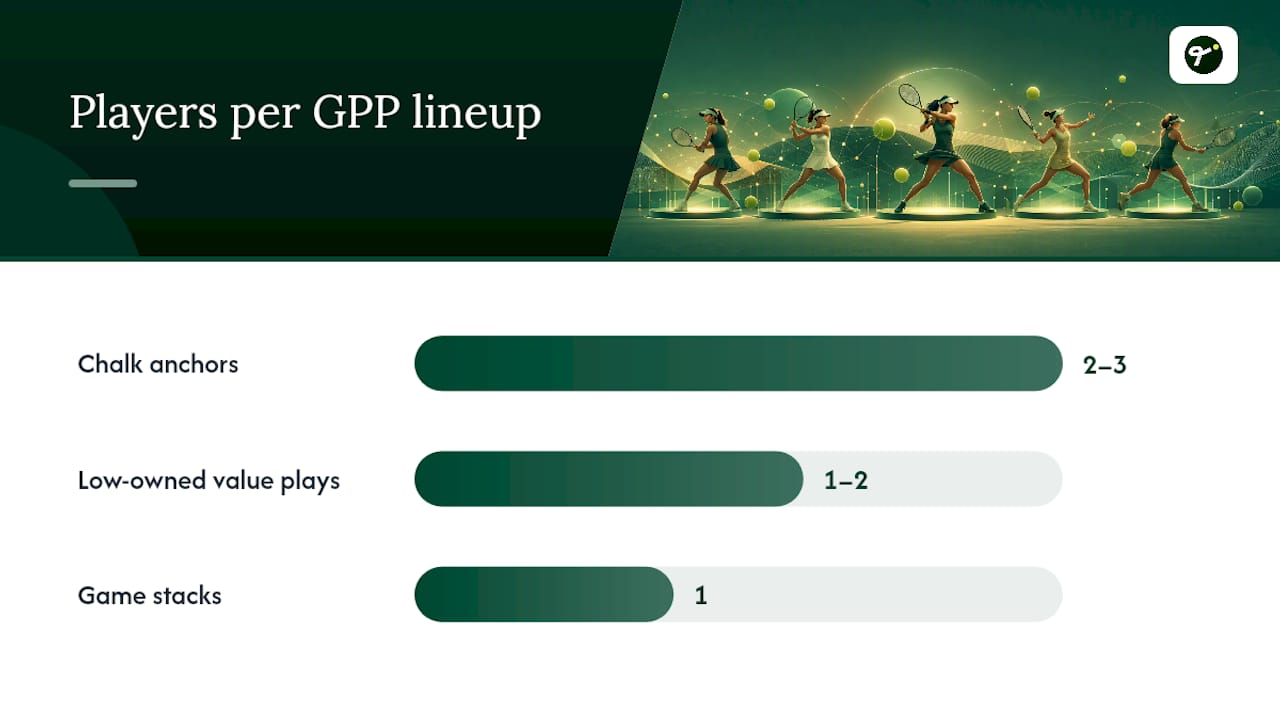
- Blend chalk and contrarian in GPPs. Two to three chalk anchors for stability, one to two low-owned value plays for differentiation — this is the standard GPP construction that fantasy draft experts validate through sleeper and diversification analysis.
- Don't rely on ranking alone. Rankings lag form by weeks or months. A player returning from injury at a high ranking can be a trap; a player on a six-match winning streak at a lower ranking can be a steal.
- Limit stacks to one per lineup. Two game-stacks in a 5-player roster leaves almost no independent scoring legs and amplifies bust risk.
Sourced insight: WTA tour dynamics — higher break rates and more comebacks than ATP — shift fantasy priorities toward return aggression and break-conversion when selecting players. This is the single biggest structural difference between ATP and WTA fantasy strategy.
Pro Tip: When ranking, recent form, and draw all point in different directions for the same player, default to the draw. A great player in a brutal draw section is a liability; a good player in an open draw section is an opportunity.
How does opponent difficulty change your lineup strategy?
Matchup difficulty is the variable most fantasy players underweight, and it's where the biggest edges hide. A player ranked 15th in the world facing a top-three opponent in round two is a different fantasy asset than the same player facing a qualifier. The roster construction changes accordingly.
When your anchor faces a soft draw, you can afford to spend up on her and treat the salary as locked. When your anchor faces a difficult early matchup, consider whether a slightly lower-ranked player with an easier path offers better expected value at a lower price.
For attackers, opponent difficulty cuts both ways. A low-owned attacker who faces a beatable opponent in rounds one and two has a realistic path to accumulating three or four matches of scoring. That's the scenario that wins GPP tournaments. Conversely, an attacker who draws a top-five player in round one is a one-and-done risk regardless of her ceiling.
The practical rule: map every candidate's projected path through at least three rounds before finalizing your roster. Players with two soft matches before a potential quarterfinal clash are worth more than their salary suggests. Players who face a top-ten opponent in round two are worth less, even if their ranking looks attractive.
Surface matchups add another layer. A clay specialist facing a hard-court specialist on clay is a favorable matchup even if the rankings are close. Matchup analysis that combines surface preference with draw position gives you a more complete picture than either variable alone.
The part of WTA fantasy most people get wrong
The conventional wisdom says: pick the best players, stay chalk in cash, go contrarian in GPPs. That's correct as far as it goes. What most guides miss is that WTA fantasy requires a different mental model than ATP fantasy — not just different player names.
WTA matches break serve more often, produce more three-set results, and generate more volatility at every ranking level. That means the "safe" anchor on WTA is less safe than the equivalent anchor on ATP. Swiatek on clay is as close to a true lock as WTA offers, but even she loses matches she's heavily favored to win. The implication: your floor on WTA is always lower than it looks, and your ceiling is always higher.
The players who build consistently profitable WTA lineups treat every roster like a portfolio with a range of outcomes, not a prediction. They accept that the anchor might lose, build enough ceiling into the attacker slots to survive it, and use ownership data to make sure their ceiling plays are differentiated enough to matter when they hit.
One more thing most people skip: check the physical schedule. WTA players at Grand Slams sometimes play back-to-back days in early rounds. A player who played a three-set match 20 hours before her next match is a fatigue risk, and that risk rarely shows up in projected ownership.
Tweener is where these WTA lineups come to life
If you've built a 5-player WTA roster using this framework, Tweener is the app designed to run it. Unlike generic fantasy platforms, Tweener is built specifically for tennis — 5-player contest formats, real WTA scoring, and both free and cash modes so you can test lineups without risking money before you're confident.
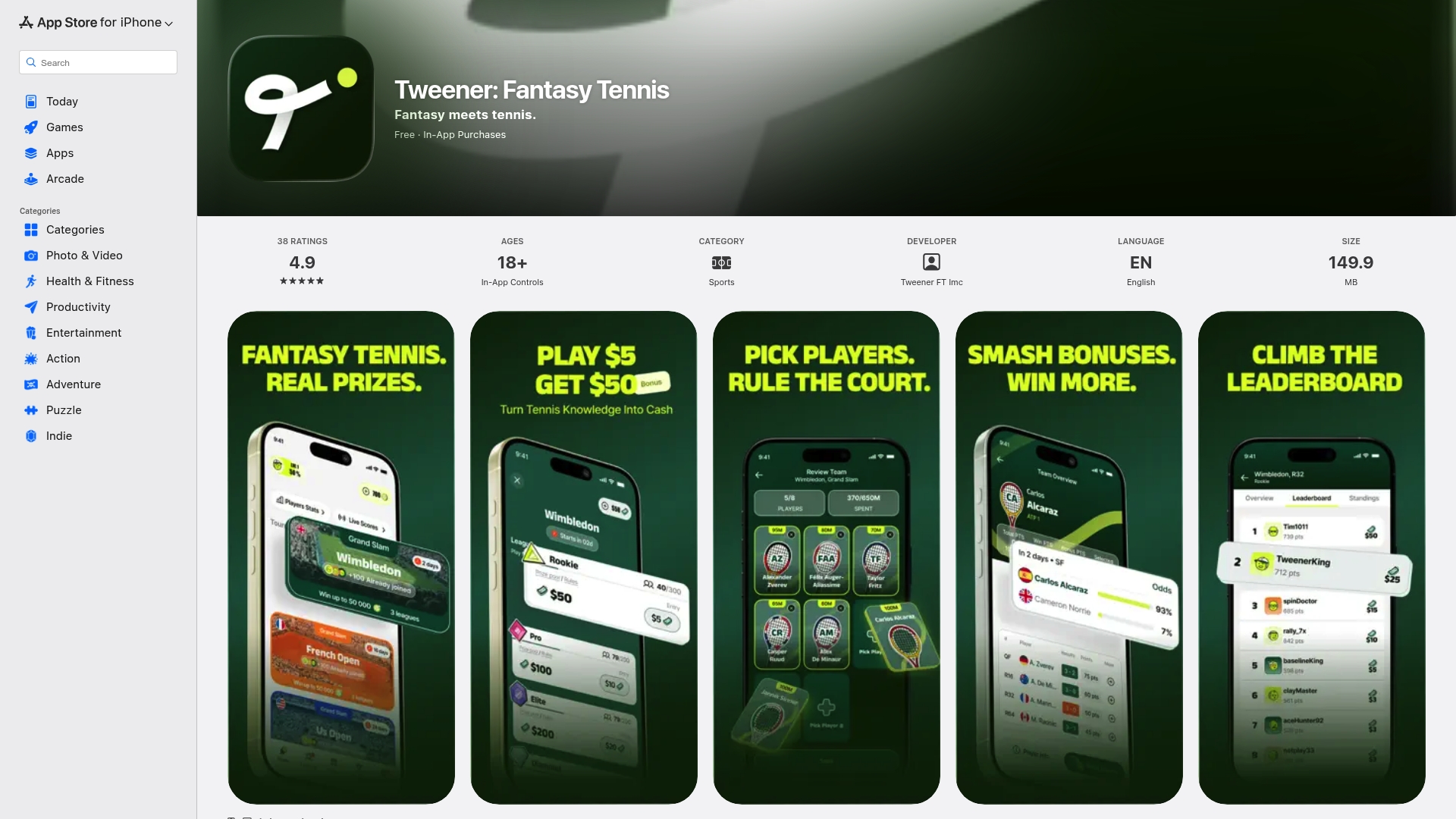
The features map directly to what this guide covers: salary-cap contests that force the anchor/attacker tradeoff, private Grand Slam leagues where you can compete with up to nine friends across an entire tournament, and real-time lineup locks tied to actual match schedules. Free mode lets you practice with virtual coins; cash mode lets you compete for real payouts where legally permitted.
Download Tweener, set your first 5-player WTA lineup using the cash roster above, and see how the framework performs in a live contest. The app is available now on iOS.
Sources
These resources go deeper on the tactics covered above: