
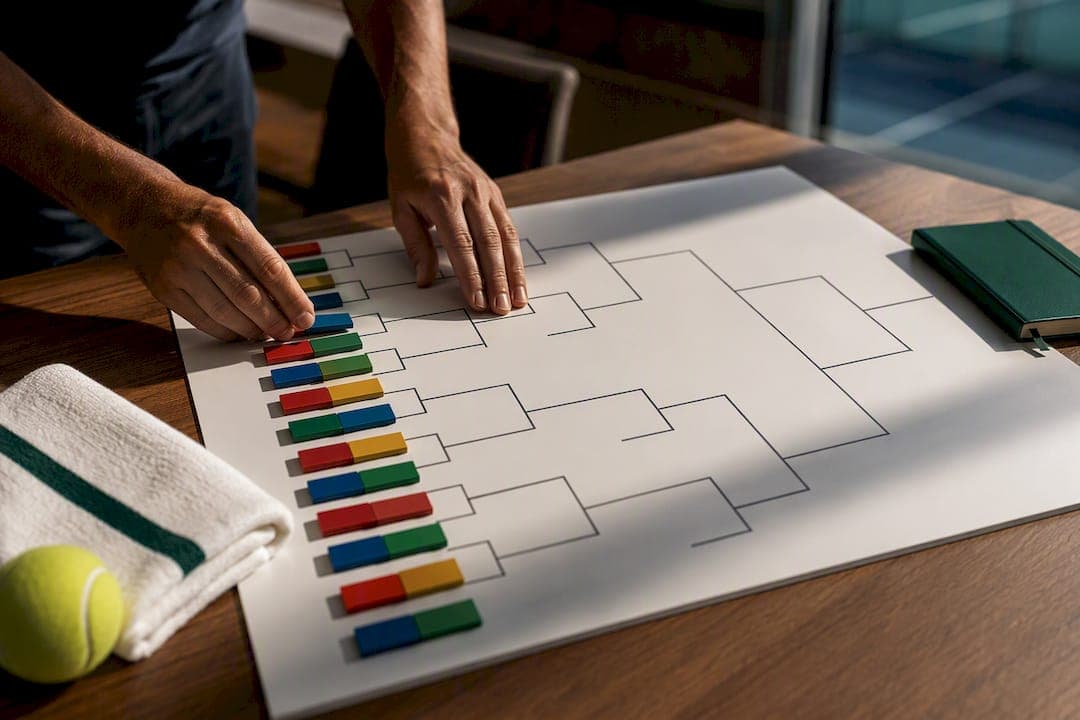
A tournament draw can decide half a player's fate before they hit a single ball. Seeding softens that luck by keeping top players apart early, but it never erases it. Simulation research shows draw structure alone can swing qualification odds by double digits, so smart fans check the bracket for clustered contenders and brutal travel stretches before trusting a name-brand favorite to cruise through.
TL;DR:
- A player's chance of qualifying can vary significantly depending on the luck of the draw, especially in formats like single-elimination tournaments.
- Seeding improves a player's odds by preventing the top players from meeting early, but it does not eliminate the randomness introduced by unseeded players' placement.
- Researchers measure draw luck by simulating thousands of tournament outcomes, calculating a luck index based on variations in qualification probabilities.
- Difficult draws often cluster top contenders together or place unseeded floaters early, increasing upset risks and fatigue for affected players.
- Understanding draw mechanics can inform better betting and fantasy strategies by emphasizing the importance of bracket placement, travel, scheduling, and format choices.
Table of Contents
- What a Tournament Draw Actually Is
- Seeding and Its Measurable Impact
- How Researchers Actually Measure Draw Luck
- What a Hard Draw Actually Costs a Player
- Using Draw Analysis in Fantasy and Prediction
- Learn the Mechanics Before You Bet on Them
- Analyzing Upset Odds Created by the Draw
- The Mental Side of Landing a Tough or Easy Draw
- Can Organizers Tilt the Draw for Drama or Fairness?
- Does Draw Size Change How Fair a Tournament Is
- Why Draw Literacy Changes How You Watch Tennis
- Put Draw Analysis to Work in Draft or Pick'em Mode
- Sources
- FAQ
What a Tournament Draw Actually Is
A draw is the bracket that determines who plays whom, and in what order, across a tournament. The format dictates how much luck the draw injects into the results.
- Single-elimination: one loss and you're out, the standard Grand Slam format and the most draw-sensitive structure in tennis.
- Double-elimination: a loss sends a player to a lower bracket instead of home, giving strong players a second life.
- Round-robin: every entrant in a group plays every other entrant, spreading risk across multiple matches instead of one.
- Incomplete round-robin: entrants play only some of the group, a format gaining traction in soccer competitions like the UEFA Champions League group phase.
Placement inside these formats is rarely a coin flip. Associations protect certain matchups (avoiding same-country pairings in early rounds, for example), and seeded players get locked into separate quarters of the bracket by rule, not chance. Unseeded players fill the remaining slots through a random draw, which is where variance creeps back in. A random draw among lower-ranked players can still produce a brutal opening match, while a rigged-by-design seeding structure guarantees the top two players can't meet until the final. That contrast, structured protection for some, randomness for others, is the entire engine behind draw luck in tennis.
Seeding and Its Measurable Impact
Seeding assigns preliminary rankings so the best players avoid each other until later rounds. Grand Slam draws use 32 seeds in a 128-player main draw), based on ATP and WTA rankings, with protected-ranking exceptions for players returning from injury.
The system works, statistically. A peer-reviewed study on elite tennis competition found that seeded players outperform non-seeded players across serve and return points won, ace percentage, net points won, and break-point conversion, differences significant at p < 0.01.
Statistic Callout: Seeded players in Grand Slam draws show measurably better serve/return efficiency and lower unforced-error rates than unseeded players, and separate research on the FIFA World Cup found seeded teams reach the quarterfinals at meaningfully higher rates than unseeded ones, evidence that seeding's effect isn't unique to tennis.
What seeding does not do is guarantee anything:
- It spreads the top 32 players across separate quarters, not individual matches.
- It relies on current rankings, which lag behind form, meaning a red-hot unseeded player can still land a landmine draw.
- It leaves the other 96+ slots in a 128-player field open to a random draw among comparably ranked competitors.
How Researchers Actually Measure Draw Luck
You can't eyeball how much a draw mattered. Researchers run thousands of simulated tournaments, holding player skill constant, and reshuffle the bracket each time.
The method looks like this: generate a large batch of random draws, simulate every possible match outcome using win-probability models, calculate each entrant's qualification probability under each draw, then measure how much those probabilities move across the whole batch. The standard deviation of that qualification probability is the "luck index." A low deviation means the draw barely matters. A high one means where you land changes your fate.
A study on the UEFA Champions League's incomplete round-robin reform used exactly this approach and found the new format cut the standard deviation of qualifying probabilities by about half on average, a large drop in draw-driven variance. The caveat matters: that benefit shrinks when seeding is already accurate, because the format mainly compensates for seeding errors rather than eliminating luck outright.
| Metric | What it measures |
|---|---|
| Qualification probability | Chance a given entrant advances under one specific draw |
| Standard deviation across draws | How much that chance swings when the draw is reshuffled |
| Luck index | Shorthand for draw-driven variance, derived from the standard deviation |
| Decomposition analysis | Splits variance into seeding effects vs. format effects |
What a Hard Draw Actually Costs a Player
A "nightmare" draw is what commentators call it when a player, seeded or not, lands three or four dangerous opponents stacked in their own quarter before the semifinals. Clustering matters more than most fans realize: facing one big name is manageable, but facing a gauntlet of in-form floaters back to back raises upset risk with every round, because fatigue and momentum compound.
Travel and scheduling add a second, quieter layer of difficulty. Two players can face opponents of similar ranking, yet one grinds through three-set matches on back-to-back days while the other gets extra rest, a factor route-difficulty analysis in continental competitions increasingly treats as its own variable alongside opponent quality.
Format choice amplifies all of this. Expanded tournaments using three-team groups have shown advancement-probability swings roughly 3.2 times more volatile than comparable four-team groups. This is because a single draw or upset in a three-team format carries outsized weight on tiebreakers.
Signs a draw is unusually tough:
- Two or more top-20 players sharing the same quarter.
- A floater (an unseeded player with recent big wins) in the first or second round.
- A grueling travel path between rounds compared to the rest of the field.
- A seed facing a surface specialist who thrives on that specific court.
Pro Tip: Before locking a fantasy roster, scan the bracket two rounds ahead, not just the next opponent. A favorable first match means little if round three is a minefield.
Using Draw Analysis in Fantasy and Prediction
Draw sensitivity isn't evenly distributed. Elite seeds absorb bad luck better than mid-tier players, who can flip from underdog to legitimate contender depending purely on who they're grouped with.
- Widen your uncertainty bands for players ranked roughly 15 to 50. Their outcomes swing hardest based on bracket placement.
- Favor entrants whose quarter is thin on dangerous floaters, even over a slightly higher-ranked player stuck in a stacked section.
- Weigh travel and schedule density, not just opponent ranking, when comparing two similarly seeded picks.
- In Draft Mode, spread your roster across different bracket halves instead of loading up on one favorable quarter.
- In Pick'em Mode, treat early-round seeded matchups as lower-variance picks and reserve your risk tolerance for the wide-open unseeded rounds.
Pro Tip: A mid-tier player with an easy path to the quarterfinals is often better fantasy value than a top seed with a landmine draw, even when their season stats look similar.
Learn the Mechanics Before You Bet on Them
Tweener's blog breaks down exactly how ranking bodies build these brackets, which is worth reading before you trust any prediction, including your own.
- How Tennis Seeds Are Determined: The Full Guide covers protected rankings and the judgment calls tournaments make.
- Tennis draw explained: A fan's guide to tournament brackets walks through bracket construction step by step.
Tweener's app offers game modes that let you test this knowledge against a live bracket instead of just reading about it. You can form private leagues with friends to compete in fantasy tennis tournaments.
Analyzing Upset Odds Created by the Draw
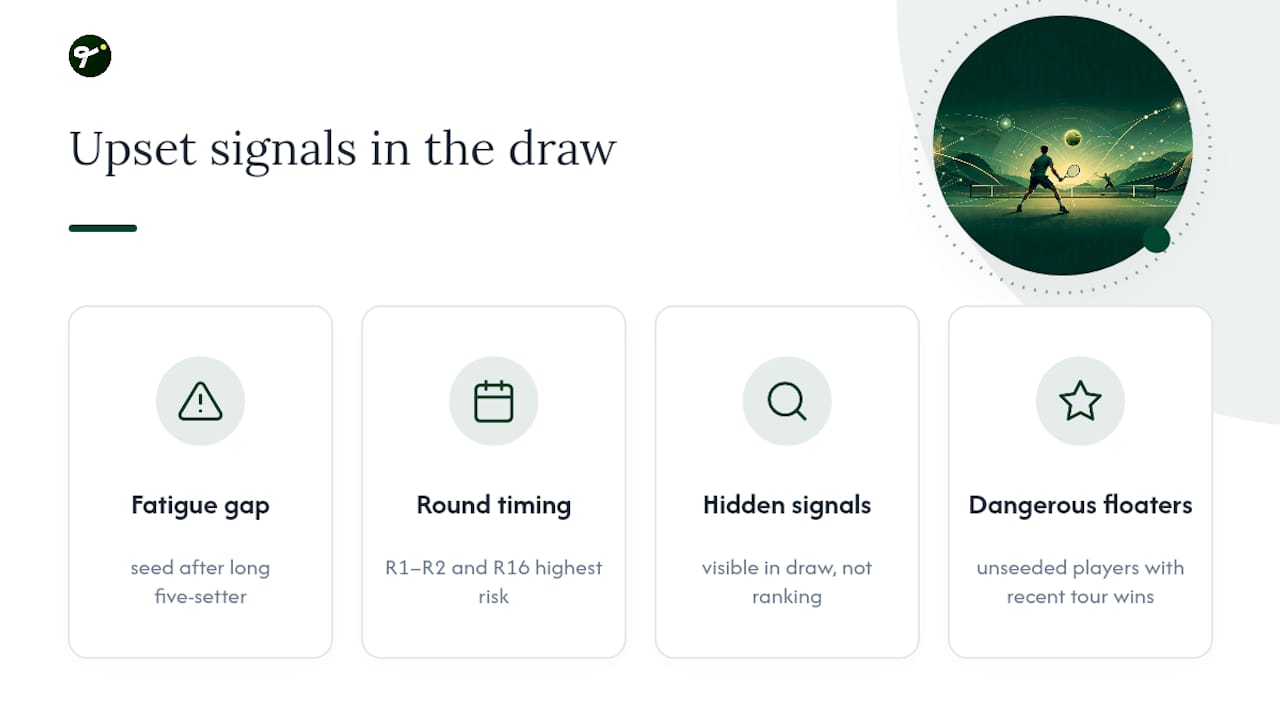
An upset isn't random noise. It's often the predictable result of a draw putting a player in a bad spot. When a lower-ranked but in-form player lands next to a seed coming off a long, physical five-setter, the "upset" is really just the draw exposing a fatigue gap that existed before the match started.
Analysts model this by comparing pre-tournament win probabilities against actual outcomes across many events, then checking which upsets cluster around specific draw conditions: a seed's first match after a bye, a surface-specialist opponent slipped into round two, or a floater with recent tour-level wins sitting in the unseeded bracket. None of these are visible in a player's ranking. They're only visible in the draw itself.
Round timing matters too. Upset risk is highest in rounds one and two, when unseeded players with nothing to lose face seeds who haven't found their rhythm yet, and again in the round of 16, where the bracket has funneled dangerous floaters into contact with top seeds for the first time. A seed who survives the first week often faces tougher opposition on paper but lower upset risk in practice, because by then the field has been filtered down to players who've proven form under pressure.
For fantasy purposes, this means upset probability isn't static. It's tied to a specific round, a specific opponent type, and a specific position in the bracket. Treating every unseeded opponent as equally dangerous ignores exactly the signal a good draw analysis is supposed to catch.
The Mental Side of Landing a Tough or Easy Draw
Players read the draw the moment it drops, and it visibly changes how they talk about a tournament. A favorable draw, one with no seeds until the fourth round, breeds a different kind of confidence than a bracket loaded with dangerous floaters in the opening rounds. Coaches openly discuss draw difficulty in pre-tournament interviews for a reason: it changes practice focus, scouting priorities, and even how conservatively a player approaches an early match they'd otherwise treat as a formality.
There's a flip side to an easy draw, too. Complacency creeps in when a player expects a routine win, and that mental letdown is exactly how floaters spring their upsets. A brutal draw can sharpen focus from round one, while a soft draw can lull a favorite into the kind of sluggish start that turns a routine match into a scare.
Strategically, draw position also shapes how players manage their bodies. A seed who knows their quarter is light on physical threats might push harder in practice or take more risks tactically in early rounds, banking energy reserves for a tougher stretch later. A player staring down three consecutive five-set threats plans differently, sometimes even adjusting their travel and rest schedule between rounds to protect against the cumulative toll. None of this shows up in a box score, but it shows up in results.
Can Organizers Tilt the Draw for Drama or Fairness?
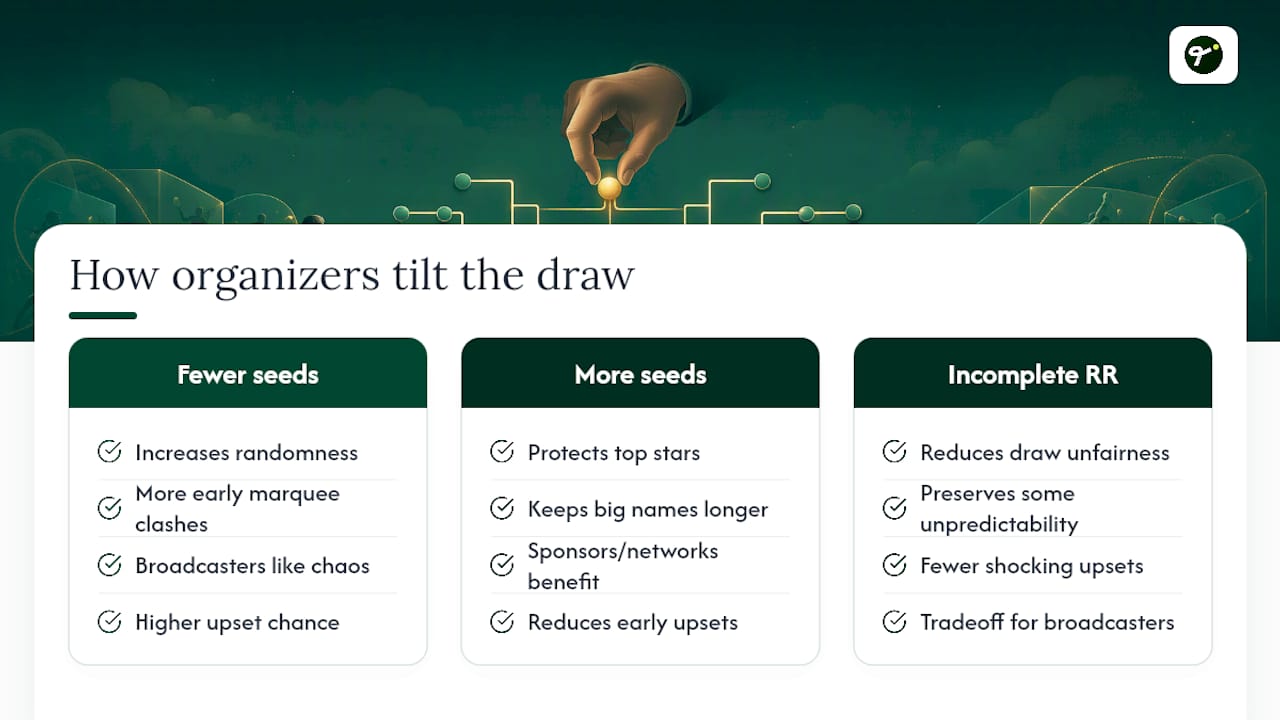
Tournament organizers can't literally rig who plays whom beyond the seeding rules, but format design gives them enormous influence over how much draw luck the event produces, and they use it. Seeding fewer players increases randomness and creates more marquee early-round clashes, which broadcasters love. Seeding more players, as Grand Slams did when they expanded from 16 to 32 seeds, protects stars from early exits and keeps the biggest names in the draw longer, which sponsors and networks also love, for different reasons.
Format choice is the bigger lever. Switching to an incomplete round-robin structure, as UEFA did with the Champions League, was explicitly about reducing draw-driven unfairness while still preserving enough unpredictability to keep matches meaningful. The tradeoff is real: less draw luck means fewer shocking group-stage upsets, which cuts both ways for a broadcaster who profits from chaos in the standings.
Wild cards and bracket seeding decisions can also nudge viewer interest without touching the "random" portion of the draw at all. Placing a popular local player's likely path away from an early seed collision, within the rules, keeps them alive longer for a home crowd. None of this requires cheating. It just requires understanding, as organizers clearly do, that the format itself is a competitive-balance lever long before a single ball is struck.
Does Draw Size Change How Fair a Tournament Is
Bigger draws don't automatically mean fairer draws. A 128-player Grand Slam field spreads variance across seven rounds, giving skill more room to assert itself over the long run than a smaller, single-weekend event where one bad match ends your tournament regardless of overall form.
Bracket balancing, ensuring each quarter carries a roughly even distribution of seeded strength, is the mechanism that keeps larger draws fair. When that balancing works as intended, the toughest possible semifinal matchups are also the most likely ones, top seed versus top seed, rather than two mid-tier seeds who got lucky avoiding each other's quarter. When it breaks down (which happens more in smaller ATP 250 and WTA 250 events with fewer seeds to distribute), one quarter can end up dramatically harder than the rest, and that imbalance shows up directly in who reaches the final.
Expanding a draw's format, not just its size, changes fairness in its own way. Fewer total matches, like a 32-draw ATP 250 event, leave far less room for a rough patch to even out, which is exactly why a lower seed occasionally runs the table at a smaller event in a way that almost never happens across a full Grand Slam fortnight.
Why Draw Literacy Changes How You Watch Tennis
Understanding draw mechanics doesn't just make you a better predictor. It makes tennis more interesting to watch, because you start seeing the tournament as two separate stories: who's good, and who got lucky or unlucky in the bracket. Those aren't the same question, and conflating them is the single biggest mistake casual fans make when picking winners.
The data backs this up more than most fans assume. I'd rather build a fantasy roster around that reality than pretend rankings tell the whole story. Pull up the bracket before your next Slam, trace two rounds ahead for your picks, and see how differently you read the tournament.
— Nathan
Put Draw Analysis to Work in Draft or Pick'em Mode
Reading a bracket is one thing. Betting your fantasy season on it is another, and that's exactly where Tweener's Draft Mode and Pick'em Mode come in.
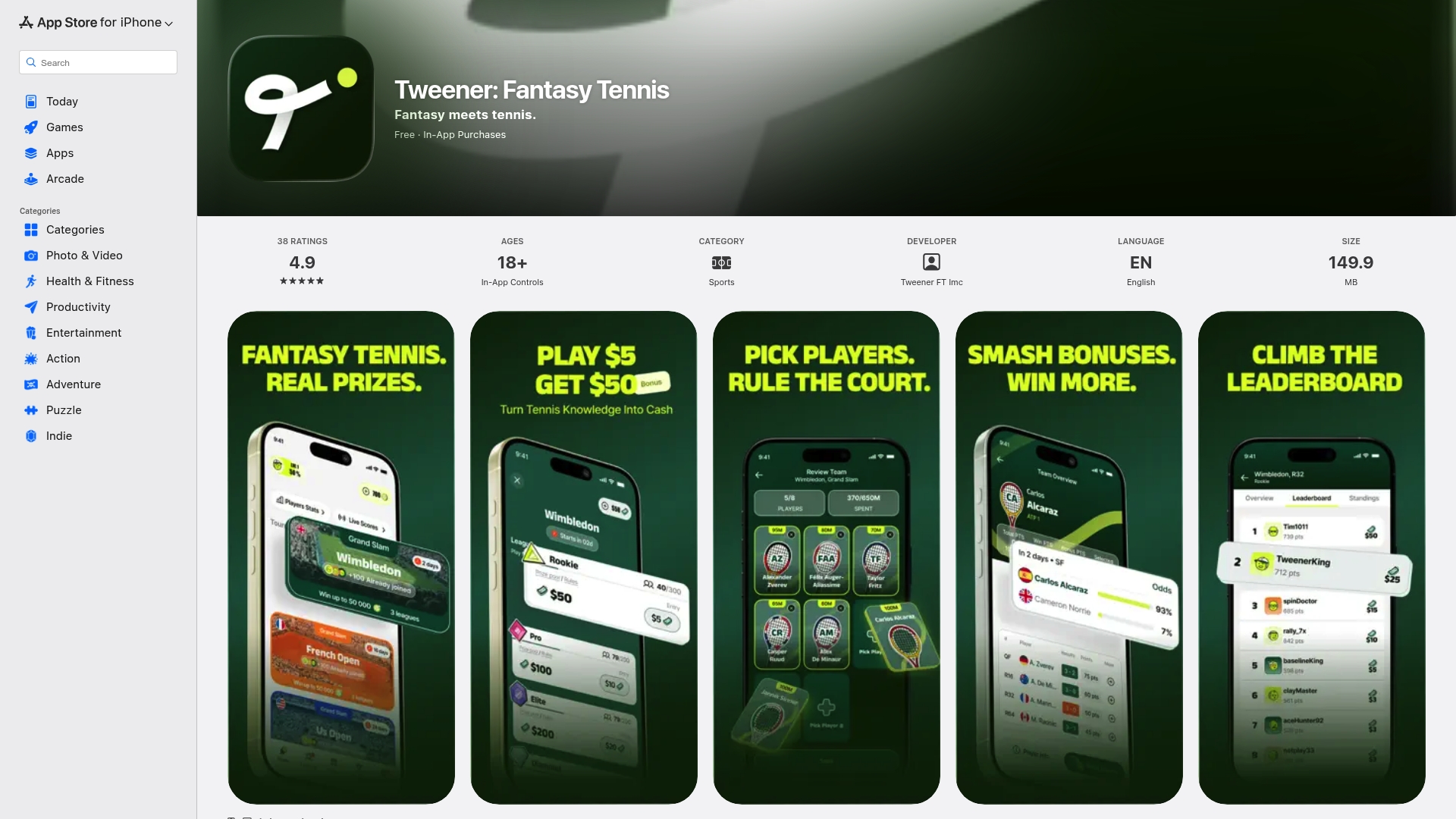
One fantasy mode allows building a full roster of ATP and WTA players before a tournament starts, making strategic insights about draws and volatility valuable for player selection and risk management. Another mode enables backing individual matchups round by round without committing to a full-tournament roster. These modes emphasize skill and strategic analysis over luck, offering an alternative to sports betting. Groups of friends can join private leagues to compete in fantasy tennis contests. Head to Tweener and set up your first league before the next draw drops.
Sources
- Effect of a seeding system on competitive performance of elite players during major tennis tournaments — PMC
- Does the draw matter in an incomplete round-robin tournament? The case of the UEFA Champions League — alphaXiv
FAQ
What Does Tournament Draw Mean?
A tournament draw is the process and resulting bracket that decides who plays whom, and in what order, across an event. It combines seeding rules that separate top players with a random draw for the remaining slots, which is why two players with similar rankings can face very different paths through the same tournament.
Has There Ever Been a 100% Correct Bracket?
No verified perfect bracket has ever been produced for a large single-elimination tournament, and the odds against it are astronomical given the number of possible outcomes across dozens of matches. Even seeding-informed models only shift probabilities, they don't eliminate the upsets that make a perfect prediction essentially impossible.
Can AI Predict a Perfect Bracket?
No current model, AI or otherwise, can reliably predict a perfect bracket, because tennis outcomes involve too many variables like form, injury, and draw luck that shift week to week. AI-driven models can improve probability estimates and are genuinely useful for setting fantasy lineups in tools like Tweener's Draft Mode, but they narrow uncertainty rather than remove it.
Can You Give Me an Example of a Round-Robin Tournament?
A round-robin group stage, like the pool play format used in the group stage of many international team events, has every entrant in a group play every other entrant before anyone advances. The UEFA Champions League's newer incomplete round-robin format is a modified version, where teams play only a subset of the full group rather than everyone, which research shows still meaningfully reduces draw-driven variance compared to a straight knockout bracket.