
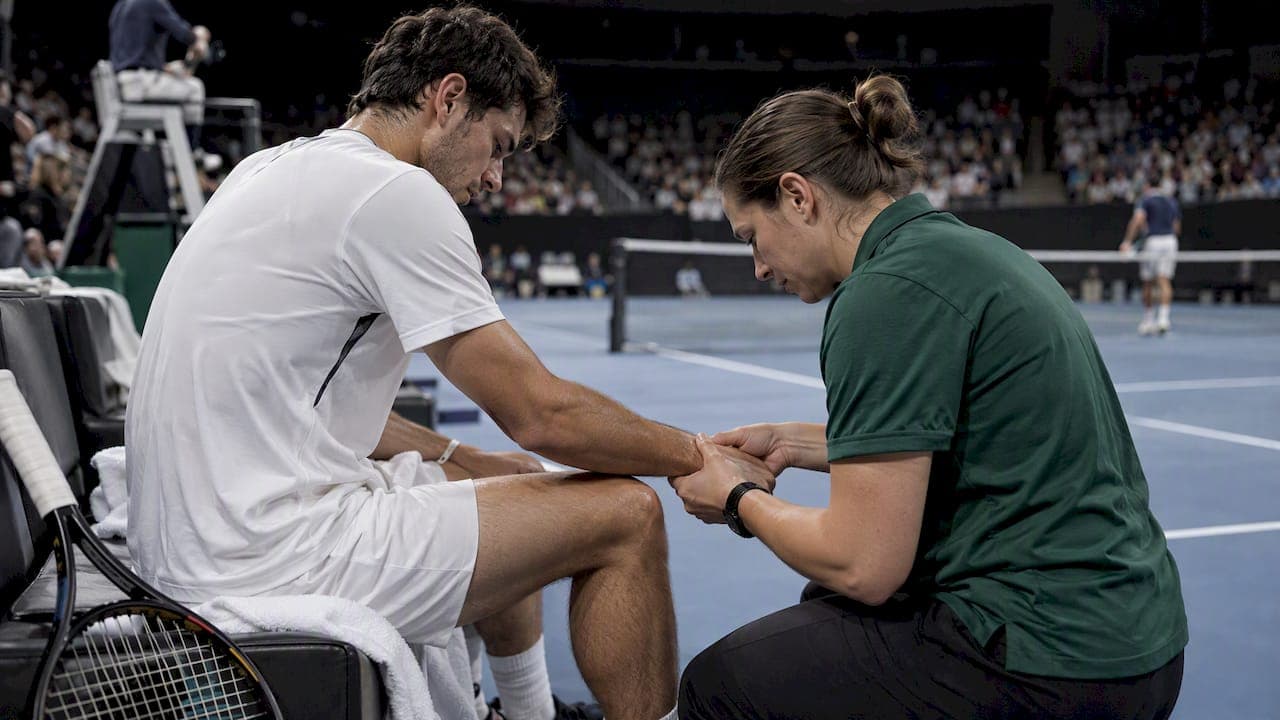
A medical timeout gives a player up to three minutes of treatment for each distinct, treatable condition, and only tournament medical staff decide whether it is granted. The Grand Slam rulebook sets that cap. Bleeding is the exception: officials stop play, and medical staff may get up to five minutes to control it and clean the court.
TL;DR:
- Tournament medical staff decide whether an acute, treatable match condition qualifies; fatigue, chronic problems, and conditions requiring injections do not.
- The treatment clock starts only after the physiotherapist finishes evaluating the player, so the full stoppage can exceed three minutes, excluding any scheduled rest.
- A player gets one timeout per distinct condition: heat symptoms and linked injuries count as one, while a new, unrelated injury may qualify separately.
- Bleeding or vomit triggers an emergency stoppage, with up to five minutes to treat the player and clean the court without using a medical timeout.
- Cramping receives treatment only during scheduled breaks, not through an extra pause, unless medical staff classify it as part of heat illness.
Table of Contents
- What counts as a treatable medical condition, and who decides?
- How does a medical timeout work during a match?
- How long can a medical timeout last, and how many can a player take?
- Why do bleeding and vomiting get special treatment?
- Why isn't cramping a medical timeout?
- What happens when players overrun the clock or abuse the rule?
- Which medical timeout myths do fans get wrong?
- Where do these rules come from?
- Why do the rules matter for fans and fantasy players?
- How can you use these rules in your fantasy tennis picks?
- FAQ
- Sources
What counts as a treatable medical condition, and who decides?
Rulebook language centers on conditions that are acute and treatable. Acute means something that happens during the match and can be addressed on court by a sports physiotherapist or tournament doctor. A player cannot declare a condition qualifying on their own. The player tells the chair umpire, the chair umpire calls the medical staff, and the medical staff classify the problem. Per the Grand Slam rulebook, the final decision on whether to administer a timeout, and for how long, rests with tournament medical staff based on their professional evaluation, not the player's request.
Conditions that typically qualify or fall outside the rule:
- Usually qualifies: a sudden injury such as a rolled ankle, a strained muscle, or a joint problem that appears mid-point.
- Usually qualifies: heat illness, which medical staff can treat as one condition even when it shows up as several symptoms.
- Usually does not qualify: general fatigue, which is a performance matter. Our breakdown of tennis fatigue causes and fixes covers why tired legs are never a medical reason.
- Usually does not qualify: degenerative or chronic conditions that were not acute during the match, and anything requiring an injection.
- Handled separately: muscle cramping, covered in its own section below.
This decision chain is why a player's body language on court tells you little. A grimace or a limp does not trigger a timeout. A medical classification does.
How does a medical timeout work during a match?
The process follows a predictable order, and the biggest surprise for fans is that the three minutes do not start when the player asks for help.
- The player signals the chair umpire. The request typically comes at the next changeover or set break, unless the condition is acute and needs attention right away.
- The chair umpire calls the sports physiotherapist or tournament doctor. Play is suspended while they walk on court.
- The medical evaluation happens. It can take place on court or off court, depending on the problem and the event's setup. Medical staff decide whether the condition is treatable and whether a timeout is warranted.
- The treatment clock starts. The rules summary at Sport Rules states that the three minutes of treatment begin only when the sports physiotherapist has completed the evaluation and is ready to start treatment.
- Treatment runs up to three minutes. It may be given with the tournament doctor involved. When the timeout is taken at a changeover or set break, it is additional to the normal rest time.
- Play resumes. The player returns and the match continues from where it stopped.
Pro Tip: When a stoppage looks long on TV, remember the evaluation walk-on and discussion are not part of the three-minute treatment window, so total time off the point can exceed three minutes.
This is also why fans sometimes accuse players of stalling. The visible pause includes evaluation, a stretch that the rulebook does not count against the treatment cap. The cap itself stays firm, and no coaching is allowed during the interruption, a point we cover in our guide to the role of coaching in tennis matches.
How long can a medical timeout last, and how many can a player take?
The firm numbers are short. Treatment is limited to three minutes per distinct treatable condition, and unused time cannot be banked or carried over to a later problem. The Grand Slam rulebook allows only one three-minute medical timeout for each distinct, treatable medical condition. The ATP's official rulebook likewise limits treatment to three minutes, and notes that at some lower-level events the Supervisor may extend treatment time if necessary.
The word that does the work is "distinct." Some guidelines on how it plays out:
- Heat illness counts as one condition, even if the player shows dizziness, nausea, and cramping together.
- Linked injuries count as one. If a hamstring problem and a hip problem belong to the same kinetic chain, medical staff treat them as one condition and one timeout.
- A new, unrelated injury later in the match can qualify for its own timeout, since it is a different condition.
- A recurrence of the same problem does not earn a second timeout. The condition has already been treated once.
There is also a narrow exception for back-to-back timeouts. A maximum of two consecutive medical timeouts may be granted only if the physiotherapist determines the player is suffering from at least two distinct, acute, and treatable conditions during a single evaluation. That is rare. Most matches with a medical stoppage see exactly one.
Toilet and change-of-attire breaks are separate from all this, and OpenSourceSports' rule summary notes that bleeding stoppages are not counted against a player's medical timeouts either.
Why do bleeding and vomiting get special treatment?
Blood and vomit are safety hazards for both players and the court surface, so they follow an emergency protocol rather than the ordinary medical timeout process. If a player is bleeding or has vomited, the chair umpire must stop play and call medical staff right away, without waiting for a changeover.
The ITF Masters World Tennis Tour regulations state that the tournament physician or physiotherapist may be granted up to five minutes to control the bleeding and ensure the court is cleaned before play resumes. That is two minutes more than the standard cap, because the job includes more than treating the player: staff must also make the playing area safe.
Play cannot restart until two things are true. The bleeding has been controlled, and any blood or vomit on the court has been cleaned so no one slips or comes into contact with it. If the spill is not resolved, the match stays paused. Because this stoppage is classified as an emergency rather than an injury timeout, it does not eat into a player's allowance for a separate treatable condition.
Why isn't cramping a medical timeout?
Muscle cramping is the most misunderstood case. It is generally not eligible for a medical timeout. According to Sport Rules, cramp can be treated only during changeovers or set breaks, not by pausing play mid-game.
What the rules allow:
- Treatment only at scheduled breaks. The physiotherapist can work on the player during a change of ends or a set break, using only the time those breaks already provide.
- Treatment for cramp may be available during scheduled breaks.
- No timeout if a player cannot reach a changeover. A player who cannot continue between breaks does not get an extra pause for cramp. They may have to play on or retire.
- Heat illness is the exception. If cramp is part of heat illness, medical staff may treat it under the heat-illness rules instead.
That last point explains several controversial matches. Reporting on Carlos Alcaraz's medical timeout against Zverev shows how a player can receive a stoppage when medical staff judge cramping to be part of a treatable condition like heat illness. Fans and opponents may disagree, but the officials' medical assessment is authoritative.
What happens when players overrun the clock or abuse the rule?
When a player takes too long to return, the time-violation system applies. It escalates through the Delay of Game schedule: a warning first, then a point penalty, then a game penalty if the delay continues. The USTA's Friend at Court covers medical timeouts, bleeding timeouts, breaks, and the point-penalty system for time violations in detail.

Separately, an Unsportsmanlike Conduct code violation can be assessed when officials conclude a player is gaming the rule, for example faking an injury to disrupt an opponent's rhythm. Because that is a judgment call, the referee or supervisor is brought in to review and escalate where warranted.
Two points keep this fair. First, the medical staff's ruling on whether a condition is treatable is authoritative, so a player or opponent cannot overturn it by arguing with the chair umpire. Second, a dispute about how the rule was applied moves through officiating channels, from the chair to the referee or supervisor, rather than being settled mid-point. What you see on court, a visible warning or a lost point, is the end of that chain.
Which medical timeout myths do fans get wrong?
Myth one: a medical timeout is a free rest. The rules cut against this. Treatment is capped at three minutes, requires a medical evaluation, and is decided by medical staff. A player cannot demand it, and tiredness does not qualify. The strict caps and staff authority exist precisely to counter the stalling perception.
Myth two: the clock starts the moment the player asks. It starts when the physiotherapist has finished the evaluation and is ready to treat. Picture a player who signals during a set. The chair umpire calls the physio, the physio walks out, assesses the problem, and only then begins treatment. The time between the request and the player's return can exceed the treatment window, even though only three minutes count as treatment time.
Myth three: a dramatic stoppage proves gamesmanship. High-profile controversies have drawn heated reactions, yet they tend to hinge on how medical staff classified the condition, not on anyone breaking the rulebook. When you watch one, ask whether the stoppage was an evaluation, treatment, a changeover cramp treatment, or a bleeding protocol. Each runs on different rules, which makes the rule application, rather than the personalities, the thing worth watching.
Where do these rules come from?
The core confirmation sits in the Grand Slam rulebook: three minutes of treatment, one timeout per distinct treatable condition, and a maximum of two consecutive timeouts only for two distinct acute conditions. Practitioner-level insight adds the detail that matters most in practice: the timeout begins when the physio is ready to treat, not when the player asks. For event-specific variations, check the individual tournament's regulations and the USTA scenario guides, since organizers can announce additional rules in advance, and the ITF Rules of Tennis note that no extra recovery time is allowed except for treatable medical conditions.
Why do the rules matter for fans and fantasy players?
I think the fixed limits and medical authority are what keep this rule honest. When a stoppage looks suspicious, the three-minute cap and staff decision are the protections. Knowing them also makes you a sharper viewer: you can read whether a player is likely to continue, play limited, or retire, which matters when you set a fantasy lineup or adjust picks mid-tournament. When in doubt, check that event's own regulations.
— Nathan
How can you use these rules in your fantasy tennis picks?
Reading a stoppage correctly is a real edge in live tennis, because an injury or heat problem changes how a player moves and whether they finish a match. We built Tweener around that kind of analytical edge: our app lets you draft real ATP and WTA players in Draft Mode and Pick'em Mode, compete in public or private leagues with friends, and earn points from actual match results. We offer a free mode with virtual coins and a cash mode where legally permitted. If you want to put your match-reading skills to work, you can download the Tweener app and build your next team. For rule changes that can move your picks, see our look at the new tennis rules for 2026.
FAQ
How many medical timeouts are you allowed in tennis?
A player gets one three-minute medical timeout for each distinct, treatable condition. Two consecutive timeouts are allowed only when the physiotherapist identifies at least two distinct, acute, and treatable conditions in one evaluation, per the Grand Slam rulebook.
Why was Alcaraz allowed a medical timeout?
Tournament medical staff decide, not the player. In reporting on his match against Zverev, the stoppage was tied to cramping that medical staff judged part of a treatable condition like heat illness.
What are the USTA rules for medical timeouts?
The USTA's Friend at Court covers medical timeouts, bleeding timeouts, toilet and change-of-attire breaks, and the point-penalty system for time violations. Check the specific event's regulations for local variations.
When does the three-minute medical timeout clock start?
The clock starts when the sports physiotherapist has finished the evaluation and is ready to begin treatment, not when the player requests help. The Sport Rules summary confirms this.