
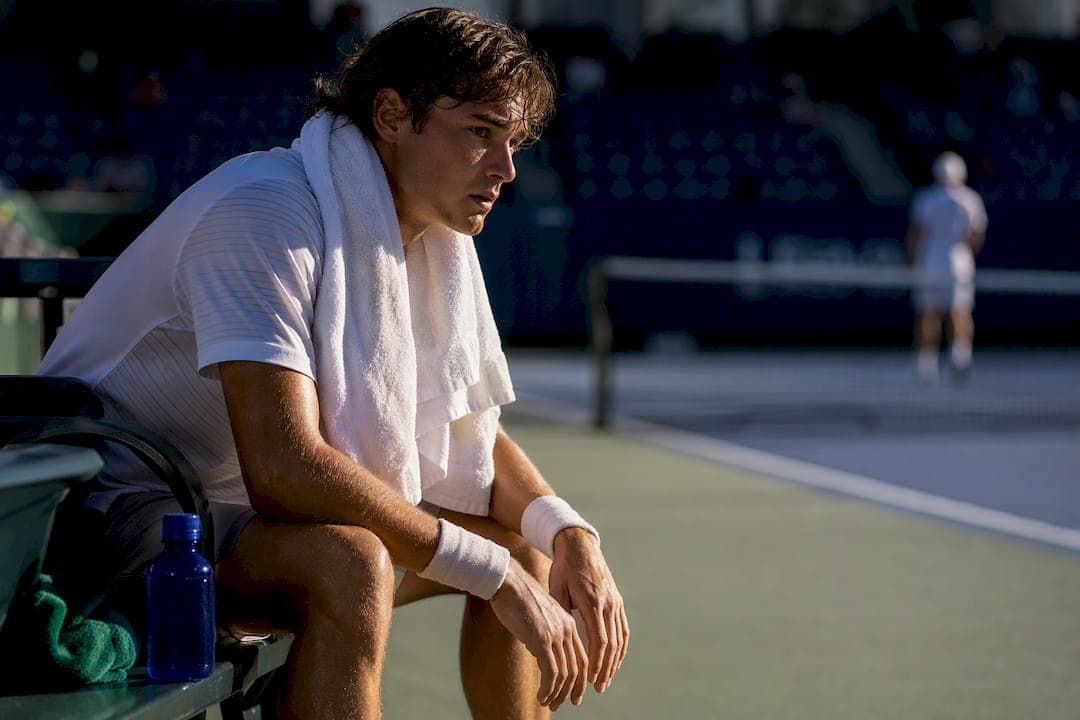
Player fatigue in tennis comes from four sources stacking on top of each other: central nervous system depletion, peripheral muscle breakdown, cognitive load, and travel-driven circadian disruption. A 2025 systematic review found the physiological hit is severe, while stroke performance holds up better because players adapt tactically. The fastest wins come from sleep discipline, smart travel timing, in-match pacing, and simple daily monitoring like RPE scores and sleep logs.
TL;DR:
- Fatigue in tennis involves central nervous system, muscle, and mental components, which interact to worsen performance in complex ways.
- Physical markers like reduced jump height and slower sprints usually appear after two hours of play, with declines in speed and power often preceding technical errors.
- Mental fatigue significantly impairs shot targeting and decision-making, even when physical fitness and body feel alert, due to attentional depletion.
- Travel across multiple time zones, especially eastward, causes sleep debt and circadian disruption, significantly impacting match readiness from the first round.
- Prioritizing sleep, strategic travel planning, and hydration are the most effective measures to reduce fatigue and injury risk during tournaments.
Table of Contents
- What Fatigue Actually Means in Tennis
- The Physiological Engine Behind Tennis Fatigue
- How Fatigue Breaks Down Speed, Power, and Stroke Mechanics
- Why Mental Fatigue Wrecks Shot Targeting
- Beating Jet Lag: Travel and Circadian Strategy for Tennis
- How to Actually Measure Fatigue Day to Day
- Fueling and Pacing Through a Long Match
- Recovery Between Matches: What Actually Moves the Needle
- Turning the Science Into a Match-Day Checklist
- Why Fatigue Raises Injury Risk on Court
- Fatigue Looks Different on Clay, Grass, and Hard Courts
- Staying Sharp Mentally When the Legs Start to Go
- The Editorial Take: Fatigue Science Beats Fatigue Folklore
- Sources
- FAQ
What Fatigue Actually Means in Tennis
Coaches throw the word "fatigue" around like it's one thing. It isn't. Tennis fatigue splits into at least two physical categories and one mental category, and each shows up differently on court.
Peripheral fatigue happens in the muscle itself. Think reduced leg drive on a split step, a serve that loses pace late in the third set, or calves that just won't fire on the tenth deuce point of a game. It's local, mechanical, and tied directly to how many meters a player has covered and how many explosive movements they've fired off.
Central fatigue originates in the brain and nervous system, not the muscle fibers. It shows up as decision slowness, hesitation before committing to a shot, or a player who physically still has legs but keeps picking the wrong ball to attack. A comprehensive review of match-play fatigue describes this as a drop in the drive signal from brain to muscle, separate from whether the muscle itself is tired.
Then there's mental or cognitive fatigue, which is a different animal entirely. It's not about tired legs or a sluggish nervous system. It's about a depleted capacity to sustain attention, and it can hit a player who is physically fresh but mentally fried from a long, tactically demanding rally exchange or a stressful few days off court.
These three interact in ways that make fatigue worse than the sum of its parts:
- Cognitive load makes physical effort feel harder even when the actual physiological cost hasn't changed.
- Central fatigue slows shot selection, which forces more unforced errors even with normal footspeed.
- Peripheral fatigue in the legs reduces court coverage, which increases the number of low-quality shots a player has to hit, which then increases cognitive load trying to problem-solve out of bad positions.
That loop is why a player can look "gassed" in set three despite the same aerobic fitness score they had in the first game.
The Physiological Engine Behind Tennis Fatigue
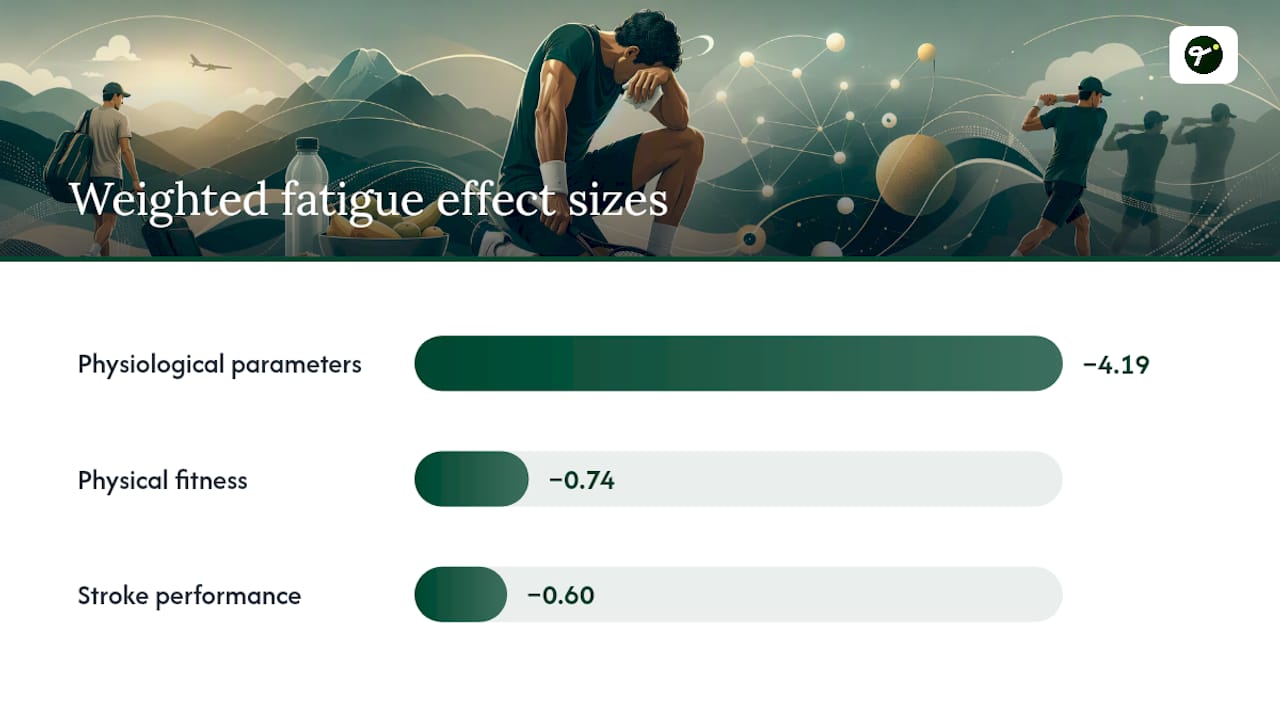
The physical toll of a long match is not subtle. The 2025 systematic review and meta-analysis, pooling 18 trials and 318 players, found fatigue produces a large negative effect on physiological parameters, a moderate hit to physical fitness markers, and a smaller but still real dent in stroke performance.
The statistic that matters most here: the weighted effect size for physiological parameters came in at −4.19, compared to −0.74 for physical fitness and −0.60 for stroke performance. That gap tells you something coaches often miss. The internal physiological cost of a long match (heart rate drift, lactate accumulation, core temperature climb) is far larger than what shows up on the scoreboard. Elite players are good at masking the internal damage with technique and tactics.
Three markers drive that physiological collapse:
Cardiovascular strain. Heart rate climbs and stays elevated through long rallies, especially on slower surfaces like clay where points run longer. Recovery between points becomes incomplete, so a player enters point 40 of a game already running a partial deficit from point 30.
Metabolic byproduct accumulation. Blood lactate rises during high-intensity rally exchanges and repeated sprint efforts. It's not the sole villain in fatigue science anymore, but sustained elevation correlates with the drop in explosive output you see in a fifth set.
Thermoregulatory load. Core temperature rises during long matches, and heat exacerbates both central and peripheral fatigue simultaneously. Dehydration compounds this by reducing blood plasma volume, which forces the heart to work harder to maintain cardiac output while also impairing the body's ability to shed heat through sweat. Hot, humid conditions during outdoor tournaments turn a normally manageable three setters into a survival exercise, and weather conditions on court can shift a match's physical demands more than most fans realize.
For on-court coaching teams without lab equipment, the practical monitoring priority list is short: track session heart rate trends over a tournament week, watch for subjective heat complaints as an early warning sign, and treat unusual thirst or dark urine as a hydration red flag worth acting on immediately rather than at the next changeover.
How Fatigue Breaks Down Speed, Power, and Stroke Mechanics
The body doesn't fail all at once. It degrades in a specific order, and knowing that order lets a coach predict what's about to go wrong before it costs a set.
Sprint speed and jump power go first. Research on prolonged match-play consistently shows reduced countermovement jump height and slower first-step sprint times after roughly two hours of continuous play, according to the match-play fatigue review. Leg stiffness, the spring-like quality that lets a player change direction efficiently, softens too, which is why footwork looks "heavy" late in a match even when a player insists they still feel fine.
Technical breakdowns follow close behind:
- The serve toss drifts, usually lower and less consistent, because shoulder stabilizer muscles fatigue before the bigger prime movers do.
- Contact point drops on groundstrokes, turning what should be a clean strike into a rushed, defensive shot.
- Recovery steps after each shot slow down, leaving players a half step later to the next ball and forcing more stretch volleys and lunges.
- Second-serve percentage often climbs because players protect their toss consistency by taking pace off, a tactical concession to physical decline.
What separates a top-20 player from a journeyman under fatigue isn't that the top player doesn't get tired. It's that they compensate tactically before the physical decline turns into unforced errors. That's the tactical adjustment layer the PMC review highlights: players shorten points deliberately, take more first-strike risks early in the rally, and target the body or the weaker wing instead of grinding out 12-shot exchanges they no longer have the legs to win.
Pro Tip: Watch a player's second serve percentage climb through a match, not just their unforced error count. A rising second-serve rate late in set three is often the first visible signal of peripheral fatigue in the shoulder, showing up well before footwork or error rate does.
Why Mental Fatigue Wrecks Shot Targeting
This is where the science gets genuinely surprising, and it's why you see elite players like Carlos Alcaraz blowing on his fingers between points or Jelena Ostapenko visibly frustrated over routine misses that look nothing like her usual ball-striking.
A randomized, placebo-controlled crossover trial published in 2025 induced mental fatigue in tennis players using a 30-minute Stroop task, a classic cognitive test that forces the brain to override an automatic response. The result: Stroop Attention Test completion times and error rates rose significantly (p < 0.001) compared to placebo and control conditions. Groundstroke targeting performance dropped by a comparable margin.
That p-value matters because it rules out chance. This wasn't a subtle trend buried in noise. Mentally fatigued players hit worse targets on shots that require zero additional physical effort to execute correctly. The mechanism runs through attention, not muscle: a depleted brain struggles to filter distraction and sustain focus on a target zone, so shots drift toward the center of the court, the safest and least demanding aim point, rather than the corners a player intended to hit.
That single finding explains a lot of what commentators call "mental fatigue" without ever defining it. It's not sadness or frustration alone. It's a measurable decline in targeting precision driven by depleted attentional control.
Practical takeaways for players and coaches:
- Avoid intensive cognitive tasks in the hours before a match: heavy strategy sessions, screen-heavy scouting reviews, or long tactical debriefs the morning of a match all draw down the same attentional reserve.
- Structure warm-ups around focus drills rather than pure repetition. Targeted-zone hitting during warm-up primes the same attention system the match will demand.
- Build in simple mental reset cues between points, like a fixed routine at the back fence, to prevent cognitive fatigue from compounding across a long match.
Beating Jet Lag: Travel and Circadian Strategy for Tennis
Travel fatigue in tennis is not a vague complaint. It has a measurable number attached to it, and that number should change how tournament calendars get planned.
Research on travel-related circadian desynchronization found elite athletes normally sleep close to 437 minutes per night. Each time zone crossed reduces first-night sleep by roughly 11 minutes on average, but the direction of travel matters enormously. Eastward travel costs athletes about 24.5 minutes of sleep per time zone crossed, while westward travel actually added around 30 minutes in the same data. That asymmetry exists because eastward travel forces the body to shorten its day, which fights against the natural human circadian rhythm far more than lengthening it does.
A player flying from the US to Melbourne for the Australian Open is crossing somewhere around 15 to 19 time zones depending on the route and layover, almost entirely eastward. Do the math on that sleep debt and it's easy to see why first-round upsets cluster early in Grand Slam events held far from a player's home time zone.
Here's the practical arrival sequence coaching teams increasingly use:
- Arrive several days early when the schedule allows it. Three to five days is the rough window cited in applied coaching protocols for adapting to a multi-zone shift before a first-round match.
- Control light exposure deliberately. Morning light exposure at the destination helps shift the body clock forward for eastward travel; evening light delays it for westward trips.
- Time meals to the destination schedule immediately upon arrival, not the departure city's clock. Meal timing is one of the strongest circadian cues available outside of light.
- Take a short pre-departure nap rather than a long one, to avoid disrupting the sleep pressure needed for that first night in the new time zone.
- Cut screen exposure in the hour before attempting sleep at the destination, since blue light delays melatonin release exactly when a traveling player needs it most.
Coaching teams are also mapping player chronotype (natural morning-person versus night-person tendencies) against scheduled match times, using applied coaching protocols that pair timed light exposure with post-travel serve-percentage tracking to catch circadian disruption before it costs a match. Understanding how tournament schedules and time zones interact helps explain why certain early-round matches at global events are more volatile than the rankings suggest.
Pro Tip: If you're tracking a player for fantasy purposes right after a long-haul eastward flight, treat their first tournament match with real skepticism. The sleep-debt math says they're playing at a physiological disadvantage regardless of ranking.
How to Actually Measure Fatigue Day to Day
Most fatigue monitoring advice for club and college players is either too vague ("listen to your body") or too complicated (lab-grade lactate testing nobody has access to). The useful middle ground combines cheap subjective tools with a couple of quick physical tests.
Subjective daily measures cost nothing and take thirty seconds. Session RPE (rating of perceived exertion on a 1 to 10 scale) logged after every practice builds a trend line over weeks. Sleep duration logged each morning does the same. A simple readiness question, something like "how ready do you feel to compete today, 1 to 10," turns out to be a surprisingly reliable early warning system when tracked consistently.
Field tests give objective backup. A countermovement jump, measured with something as simple as a jump mat or even a phone app, drops noticeably when neuromuscular fatigue sets in. A 10 to 20 meter sprint time is another quick check; a slowdown of even a few tenths of a second across a tournament week is a real signal, not noise. Short serve-sampling, hitting a handful of serves and tracking toss consistency and speed, catches shoulder and technical fatigue before it shows up in a match.
Wearables add a longer view. HRV (heart rate variability) trackers and sleep monitors are useful for spotting week-over-week trends, but a single bad night's HRV reading means very little on its own. The mistake most players make is overreacting to one data point instead of watching the rolling average.
| Measurement type | Tool | What a fatigue signal looks like |
|---|---|---|
| Subjective load | Session RPE (1 to 10) | Rising trend across a training week |
| Subjective readiness | Morning readiness rating | Drop of 2+ points from personal baseline |
| Sleep | Sleep diary or wearable tracker | Consistent nights under personal average |
| Explosive power | Countermovement jump | Reduced jump height versus baseline |
| Speed | 10 to 20 meter sprint | Slower times across consecutive days |
| Technical consistency | Serve sampling (5 to 10 serves) | Toss height variability, reduced first-serve percentage |
| Autonomic recovery | HRV wearable | Downward trend over 5+ days, not a single reading |
Fueling and Pacing Through a Long Match
Nutrition, hydration, and pacing decisions made hours before a match, and minutes into one, are the highest-leverage tools available for delaying fatigue.
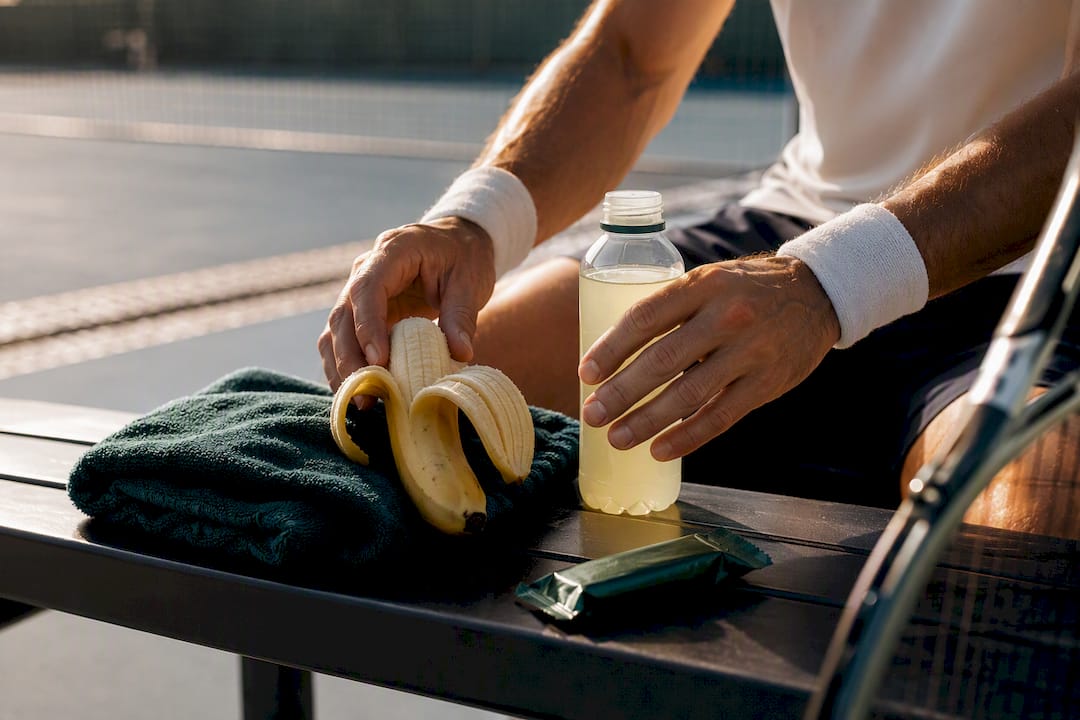
Carbohydrate timing matters more in tennis than casual fans assume, given matches can run three to five hours. Consuming carbohydrates in the 24 hours before a match to fill glycogen stores, then topping up during changeovers with easily digestible sources, helps delay the metabolic component of fatigue discussed earlier. Electrolyte strategy matters just as much as pure water intake, since sweat losses in hot conditions drain sodium and potassium alongside fluid. Overhydrating with plain water without electrolyte replacement (a real risk some amateur players create for themselves) can actually worsen performance through diluted blood sodium levels, so balance matters more than volume alone.
Caffeine is one of the more reliably effective tools in sports science generally, with typical effective doses in most sports performance research landing in a moderate range taken roughly 30 to 60 minutes before competition. Regular heavy caffeine users tend to see a smaller performance boost than occasional users, since tolerance blunts the effect. Timing it for the start of a match rather than mid-match tends to work better than trying to chase a fade with a mid-match dose, since absorption takes time a changeover doesn't always allow.
Tactical pacing is the in-match lever players control directly. The PMC review on match-play fatigue documents how experienced players shorten points deliberately as fatigue accumulates, taking more first-strike risks early in a rally instead of grinding out long exchanges they no longer have the legs to sustain.
For training under fatigue, the guidance splits cleanly by goal:
- Learn new technical skills when fresh, never late in an exhausting session, since fatigued reps risk grooving compensations rather than correct mechanics.
- Practice existing skills under fatigue occasionally, to build the biomechanical resilience needed to hold form deep into a third set.
- Avoid heavy skill-acquisition work in the 48 hours before a match, reserving that window for pacing and tactical rehearsal instead.
Pro Tip: Practice serving after a hard fitness set at least once a week during preseason. Grooving your toss and rhythm while tired is what keeps your first-serve percentage from collapsing in a real third-set dogfight.
Recovery Between Matches: What Actually Moves the Needle
Recovery time between tournament rounds is scarce, so spending it on the highest-yield actions first matters more than chasing every recovery gadget available.
- Sleep opportunity comes first, before anything else. No recovery tool compensates for a shortened sleep window, and the circadian research above shows how quickly lost sleep compounds after travel.
- Nutrition and rehydration come second. Replacing glycogen and fluid losses within the first couple of hours after a match sets up the next day's training or match far better than doing it hours later.
- Low-cost active recovery comes third. Light aerobic work, easy mobility sessions, and basic stretching support blood flow without adding real fatigue load.
- Cold water immersion and compression are situational tools, not daily habits. They have a place after unusually demanding matches or in back-to-back match scheduling, but the evidence for daily use is thinner than the marketing around them suggests.
- Guard against late-night obligations aggressively. Media commitments and physio sessions that push bedtime late are a real, documented contributor to cumulative fatigue at Grand Slam events, according to reporting on player routines at recent majors, and cutting them short protects the next day's performance more than most training adjustments do.
Tournament-level scheduling should build in arrival buffers before the draw begins, protect practice-court time in the early morning when possible to align with match-time energy peaks, and treat the day immediately after a five-set match as a recovery day, not a normal training day. Fans tracking tournament schedules for fantasy strategy will notice these cumulative fatigue patterns show up as form dips in the back half of two-week events almost every year.
Turning the Science Into a Match-Day Checklist
All the research above collapses into a workable checklist, and this is where the science actually earns its keep for players and coaches on a tight schedule.
Pre-match: hit a personal sleep target the night before (aim for consistency more than a magic number), confirm travel arrival windows leave at least a few days for circadian adjustment on big trips, and lock in carbohydrate and electrolyte intake the day before rather than scrambling the morning of.
In-match: track pacing cues like second-serve percentage and point length as early fatigue signals, use changeover fuel and fluid strategically rather than only when thirsty, and lean on a fixed mental reset routine between points to protect attentional focus.
Post-match: prioritize sleep opportunity over every other recovery tool, get fluids and carbohydrates in early, and guard the schedule against late-night obligations that eat into recovery time.
This kind of pattern appears across tournament draws. Fatigue risk from tight scheduling, surface transitions, and travel shows up in form well before a scoreline reflects it, and tracking that form data is a real analytical edge in Draft Mode and Pick'em Mode contests. Fantasy tennis rewards exactly this kind of pattern recognition: who's fresh, who's grinding through their fourth match in six days, and who just flew fifteen time zones east for a first-round match.
- Log sleep and RPE trends, not single data points.
- Weight recent travel and match load into player selections, not just ranking or surface fit.
- Treat back-to-back tournament weeks as a fatigue risk flag for any player without a bye.
- Watch second-serve percentage drift as an in-tournament fatigue tell.
Why Fatigue Raises Injury Risk on Court
Fatigue and injury risk are directly linked, and the mechanism is straightforward once you understand the neuromuscular decline covered earlier. Tired muscles absorb shock less efficiently, tired stabilizer muscles around joints fire later and weaker, and tired players make compensatory movements their body isn't conditioned to handle. The result is a well-documented spike in soft-tissue injuries during the third set and beyond, particularly ankle, knee, and shoulder strain.
Reduced leg stiffness, one of the neuromuscular markers discussed in the match-play fatigue review, means joints absorb more force directly instead of the muscle system cushioning that load. That's a direct pathway from fatigue to acute injury, not just a performance decline.
Prevention strategies follow logically from the mechanism:
- Strength and conditioning work targeting late-match resilience, not just peak power, matters more than most amateur training plans account for.
- Proper warm-up protocols before every match matter more, not less, as a tournament progresses and cumulative fatigue builds across rounds.
- Recognizing early technical breakdown (the lower contact point, the softer toss discussed earlier) as an injury warning sign, not just a performance issue, gives coaches a chance to intervene with a tactical timeout or a change in strategy before a joint gives out.
- Building in genuine rest days between demanding matches rather than always scheduling full-intensity practice, especially for players managing a heavy tournament calendar.
Shoulder injuries cluster particularly heavily around fatigued serving mechanics, since the toss and contact point are among the first things to degrade under both peripheral and central fatigue.
Fatigue Looks Different on Clay, Grass, and Hard Courts
Surface and match duration change the fatigue equation substantially, and treating every match the same way is a mistake both coaches and fantasy players make constantly.
Clay court matches run longer because the surface slows the ball and produces higher, less conclusive bounces. Points extend, rallies multiply, and the physiological cost per set climbs accordingly. A three-set clay match can carry a comparable physical toll to a five-set hard-court match, simply because of how many extra shots and extra meters covered accumulate inside each point.
Grass court matches tend to be shorter and more explosively demanding. Points end faster, serves carry more weight relative to return difficulty, and the fatigue profile skews toward short, high-intensity bursts rather than sustained aerobic grinding. Peripheral fatigue in the legs from repeated explosive first steps shows up faster than the cardiovascular drift seen on clay.
Hard courts sit in between, but conditions vary enormously by tournament. A hot, humid hard-court event pushes the thermoregulatory load toward clay-match territory, while a cool, fast hard court plays closer to grass in terms of point length and explosive demand.
Match duration compounds all of this. A five-set men's match at a Grand Slam can run past four hours, which pushes players well past the two-hour threshold where neuromuscular decline becomes measurable in most match-play research. Best-of-three matches on the WTA tour rarely reach that same cumulative load, which is one reason fatigue-driven collapses look different across tours and why fatigue modeling has to account for format, not just surface.
Staying Sharp Mentally When the Legs Start to Go
Physical fatigue and mental fatigue feed each other in a loop, but players who compete well through long matches share a set of psychological tools that interrupt that loop rather than let it spiral.
Point-by-point resets are the foundation. A fixed physical routine between points (adjusting strings, taking a specific number of breaths, walking to the same spot on the baseline) gives the brain a structured task that prevents rumination on the previous point's error. This is a big part of why you'll see players like Alcaraz blowing on his fingers or adjusting his shirt between points; it's less about the physical action itself and more about the mental reset a consistent ritual provides under pressure.
Reframing physical discomfort as expected rather than alarming helps prevent the catastrophic thinking that turns tired legs into a mental collapse. Players trained to expect fatigue in set three treat it as a known checkpoint, not a crisis.
Narrowing focus to controllables counters the attentional drift the mental fatigue research described earlier. When targeting precision starts slipping, deliberately simplifying shot selection (aim bigger targets, favor cross-court over risky angles) protects against the center-of-court drift that depleted attention produces.
Visible frustration, managed rather than suppressed, is worth naming honestly. Some players, and Ostapenko's on-court demeanor during rough patches is a familiar example to tennis fans, wear frustration openly. The research suggests the issue isn't the emotion itself but whether a player has a reset mechanism that follows it, rather than letting frustration compound into further attentional decline.
The Editorial Take: Fatigue Science Beats Fatigue Folklore
The conventional wisdom treats fatigue as one dial: tired versus fresh. The research says otherwise. Physiological decline (SMDw of −4.19) dwarfs the drop in actual stroke performance (−0.60), which tells you elite players are far better at masking internal damage than most broadcasters give them credit for. That gap between what's happening inside the body and what shows up on the scoreboard is the single most underrated insight in this entire field.
Where conventional advice falls short is travel. Too many amateur and even semi-pro schedules treat a flight as a formality instead of a measurable sleep debt with a documented asymmetry between eastward and westward directions. Arrival timing deserves the same seriousness as a training block.
If you take one thing from this guide, prioritize sleep and travel planning over any recovery gadget. Cold plunges and compression gear are marginal. A well-timed arrival window and a consistent sleep target are not. Everything else, pacing, nutrition, mental resets, works best layered on top of that foundation, never as a substitute for it.
— Nathan
Sources
The research behind this guide comes from a mix of peer-reviewed sports science and applied journalism:
- Effects of fatigue on physiological, physical fitness, and stroke performance related parameters in healthy tennis players: a systematic review and meta-analysis
- The development of fatigue during match-play tennis
- Australian Open 2026: How Novak Djokovic, Iga Swiatek and others try to avoid jetlag - BBC Sport
FAQ
Why does Alcaraz keep blowing on his fingers during matches?
It's a mental reset ritual more than a physical necessity. Players use fixed, repeatable actions between points to interrupt rumination on the previous point and protect attentional focus, which the research on mental fatigue links directly to shot targeting accuracy.
What is Ostapenko's problem with maintaining consistency during matches?
There's no single documented "problem" specific to any player, but the visible frustration some players show often reflects the attentional drift that comes with mental fatigue. The RCT on mental fatigue and groundstroke targeting found that depleted attention pushes shots toward safer, less precise targets, which produces exactly the kind of routine misses that trigger visible frustration.
What sport is linked to added years of life expectancy?
Tennis has been associated with longevity benefits in population studies, largely credited to its mix of aerobic demand, social engagement, and the reaction-based cognitive load discussed throughout this guide. That said, this article focuses on fatigue mechanics rather than longevity research specifically, so treat that connection as a well-known finding worth its own deeper look elsewhere.
What sport causes the most fatigue among athletes?
There's no single definitive ranking across all sports, but endurance-based, high-decision-density sports like tennis, soccer, and distance cycling consistently rank among the most fatigue-inducing due to combined physiological and cognitive demands. Tennis stands out specifically because match duration is unpredictable, sometimes stretching past four hours, which compounds physical and mental fatigue in ways fixed-duration sports don't.
How can coaches tell the difference between physical and mental fatigue in tennis?
Physical fatigue shows up as slower sprint times, reduced jump height, and technical breakdowns like a lower serve toss. Mental fatigue shows up as attention lapses and worse shot targeting even when footwork and power look normal, based on findings from the Stroop-task fatigue trial. Tracking both RPE and shot placement data separately helps distinguish which type is driving a given performance dip.