

Indian Wells fantasy means building a team of real ATP and WTA players from the BNP Paribas Open field and scoring points from their actual match results in the California desert. You can do it in a free league with friends or, where it is legal, in a cash contest. The next edition is scheduled for February 28 to March 14, 2027, so you have months to learn the event before the draw drops. This guide covers what to read in the draw, how the desert conditions change who you should pick, and how to turn that into a lineup.
TL;DR
- The 2027 BNP Paribas Open is scheduled for February 28 to March 14, 2027, with qualifying from February 28 to March 2.
- Men's and women's singles each have 96 players, so top seeds usually get a first-round bye. The draw path matters as much as the ranking.
- Fantasy tennis rewards skill: form, head-to-head, surface fit and fatigue beat gut feeling over a two-week event.
- Lock times come before first serves. Check the draw, the order of play and injury news before you set your team.
- On Tweener you can play free with virtual coins, or enter cash contests in select US states where skill-based play is permitted.
Table of Contents
- What Indian Wells fantasy actually is
- Know the calendar and the draw structure
- How desert conditions shape your picks
- The form, availability and fatigue checklist
- Two ways to build an Indian Wells team
- What to check before you enter any contest
- Our perspective: why Indian Wells is the right place to learn fantasy tennis
- Play Indian Wells on Tweener
- A pre-lock routine for Indian Wells
- FAQ
- Sources
What Indian Wells fantasy actually is
The BNP Paribas Open is played at the Indian Wells Tennis Garden over two weeks. It is the first Masters 1000 of the North American hard-court swing, and the tournament's own fan guide lists Carlos Alcaraz and Elena Rybakina as the 2023 singles champions. That mix of men's and women's stars in one draw is why it works so well for fantasy.
Search for "indian wells fantasy" and the results are mostly betting previews, ticket pages and draw lists. Nobody has put together a plain explanation of how to play the tournament as a fantasy game. That gap is odd, because tennis suits fantasy better than most sports: every match is individual, results are cleanly measurable, and a two-week event gives you many rounds to adjust and compete.
The basic loop looks like this:
- The draw is published and the player pool is set.
- You build a team, either by drafting players or picking match winners, depending on the mode.
- Players score points from real match results.
- You climb a leaderboard against friends or the public.
Nothing about it depends on a single result. A well-built team survives a surprise upset because you have spread your exposure.
Know the calendar and the draw structure
According to the tournament FAQ, the 2027 event runs February 28 to March 14, and qualifying runs February 28 to March 2. Always confirm the current schedule on that page, because tournament dates can shift year to year.
The same page gives the structure that matters for your picks:
- Men's and women's singles draws each have 96 players.
- The 32 seeds are placed first, and everyone else is drawn at random.
- The draw ceremony happens during the qualifying days, and the published draws are updated live on the tournament site.
- Daily schedules are set by tournament officials and posted each evening.
That last point is easy to underrate. In a 96-player draw with 32 seeds, the seeds start in round two, which means a top seed does not play until a few days into the event. If you are playing a contest that locks before a given round, you may be picking a player who has not yet hit a ball on that court. Read your contest's lock rules before you assume anything.
Why the draw matters more than the ranking
A No. 3 seed in a soft quarter is a better fantasy asset than a No. 2 seed who runs into a dangerous floater in round three. Seeding protects the top players only from other seeds early. It does not protect them from the unseeded players who can beat anyone on a good day, such as a recent clay-court champion or a returning former top-10 player.
When the draw comes out, map each quarter. For each player you like, list:
- Their likely second-round opponent (a qualifier or a lucky loser, or a dangerous unseeded player?)
- Their likely third-round opponent
- Where the first seed-versus-seed meeting would fall
If a player's path has two or three coin-flip matches before the quarterfinals, their expected number of matches played drops, and so does their expected fantasy output.
How desert conditions shape your picks
Indian Wells sits in the Coachella Valley, a dry desert location. Players and commentators have long described the courts as playing slower than many hard courts, while the dry air makes the ball fly a bit more. Those two effects pull in different directions, and that is exactly the kind of tension a good fantasy player can use.
There is no official speed rating you can quote with confidence, so treat conditions as a lens rather than a rule. A few practical principles hold up:
- Rally tolerance matters. On a slower surface, players who can defend, redirect and grind get more chances to win points. Big servers still hold, but breaks come easier than at a fast indoor event.
- Day and night are different tournaments. Day sessions in the sun play quicker and hotter. Night sessions cool off, the ball gets heavier and rallies stretch. Check the order of play each evening and see who is on at which time.
- Wind is common. Gusts in the desert punish players who rely on timing, and they help steady, low-risk hitters.
- Heavy topspin can pay. Players who bounce the ball high can push opponents back, especially in the cooler evening.
Use these as tie-breakers, not as headline reasons. If two players are close in ranking, form and draw, let conditions decide.
The form, availability and fatigue checklist
The research on this tournament says the draw and schedule are the official sources of truth. Everything else, form and fitness, you have to build yourself. Here is the checklist we use.
1. Recent form on hard courts
Look at the last 8 to 10 matches on hard courts, not the whole season. Ranking lags behind form by weeks. A player who won a hard-court title in the last month and arrives rested is a better bet than one whose ranking comes from a clay-court run in the spring.
2. Head-to-head, read carefully
Head-to-head records look decisive, but small samples mislead. A 4-1 record built entirely on clay means little for a hard-court event. Weight the head-to-head by surface, by how recent the meetings were and by how close the sets were. A player who loses every time but takes sets is closer to an upset than the record shows.
3. Workload and travel
Indian Wells follows the early-season swing from Australia and the Middle East or South America. Players coming off long runs in earlier events may have little left, especially in a two-week tournament where deep runs mean seven matches. Look at how many matches a player has played in the last three weeks and how long those matches were.
4. Injury and withdrawal news
Withdrawals are announced up to the last minute. Follow the tournament website and social channels for official updates, and check the order of play each evening. If a player withdraws before the draw, a lucky loser or an alternate takes the spot, and the bracket shifts.
5. Motivation and schedule
Some players treat Indian Wells as a priority. Others use it as a bridge to the next event. This is hard to measure, but stated goals, public comments and past patterns can tell you something. A player who has historically gone deep here earns a small bonus.
Two ways to build an Indian Wells team
Fantasy tennis comes in more than one format. The two most common are drafting and picking, and they reward different skills.
| Format | What you do | Skill it rewards | Risk profile |
|---|---|---|---|
| Draft | Build a roster of players across the field | Spotting value, reading draw paths, balancing stars and mid-tier players | Spread across several matches |
| Pick'em | Choose winners of individual matches or rounds | Matchup analysis, upset spotting, calibration | Many small decisions, each one scored |
Our guide to contest formats in tennis fantasy goes deeper on how each one plays out. For a two-week event like Indian Wells, drafting rewards a strong read of the full bracket, while pick'em rewards you for daily preparation.
A worked example of draft thinking
Suppose the draw gives you four candidates. Player A is a top seed with a rough quarter. Player B is a No. 6 seed whose first seed-versus-seed match is the semifinal. Player C is a rising unseeded player with a good hard-court run. Player D is a veteran coming off a long layoff.
A safe lineup takes B for a long run, A as a high-ceiling pick, and C as a value pick if the contest prices players by tier. D is a risk you skip unless the contest gives you few other options. The point is not that B is the best player. The point is that B has the best ratio of likely matches to cost.

What to check before you enter any contest
Fantasy rules vary a lot, so read them before you play. A few principles are widely shared. Mississippi's official fantasy-contest regulations, for example, define a fantasy contest as one whose outcome reflects player knowledge and skill and is determined predominantly by accumulated individual-athlete statistics, and they require advance disclosure of prizes and entry limits. Rules differ by state, so do not assume the same standard applies where you live.
One operator's published rules show the kind of mechanics to look for: entry fees and prize pools stay fixed after a contest is created, contests have maximum entry limits, and eligible contests can be entered until lock time. Treat that as a model of what clear rules look like, and check that your contest spells out the same things.
Before you pay an entry fee, confirm:
- The lock time. Is it before the first match of the round, or before the whole tournament?
- The scoring rules. How are match wins, sets and games valued?
- The prize structure. Is it winner-take-all, or paid down the leaderboard? Our piece on how prize structures shape winning fantasy tennis teams explains why this changes your strategy.
- The entry limit. How many lineups can one person enter?
- Your state. Cash contests are not available everywhere.
If you are new to paying for entry, read what entry fees in fantasy sports mean first. Set a budget for the tournament and keep to it. If fantasy play stops feeling like a game, or you are worried about your spending, the National Problem Gambling Helpline offers confidential support at 1-800-GAMBLER.
Our perspective: why Indian Wells is the right place to learn fantasy tennis
We built Tweener because tennis fans did not have a fantasy game worthy of the sport. Football, basketball and baseball have mature daily fantasy platforms. Tennis, with all its data, had almost nothing. Indian Wells shows why that is a missed opportunity.
The field is deep, with 96 players in each singles draw. The first week is full of matches with real uncertainty, which is where analytical fans earn an edge. The surface is consistent enough that form carries over from the last few hard-court events. And the tournament lasts long enough that you can learn from your own mistakes within the same event.

We also think fantasy tennis is a better outlet for analytical fans than guessing at a betting line. A fantasy contest asks you to build something: a roster, a set of picks, a thesis about the draw. You win by being right about many small things, not by getting lucky on one. That is a skill, and you can improve it.
Our advice for a first Indian Wells: play the first few rounds in a free league with friends. Learn how the draw feeds into scoring. Track your picks and write down why you made them. By the second week, you will see which of your reasons held up. Then decide whether cash contests are for you.
— Nathan
Play Indian Wells on Tweener
Tweener is a mobile fantasy app built only for tennis, with ATP and WTA players, public and private leagues, and two main modes: Draft Mode and Pick'em Mode. You can play free with virtual coins that you earn through play and other in-app activities, and redeem them for rewards such as gift cards. Cash contests with real-money payouts are available in select US states where skill-based play is legally permitted.
For a Slam or a Masters event, a private league is the easiest way to get started: gather a few friends, pick the same tournament and compete on one leaderboard.
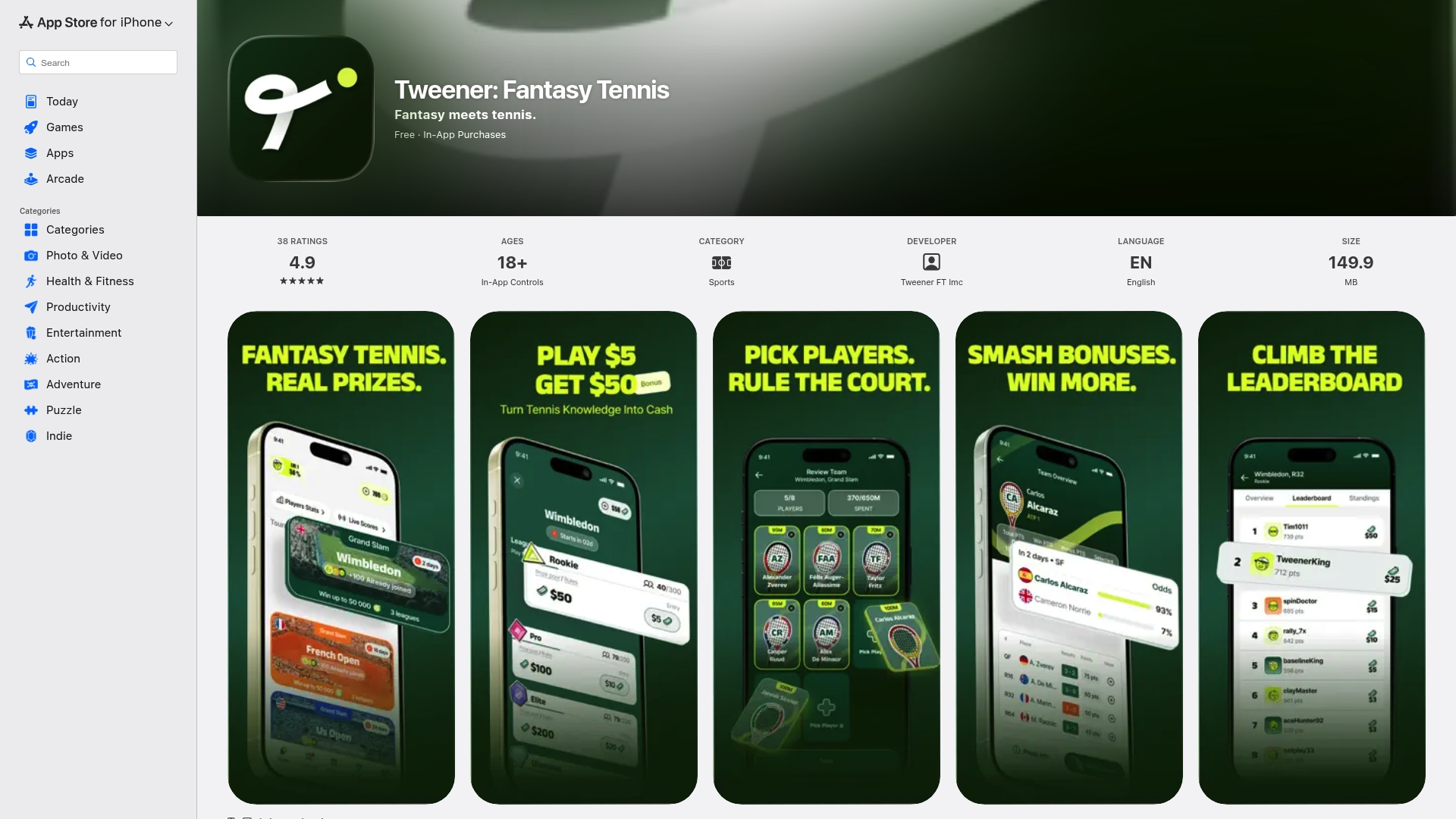
You can download the Tweener app or see both play modes on tweener.io. If you want a walkthrough first, our step-by-step guide to entering tennis contests covers it from sign-up to lock.
A pre-lock routine for Indian Wells
When the draw is out, the clock starts. A repeatable routine saves you from rushed decisions.
- Read the full draw once. Note the seeds, the byes and the strongest unseeded players.
- Map the quarters. Mark where seed-versus-seed clashes could occur.
- Shortlist 8 to 12 players across the men's and women's fields.
- Check form and workload for each name on your list.
- Check the order of play and weather. Evening matches and wind change the picture.
- Look for late news from the tournament site before lock.
- Submit and note your reasoning. You will learn more from the notes than from the result.
We keep a mobile pre-lock checklist with a similar flow, and a piece on daily fantasy tennis strategies that covers lineup construction in more depth.
Common mistakes
- Picking only the biggest names. Stars are popular, and in a public contest that means your lineup looks like everyone else's.
- Ignoring byes. A seed with a bye has not played yet when others have, so timing matters for round-by-round contests.
- Overvaluing head-to-head. Check the surface and the date of those meetings.
- Forgetting withdrawals. Re-check your players before every lock.
- Chasing losses. A bad round is information, not a reason to raise your stakes.
FAQ
When is the next Indian Wells tournament?
The 2027 BNP Paribas Open is scheduled for February 28 to March 14, 2027, with qualifying from February 28 to March 2. Check the official FAQ page for the current schedule, because dates can change.
How many players are in the Indian Wells draw?
The men's and women's singles draws each have 96 players. The 32 seeds are placed first, and the other players are drawn at random. Daily schedules are posted each evening on the tournament website.
Can I play Indian Wells fantasy for free?
Yes. Free leagues use virtual coins instead of money, so you can follow the whole tournament without paying an entry fee. On Tweener, coins earned in free play can be redeemed for rewards such as gift cards. Cash contests are a separate mode, available only in select US states.
Is fantasy tennis the same as betting?
No. Fantasy contests are built around a roster or set of picks scored on accumulated results, and regulators such as the Mississippi Gaming Commission describe them in terms of player knowledge and skill. Betting is a wager on a single outcome at set odds. Laws vary by state, so check the rules where you live.
What should I check before lock time?
Check the final draw, the order of play, any withdrawals and the contest's scoring rules. Entry is typically open until lock, so you have time to adjust, but not after. Our checklist for joining tennis tournaments goes through each step.
Sources
- FAQs | BNP Paribas Open
- Your Complete Fan Guide To The 2024 BNP Paribas Open
- Mississippi Gaming Commission Regulations
- Fantasy Sports Contest Rules & Scoring Overview (US)