

Before you hit Enter on any fantasy tennis contest, run this 10-point checklist: confirm account and KYC status, verify the slate surface and match format, check scoring rules and salary cap, pull surface-specific stats, review injuries and withdrawals, set your anchors versus value plays, check ownership projections, finalize your captain or bonus pick, scan last-minute news, and submit before lock. That sequence is your tournament entry checklist for every slate on Tweener.
Quick pre-lock checklist (run in order on mobile):
- Confirm account is verified (KYC complete) and balance is funded
- Check contest type, entry fee, and payout structure
- Verify slate: surface, tournament round, and match format (best-of-3 vs. best-of-5)
- Pull surface stats: ace %, hold %, break conversion for each player
- Review scoring rules and calculate points-per-dollar for your top targets
- Set lineup roles: anchors, attackers, game-stacks
- Check ownership projections and flag chalk vs. contrarian plays
- Confirm captain or bonus-ball selection
- Scan injury reports and withdrawal lists
- Submit lineup with at least 5 minutes to spare
Pro Tip: If you have only 2 minutes before lock, prioritize in this order: injury check first, then captain confirmation, then submit. Everything else can wait.
Key Takeaways
Running a disciplined pre-lock checklist on every fantasy tennis slate — covering account status, surface stats, scoring value, ownership, and injury news — is the most reliable way to avoid avoidable losses and build long-term edge on Tweener.
| Point | Details |
|---|---|
| Account and KYC first | Verify identity and fund your balance before the slate opens, not at lock time. |
| Points-per-dollar target | Aim for players projecting above 2.5 points per $1,000 salary; below 2.0 is a red flag. |
| Surface stats drive picks | Pull ace %, hold %, and break conversion from the last 3–5 events on the current surface. |
| 5% bankroll rule | Risk no more than 5% of total bankroll on any single slate to survive variance. |
| Tweener for mobile play | Use Tweener's in-app tools, push alerts, and game rules page to run the full checklist on mobile. |
Table of Contents
- What account and contest checks do you need before entering?
- Which surface and matchup stats should you pull for every slate?
- How do you translate scoring rules into points-per-dollar value?
- How do you build lineups for cash games versus GPP tournaments?
- How do ownership thresholds create leverage in large-field GPPs?
- What is the final routine to run 5–10 minutes before lock?
- How much of your bankroll should you risk on a single slate?
- Which tools give you the fastest data on mobile?
- Your one-page checklist to screenshot before every slate
- The checklist is the discipline, not the shortcut
- Tweener is built for exactly this kind of play
- Sources
What account and contest checks do you need before entering?
Your account has to be ready before you think about players. That means KYC (identity verification) is complete, your payment method is confirmed, and your balance covers the entry fee plus a buffer. Skipping this step and discovering a pending verification at lock time is a common, avoidable loss.
On the contest side, read the fine print before you enter:
- Contest type: Cash game (50/50, double-up) or GPP tournament? The payout structure changes everything about how you build.
- Entry fee and paying places: Know exactly how many spots cash out before you commit.
- Roster size: Most platforms use 4–6 players; ATP Fantasy runs six starters plus two alternates, with a Bonus Ball mechanic that doubles one player's points.
- Switch and edit policies: ATP Fantasy allows two free switches per tournament week. Know your platform's rules before lock.
- Legal availability: Cash contests are not available in every U.S. state. Confirm your state is eligible before depositing.
- Device readiness: Per MatchPointKings, check app compatibility and connectivity before the final minutes.
Which surface and matchup stats should you pull for every slate?
Surface is the single biggest variable in fantasy tennis; for insights on physical training and surface preparation, consider Tennis — Alpha Imprinting · Roberts Neurotraining. A player who dominates on clay can be a liability on grass, and the stats that predict performance shift with the court.
Start by confirming the slate: surface type (hard, clay, grass) and match format. Best-of-five Grand Slam matches produce higher fantasy ceilings than best-of-three events, so adjust your lineup roles and variance tolerance accordingly.
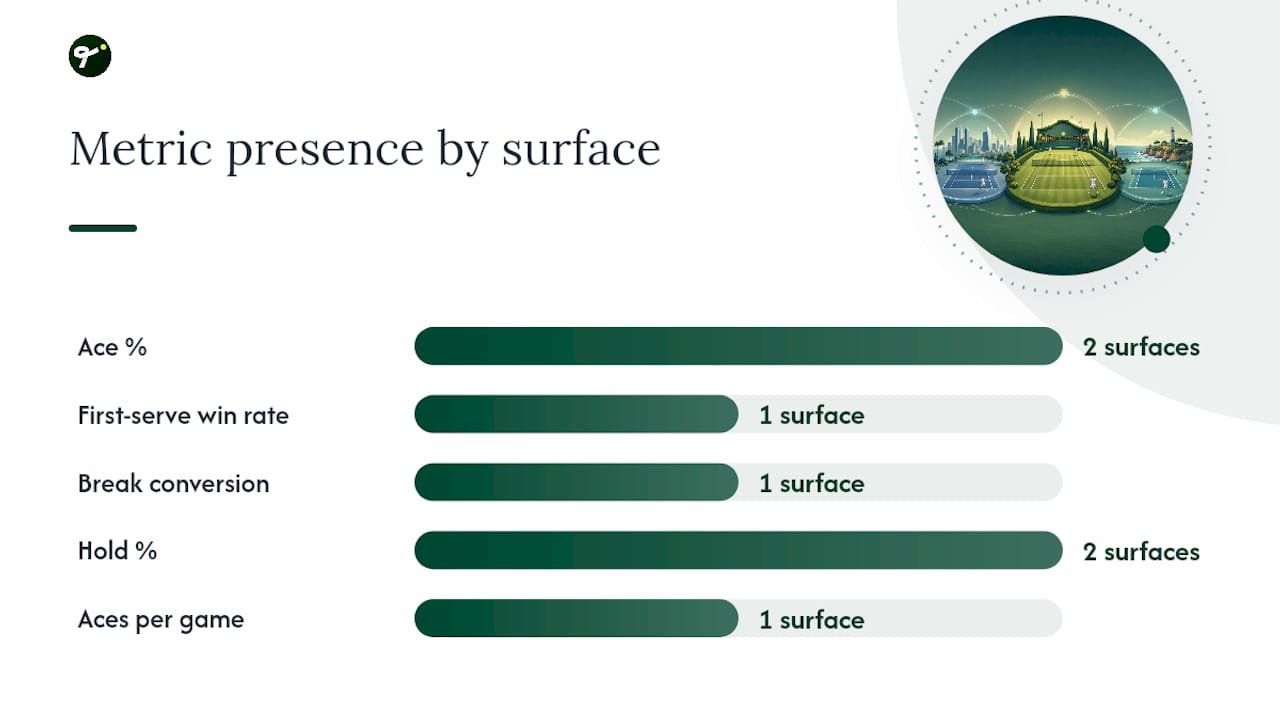
Priority stats by surface, per Tennis Majors DFS guidance:
| Surface | Key Metrics | Typical Thresholds |
|---|---|---|
| Hard court | Ace %, first-serve win rate | High ace percentage and first-serve win rate |
| Clay | Break conversion, hold % | Solid break conversion and hold percentages |
| Grass | Hold %, aces per game | High hold percentage and aces per game |
Pull recent form from the last 3–5 events on the same surface, not season-wide averages. A player's clay numbers from January mean little at Roland Garros in May.
Pro Tip: Use Ultimate Tennis Stats for surface-split data and FlashScore for live draw updates. Save your most-used filters as bookmarks on mobile so you can pull the numbers in under 60 seconds.
How do you translate scoring rules into points-per-dollar value?
Scoring varies by platform, but the underlying logic is consistent. Points come from aces, breaks, games won, and sets won, with bonus mechanics layered on top. Tennis Majors gives concrete examples: an ace is worth roughly 3 points, a break around 4, and games approximately 1.2 points each. Sets vary by platform.
Convert those numbers into a points-per-dollar metric before you finalize any pick. Divide a player's projected fantasy points by their salary (in thousands). A player projected at 35 points with a $10,000 salary gives you 3.5 points per $1,000, which clears a reasonable value threshold.
Value target: Aim for players projecting above 2.5 points per $1,000 salary. Below 2.0 is a red flag unless the player is a deliberate ceiling play in a GPP.
Salary-cap tradeoffs work differently by contest type. In cash games, prioritize consistent floor over ceiling. In GPPs, you can sacrifice floor on one or two salary slots to free up budget for a high-upside attacker. The ATP Fantasy scoring video is a fast primer if you want a visual walkthrough of how tournament results map to fantasy points.
How do you build lineups for cash games versus GPP tournaments?
The roster construction blueprint changes completely depending on the contest. Think of your lineup as a portfolio: anchors provide the floor, attackers provide the ceiling, and game-stacks add correlated volume.
Per Tweener's lineup tips, the recommended allocation splits look like this:
- Cash games (50/50s, double-ups): ~70% anchors, ~20% game-stacks, ~10% attackers
- GPP tournaments: ~40% anchors, ~40% attackers, ~20% game-stacks
A cash lineup for a hard-court slate might anchor on a top-5 seed with a strong first-serve win rate, add a reliable second seed, and fill the remaining slots with consistent mid-tier players projecting solid floors. A GPP lineup on the same slate might swap one anchor for a lower-owned attacker with a favorable draw and a history of deep runs on hard courts.
Pro Tip: For GPPs, submit 2–3 lineups with different attacker selections rather than duplicating the same roster. Simple correlation rule: never stack two players from the same match in a cash game, since one of them loses.

For deeper lineup construction strategy, the Tweener blog covers role-based construction in detail.
How do ownership thresholds create leverage in large-field GPPs?
The payout leverage comes from being right when the field is wrong.
Ownership thresholds to know: Chalk is anything above 30–40% owned. Low-owned leverage plays sit below 10–15%. The sweet spot for differentiation is 15–30% ownership on a player with a real case to outperform.
Practical rules for building leverage:
- Pair a low-owned attacker with your chalk anchors so you still have a floor if the contrarian misses
- Target qualifiers or lower seeds with rest advantages against fatigued opponents deep in a draw
- Watch for late ownership shifts in the final 30 minutes before lock; a player news item can move ownership 10–15 points fast
Surface specialization is one of the most underused leverage sources. RotoWire's draft strategy guidance reinforces this: prioritize surface specialists for tournaments that favor their game.
What is the final routine to run 5–10 minutes before lock?
This is the step most players skip, and it is where lineups get wrecked. A withdrawal you missed, a captain you forgot to update, or a connectivity issue at the wrong moment can cost you the entire entry fee.
Run this in order:
- Check injury reports and official withdrawal lists (ATP, WTA, or tournament draw pages)
- Confirm no opponent changes that affect your attacker's matchup
- Verify weather or scheduling delays for outdoor events
- Re-check your captain or bonus-ball selection against the updated slate
- Open the app, confirm your lineup loaded correctly, and check connectivity
- Submit and screenshot your confirmed lineup
For roster updates and alternate slot management within Tweener, the platform's roster guide walks through the exact steps.
Pro Tip: Enable Tweener push notifications so player news hits your phone before you open the app. That 60-second head start on a withdrawal alert is often the difference between a clean swap and a locked lineup with a retired player.
How much of your bankroll should you risk on a single slate?
That ceiling exists because tennis DFS carries higher variance than team sports: one retirement, one rain delay, one upset in the first round, and your entire lineup projection collapses. Conservative sizing keeps you in the game long enough to learn.
The 5% rule: If your total bankroll is $200, your maximum exposure on one slate is $10, spread across all contests you enter that day.
Contest selection should match your experience level:
- Beginners: 80% of entries in cash games (50/50s, double-ups), 20% in low-stakes GPPs
- Intermediate: 60% cash, 30% GPP, 10% satellites or qualifiers
- Advanced: Adjust toward GPPs as your edge in lineup construction grows
For more on why cash contests build discipline before you scale into GPPs, the Tweener blog covers the reasoning in depth.
Which tools give you the fastest data on mobile?
Open these in this order when time is short:
- Tweener in-app tools and game rules: Scoring definitions, switch policies, and lineup interface all in one place
- Ultimate Tennis Stats: Surface splits, H2H records, and serve/return stats by surface
- FlashScore: Live draw updates, real-time scores, and injury news
- RotoGrinders: Projections, ownership estimates, and DFS-specific player analysis
- Tweener blog strategy posts: Role-based lineup construction and surface-specialist guides
Prediction models that combine recent form, surface performance, H2H records, and serve/return stats consistently outperform ranking-only forecasts, per Tweener's prediction analysis. For season-long leagues, RotoWire's draft tools add sleeper identification that pure stat sites miss.
Your one-page checklist to screenshot before every slate
Save this to your phone's photos or pin it inside Tweener for one-tap access before lock:
Account and contest:
- KYC verified, balance funded
- Contest type and payout structure confirmed
- Legal availability checked
Slate and surface:
- Surface confirmed (hard/clay/grass)
- Match format confirmed (best-of-3 or best-of-5)
- Lineup lock time noted
Scoring and salary:
- Scoring rules reviewed
- Points-per-dollar calculated for top targets (target: >2.5 per $1,000)
- Salary cap allocation mapped by role
Stats and form:
- Surface win % pulled (last 3–5 events)
- Ace %, hold %, break conversion checked
- H2H on current surface reviewed
Injuries and ownership:
- Withdrawal list checked
- Ownership projections reviewed
- Contrarian plays flagged
Final lock:
- Captain or bonus-ball confirmed
- Lineup submitted and screenshot taken
The checklist is the discipline, not the shortcut
Most fantasy tennis losses are not about picking the wrong player. They are about skipping a step. The manager who enters a GPP with a chalk lineup and no ownership awareness, or who misses a withdrawal because they submitted 30 minutes early and never checked back, is not losing on skill. They are losing on process.
A checklist does not remove the need to understand tennis. It removes the noise that gets between your knowledge and your lineup. The surface-stat triggers, the points-per-dollar math, the ownership thresholds — those are the analytical layer. The checklist is what makes sure you actually apply them under time pressure, on a phone, five minutes before lock.
Log your results after every slate: which picks hit, which missed, and why. That feedback loop, more than any single tool or projection model, is what separates managers who improve from those who repeat the same mistakes across every tournament.
Tweener is built for exactly this kind of play
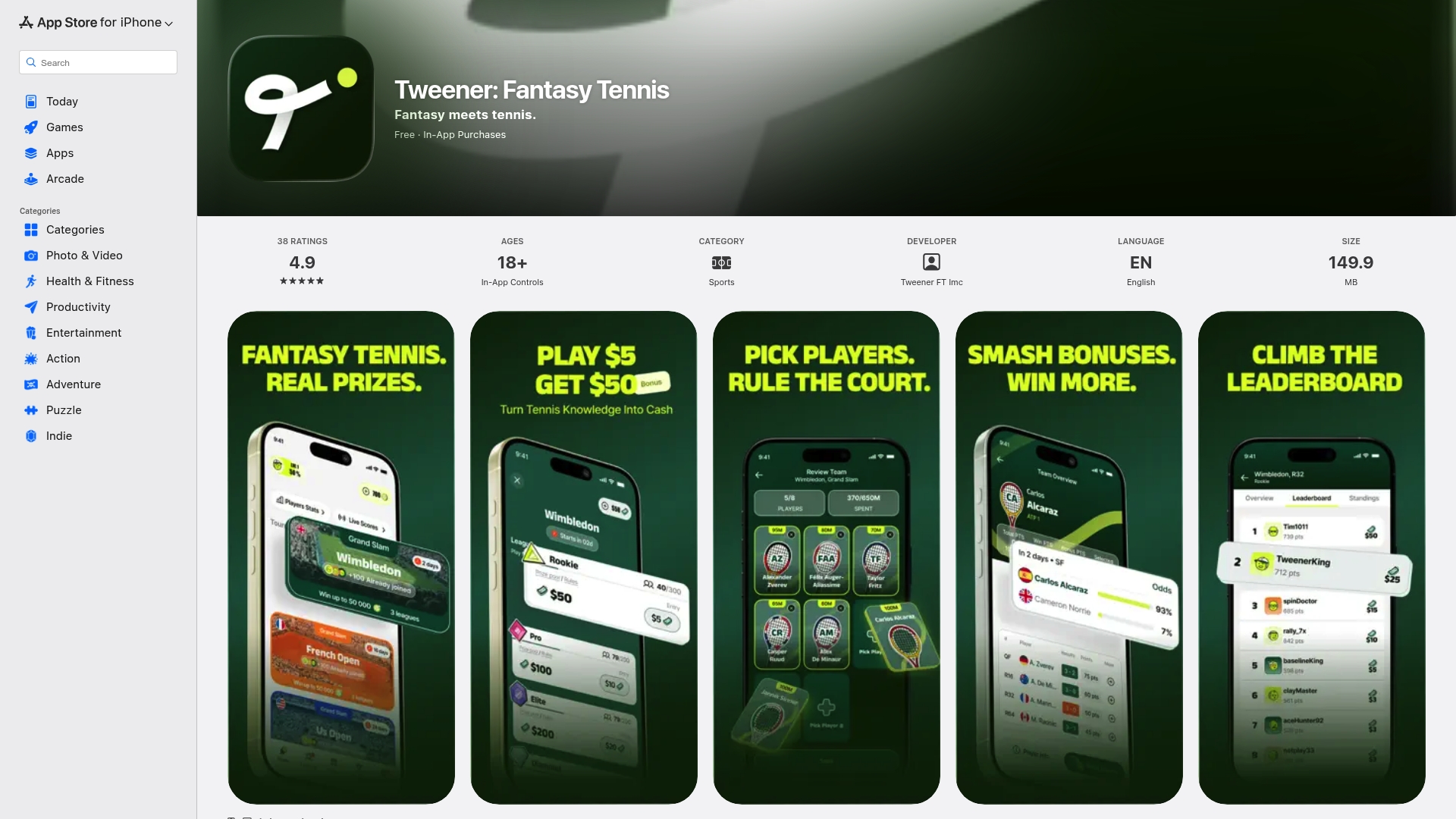
Tweener is the mobile-first fantasy tennis platform that fits this checklist from the first step to the last. In-app scoring definitions, push alerts for player news, private leagues for Grand Slams with up to 9 friends, and real-money contests where legally available — it is the closest thing tennis has to a dedicated DFS platform.
Read the Tweener game rules to confirm scoring mechanics, switch policies, and roster requirements before your first entry. Then head to Tweener to download the app and join a contest. Complete your KYC verification before you deposit so you are ready to enter the moment a slate opens.
Sources
- ATP Fantasy: How to play, choose your team, win points & climb leaderboards | ATP Tour | Tennis
- How to Build a Winning Tennis DFS Strategy: From Beginner Picks to Advanced Tactics - Tennis Majors
- Fantasy tennis expert: rest-of-season draft strategies and sleepers - RotoWire
- How To Play | Matchpointkings