

TL;DR:
- Peer competition in fantasy tennis involves competing directly against other players, making your success relative to their scores. This shift from fixed benchmarks to head-to-head rivalries increases strategic depth, emphasizing differentiation and psychological insight over pure statistics. To succeed, managers should exploit unique player matchups, anticipate rivals’ choices, and avoid herd mentality to gain a competitive edge.
Most tennis fantasy players spend hours agonizing over which ATP or WTA stars to put on their roster. They study serve percentages, surface stats, and head-to-head records. Then they build what looks like an unbeatable squad and still finish in the middle of the pack. The reason? They forgot that peer competition in fantasy sports means you're not playing against statistics or a house system. You're playing against real people making real decisions. That shift in perspective changes everything about how you should approach your league.
Table of Contents
- What does peer competition mean in fantasy tennis?
- How peer competition works in mobile fantasy tennis leagues
- Types of peer competition: Private leagues, public leagues, and leaderboards
- How differentiation and strategy set winners apart
- Peer competition trends and what's next for tennis fantasy
- Why most players misunderstand peer competition—and how to fix it
- Ready to compete? Try your skills in a tennis fantasy league
- Frequently asked questions
Key Takeaways
| Point | Details |
|---|---|
| Peer competition defined | You compete directly against other users in tennis fantasy, not against house odds. |
| League mechanics matter | How leagues and leaderboards are structured shapes your rivalry and strategy. |
| No skill-based matching | Leagues often group players by choice or fill with bots, not by skill. |
| Stand out with strategy | Avoid copycat tactics by making brave, unique picks to rise above the crowd. |
| Trends shaping the future | Peer-vs-peer competition and AI use are on the rise in fantasy tennis. |
What does peer competition mean in fantasy tennis?
With the basics established, let's break down exactly what peer competition means for fantasy tennis fans.
In traditional odds-based or house-driven games, you compete against a fixed benchmark. You either beat a scoring threshold or you don't. Win or lose, the "opponent" never adapts, never surprises you, and never gets lucky. Peer competition is the opposite. Peer competition in fantasy sports places you directly against other users. Your score only matters relative to what they score. A 200-point week can be a landslide win or a close loss depending entirely on what your rivals put up.
This model fundamentally changes the motivation for playing. When you're playing against a house, you focus on absolute performance. When you're playing against friends or strangers in a league, social rivalry kicks in. You want bragging rights. You want to prove that your tennis knowledge runs deeper than your coworker's or your group chat's. That emotional layer makes the game far more engaging and far more strategic.
"The beauty of peer-to-peer fantasy leagues is that the leaderboard is a living document. Every pick your rival makes is a strategic move you have to anticipate, not just react to."
Platforms like Tweener's platform are built around this model. Rather than betting on a single player outcome, you build a full team and measure yourself against a field of other managers who are doing the same. The ATP Fantasy platform works similarly. What unites them is the core idea: your score only wins if it's better than the people you're competing against.
How peer competition works in mobile fantasy tennis leagues
Now that we know what peer competition is, let's see how it plays out in the top fantasy tennis platforms.
The mechanics in mobile fantasy tennis apps like Tweener involve building rosters within set budgets, earning points from real player performances during live tournaments, and stacking those points against everyone else in your league or on a public leaderboard. The process generally works like this:
- Set your roster. You pick a team of real ATP or WTA players within a fixed budget or credit limit. Each player has a value, and you can't just stack every top seed.
- Points accumulate in real time. As those players win matches, hold serve, break opponents, or go deep in a draw, you earn points. A strong Novak Djokovic performance at a Grand Slam can flood your total quickly.
- Your score gets compared. Whether you're in a private league with 10 friends or a public league with 500 strangers, you're ranked against everyone else who drafted a team for that same contest.
- Prizes or bragging rights are awarded. On Tweener, free-mode winners earn virtual coins redeemable for gift cards. In cash mode, where legally available, real money is on the table.
Good fantasy tennis team management includes knowing when to rotate players between rounds, how to handle injured favorites, and how to exploit underrated matchups. These decisions separate active managers from passive ones.
Here's a quick overview of how different league formats compare in terms of size and competition style:
| League type | Typical size | Competition style | Reward structure |
|---|---|---|---|
| Private league | 5 to 20 users | Friends or known rivals | Social, coins, or cash |
| Public league | 20 to 500+ users | Open entry, app-filled | Coins or cash prizes |
| Global leaderboard | Unlimited | All active users | Top-tier prizes or ranking |
| Bot-filled league | Variable | App uses AI to fill gaps | Maintains engagement |
Pro Tip: When you're just starting out with joining a fantasy tennis league, pick a small private league first. The smaller field lets you observe how specific rivals draft and respond, building your strategic instincts before you scale up to bigger public contests.
Types of peer competition: Private leagues, public leagues, and leaderboards
With the mechanics in mind, let's compare the different formats of peer competition you'll encounter.
Not all peer competition feels the same. The format shapes the rivalry intensity, the strategy required, and the experience overall. According to tennis fantasy analysis, there is no explicit skill-based peer matching in most tennis fantasy platforms. You compete through self-selected private leagues, app-filled public leagues, or open leaderboards.
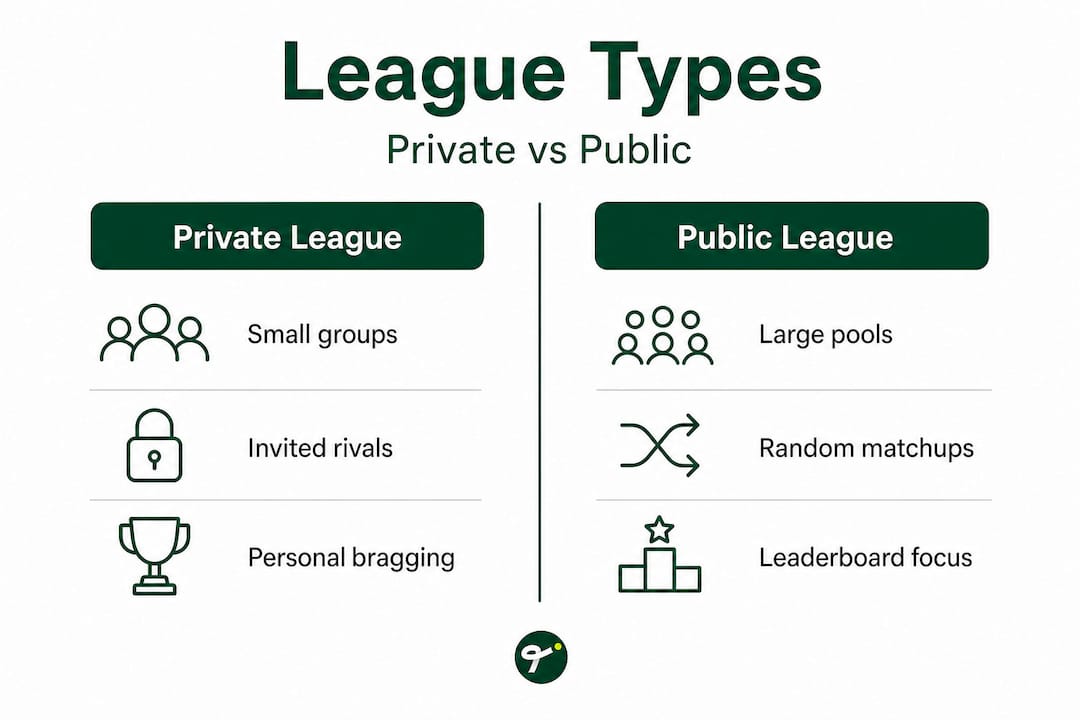
Private leagues are where personal rivalries live. You control who joins. You might create a league with five coworkers or twelve friends from a tennis club. Because entry is restricted, everyone knows each other's tendencies. You remember that one friend who always drafts Carlos Alcaraz no matter what surface is being played. That context makes every pick feel personal. The stakes feel higher even when no money is involved.
Public leagues are curated by the app. You sign up, get placed into a pool with other active users, and compete against strangers. The anonymity shifts the strategy because you can't rely on knowing your rivals' habits. You have to make decisions based purely on what the average manager is likely to do.
Global leaderboards are pure mass competition. Every active user is ranked. This format rewards consistency more than any single hot week. Your real money fantasy tennis potential is often highest here in cash competitions, but so is the variance. A bad round of matches can knock you dozens of spots in an afternoon.
Key differences at a glance:
- Private leagues reward knowing your specific rivals and playing against their tendencies
- Public leagues reward knowledge of popular picks and the wisdom to deviate from them
- Leaderboards reward consistency across a full tournament or season
One critical note: because there's no enforced skill matching, you might find yourself in a league filled partly with bots or AI-generated entries. Apps use these to ensure tennis fantasy prediction games stay active and competitive even when real user numbers are thin for a specific contest. This practice keeps engagement high and prevents leagues from sitting empty during smaller tournaments.
Statistic to know: The shift toward peer-vs-peer formats in fantasy sports is accelerating. Regulatory changes in several U.S. states have pushed platforms away from house-odds models and toward user-vs-user structures precisely because these are classified differently under gaming law. That means the competitive landscape you're entering is growing and evolving fast.
How differentiation and strategy set winners apart
Of course, simply joining a league isn't enough. Here's how top fantasy players separate themselves from the pack.

Here's the uncomfortable truth most fantasy tennis guides won't tell you. When there's no ownership pricing that limits how many users can draft the same player, the entire field gravitates toward the same safe choices. Everyone drafts Jannik Sinner on a hard court. Everyone grabs Iga Swiatek on clay. The result is a sea of nearly identical squads where first place is decided by a single tiebreaker or a lucky second-tier pick.
Differentiation matters in leagues without ownership pricing. Following popular picks such as those suggested by official fantasy coaches or consensus rankings leads to clustered squads. When everyone gets the same result from their top picks, the players who win are those with one or two unique selections that outperformed expectations.
Use these approaches to build a genuinely different team:
- Identify draw-friendly players. A player ranked 30th who has a favorable draw through the first three rounds can outscore a top-10 seed facing brutal early matchups.
- Exploit surface mismatches. Some players massively overperform on specific surfaces relative to their ranking. These create enormous value if the majority of your league ignores them.
- Use the second-tier strategically. Your highest-profile picks probably match your rivals. The difference often comes from who fills your budget spots below the marquee players.
- Watch injury news late. Late scratches and withdrawals create rushed changes across the field. Users who react faster secure better replacements.
Pro Tip: Check fantasy lineup tips before each tournament to identify which lesser-known players are generating buzz for good reasons, then cross-reference with smart team selection principles to balance risk and value.
The essential skills for fantasy success go beyond knowing player stats. They include reading the competitive landscape, anticipating what your rivals will likely draft, and making deliberate choices to separate yourself. Think of it less like a stats exam and more like a chess match where your opponent is the collective behavior of your league. Learning the art of drafting tennis players with this mindset turns an average manager into a consistent winner.
Peer competition trends and what's next for tennis fantasy
Let's step back and look at the broader trends shaping peer competition in fantasy tennis.
The shift toward peer-vs-peer daily fantasy models across the industry isn't random. It's driven by two major forces: regulatory pressure that distinguishes peer games from house-odds gambling, and genuine user preference for competing against real people rather than faceless algorithms. Players want to beat someone they know or someone whose name they can see on a leaderboard.
"Fantasy sports are most engaging when the rivalry is human. Users don't just want a prize. They want to prove they know more than the person sitting next to them."
Looking at where mobile tennis fantasy is heading, several trends are already taking shape:
- Smarter AI fills. Apps use AI and bots to fill inactive leagues ensuring play continuity without skill-matching. But next-generation AI fills are getting harder to distinguish from active human players, raising the competitive floor for everyone.
- More granular league formats. Expect to see formats that match users by recent performance or tournament history without formal skill tiers, creating more balanced but still self-selected competition.
- Real-time leaderboard updates. As live match data speeds up, leaderboard shifts during a single match are becoming part of the drama. Watching your rank change point-by-point while a Wimbledon final plays out is a completely different experience from checking results at midnight.
- Social integration. Private leagues are evolving to include chat features, trash-talk tools, and in-app rivalry stats that deepen the personal competition element.
There are still no widely published benchmarks measuring peer competition intensity specifically within tennis fantasy. The data gap means most platforms operate without clear metrics for how evenly matched their leagues actually are. For you as a player, that's both a limitation and an opportunity to understand the game more deeply than most of your rivals.
Why most players misunderstand peer competition—and how to fix it
Here's a perspective that cuts against most fantasy tennis advice you'll find online.
Conventional wisdom says you should build the statistically strongest team possible. Study the rankings, track the form, optimize your budget, and let the numbers do the work. That advice is correct in a vacuum. The problem is that everyone in your league has access to the same rankings and the same form guides. When you follow the consensus perfectly, you produce the same squad as everyone else. And the consensus squad finishes in the middle of the pack because all the consensus squads cancel each other out.
The real enemy in fantasy tennis isn't bad luck or tough match conditions. It's peer groupthink. The herd mentality that pulls everyone toward the same five players at every major tournament. When 80 percent of a public league drafts the same top seeds, those picks essentially become neutral. The winner is almost always the person who saw something others missed.
Savvy fantasy managers think one level above strategy. They don't just ask "which players are most likely to win?" They ask "which players is everyone else going to pick, and how do I exploit the gap between what the field drafts and what actually happens?" That second question is where real edges live.
This means being willing to leave obvious value on the table sometimes. It means taking a calculated risk on a player coming off a strong clay season entering Roland Garros unseeded. It means using advanced selection strategies to read the meta as much as the matchups. Peer competition rewards the person who understands both the sport and the psychology of their rivals. That's a completely different skill than just being a good tennis fan.
Ready to compete? Try your skills in a tennis fantasy league
If you're ready to apply these lessons, here's how to jump into your next fantasy tennis competition.
Understanding peer competition theory is only useful if you get into a real league and test it. Tweener puts everything we've covered into practice. You build a roster from real ATP and WTA players, compete in private leagues with friends or public contests against hundreds of users, and earn points as your picks perform in live tournaments. The free mode lets you compete with virtual coins, so there's no barrier to getting started today.
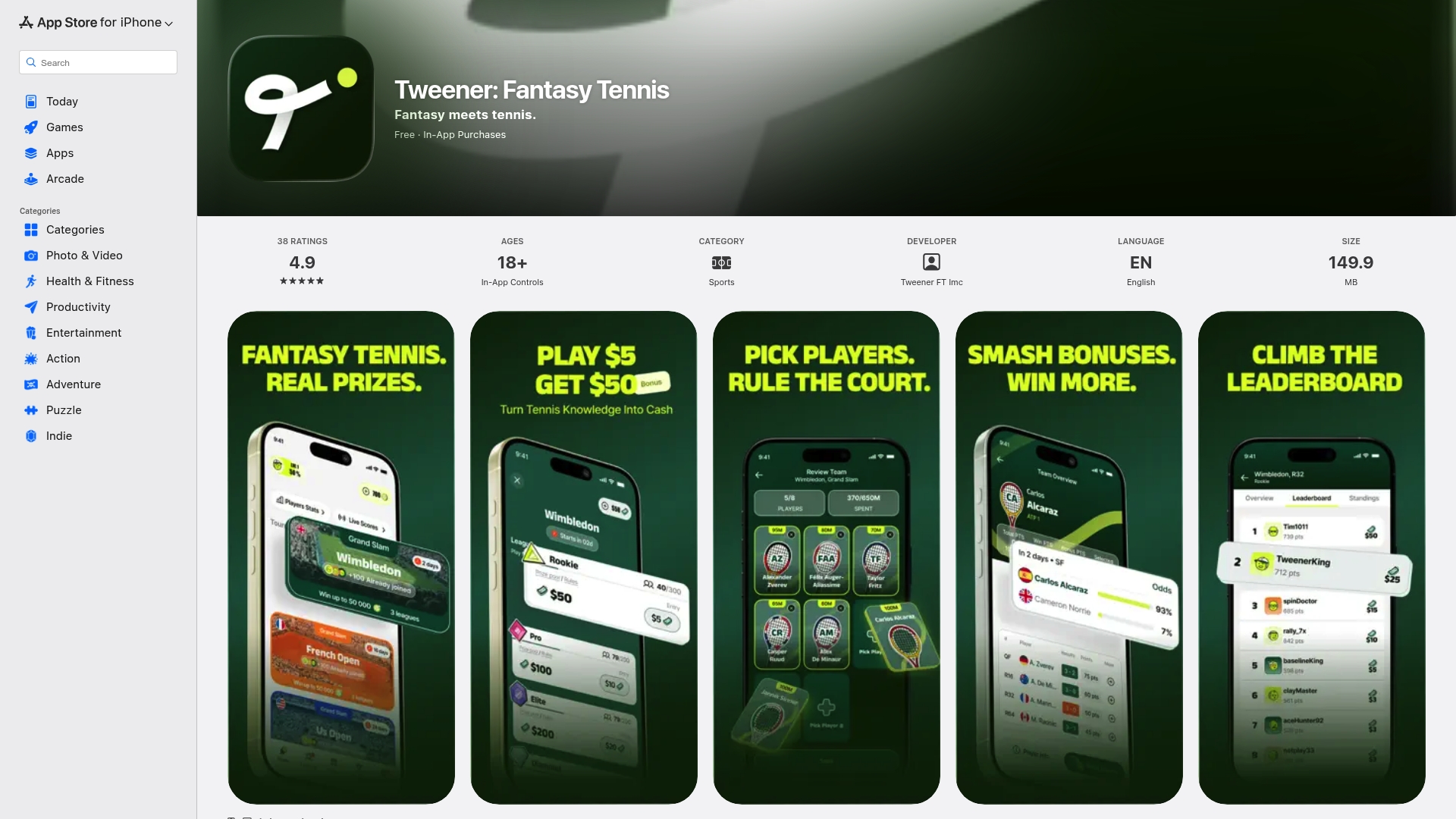
The Tweener platform is designed for exactly the kind of engaged tennis fan who wants more than just watching matches. It rewards strategic thinking, rewards differentiation, and rewards the kind of meta-awareness that this article has laid out. You can download Tweener right now and join a league before the next tournament begins. The leaderboard is waiting, and your rivals are already drafting.
Frequently asked questions
What is peer competition in fantasy tennis?
It means you compete directly against other users in leagues or on leaderboards. Peer competition in fantasy sports means your score is always measured relative to what real rivals score, not against a fixed house projection.
Are fantasy tennis leagues matched by skill?
No, most platforms do not use explicit skill-based matching. No explicit skill-based peer matching exists in tennis fantasy; you join leagues by choice or the app fills them with other users or bots.
How do I get an edge over peers in fantasy tennis?
Avoid copying the most popular player picks and build a roster that stands apart from the consensus. Differentiation matters in leagues without ownership pricing, and unique strategies consistently beat safe, crowd-following lineups.
What happens if not enough users join a league?
The app may fill open spots automatically so the contest can still run. Apps use AI and bots to fill inactive leagues, ensuring play continuity without needing full human rosters before a tournament starts.