

Treat ownership as your differentiation thermometer: in cash games, lean into consensus picks with a high floor, and in tournaments, hunt for players your sim models like more than the field does. That single rule works because cash games reward consistency while GPPs pay only the top finishers, and Tweener's tennis-focused data makes applying it to ATP and WTA slates far more precise than guessing off gut feel.
TL;DR:
- Projected ownership often underestimates the actual field percentage, creating opportunities for leverage plays that outperform the field's expectations.
- In cash games, prioritize high-floor, consensus picks because consistency usually outweighs contrarian upside, unlike GPPs which favor differentiated, high-ceiling plays.
- Simulated win rates, accounting for variance and match dynamics, offer a more reliable leverage signal than simple point projections, especially when supported by large sample sizes.
- Tennis-specific factors like surface type, draw quality, and injury withdrawals significantly influence ownership, often more than ranking or recent form.
- Effective ownership strategies require careful portfolio exposure caps, late adjustments for withdrawals, and contest selection aligned with the leverage potential of your player pool.
Table of Contents
- What ownership percentage actually measures
- Ownership tactics: cash games vs large-field GPPs
- Leverage and simulation-based approaches
- Estimating and projecting ownership before lock
- Constructing lineup exposures and portfolio rules
- Tennis-specific ownership signals: surface, draw, and withdrawals
- Common ownership mistakes and a pre-lock checklist
- Contest selection: when ownership actually matters
- Bankroll management and risk tolerance around ownership
- Adjusting strategy for slate size and match timing
- How ownership strategy differs across major sports
- Case studies: ownership strategy in real contest structures
- Tools and software for tracking ownership trends
- Why ownership modeling is a skill, not a hunch
- Tweener: where tennis ownership strategy actually gets applied
- Sources
- FAQ
What ownership percentage actually measures
Ownership percentage is the share of entered lineups in a contest that include a given player. Most operators publish two versions of this number: a projected ownership figure available before lock, built from early entry patterns and salary signals, and a final post-lock ownership figure that reflects every entry once the slate closes. The gap between the two matters more than either number alone, since a player projected at 15% who actually lands at 28% has been "found" by the field late, often after news breaks or a favorable matchup gets attention.
Ownership drives strategy because of how payouts split. When a highly owned player performs well, a large share of the field earns similar points from that pick, which compresses the payout differential between finishing 10th and finishing 100th. When a lightly owned player hits, the managers who rostered them separate from the pack. This is the entire logic behind leverage, and it's why the same player can be a smart cash play and a poor tournament play in the same slate.
Ownership matters less in some formats than others:
- Heads-up and small-field contests, where beating one or a handful of opponents makes the field's overall rostering habits close to irrelevant.
- Contests with flat or near-flat payout structures, where finishing position barely changes the payout.
- Extremely top-heavy slates with only one or two viable plays at a price point, where high ownership is unavoidable regardless of strategy.
Outside those cases, ownership is one of the more reliable signals a fantasy tennis player can use to separate skill-based decisions from noise, a distinction MIT research on FanDuel performance found tends to favor players who study these patterns.
Ownership tactics: cash games vs large-field GPPs
Cash games (head-to-heads, 50/50s, double-ups) and large-field GPPs call for close to opposite ownership philosophies, even when the underlying player pool is identical.
- In cash games, prioritize floor over ceiling. Consensus picks earn that consensus because they're the safest projected scorers, and there's little reward for being contrarian when you only need to beat half the field.
- In GPPs, prioritize differentiation on a subset of your roster while anchoring the rest with reliable scorers, since you're competing against thousands of entries chasing the same top-heavy prize pool.
- Use projected ownership to decide which roster spots to make contrarian. Don't fade chalk everywhere at once. Pick one or two spots where a low-owned player has real ceiling upside and build around that.
A workable mix for a mid-size GPP looks like 40 to 50% of roster spots filled with likely-chalk anchors who carry a strong floor, 20 to 30% in clear value plays chosen on salary efficiency rather than ownership, and the remainder reserved for genuine pivots, players you believe are underpriced relative to their sim win rate.
Statistic Callout: Research on opponent-aware DFS optimization found that modeling how the field rosters players produces measurably higher expected payoffs than optimizing on projected points alone. That's the mathematical case for treating ownership as a first-class input, not an afterthought.
Leverage and simulation-based approaches
Leverage is the gap between a player's simulated win rate and their projected ownership. A player projected for a 20% sim win rate in a tournament who's only owned by 8% of the field carries strongly positive leverage: they're more likely to produce a winning lineup than the field is accounting for. A player whose roster share exceeds their sim win rate carries negative leverage, indicating overvaluation by the field.
Sim win rate differs from a simple point projection because it accounts for variance and correlation across an entire slate, not just a single player's median outcome. A points-based projection tells you what a player is expected to score on average. A simulation runs the slate thousands of times, factoring in scoring distributions, match outcomes, and how players' results interact, then reports how often a given roster combination would have actually won.
To calculate leverage:
- Take a player's sim win rate (the percentage of simulated contest outcomes where lineups including them finish first or in the money).
- Subtract their projected ownership percentage.
- A positive result signals an underpriced opportunity relative to the field; a negative result signals a crowded, overvalued pick.
Industry guidance on leverage scoring recommends sorting your entire player pool by leverage before building lineups, rather than building lineups first and checking ownership afterward. That single sequencing change forces you to consider differentiation from the start instead of retrofitting it.
For portfolio allocation, a reasonable split gives your top three or four positive-leverage plays meaningful exposure across 40 to 60% of your entries in a large-field GPP, while keeping negative-leverage chalk under 20% exposure unless the player's floor is so dominant that fading them is reckless. Running sims well requires volume: leverage guidance built on Monte Carlo modeling suggests that 50,000 to 100,000 correlated simulation runs are needed for stable win-rate outputs on a given slate, and that correlation should be handled at the full-lineup level rather than by simulating players independently, since tennis outcomes within a match are tightly linked.
Pro Tip: Never trust a sim win rate built from fewer than a few thousand runs; small sample sizes produce leverage numbers that look decisive but are mostly noise.
Estimating and projecting ownership before lock
Since most platforms don't publish live ownership until after entries close, you need a way to estimate it in advance. The most useful signals are salary tier (favorites at the top of the pay scale draw ownership almost automatically), matchup narrative (a marquee name playing a weak-ranked opponent draws attention disproportionate to the actual scoring edge), betting favorites (heavy moneyline or set-spread favorites tend to be highly rostered regardless of fantasy scoring format), and recent media coverage or a hot streak, which pulls casual players toward a name they recognize.
A simple weighted model can approximate projected ownership without needing proprietary software:
- Weight salary rank roughly 35%, since price is the single strongest ownership predictor on most slates.
- Weight betting favorite status roughly 25%, since moneyline favorites draw attention independent of fantasy scoring.
- Weight recent form or media narrative roughly 25%, capturing the "hot name" effect.
- Weight matchup difficulty roughly 15%, since an easy path draws incremental ownership beyond the player's raw talent level.
Ownership also shifts in real time as a slate fills. Public data from FanDuel-style contests shows top managers converge on similar rosters over time, a pattern researchers call a template effect in fantasy management, where a shared core of popular players emerges well before lock. Watching that template take shape lets you enter late, after ownership stabilizes, or swap a pivot in during the final hour if a name is climbing faster than its performance justifies.
Constructing lineup exposures and portfolio rules
Building more than one lineup means managing exposure, the percentage of your total entries that include a given player, rather than treating each lineup as an isolated bet.
- Cap any single player's exposure at roughly 40 to 50% of your entries in large multi-entry contests, even a favorite you strongly believe in, to protect against one bad match wiping out your whole portfolio.
- In a 5-entry portfolio, keep it simple: one core build with two or three swapped roster spots across the remaining entries.
- In a 10 or 25-entry portfolio, split roughly a third around your highest-conviction chalk, a third around mid-tier value plays, and the remaining third around genuine leverage pivots.
- Build intentional correlation. If you're stacking a player whose match is likely to run long, pair them with a doubles partner or a same-tournament player whose scoring depends on similar match dynamics, rather than stacking randomly.
Tennis stacking works differently than team-sport stacking. Correlation in tennis comes from match-level variables such as games played, sets completed, and aces, not shared possessions or innings, so exposure should be optimized across tournament rounds rather than across a single game's structure.
When a heavily owned player busts, you'll take a hit relative to lineups that faded them, but a well-built portfolio survives it because your pivots create separate paths to a good finish. That's the actual purpose of exposure caps: not avoiding chalk, but making sure no single outcome determines your entire slate.
Pro Tip: Build your highest-conviction lineup first, then intentionally break from it on your second and third entries rather than tweaking one player at a time.

Tennis-specific ownership signals: surface, draw, and withdrawals
Tennis ownership behaves differently than stick-and-ball sports because match outcomes hinge on variables the public consistently underweights. Surface is the clearest example: a grinder who thrives on slow clay through long rallies scores fantasy points differently than a big server on a fast grass court, yet public ownership models often price both players by ranking and recent form alone, ignoring surface fit almost entirely.
Match length compounds this. Fantasy scoring in tennis typically rewards games played and sets completed, so a player expected to grind through a five-setter can outscore a higher-ranked opponent who's projected to win in straight sets. This surface and duration gap is exactly the kind of underpriced signal that tennis DFS strategy guidance points to as a repeatable source of low-ownership upside.
Draw position matters just as much. A seeded player with a soft early-round path draws heavy ownership almost by default, while an unseeded player who's landed a genuinely favorable draw, an ideal surface matchup against an underperforming seed, often goes overlooked simply because public projections weight seeding more heavily than draw quality.
Withdrawals and alternates create the sharpest ownership swings on any tennis slate. When a seeded player pulls out and an alternate enters late, that new player almost always starts with near-zero ownership relative to their actual win probability, since most of the field has already built and locked. Tracking live withdrawal windows and adjusting lineups accordingly is one of the most repeatable edges available to fantasy tennis players who stay active near lock.
- Target surface specialists whose scoring format fits (grinders on clay, servers on grass) over pure ranking.
- Weigh draw quality, not just seed number, when comparing two similarly priced players.
- Monitor withdrawal and alternate windows aggressively in the final hour before lock.
Statistic Callout: Tennis DFS guidance identifies surface suitability and match-length expectations as consistently underweighted variables in public tennis ownership models, meaning the players who fit those criteria are frequently mispriced relative to their actual ceiling.
Common ownership mistakes and a pre-lock checklist
The most common mistake is chasing a narrative, rostering a player because a name is trending in coverage rather than because the matchup and price support it. A close second is overfading chalk purely to be different, which sacrifices expected value for the sake of contrarianism with no leverage math behind it. A third is ignoring live ownership movement in the final hour, when the most exploitable gaps between projection and reality actually open up.
A quick pre-lock checklist:
- Confirm no late withdrawals or injury news has changed the slate since you last checked.
- Recheck projected ownership on your anchor plays; a name that's climbed sharply may no longer carry the leverage you built around.
- Verify your exposure caps still hold across your full portfolio, not just your top lineup.
- Have one alternate pivot ready in case a late scratch opens a low-ownership opportunity.
If a highly owned anchor busts, resist the urge to overcorrect by fading every popular player on the next slate. One bad outcome doesn't invalidate the process; it's a single simulated draw from a much larger distribution.
Contest selection: when ownership actually matters
Ownership strategy only pays off if you're entering the right contest type in the first place. In large-field, multi-entry GPPs, ownership and leverage are central, since separating from thousands of similar rosters is the entire game. In small, single-entry contests, ownership still matters, but less urgently, since the field is smaller and payout structures are often flatter.
Contest size changes how aggressively you should lean into leverage. On a slate with a few hundred entries, one or two smart pivots can meaningfully move your finish. On a slate with tens of thousands of entries, you generally need several genuine leverage plays working simultaneously to separate from the pack, since a single differentiated pick gets diluted across a much larger field.
Single-entry and "max three entries" contest formats reward a different mindset than unlimited multi-entry contests. With only one lineup, you're forced to balance floor and ceiling in the same roster rather than spreading risk across a portfolio, which usually means treating ownership as a tiebreaker between two similarly projected players rather than the primary driver of your build. Contest selection heuristics, including capping how much of your budget goes into any single slate type, help keep ownership strategy proportional to the actual format you're playing rather than applying GPP logic to a cash game or vice versa.
Bankroll management and risk tolerance around ownership
Ownership strategy and bankroll management are connected more directly than most players realize. Leaning heavily into low-ownership pivots increases variance, which means a bankroll built for consistent cash-game grinding can take a real hit if it's suddenly deployed on high-leverage GPP builds without adjustment.
A sustainable approach ties entry sizing to contest type. Tennis-specific bankroll guidance suggests limiting individual entries to 1 to 3% of your total bankroll, with a daily cap around 5%, which gives you enough entries to let a sound leverage strategy play out across a full season rather than risking a meaningful chunk of your bankroll on a single slate's ownership bet.
Risk tolerance should also shape how many leverage plays you stack into one lineup. A player with a genuinely conservative risk profile might build one high-conviction pivot per lineup and anchor the rest with floor plays, while a player more comfortable with variance might stack two or three positive-leverage picks into a single build, accepting a lower hit rate in exchange for a higher ceiling when it connects. Neither approach is wrong, but mismatching your risk tolerance to your contest selection is how bankrolls disappear fastest.
Adjusting strategy for slate size and match timing
Not every tennis slate calls for the same ownership approach. A small slate, a handful of matches during an early tournament round, concentrates ownership heavily on the two or three most obvious favorites, since there simply aren't enough viable alternatives to spread the field's attention. That concentration makes genuine pivots rarer but more valuable when they exist.
A large slate, such as a full day of first-round Grand Slam matches, spreads ownership across a much wider player pool, which means projected ownership numbers are individually lower but leverage opportunities are more plentiful, since the field's attention is divided across dozens of viable options instead of concentrated on a handful.
Game timing matters just as much as pool size. Slates with staggered start times let you enter lineups after early matches begin, which means you can react to real information, an early set score, a retirement, a surface playing faster or slower than expected, instead of projecting blind. Late swap and staggered entry are underused tools for capturing ownership edges that simply don't exist before the first ball is struck. On single-session slates where every match starts close together, that reactive advantage disappears, which pushes more of your edge back toward pre-lock projection and less toward live adjustment.
How ownership strategy differs across major sports
The core logic of ownership, leverage, and portfolio construction transfers across daily fantasy sports, but the specific signals change with each sport's structure. In football, ownership concentrates around game scripts and Vegas totals, with stacking built around quarterback-receiver correlation within a single offense. In basketball, ownership shifts fast around late-scratch news because rosters are smaller and pace-of-play changes scoring more dramatically than in most sports. In baseball, ownership clusters around stacking an entire batting order against a struggling pitcher, a correlation structure that has no real equivalent in individual sports.
Tennis stands apart because there are no teammates and no shared possessions. Correlation in tennis comes from match length and round survival rather than shared offensive possessions, which means stacking logic has to be rebuilt from scratch rather than borrowed from team-sport frameworks. A five-set match at a Grand Slam behaves nothing like a three-set match at a smaller event, and ownership models that don't account for that gap will misprice players consistently.
This is also why general DFS content, most of it written for football, basketball, and baseball, translates only partially to tennis. The underlying math of leverage and exposure caps holds across every sport, but the input signals (surface, draw, match length, withdrawals) are tennis-specific enough that generic ownership advice needs real adaptation before it's useful on an ATP or WTA slate.
Case studies: ownership strategy in real contest structures
Consider a hypothetical Grand Slam first-round slate with 64 men's matches. A top-five seed facing a qualifier draws heavy chalk, easily the most rostered player on the board, because the outcome looks obvious on paper. A mid-tier seed with a tricky draw against a big-serving specialist on a fast surface, by contrast, might carry real upside that the field ignores because the seed's ranking looks safe. A manager who recognizes the surface mismatch and builds around the mid-tier seed's opponent, betting on an upset that flips a full round of scoring, captures exactly the kind of positive leverage this entire framework is built around.
A second, more conservative example: in a cash game built around the same slate, the winning approach usually looks unremarkable. It rosters the obvious favorites, accepts high ownership across the board, and wins by consistency rather than by finding a single contrarian pick. That's not a failure of strategy; it's the correct application of the format's own rules.
What both examples share is discipline. The GPP build takes a calculated, leverage-supported risk on one or two roster spots while anchoring the rest. The cash build takes almost no risk at all. Neither one works by accident, and neither one works if the format and the ownership approach don't match.
Tools and software for tracking ownership trends
A handful of tool categories cover most of what serious DFS players use to track ownership. Ownership and leverage calculators take a projected ownership figure and a sim win rate and output a ranked list of positive and negative leverage plays across the slate. Live ownership trackers, where the platform publishes them, show how rostering shifts in the hours before lock, letting you react rather than guess. Simulation software runs the correlated Monte Carlo modeling described earlier in this guide, producing the sim win rates that leverage scoring depends on.
For tennis specifically, the more useful tools are the ones that combine live match data with lineup tools in one place, since withdrawal news, surface data, and draw information change ownership dynamics faster in tennis than in most other sports. A platform that surfaces alternates and late withdrawal information directly inside the app removes a step that otherwise requires checking multiple outside sources during a live slate.
No tool replaces the underlying process. Ownership trackers and sim calculators are only as useful as the inputs you feed them, and a player who understands why surface and match length move ownership will get more out of a basic spreadsheet than a player running expensive software without understanding the signals behind the numbers.
Why ownership modeling is a skill, not a hunch
Ownership modeling looks like guesswork from the outside, but it isn't. It's pattern recognition applied consistently: the same surface signals, the same draw logic, the same leverage math, slate after slate, refined by what actually happened last time. That repeatability is what separates it from a hot streak.
A useful way to think about it: imagine tracking a mid-tier clay-court specialist across a full tournament, someone the field consistently underrates because their ranking doesn't reflect their surface fit. Fading the field's chalk in that one specific, recurring spot, round after round, is a process, not a lucky guess. Academic research on daily fantasy performance backs this framing directly.
Skill dominates chance in daily fantasy sports outcomes, with past performance predicting future results.
— Nathan
Tweener: where tennis ownership strategy actually gets applied
Everything in this guide only matters if the platform you're playing on gives you tennis-specific data to act on, and that's the gap Tweener exists to close. General fantasy platforms treat tennis as an afterthought bolted onto football and basketball tools; Tweener is built around ATP and WTA tournaments specifically, with scoring, matchups, and slates designed around how tennis actually plays out.
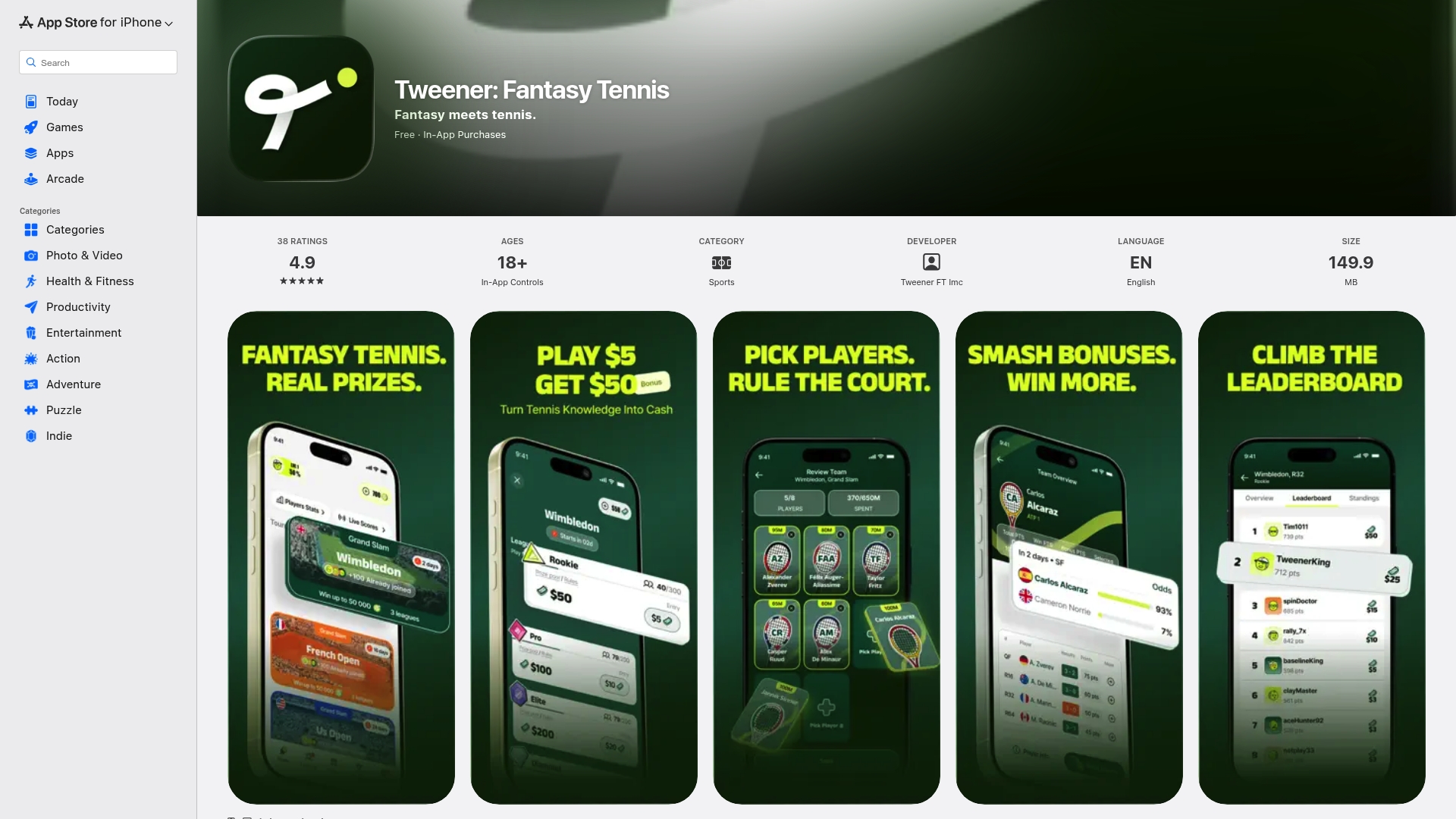
- Draft Mode lets you build a team of real ATP and WTA players and compete based on live tournament results.
- Pick'em Mode offers a faster, matchup-based way to apply surface and draw logic without building a full roster.
- Private leagues let you compete directly against friends during a Grand Slam, turning ownership and leverage decisions into a head-to-head contest rather than an anonymous field.
If you've been applying general DFS ownership advice to tennis and getting mixed results, the fix usually isn't the framework, it's the data feeding it. Visit Tweener to see Draft Mode and Pick'em Mode for the current tour schedule and start building lineups with tennis-specific ownership signals instead of borrowed football logic.
Sources
For deeper research behind this guide: MIT's analysis of skill in fantasy sports, Columbia's research on opponent-aware DFS optimization, and PLOS ONE's study on fantasy manager team similarity. For tennis-specific tactics, see Tweener's guides on matchup analysis and bankroll rules.
- Study shows fantasy sports are driven by skill — MIT News
- Opponent-aware DFS strategies (Columbia PDF)
- PLOS ONE article on fantasy manager strategies and team similarity
- DFS Leverage: How to Beat the Field, Not Just Predict It — DFS Only
FAQ
What is the best strategy for daily fantasy sports?
The strongest general approach balances floor and ceiling based on contest type: prioritize consensus, high-floor picks in cash games and reserve one or two leverage-based pivots for tournaments. Research on opponent-aware optimization shows that factoring in how the field rosters players improves expected payoffs over projection-only strategies.
Is daily fantasy sports considered skill or luck?
Daily fantasy sports performance skews toward skill rather than pure chance. MIT's analysis of FanDuel data found that players who performed well in the past tended to keep performing, a pattern consistent with skill-driven outcomes rather than random results.
How do I win more often in daily fantasy tournaments?
Winning consistently in large tournaments comes down to leverage: rostering players whose simulated win rate exceeds their projected ownership. Combining that leverage math with sound exposure caps across a multi-lineup portfolio, rather than chasing one big single-lineup swing, is the more repeatable path.
What are the best lineup combinations to build today?
The right combination depends on the day's specific matchups, surface, and draw, so there's no fixed answer that holds across slates. The reliable process is checking surface fit, match length expectations, and current ownership trends before locking any lineup, rather than following a fixed formula.
How does ownership percentage affect tennis fantasy lineups specifically?
In tennis, ownership often clusters around seeded favorites regardless of surface fit or draw quality, which creates recurring leverage opportunities on grinders, servers, and players with favorable unseeded paths. Tracking withdrawal and alternate windows close to lock adds another layer of low-ownership value that's specific to how tennis tournaments are structured.