

A deposit limit caps how much money you can move into your fantasy account over a set period, such as a day, week or month. Where a state regulates fantasy contests, operators are often required to offer that control, along with entry limits and self-exclusion. The rules differ by state, so the safest habit is to set your own limit before your first paid entry.
TL;DR
- A deposit limit restricts how much you can add to your account from an outside source over a fixed period. It is a spending guardrail you choose in advance.
- Several states require fantasy operators to offer deposit limits, daily spending limits and self-exclusion. Pennsylvania, Connecticut and Louisiana are examples, and Maryland sets a hard monthly deposit ceiling.
- Self-exclusion goes further than a limit: it blocks new deposits and entries for the period you choose, while you can still withdraw what is left in your account.
- If spending feels hard to control, call 1-800-MY-RESET (1-800-697-3738), the National Problem Gambling Helpline.
Table of Contents
- What a deposit limit actually does
- Deposit limit, spending limit, entry limit: three different controls
- What states require
- Industry guidelines behind the tools
- How to set a limit that works
- Fantasy tennis has its own pressure points
- Check where you can play for cash
- Questions to ask any fantasy app before you deposit
- Our perspective
- Try the free side first
- When limits are not enough
- FAQ
- Sources
What a deposit limit actually does
The idea is simple. A deposit limit restricts the total amount of money you can transfer from an outside source into your gambling account over a specified period. The purpose, as the Danish Gambling Authority describes it, is to make players think about what they can afford before they play. That regulator is not American, but the definition is the standard one used across the industry.
On a daily fantasy sports (DFS) app, the limit works like this:
- You pick a period: daily, weekly or monthly.
- You pick a dollar amount.
- The app declines any deposit that would push you past that amount during the period.
Two details matter in practice. First, a limit applies to money going in, not to what you have already deposited. If you deposited $50 on Monday and have $50 sitting in your balance, the limit does not stop you from entering contests with that balance. Second, a limit is only as strong as the settings behind it. Ask yourself whether you can raise it instantly, or whether the app makes you wait. Most responsible-play frameworks treat a decrease as immediate and an increase as something that should involve a delay or review, though how that works varies by operator and state, so read the app's own rules.
Deposit limit, spending limit, entry limit: three different controls
Readers often search for "spending limits" and "deposit limits" as if they were one tool. They are related but not the same.
| Control | What it caps | Typical use |
|---|---|---|
| Deposit limit | Money added to your account per day, week or month | Setting a monthly entertainment budget |
| Spending limit | Entry fees you can pay per day | Stopping a big balance from being spent in one slate |
| Entry limit | Number of contests you can enter per day | Avoiding chasing entries after a bad day |
| Timeout | A short, instant break from play | Stepping away for a few hours or days |
| Self-exclusion | Access to paid play for a longer, chosen period | A serious reset |
Pennsylvania shows how these stack. The Pennsylvania Gaming Control Board says licensed fantasy providers must allow account limits on deposits, on daily spending on fantasy entries, and on the number of entries per day. That three-part setup is a good template even if you live somewhere with looser rules: limit what goes in, limit what you can spend in a day, and limit how many entries you can fire off.
What states require
There is no single federal rulebook for fantasy sports player protections. States that regulate paid fantasy contests write their own, so the tools you see depend on where you live and which operator you use. A few examples from official text:
- Connecticut. State law requires applicable fantasy-contest operators to let users limit deposits and daily spending, and to run a voluntary self-exclusion process that can prevent account creation, contest participation or spending.
- Louisiana. Regulations require licensees to offer limits on contest frequency, entry-fee spending and deposits, and to allow self-restriction for a period of at least three months. Licensees must also keep an online self-restriction form and tell players they can self-exclude from casino gaming too.
- Maryland. This is the strictest example of a hard cap. Except for season-long fantasy competitions, a player may not deposit more than $5,000 with an operator in a single calendar month unless the operator approves an increase after reviewing evidence such as income or assets, and then runs annual affordability evaluations.
- New York. State gaming commission rules prohibit operators from accepting new entries or deposits once a user self-excludes, but they must still let the user withdraw remaining funds.
Rules change, and several states have amended their fantasy and gaming statutes in recent sessions. Treat the links above as the starting point and check your state regulator's current page before relying on any figure.
Industry guidelines behind the tools
Much of what you see in app settings traces back to voluntary standards. The National Council on Problem Gambling (NCPG) published consumer protection guidelines for fantasy sports in 2015. Three points are worth knowing as a player:
- Timeouts. The guidelines define a timeout as an instant stop in game-play lasting at least one hour but less than 30 consecutive days. It is the lightest tool, useful when you notice you are playing on tilt.
- Account history. Customers should have convenient access to play history and account details, including deposits, withdrawals and bonus information. Use it. A monthly look at your deposit history tells you more than your memory does.
- Self-exclusion. The guidelines say it should be customer-initiated and irrevocable for the period you select. Accounts should be closed or suspended so deposits and buy-ins are blocked, and excluded customers should not receive direct marketing.
That last point is the one people misunderstand. Self-exclusion is designed so you cannot talk yourself out of it on a bad night. If you are not sure you want that, start with a timeout or a lower deposit limit instead.
How to set a limit that works
A limit you will never hit is decoration. A limit you hit every week is a sign the number is wrong, or that something else needs attention. Here is a practical way to choose the figure.
Start with a monthly number, not a daily one
Decide what you would comfortably spend on entertainment in a month, the same way you would budget for streaming services or concert tickets. It should be money you would not miss. Then set the monthly deposit limit to that amount. If your app offers daily limits too, set one at roughly a fifth to a quarter of the monthly figure so a single slate cannot eat the month.
Size entries against your balance
A deposit limit controls how much you add. Entry sizing controls how fast you burn through it. Our bankroll guide for tennis, Tennis DFS Bankroll: Use 1–3% Entries and a 5% Daily Cap, walks through a simple rule of thumb: keep each entry to a small slice of your balance and cap total daily spending. If you are using an entry limit and a spending limit together, those numbers should line up with that rule.
Know the fees you are paying
Entry fees, rake and contest formats change what a given deposit buys you. Before you set a number, read what entry fees in fantasy sports actually mean so you know how many entries a monthly budget really covers.
Plan for taxes
Deposits are not the only number on your statement. Winnings can create tax obligations, and net results over a year matter. Our explainer on U.S. fantasy sports taxes covers how that works, so you do not treat withdrawals as pure profit.
Write down your rules before you play
Pick three: your monthly deposit limit, your maximum daily entries, and the signal that triggers a timeout. A common signal is making an entry you did not plan, or depositing again within an hour of hitting your daily limit. Writing it down makes it easier to follow when you are annoyed about a retirement mid-match.

Fantasy tennis has its own pressure points
Tennis creates specific temptations that a deposit limit helps with. A Grand Slam gives you two weeks of daily slates, so it is easy to keep topping up. Matches also swing live: a player can retire, a rain delay can reshuffle the schedule, and an upset in the first round changes everything. That volatility is why you want rules set before the tournament starts, not during it.
Some habits help:
- Set a tournament budget. Divide your monthly limit by the number of events you want to play, and treat a Slam like one budget line, not a license to deposit daily.
- Use alternates. Withdrawals and late scratches can ruin a lineup. Our guide on setting alternates before lock explains how to protect an entry without adding another one.
- Skip the chase. If an early upset knocks out your top seed, the answer is rarely a fresh deposit. Check your plan and wait for the next slate.
If you want a closer look at the downside scenarios, the risks tennis players should know are laid out in a separate guide.
Check where you can play for cash
Deposit limits only matter where paid contests are available. Legality of cash fantasy play depends on your state, and operators restrict access accordingly. Before depositing, confirm that your state allows it. Our guides on daily fantasy legal states, how state rules for fantasy cash work and fantasy tennis legal states show what to check. Tweener's cash mode is offered only where legally permitted, and only in select U.S. states.
Questions to ask any fantasy app before you deposit
Use this checklist in the app's settings or help center:
- Can I set a deposit limit by day, week and month?
- Is there a daily spending limit on entry fees, and a cap on entries per day?
- How fast does a lower limit take effect, and what happens when I ask for a higher one?
- Is there a timeout option, and how short can it be?
- How does self-exclusion work, how long can I choose, and can I still withdraw my balance?
- Does the app stop marketing messages once I exclude myself?
- Can I see my full deposit and withdrawal history in one place?
If an app cannot answer these clearly, that is information. A well-run platform makes the tools easy to find.
Our perspective
We built Tweener around one idea: tennis fans who think analytically should have a serious, skill-based way to compete. That includes how you manage your money.
The free mode exists for a reason. You play with virtual coins, earn more through gameplay and other in-app activities, and can redeem coins for rewards such as gift cards. For many fans, that is the whole point, and it costs nothing to learn surfaces, head-to-head records and form without any deposit to limit.
When you do choose cash contests, treat the entry fee as the price of entertainment and a test of your analysis, not as income. Pick a monthly figure, keep entries small, and let your edge come from preparation. Strategy over luck only works when the bankroll lasts long enough for strategy to matter.
We would rather you play a full Slam on a modest budget with a private league of friends than burn a month's budget in a weekend.
Nathan
Try the free side first
If you want to sharpen your tennis reads before putting money in, Tweener lets you build a team of real ATP and WTA players and score points from live match results. You can compete in Draft Mode or Pick'em Mode with virtual coins, join public leagues, or set up a private league with friends for a tournament. Cash contests are available where legally permitted.
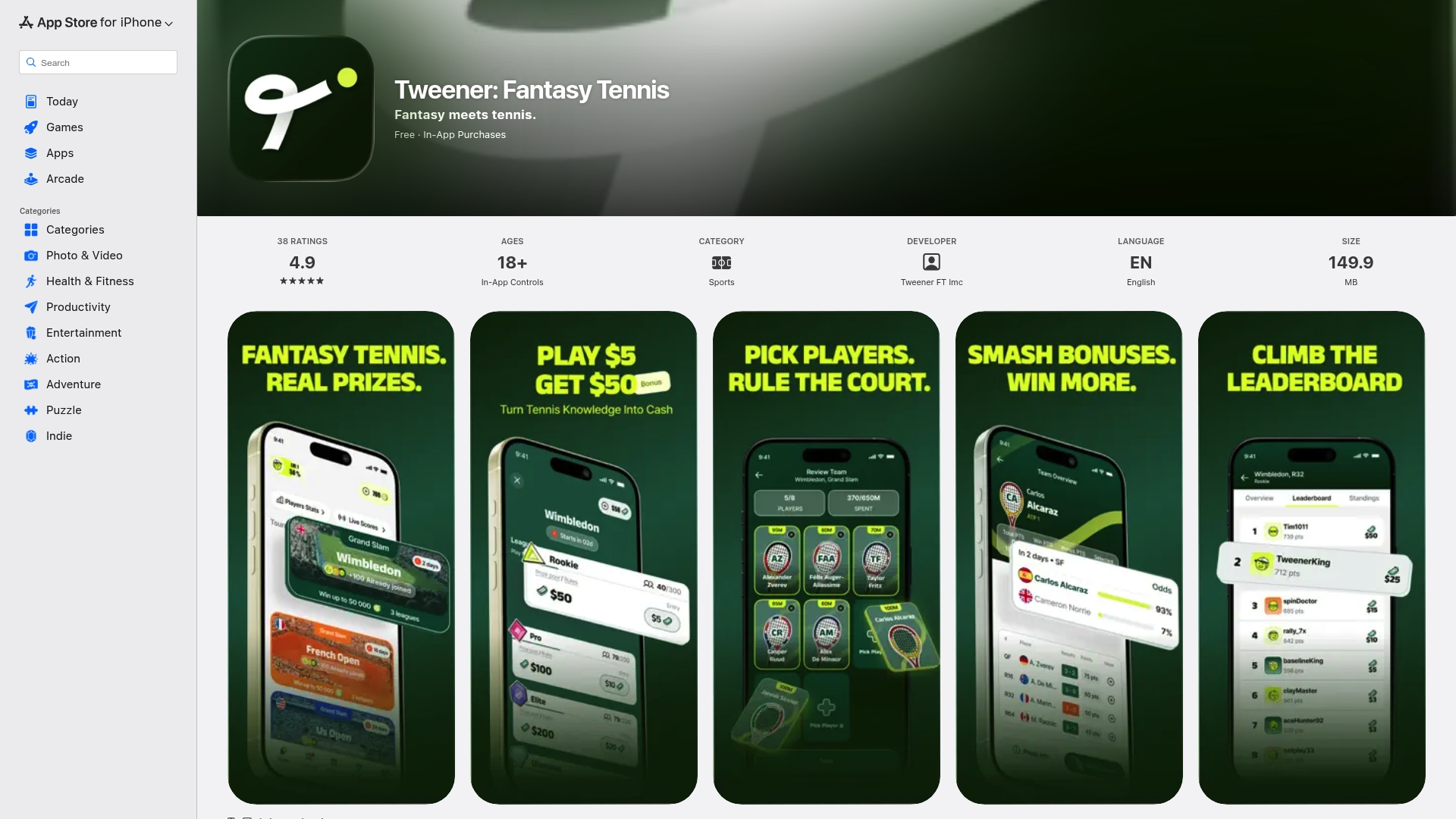
Play a few slates for free, learn how scoring responds to surface and form, then decide whether paid entries fit your budget.
When limits are not enough
Tools help, but they do not replace support. If you are depositing more than you planned, hiding activity, or chasing losses, stop and talk to someone. In the U.S., the National Problem Gambling Helpline is 1-800-MY-RESET (1-800-697-3738). NCPG says it connects callers with local help and covers all 50 states and U.S. territories. Alongside that call, use self-exclusion on every app you have an account with, since one exclusion does not automatically cover the others, though some states link exclusion lists across regulated gaming.

FAQ
Can I change a deposit limit after setting it?
Usually yes, but the rules depend on the operator and state. Lowering a limit is typically immediate, while raising one may involve a delay or review. Maryland goes further: raising the monthly $5,000 ceiling requires operator approval after an evidence review of income or assets.
Does self-exclusion stop me from withdrawing my money?
No. Under New York's rules, operators must stop accepting new entries and deposits after a self-exclusion request, but they must still allow you to withdraw the funds remaining in your account. Check your own state's rules and the app's terms for the process.
What is the difference between a timeout and self-exclusion?
A timeout is a short break. NCPG's guidelines define it as an instant stop lasting at least one hour but less than 30 consecutive days. Self-exclusion is customer-initiated and irrevocable for the period you pick, so it is the stronger option when you need a real reset.
Do deposit limits exist on every fantasy app?
Not in the same form. States such as Pennsylvania, Connecticut and Louisiana require them from regulated operators, but requirements vary elsewhere. Look in the account settings before you deposit, and use the checklist above to compare what an app offers.
Sources
- The Danish Gambling Authority's guidance on responsible gambling
- Fantasy Contests, Pennsylvania Gaming Control Board
- NCPG Fantasy Sports Consumer Protection Guidelines (2015)
- Connecticut General Statutes, Chapter 229b
- Louisiana Administrative Code, Title 42, § VII-517
- Maryland COMAR 36.09.04.02, Limits on Deposits
- New York State Gaming Commission, Interactive Fantasy Sports rules
- National Council on Problem Gambling, Helpline