

TL;DR:
- Age verification in gaming apps involves layers of checks, from simple birthdate entry to government ID verification. Stronger methods are used when cash payouts or chat features are enabled to comply with regulations and protect users. Platforms adopt a risk-based approach, requiring early verification before major tournaments to prevent payout delays.
Age verification in gaming apps is the set of checks that confirm a user meets a required minimum age using evidence beyond a typed birthdate. For fantasy-tennis players on Tweener, it governs three things directly: access to cash contests, participation in chat and private leagues, and certain in-app purchases. Get it wrong and you're locked out of a payout. Understand it and you'll never hit a surprise wall mid-tournament.
Here's what age verification in gaming apps actually covers:
- Cash contests and payouts: Real-money entry and withdrawal require stronger identity checks than free play.
- Chat and direct messages: Social features are gated separately, often under COPPA and platform safety rules.
- In-app purchases: Some purchase flows trigger verification at the point of transaction.
- Platform-level enforcement: Age checks apply to features like chat, store access, and user-generated content, not just gameplay itself.
Table of Contents
- What's the difference between an age gate and real age verification?
- How do gaming apps actually verify your age?
- How does a risk-based approach decide which check you get?
- Why privacy-preserving verification is where the industry is heading
- What should you expect when an app asks to verify your age?
- Developer checklist for building age verification into a fantasy sports app
- U.S. regulatory cautions every fantasy-tennis app should know
- What happens when verification fails?
- Specific challenges for fantasy-tennis apps offering cash contests
- How age verification requirements differ outside the U.S.
- What's next for age verification technology in gaming apps
- Key Takeaways
- Age verification and what it means for the fantasy-tennis community
- Tweener's approach to age verification
- Useful sources
What's the difference between an age gate and real age verification?
An age gate is a self-declared birthdate. You type "January 1, 1990," click confirm, and you're in. No evidence required. It's fast, frictionless, and easy to lie about, which is exactly why it doesn't satisfy regulators or payment processors when real money is involved.
Age verification uses higher-assurance methods: government ID checks, biometric facial age estimation, financial or credit database signals, or tokenized attestations. The distinction matters practically because platforms apply different standards to different features. A typed birthdate might clear you for free play. A cash payout requires proof.
Age assurance sits between the two: it's a broader term covering any method used to estimate or confirm age, including privacy-preserving signals that only assert "over 18" without revealing your actual date of birth or ID details.
The key insight: you won't always face the stronger check at signup. Platforms often route you to ID verification only when you try to withdraw winnings or enable chat, because that's when the legal and financial risk actually materializes.
Pro Tip: If you plan to enter cash contests on any fantasy-sports app, complete the stronger verification step before your first deposit. Waiting until payout day creates delays that can last 24–72 hours.
How do gaming apps actually verify your age?
Different surfaces call for different methods. Here's how the main options stack up:
| Method | How it works | Primary benefit | Main drawback | Best for |
|---|---|---|---|---|
| Age gate | Self-declared birthdate | Zero friction | Easily bypassed | Free play, general access |
| Email/phone | OTP sent to registered contact | Low friction | Doesn't confirm age | Account creation |
| Credit/financial signal | Cross-references payment data | No document upload | Requires a card | Purchase gating |
| Document IDV | Photo of passport or driver's license | High accuracy | Friction, privacy risk | Cash payouts |
| Facial age estimation | AI selfie analysis with liveness check | Moderate friction | Less reliable alone | Chat gating, quick checks |
| Parental consent | Parent confirms minor's account | Covers under-13 | Complex workflow | COPPA compliance |
| Attestation/token | OS or platform-level age signal | Verify once, reuse | Requires platform support | Repeat sessions |
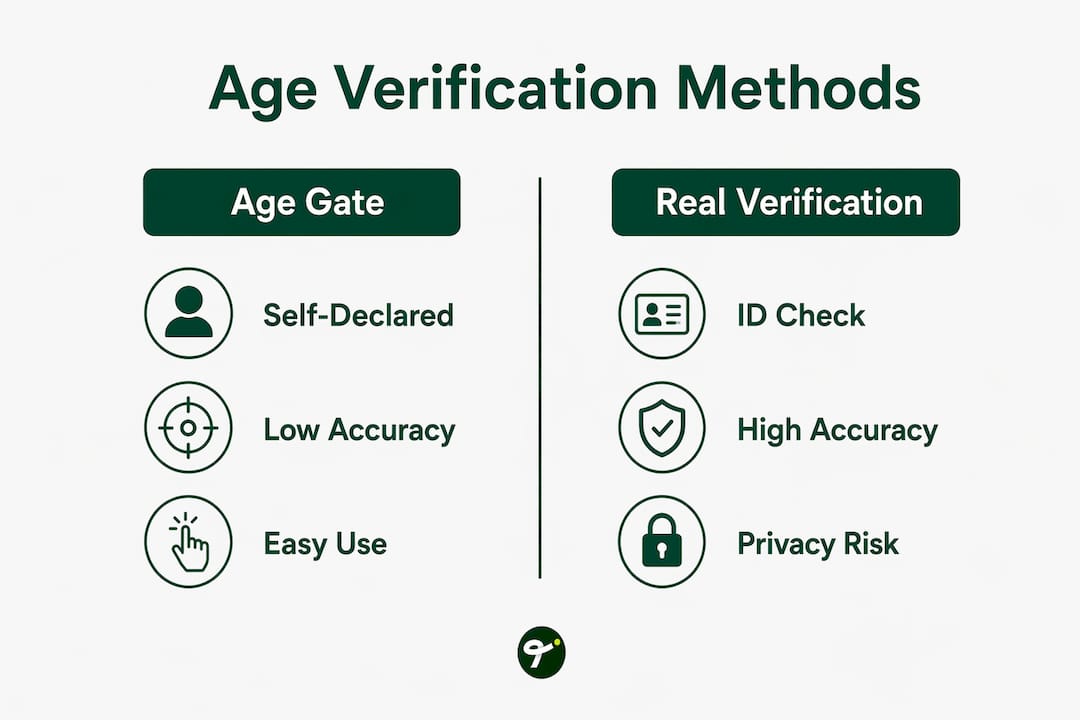
Identity document verification is the most accurate method, but it introduces the most friction and the greatest privacy exposure. That's why platforms defer it until it's genuinely necessary. Facial age estimation has grown rapidly since Roblox's 2025 implementation with Persona, but it's most reliable when paired with a liveness check or a document fallback rather than used alone.
How does a risk-based approach decide which check you get?
Apps don't apply the same check to every action. The logic is layered: low-friction gates for low-risk features, stronger verification when the stakes rise. This is industry best practice for balancing user experience against compliance.
Here's what a typical verification flow looks like for a Tweener player:
- Account creation: Enter birthdate (age gate). Access free play immediately.
- Enabling chat or private leagues: Platform may request email/phone confirmation or a quick facial age check.
- First cash deposit: Triggers a financial signal check or document IDV, depending on deposit size and state rules.
- Cash contest entry: Confirmation that prior verification is complete; no repeat upload needed if tokenized.
- First payout: Full IDV or KYC check required. This is where most delays happen.
The triggers that escalate checks are predictable: first cash deposit, first payout request, enabling direct messages, or accessing mature user-generated content. Understanding in-app purchase flows helps you anticipate where verification will appear.
Pro Tip: Modern platforms issue a verification token after your first successful ID check. That token carries across sessions, so you verify once and the app reuses the attestation rather than asking you to re-upload documents every time.
Why privacy-preserving verification is where the industry is heading
The old model stored your ID scan and date of birth on a server. The new model sends a single signal: "this user is over 18." Nothing else. Persona is a noted provider working on exactly these privacy-preserving attestations for gaming platforms, confirming age thresholds without retaining sensitive document copies.
"Age-appropriate design" means limiting what unverified users can access rather than blocking them entirely. An unverified player can still compete in free leagues; they just can't enter cash contests or use chat until they verify. That's a better UX and a more defensible compliance posture than a hard wall.
Regulatory pressure is reinforcing this direction. The shift from blocking to age-appropriate design means platforms should default unverified users to safer settings rather than locking them out entirely. The EU's 2026 Age Verification Recommendation formalizes this with a blueprint for privacy-preserving, "over-X" signals that reveal no other personal data.
Pro Tip: Before submitting any ID to a gaming app, check the privacy policy for three things: how long documents are retained, whether raw ID copies are stored or only a derived signal, and which third-party processors handle the data.
What should you expect when an app asks to verify your age?
- At signup: Enter your birthdate. Expect no document upload for free play.
- At first cash deposit: You'll likely see a prompt for a government ID photo or a financial verification step.
- At contest entry: The app confirms your verification status. If it's complete, you proceed instantly.
- At payout: Full KYC review. Have a valid driver's license or passport ready. Processing typically takes 1–3 business days.
Watch for red flags: any app that asks to retain a copy of your ID indefinitely with no stated deletion timeline, lacks a published privacy policy, or sends payment prompts via SMS that look like phishing. Legitimate gaming app age restrictions are compliance-driven, not data-harvesting exercises.
Pro Tip: Verify your account before the tournament you want to play. Wimbledon draws start fast, and a payout delay on a Sunday afternoon is a bad time to discover your ID check is pending.
Developer checklist for building age verification into a fantasy sports app
- Map your risky surfaces first. Chat, cash deposits, payouts, and user-generated content each carry different legal and financial risk profiles.
- Choose a layered architecture. Age gate for account creation; escalate to document IDV or financial checks for payouts.
- Select privacy-preserving providers. Prefer vendors that return attestation tokens rather than storing raw document images.
- Design clear UX and fallbacks. Tell users exactly why verification is required and what happens if it fails.
- Implement tokenized attestations. Reuse verified status across sessions to reduce drop-off at cash contest entry.
- Use liveness checks only where necessary. Facial estimation with liveness is appropriate for chat gating; full IDV is reserved for financial actions.
- Set data minimization and retention rules. Define how long any collected data is held and automate deletion.
- Build a dispute workflow. Users whose verification fails need a clear appeal path and a support contact.
- Add parental consent flows for under-13 accounts. COPPA requires verifiable parental consent before collecting data from children under 13.
- Maintain audit logs. Regulators and payment processors may request evidence of your verification controls.
Pro Tip: Run opt-in A/B tests in permissive markets to measure drop-off at each escalation trigger. Tune the thresholds before rolling out to all users. A 5% drop-off improvement at the payout step compounds significantly across a tournament season.
U.S. regulatory cautions every fantasy-tennis app should know
| Regulation | Scope | Age threshold | Practical effect |
|---|---|---|---|
| COPPA | Federal; data collection from children | Under 13 | Verifiable parental consent required before collecting personal data |
| State fantasy-sports laws | Varies by state | Usually 18+ | Real-money contests may be prohibited or require registration in certain states |
| State social media age laws | Growing; varies | 13–16 depending on state | Age assurance required for account creation on covered platforms |
| California Digital Age Assurance Act | California; OS-level age signals | Varies | App vendors must request age signals; receiving one constitutes "actual knowledge" of user age |
State-level complexity is the part most teams underestimate. Real-money fantasy-sports contests are governed differently across states, and the minimum age and registration requirements vary. Consult legal counsel before enabling cash contests in any new state. This article is general information, not legal advice; confirm current rules with a qualified attorney for your specific situation.
What happens when verification fails?
A failed verification doesn't necessarily mean a permanent ban. Most platforms distinguish between a soft failure (document unclear, liveness check not passed) and a hard failure (identity mismatch, sanctions hit). Soft failures typically trigger a retry prompt with guidance on lighting or document quality. Hard failures lock the account pending manual review.
For players, the practical impact is a delayed payout or restricted access to chat and cash contests until the issue resolves. Contact the platform's support team with a reference number from the failed check. Most platforms have a 3–5 business day review window. If you believe the failure was a system error, request escalation to a human reviewer rather than waiting for an automated retry.
Specific challenges for fantasy-tennis apps offering cash contests
Fantasy tennis sits at an interesting intersection: it's skill-based, not gambling in the traditional sense, but cash payouts trigger the same KYC and age-verification requirements as any real-money platform. The challenge is that tennis fans span a wide age range, from teenagers following Jannik Sinner and Carlos Alcaraz to seasoned fans who've watched the sport for decades.
The friction point is the Grand Slam window. Wimbledon, the US Open, Roland Garros, and the Australian Open compress a huge volume of contest entries into a short period. A verification backlog during the first week of a Grand Slam can lock players out of the contests they've been planning for months. The solution is pre-tournament verification campaigns: prompt users to complete ID checks in the weeks before a major, not the day draws are announced. Tweener's free vs cash mode structure means unverified players can still compete with virtual coins while completing the stronger checks required for paid entry.
How age verification requirements differ outside the U.S.
The U.S. framework centers on COPPA and state-level fantasy-sports laws. Outside the U.S., the picture is more prescriptive. The UK's Online Safety Act 2023, which took effect in July 2025, requires platforms hosting certain content to use age verification or age assurance to prevent children from accessing it. The EU's 2026 Commission Recommendation establishes a common framework for privacy-preserving age verification tied to European Digital Identity Wallets. Australia passed legislation in late 2025 banning users under 16 from social media, with fines of up to several tens of millions of Australian dollars for systemic breaches.
For a U.S.-based app with international users, the practical implication is that verification standards you'd apply voluntarily for good UX in the U.S. may be legally mandatory for your UK or EU users. Building to the stricter standard from the start is less expensive than retrofitting. Tennis is a global sport, and geofenced app design can help teams apply the right verification tier by region without a single global policy that over-restricts everyone.
What's next for age verification technology in gaming apps
Three trends are converging. First, OS-level age attestation APIs, like California's Digital Age Assurance Act framework, mean the device itself will carry a verified age signal that apps can query without asking users to re-upload documents. Second, AI-powered facial age estimation is improving rapidly, though it still performs less reliably on diverse skin tones and lighting conditions, which is why liveness checks and document fallbacks remain standard. Third, the EU's open-source age verification blueprint, built on the same architecture as European Digital Identity Wallets, points toward a future where a single verified credential travels with a user across platforms and borders.
For fantasy-tennis apps, the near-term opportunity is tokenized attestations: verify once, reuse across sessions and tournaments. That's the architecture that keeps cash contest entry fast while satisfying regulators and payment processors. Racquet-sport communities are also thinking about this from the facility side; the court booking software space is grappling with similar identity and access-control questions as it moves online.
Key Takeaways
Age verification in gaming apps is a layered, risk-based system: light checks for free play, stronger ID or financial checks for cash contests and payouts.
| Point | Details |
|---|---|
| Age gate vs. verification | A typed birthdate is not age verification; cash contests require document IDV or financial signals. |
| Layered approach | Free play uses low-friction gates; chat, deposits, and payouts escalate to stronger checks. |
| Privacy-preserving signals | Platforms like Persona confirm "over 18" without storing your ID or date of birth. |
| Verify early | Complete ID verification before a Grand Slam tournament to avoid payout delays. |
| Tweener's structure | Tweener uses free-play mode for unverified users and requires stronger checks for cash contest entry and payouts. |
Age verification and what it means for the fantasy-tennis community
The technical machinery of age verification can feel distant from the actual experience of picking Novak Djokovic for your Wimbledon squad. But it shapes the game more than most players realize. Cash contests require proof of identity because payment processors demand it, not because platforms want to collect your data. Chat features get gated because younger fans are part of the tennis community too, and platforms have a real responsibility to keep those spaces safe.
What I find genuinely interesting about Tweener's position is that the layered verification model maps cleanly onto how tennis fans actually engage with the sport. Casual fans following a Grand Slam can jump into free leagues with virtual coins and no friction. Serious, analytical players who want to compete for real money in private leagues with friends go through the stronger checks once, get their token, and then the verification step disappears from their experience entirely. That's the right design. It protects the community without punishing the players who are most invested in the competition.
Tweener's approach to age verification
Tweener uses a layered verification model that matches the risk level of each feature. Free-play users compete with virtual coins and face minimal friction at signup. Cash contest entry and payouts require stronger identity verification, consistent with U.S. payment-processor requirements and state fantasy-sports rules.
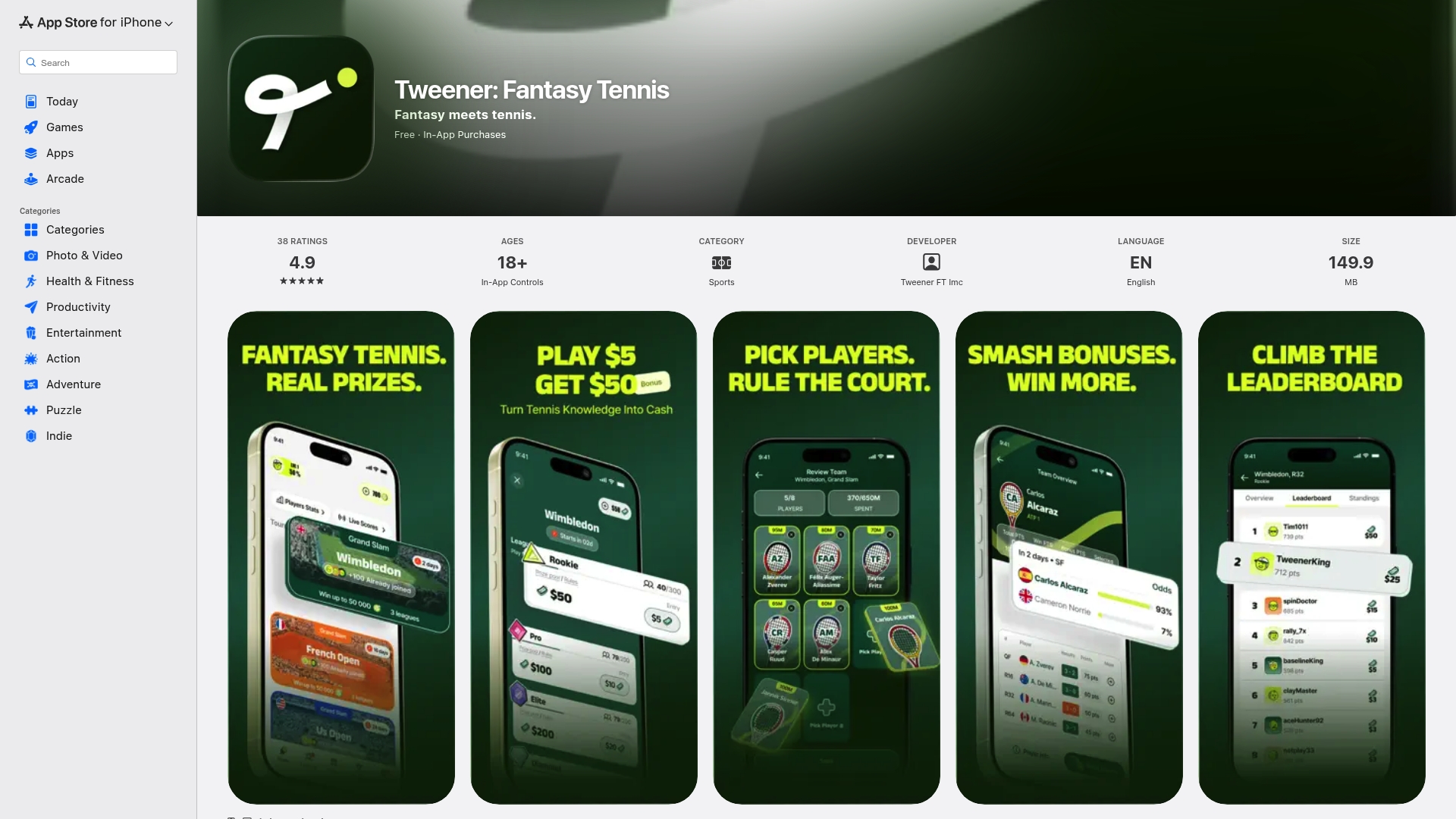

Verified accounts on Tweener can enter paid contests, access chat and private leagues, and compete for real-money payouts where permitted by state law. If you hit a verification delay, the support team can walk you through the retry process. The fastest path is to verify before your first deposit rather than at payout time.
Ready to compete in fantasy tennis with real ATP and WTA players? Start on Tweener and complete your verification before the next Grand Slam draw.
Useful sources
- Regula Forensics: Age Verification in Gaming
- Persona: Privacy and Age Verification in Gaming
- didit.me: Age Verification in Mobile Gaming
- Wiggin: Age Assurance in Games (UK)
- WIRED: Age Verification Is Sweeping Gaming
- EU Commission Recommendation on Age Verification (2026)
- Wikipedia: Age Verification
- Tweener