

TL;DR:
- A geofenced gaming app uses virtual geographic boundaries to ensure players are within permitted locations. It combines GPS, Wi-Fi, and cellular data with layered checks to verify real-time positions and prevent spoofing. This technology enforces legal compliance and enhances matchmaking by clustering nearby players for better response times.
A geofenced gaming app is a mobile game that uses virtual geographic boundaries to control or enhance gameplay based on a player's real-world location. These boundaries, called geofences, trigger specific features or restrictions the moment a player enters, exits, or lingers within a defined zone. Geofencing in gaming serves two core purposes: regulatory compliance and gameplay improvement. For real-money and skill-based games, location verification is not optional. It is a legal requirement that shapes how the entire app is built.

What is a geofenced gaming app and how does it work technically?
Geofencing technology in games relies on a method called signal fusion. Signal fusion combines GPS, Wi-Fi, and cellular tower data into a single, accurate location reading. Raw GPS alone is noisy and drains battery fast. Signal fusion solves both problems by weighting each data source based on conditions, giving the app a reliable position fix without killing your phone's charge.
The app then evaluates that position against a defined boundary. This happens in two places:
- Client-side evaluation: The device's operating system monitors the geofence locally. This is fast and works well for a small number of high-priority zones.
- Server-side evaluation: The app sends location data to a remote server, which checks it against a larger catalog of boundaries. Most systems use both, with client-side fences handling priority zones and server-side handling scale.
- Integrity checks: Apps run layered verification to catch location spoofing. One iGaming platform processes 14,000 transactions per second with over 350 integrity checks per session. That level of scrutiny reflects how seriously operators treat location fraud.
- Event triggers: Geofences fire on three conditions: entry (player crosses into a zone), exit (player leaves), and dwell time (player stays within a zone for a set period).
The dwell-time trigger is underappreciated. A player who briefly crosses a state line does not automatically gain access to restricted features. The app waits to confirm the player is genuinely within the permitted zone before unlocking anything.
Pro Tip: If your app feels slow to recognize your location after opening, it is likely running server-side verification. Give it 10–15 seconds before assuming something is broken.
How does geofencing protect legal compliance in gaming apps?
Regulatory compliance is the primary reason geofenced mobile games exist in their current form. In the United States, real-money gaming is legal only in specific states. An app operating in this space must verify that each player is physically inside a permitted jurisdiction before allowing any paid contest. IP addresses alone cannot do this reliably. A VPN or proxy can mask a user's true location at the IP level, which is why geofencing differs fundamentally from geolocking.
The distinction matters:
- Geofencing actively monitors a player's position in real time and triggers events at boundary crossings. It operates at meter-level precision.
- Geolocking passively restricts access by region, typically using IP-level checks. It works at the country or broad-region level and is far easier to bypass.
- Auditable logs are a legal requirement, not a best practice. Operators must maintain detailed records of location data sources and timestamps to defend their enforcement decisions in any regulatory review.
- Fail-safe design means the app defaults to blocking access when location data is unavailable or ambiguous. Compliance always takes priority over convenience.
- Jurisdiction-specific rules vary by state and country. An app legal in New Jersey may be prohibited in Utah. Geofencing enforces these distinctions automatically, without requiring the player to self-report their location.
"Developers should view geofencing as a rigorous control system with layered checks and defensible logs to manage legal and operational risk when games cross jurisdictions." — iGaming Geofencing Guide 2026
The legal stakes are real. An operator caught allowing players from restricted jurisdictions faces license revocation, fines, and potential criminal liability. Geofencing is the technical infrastructure that keeps the business legal.
How does geofencing shape gameplay and user experience?
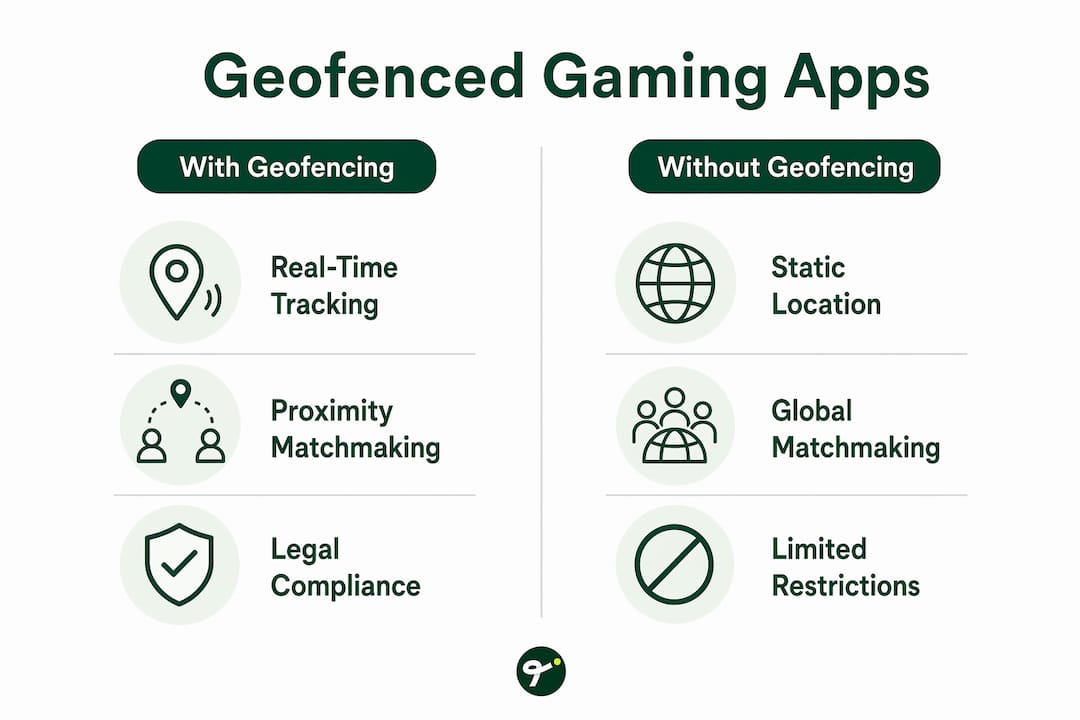
Beyond compliance, geofencing technology in games directly improves how multiplayer experiences feel. The most direct benefit is latency reduction. Geofencing clusters players by real-world proximity, which shortens the physical distance data must travel between devices and servers. Lower latency means faster response times and a fairer competitive environment.
| Feature | With geofencing | Without geofencing |
|---|---|---|
| Matchmaking pool | Proximity-based, lower latency | Global, higher latency variance |
| Skill grouping | Regionally calibrated | Diluted across all regions |
| In-game events | Location-triggered, contextual | Generic, same for all players |
| Compliance enforcement | Automatic, real-time | Manual or absent |
Location-based events add another layer of engagement. A geofenced mobile game can unlock a special tournament, bonus reward, or in-game item when a player enters a specific city or venue. This connects the digital game to real-world geography in a way that generic mobile games cannot replicate.
The flip side is that some players try to manipulate the system. VPNs can shift a player's virtual location to access a different matchmaking pool, often one with less competition. This violates most apps' terms of service and carries real risks, including account bans and forfeiture of winnings. Apps counter this with the same layered integrity checks used for compliance, cross-referencing GPS, Wi-Fi, and cellular data to detect inconsistencies that signal spoofing.
- Location-based rewards tied to real-world venues
- Proximity matchmaking for reduced ping and fairer competition
- Regional skill pools that reflect local player bases
- Dynamic event triggers based on entry, exit, or dwell time
Common misconceptions about geofenced apps
The biggest misconception players have is that disabling GPS disables geofencing. This is wrong. Apps enforce a fail-safe mode that blocks location-sensitive features entirely when location permissions are denied. Turning off GPS does not grant access to restricted content. It locks you out of it.
Battery drain is a legitimate concern, and it is worth understanding why. Continuous location monitoring, especially with signal fusion running in the background, consumes more power than a static app. Developers address this through dynamic monitoring strategies that reduce polling frequency when a player is stationary and increase it near boundary zones. The result is a reasonable tradeoff, not a dealbreaker.
Privacy is the other tension point. Geofenced apps require ongoing access to your location, which some players find uncomfortable. Reputable operators are transparent about what data they collect, how long they retain it, and who can access it. Reading the privacy policy before granting permissions is not paranoia. It is good practice.
Pro Tip: Grant location access "while using the app" rather than "always" if your device offers that option. Most geofenced gaming apps function correctly with this setting, and it limits background data collection.
Common misconceptions worth clearing up:
- Disabling GPS does not bypass geofencing. It triggers a fail-safe that blocks access entirely.
- VPNs do not reliably fool modern geofencing systems. Signal fusion cross-checks multiple data sources.
- Geofencing is not the same as geolocking. The two use different mechanisms and serve different purposes.
- Battery drain from geofencing is real but manageable with well-designed apps.
Key Takeaways
A geofenced gaming app uses signal fusion, layered integrity checks, and real-time boundary monitoring to enforce compliance and improve gameplay simultaneously.
| Point | Details |
|---|---|
| Signal fusion drives accuracy | GPS, Wi-Fi, and cellular data combine to produce reliable location readings with lower battery cost. |
| Compliance is the core use case | Real-money gaming apps use geofencing to verify players are inside legally permitted jurisdictions. |
| Geofencing differs from geolocking | Geofencing triggers events at meter-level precision; geolocking restricts access at the country or region level via IP checks. |
| Fail-safe design blocks, not bypasses | Denying location permissions locks players out of geofenced features rather than granting unrestricted access. |
| Matchmaking benefits are real | Proximity-based clustering reduces latency and improves skill grouping in competitive mobile games. |
Geofencing is more than a compliance checkbox
I have watched geofencing get treated as a legal burden for years. Operators build it because regulators require it, then stop thinking about it. That framing misses the point entirely.
The apps that use geofencing well treat it as a design tool. Proximity-based matchmaking is a direct product improvement. Location-triggered events create moments that generic apps cannot replicate. The social gaming potential of connecting players who are physically near each other has barely been explored.
The tension between mobile freedom and geographic boundaries is real, and I do not think it goes away. Players want to compete from anywhere. Regulators want to know exactly where players are. The apps that navigate this well will be the ones that build transparent, defensible systems and communicate clearly with their users about why location access matters.
The future of geofencing in gaming is not more restriction. It is more nuance. Expect to see privacy-aware designs that collect less data while maintaining compliance, and location-based features that feel like rewards rather than gatekeeping. The technology is capable of both. The question is whether developers choose to use it that way.
— Nathan
Tweener brings geofencing-aware fantasy tennis to real fans
Fantasy tennis has needed a purpose-built platform for a long time. Tweener fills that gap by turning ATP and WTA tournament results into a live, skill-based competition where your picks and strategy determine your outcome.
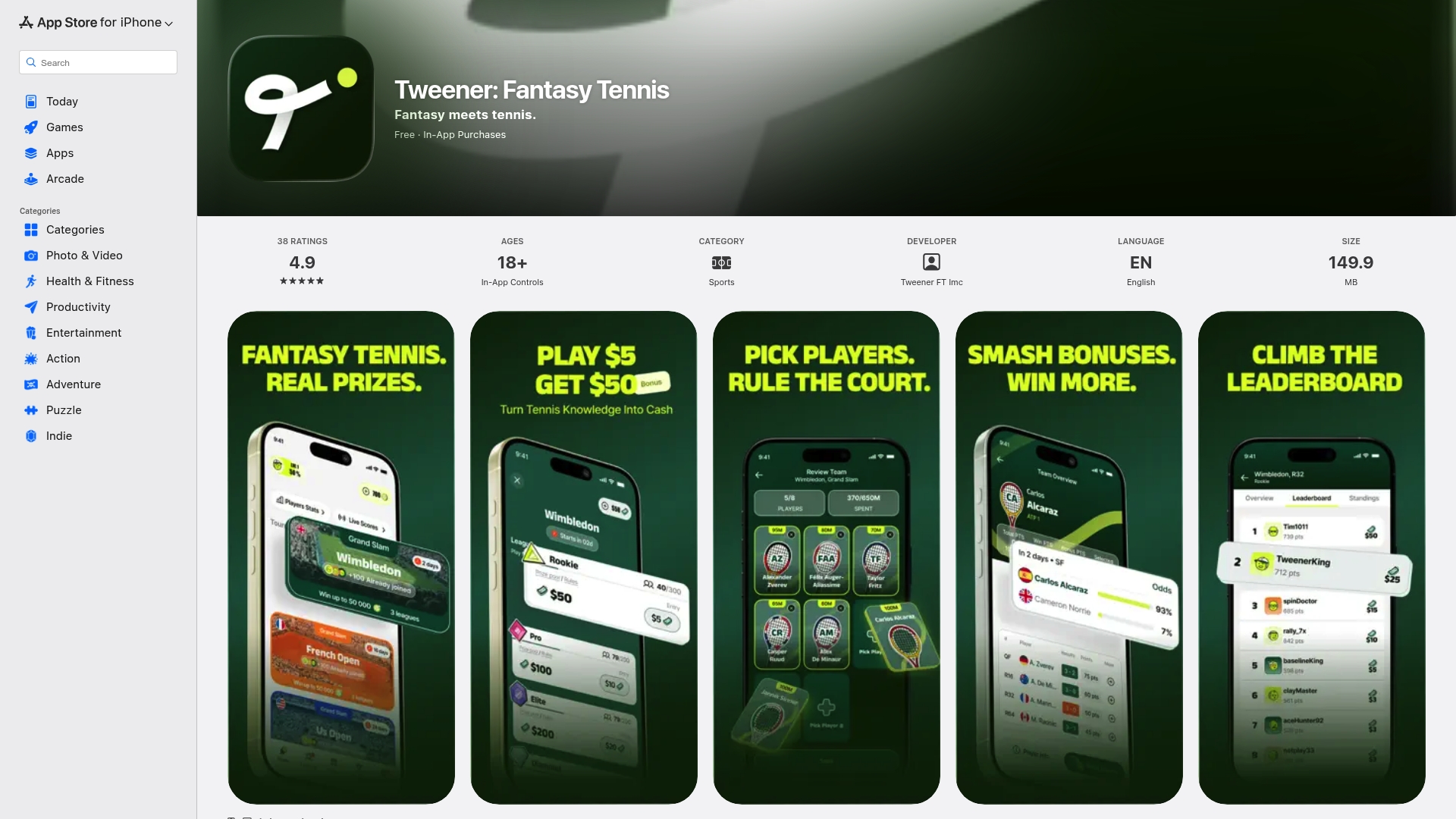
Tweener uses location-aware features to support fair competition and matchmaking across its public and private leagues. Players build fantasy teams from real professionals, earn points based on actual match results, and compete for virtual coins or real-money payouts where permitted. The platform's fantasy tennis experience is built for fans who follow the sport closely and want a strategic edge, not just a scoreboard. If you understand surface performance, head-to-head records, and tournament draw dynamics, Tweener is where that knowledge pays off.
FAQ
What is a geofenced gaming app?
A geofenced gaming app is a mobile game that uses virtual geographic boundaries to trigger features or restrictions based on a player's physical location. These boundaries enforce regulatory compliance and can also improve matchmaking and enable location-based in-game events.
How does geofencing differ from geolocking?
Geofencing actively monitors a player's position in real time and triggers events at boundary crossings with meter-level precision. Geolocking passively restricts access by region using IP-level checks, which are easier to bypass and less precise.
Can I bypass geofencing with a VPN?
VPNs can mask your IP address but cannot reliably fool modern geofencing systems. Apps use signal fusion to cross-check GPS, Wi-Fi, and cellular data simultaneously, and inconsistencies between these sources flag spoofing attempts.
Does turning off GPS disable geofencing?
No. Disabling GPS triggers a fail-safe mode that blocks access to location-sensitive features entirely. The app does not grant unrestricted access when location permissions are denied.
Why does a geofenced app drain my battery?
Continuous location monitoring with signal fusion running in the background uses more power than a static app. Well-designed apps reduce polling frequency when you are stationary and increase it near boundary zones to manage this tradeoff.