

TL;DR:
- A retirement in tennis occurs when a player withdrawals after the match has started, resulting in an immediate win for the opponent. It is triggered by injury, illness, or exhaustion and is recorded with a "ret." suffix in the score, affecting rankings and match statistics. Betting rules differ depending on the sportsbook and the timing of the retirement, impacting wager settlements significantly.
A retirement in tennis is defined as a player's withdrawal from a match after play has officially begun, resulting in their opponent being awarded the win regardless of the current score. The term carries specific meaning in professional tennis, and it is distinct from two other commonly confused terms: walkover and default. Understanding the difference matters whether you are watching a Grand Slam match, tracking ATP or WTA player stats, or managing a fantasy tennis team on Tweener. This guide covers what triggers a retirement, how it is recorded, and what it means for betting markets.
What is a retirement in tennis, and when does it happen?
A retirement is the withdrawal of a player after the match has started, with the opponent automatically declared the winner. The key legal threshold is simple: at least one ball must have been served for a withdrawal to count as a retirement rather than a walkover. Once that first serve lands, the match is officially underway, and any subsequent withdrawal carries the full weight of a retirement in the official record.
Retirements are not rare in professional tennis. The sport demands extraordinary physical output across multiple sets, sometimes in extreme heat, on unforgiving hard courts, or during the compressed schedules of back-to-back tournaments. Players at every level, from first-round qualifiers to top-ranked Grand Slam contenders, face moments where continuing a match would risk serious long-term injury. The decision to retire is a medical and personal judgment call, and the ATP and WTA both treat it as a legitimate and respected outcome.
Casual fans often confuse retirement with walkover, though the two carry different tournament significance. A walkover means the match never started. A retirement means it did, and that distinction shapes everything from official records to betting settlements.
What triggers a retirement in tennis matches?
Retirement is primarily triggered by muscle injuries, cramps, heat-related illness, or sudden sickness that prevents a player from continuing. These are not soft exits. Professional players push through pain as a matter of course, so a retirement signals that something has crossed a threshold where continuing would cause real harm.
Common causes include:
- Muscle strains and tears: Hamstring, calf, and abdominal injuries are frequent culprits, especially during long baseline rallies or explosive serve motions.
- Severe cramping: Dehydration and heat combine to cause full-body cramping, which can make movement impossible.
- Heat illness: Tournaments in Melbourne, Miami, and Doha regularly produce dangerous heat conditions. Players can experience dizziness, nausea, and heat exhaustion mid-match.
- Ankle and knee injuries: A twisted ankle on a clay court or a knee that gives out mid-sprint can end a match instantly.
- Illness: Respiratory infections, stomach bugs, and fever can strike during a tournament week, leaving a player physically unable to compete at any level.
Retirements can happen between sets or during a set, at any point after that first serve. A player may complete the first set, begin the second, and then retire at 2-1 down. The match stops at that exact moment.
Pro Tip: If you follow a player's season closely, tracking their retirement history gives you a real edge in fantasy tennis. A player returning from a recent retirement is statistically more likely to withdraw again or underperform in the next tournament.

Medical protocols on tour require that a physio assessment happens courtside before a retirement is confirmed. Players do not simply walk off. The umpire is notified, the physio evaluates the situation, and the retirement is formally declared. This process protects both the player and the integrity of the match.
How does retirement differ from a walkover and a default?
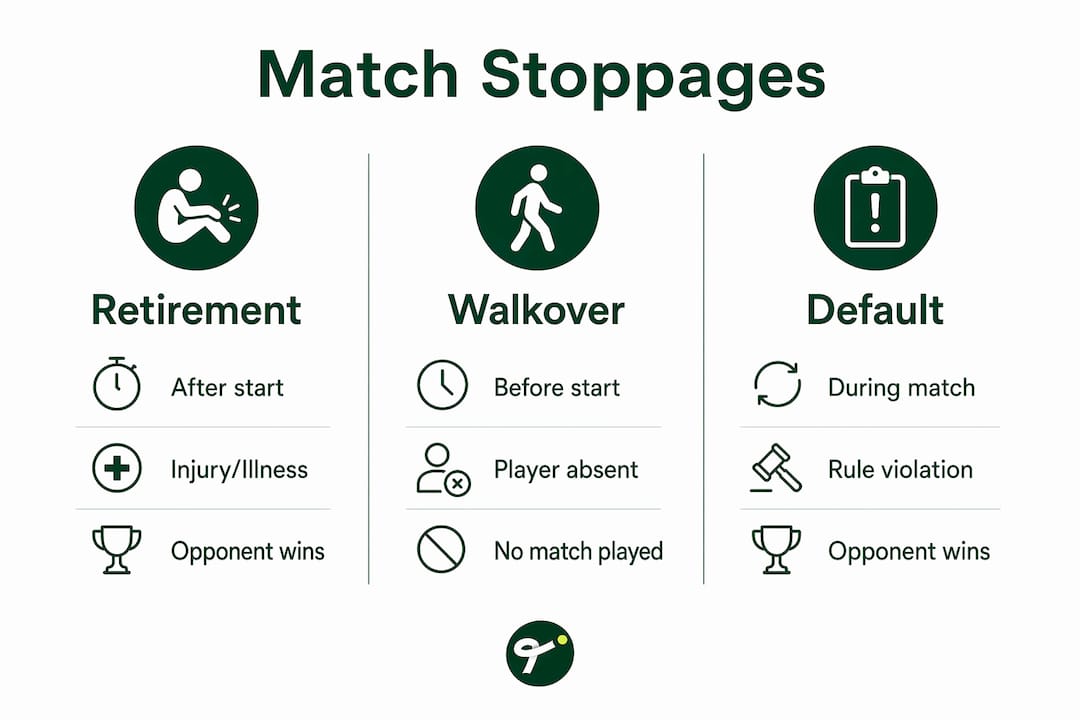
These three terms describe three distinct match stoppage scenarios, and mixing them up leads to real confusion when reading results or settling bets. Each carries distinct scoring and statistical consequences.
| Term | Match started? | Primary reason | Opponent outcome | Score recorded? |
|---|---|---|---|---|
| Walkover | No | Injury, illness, or withdrawal before first serve | Advances without playing | No score recorded |
| Retirement | Yes | Injury or illness after first serve | Wins the match | Score recorded at stoppage with "ret." |
| Default | Yes | Code violation or misconduct | Wins the match | Score recorded at point of disqualification |
A walkover happens entirely before the match begins. The withdrawing player never steps onto the court for competitive play. The opponent advances, but no match statistics are generated because no tennis was played.
A default is different again. It occurs during a match, but the cause is a rule violation rather than a physical condition. A player who hits a ball at a ball person, verbally abuses an official, or receives too many time violations can be defaulted. The most famous example in recent memory is Novak Djokovic's default at the 2020 US Open after accidentally striking a line judge with a ball. The opponent wins, but the circumstances are entirely different from a retirement.
Retirement sits between these two. The match started, real tennis was played, and the withdrawal was involuntary due to physical incapacity. That distinction matters for how the result is read and how bets are settled.
How are retirements recorded and how do they affect match outcomes?
The official score notation for a retirement uses the "ret." suffix immediately after the score at the moment of stoppage. A match that ends mid-second-set might read "6-3, 2-1 ret." in the official record. This shorthand is standard across ATP, WTA, and Grand Slam scorecards, and it immediately signals to anyone reading the result that the match did not reach a natural conclusion.
Key facts about how retirements affect outcomes:
- The opponent wins unconditionally. A player who is losing 0-6, 0-5 at the moment of retirement still receives the official win if their opponent retires.
- Rankings points are awarded. The winning player receives the full points for the round they have reached, as if the match had been completed normally.
- Player stats are affected. The retiring player's match record shows a loss. Their retirement history is tracked across seasons and informs coaching and medical decisions about workload and injury management.
- Head-to-head records include retirements. The win counts in the H2H record between the two players, which can skew long-term comparisons.
One common myth is that a player who retires while leading somehow "deserves" a partial win or that the result should be voided. Tennis rules are clear on this point. The opponent wins. The score at stoppage is preserved for statistical purposes, but the match result is unambiguous.
Understanding how tennis scoring works in full helps put retirement notation in context. The "ret." suffix is part of a broader scoring language that professional tennis has developed to capture every possible match outcome with precision.
What are the implications of retirements for tennis betting?
Retirements create genuine complexity in betting markets, and the rules vary significantly depending on where you place your bet. Betting markets implement three main retirement rules: Match Completion, One Set, and Ball One. Each rule determines whether your bet stands or is voided when a player retires.
Match Completion requires the match to finish naturally for bets to settle. If a player retires at any point, all bets are voided and stakes are returned. This is the most protective rule for casual bettors and is common among US sportsbooks.
One Set requires at least one full set to be completed before bets settle. If the match ends before a set is finished, bets are voided. If at least one set is done, the bet settles based on the result at that point. This rule is widely used in European sportsbooks.
Ball One is the most aggressive rule. As long as at least one ball has been served, bets stand and settle based on the final declared result, including a retirement win. This rule carries the most risk for bettors who back a player who then retires while leading.
The practical implication is significant. A bettor who backs a player under Ball One rules and that player retires while winning still collects. Under Match Completion rules, the same bettor gets their stake back. The difference between these outcomes can be substantial on high-stakes matches.
Pro Tip: Before placing any bet on a match involving a player with a recent injury history, check the sportsbook's specific retirement rule. It is listed in the house rules or terms section, and it directly determines your payout in a retirement scenario.
Retirement rules also interact with in-play betting. A bet placed during a match, after one set has been completed, may settle differently than a pre-match bet under the same sportsbook's rules. Always verify which rule applies to each bet type, not just the sportsbook as a whole. For a deeper look at how these rules affect fantasy and betting decisions, the risks of fantasy sports betting in tennis are worth understanding before you commit real money.
Key takeaways
A retirement in tennis is a mid-match withdrawal due to injury or illness, where the opponent wins unconditionally and the score is recorded with a "ret." suffix at the exact point of stoppage.
| Point | Details |
|---|---|
| Core definition | Retirement occurs after the first serve; the opponent wins regardless of the score at stoppage. |
| Retirement vs. walkover | A walkover happens before play begins; a retirement happens after at least one ball is served. |
| Score notation | Official records show the score at stoppage followed by "ret." to mark the retirement. |
| Betting impact | Three rules govern bet settlement: Match Completion, One Set, and Ball One. Rules vary by sportsbook. |
| Fantasy tennis relevance | A player's retirement history signals injury risk and affects fantasy team selection decisions. |
Why retirements deserve more respect from tennis fans
Retirements frustrate fans. I get it. You have bought a ticket, or you are deep into a fantasy matchup, and suddenly the match is over before it felt like it really started. The natural reaction is disappointment, sometimes even suspicion. But after years of following professional tennis closely, I have come to see retirements as one of the most honest moments in the sport.
Professional tennis players are not fragile. The ones who retire mid-match have already pushed through a level of pain that most people will never experience. When Rafael Nadal retired from the 2024 Brisbane International with a hip issue, or when players at the Australian Open collapse from heat exhaustion, those are not weak moments. They are the result of bodies that have been pushed to their absolute limit across a grueling season schedule.
What I find more interesting is what retirements reveal about the sport's structure. The ATP and WTA calendars are genuinely punishing. Players travel constantly, switch surfaces repeatedly, and compete in climates ranging from the cold of indoor European arenas to the brutal summer heat of the US Open. Retirements are a symptom of that system, not a character flaw in the players who experience them.
For fantasy tennis players, retirements are data. A player who has retired twice in the past three months is telling you something important about their physical condition. That information belongs in your team selection process, not just your post-match frustration. Tweener tracks player stats and form across tournaments, which gives you the context to make smarter picks rather than reacting to results after the fact.
The fans who understand retirements are the ones who understand tennis. The sport rewards that depth of knowledge.
— Nathan
Tweener turns retirement knowledge into a real competitive edge
Knowing what a retirement means is one thing. Using that knowledge to build a better fantasy tennis team is another. Tweener is the fantasy tennis app built for fans who take the sport seriously, with player tracking, ATP and WTA stats, and private leagues where you compete against friends across full Grand Slam tournaments.
When you understand that a player's retirement history signals injury risk, you can make smarter picks before a tournament even starts. Tweener gives you the stats and the competitive format to put that knowledge to work. Join a public league or set up a private league with up to 9 friends, draft your team, and earn points based on real match results. Download the Tweener app and start competing with the analytical edge that casual fans simply do not have.
FAQ
What does "ret." mean in a tennis score?
"Ret." is the standard abbreviation for retirement in professional tennis scoring. It appears after the score at the exact point the match stopped, for example "6-3, 2-1 ret."
Does a player lose ranking points when they retire mid-match?
The retiring player receives a loss in their match record and earns no additional ranking points for that round. The opponent receives the full points for the round they have reached.
How is a retirement different from a walkover in tennis?
A walkover occurs before the first serve is delivered, meaning no tennis is played. A retirement occurs after at least one ball has been served, so the match has officially begun.
Can a player retire while they are winning?
Yes. A player can retire at any score, including while leading. The opponent is declared the winner regardless of who was ahead at the moment of stoppage.
How do sportsbooks handle bets when a player retires?
Sportsbooks apply one of three rules: Match Completion, One Set, or Ball One. Each rule determines whether bets are voided or settled based on the result at the time of retirement. Always check your sportsbook's specific terms before betting.