

TL;DR:
- A tennis momentum shift occurs when control of a match moves from one player to another, often predicting upcoming points better than season-long rankings. Short-term signals like serve direction narrowing and increased defensive running provide early warning before the score reflects the change, guiding fantasy managers' decisions. Relying on live tactical indicators rather than just scores enables more accurate timing for swapping, captaining, or holding players during matches.
A momentum shift in tennis is the moment control of a match transfers from one player to the other — and for fantasy managers, it usually triggers an immediate decision: hold, swap, or captain. The shift is measurable, not just a feeling, and short-term match data predicts the next point better than season-long rankings.
Live trigger checklist — watch for all three before acting:
- Last 3–5 games won/lost by each player
- Break-point conversion and save rate in the current set
- Serve hold percentage over recent service games
Table of Contents
- What does a momentum shift actually mean on court?
- Which match metrics actually show a momentum swing?
- Why does momentum reverse? Anti-momentum and the leader's trap
- Short-term momentum vs. season-long form: which one to trust?
- Your live fantasy checklist: when to swap, captain, or hold
- Three scenarios that put the checklist to work
- How Tweener surfaces momentum signals in the app
- Key Takeaways
- The signal most fantasy managers ignore
- Tweener turns momentum reads into real fantasy wins
- Sources and further reading
What does a momentum shift actually mean on court?
A momentum shift is a change in which player is dictating point construction — who chooses the shot, sets the pace, and forces the other into reactive play. It is tactical and psychological at once. The player gaining control starts winning points on their own terms; the player losing it starts defending patterns they did not choose.
A concrete example: a trailing player wins a grinding 10-point game, then holds serve to love. Suddenly the leader is serving to stay in the set rather than to extend a lead. That is the shift — control has moved, and the scoreboard is about to follow.
The term entered tennis commentary in the 1980s alongside broadcast analytics, but its practical meaning is older: coaches and players have always recognized that long rallies, lucky edges, and crowd swings can flip who is in charge of a match. For fantasy managers, the definition matters because it tells you what to watch rather than just what happened.
Which match metrics actually show a momentum swing?
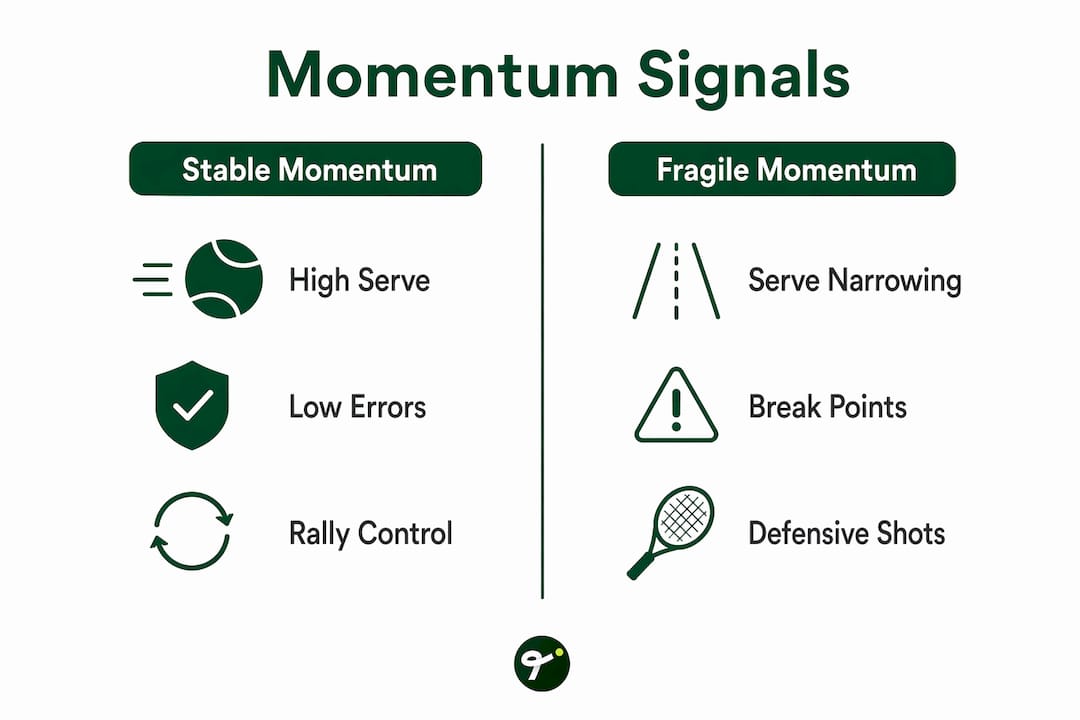
Momentum is not invisible. Several short-term signals reliably surface a shift before the score makes it obvious.
Leading indicators (early warning, before the scoreboard moves):
- Serve direction narrowing: a player hitting more centrally instead of wide or to the body signals loss of tactical control
- Increased defensive running distance: winners cover less ground; a player suddenly sprinting more is losing the initiative
- Shot selection shifting from depth/width to central, defensive balls
Lagging indicators (confirm the shift after it has started):
- Last 3–5 games trend (who won them)
- Break-point conversion rate in the current set
- Return points won percentage over the last three service games
- Unforced error rate climbing for the previously dominant player
| Signal | What it suggests | Fantasy action |
|---|---|---|
| Serve direction narrowing | Momentum fragility building | Watch closely; do not captain yet |
| 3+ consecutive games lost | Momentum shift confirmed | Consider swap or bench |
| Break point won (returner) | Reset switch triggered — rapid momentum gain | Swap in or captain the returner |
| Unforced errors spiking | Anti-momentum risk for leader | Hold off on captaining the leader |
| Defensive distance increasing | Tactical control slipping | Flag as pre-swap signal |
The Tennis Momentum Model identifies serve efficiency and rally count as the two biggest quantitative drivers, which is why serve-direction data is the earliest warning you can realistically track live.

Why does momentum reverse? Anti-momentum and the leader's trap
The most counterintuitive thing about tennis momentum is that building a lead can cause you to lose it. Sports psychologist Dr. Patrick Cohn describes the mechanism precisely: adrenaline from winning points pushes leaders toward over-aggression, causing them to deviate from the high-percentage shot selection that built the lead in the first place.
"Momentum must be contained. Players who ride an emotional high often start over-hitting, abandoning the tactical discipline that created the advantage. The opponent does not have to do anything special — the leader beats themselves." — Dr. Patrick Cohn, Sports Psychology Tennis
Dietl and Nesseler's control-theory research frames this as anti-momentum: once a player loses tactical control, their probability of winning the next set drops significantly. The loss of control is the cause; the score reversal is the effect.
Common tactical signs that a reversal is coming:
- Leader switches to high-margin, defensive shots (protecting the lead)
- Serve placement becomes predictable and central
- Rallies get longer as the leader stops attacking
- The trailing player starts dictating rally direction
For fantasy managers, these are pre-swap signals. The scoreboard has not moved yet, but the match has already turned.
Short-term momentum vs. season-long form: which one to trust?
Both matter. The question is when each one should drive your decision.
Match-flow modeling shows that recent game streaks predict the immediate next point better than season-long ranking or surface statistics. But that predictive edge is short-lived — it decays quickly as the match resets between sets.
| Situation | Weight short-term momentum | Weight long-term form |
|---|---|---|
| Live daily contest, mid-match | High — last 3–5 games dominate | Low |
| Daily contest, pre-match | Moderate — recent form (last 3 matches) | High — surface record, H2H |
| Tournament lineup, early rounds | Low | High — ranking, draw difficulty |
| Tournament lineup, late rounds | Moderate — fatigue and form trend | High — depth of run, surface |
| Live swap decision, set 3 | Very high — current set momentum | Low |
Rules of thumb:
- In daily or single-match contests, trust the last 3–5 games over ATP/WTA ranking
- In tournament-long lineups, surface form and H2H outweigh any single-match momentum reading
- Never swap based on one lost game; wait for a confirmed 3-game trend
Your live fantasy checklist: when to swap, captain, or hold
Apply these rules in order. The higher the rule, the more it overrides the one below it.
When to HOLD your player:
- They lead the match but just dropped one service game
- Serve hold percentage remains strong for the set
- No confirmed 3-game losing streak yet
When to CAPTAIN:
- Player has won 4 of the last 5 games and just converted a break point
- Serve direction is varied and wide; opponent's running distance is increasing
- XGBoost modeling ranks net points won and break points as the top momentum indicators — both are trending your player's way
When to SWAP:
- Confirmed 3-game losing streak in the current set
- Serve placement has narrowed to central; unforced errors climbing
- Opponent has converted two consecutive break points
When to do nothing:
- You are in the first two games of a set (sample too small)
- The match is in a tiebreak (momentum resets almost entirely)
- Your player just had one bad service game after holding six straight
Pro Tip: In Tweener's daily formats, limit yourself to one swap per set unless two of the three trigger metrics (games trend, break-point rate, serve hold %) all flip simultaneously. Chasing every swing destroys your lineup's edge faster than a single bad pick.
For building winning lineups in tournament formats, apply these rules only from the quarterfinals onward — early-round momentum is too noisy to act on.
Three scenarios that put the checklist to work
Vignette 1: Mid-match comeback You have Jannik Sinner captained in a live daily contest. He drops the first set 4–6 and loses the first two games of set 2. Immediate action: do not swap yet — two games is below the 3-game threshold. Wait for game 3. If he drops it and his serve placement data shows central hitting, swap. If he holds, the comeback signal is noise.
Vignette 2: Leader protecting the lead Carlos Alcaraz leads 6–3, 3–1 but his last three service games have been deuce-heavy and his unforced errors are climbing. Immediate action: bench or de-captain. The anti-momentum pattern is active — he is defending a lead rather than extending it, and the control-loss signal is present before the scoreboard shows it.
Vignette 3: Underdog building late in set 2 An unseeded player has won 3 straight games and just saved two break points at 4–5. Immediate action: swap in if your contest allows it. Break-point saves at high-leverage moments are reset switches — they generate rapid momentum gain, and the underdog now controls the set's emotional tempo.
How Tweener surfaces momentum signals in the app
Tweener is built for exactly this kind of live decision-making. The app tracks real-time match data from ATP and WTA tournaments, giving you the signals the checklist above requires.
What to watch inside Tweener:
- Real-time game-by-game score flow (your 3–5 game trend window)
- Break-point conversion and save data updated point by point
- Serve hold percentage per set, visible during live contests
- Player form indicators based on recent match results
How to apply it:
- Use the live score flow to confirm your 3-game threshold before any swap
- Check break-point data before captaining — a player converting at the net is your strongest momentum signal
- Cross-reference serve hold percentage with the pre-swap checklist before making a move
Tweener's game rules explain exactly when swaps and captain changes are permitted in each contest format, so you know the mechanics before the moment arrives.
Key Takeaways
Short-term match momentum — tracked through game streaks, break-point conversion, and serve hold rate — is the most reliable live signal for fantasy swap and captain decisions, while season-long form remains the anchor for tournament lineup construction.
| Point | Details |
|---|---|
| Momentum shift definition | A measurable change in who controls point construction, confirmed by a 3-game trend. |
| Top live signals | Serve direction narrowing and break-point conversion are the earliest and most reliable indicators. |
| Anti-momentum risk | Leaders who shift to defensive shot selection often trigger a reversal before the score moves. |
| Short-term vs. long-term | Trust last 3–5 games for live daily swaps; use surface form and H2H for tournament lineups. |
| Tweener application | Tweener's live break-point and serve hold data maps directly to the swap/captain checklist. |
The signal most fantasy managers ignore
Most fantasy managers watch the score. The sharper move is watching how the score is being made.
A player winning 6–3, 3–1 who is now hitting 80% of serves down the middle is not the same player who won that first set. The score looks safe. The match is not. Anti-momentum is a structural phenomenon, not a bad patch — once a player stops dictating shot construction, the reversal is already underway. The scoreboard just has not caught up.
The Dietl and Nesseler control-theory finding makes this concrete: losing tactical control is the cause, and the drop in next-set win probability is the effect. Fantasy managers who wait for the score to confirm a shift are always one step behind.
The practical edge is in the leading indicators: serve direction, defensive running distance, and shot selection. These are visible in live match trackers and increasingly surfaced in apps like Tweener. You do not need a machine-learning model to use them — you need a checklist and the discipline to wait for three signals before acting, not one.
Tweener turns momentum reads into real fantasy wins
If you have read this far, you already think about tennis differently than most fantasy players. Tweener is built for that edge. It is the only dedicated fantasy tennis app that puts ATP and WTA live match data in your hands during real tournaments — the closest thing to a FanDuel for tennis that exists.
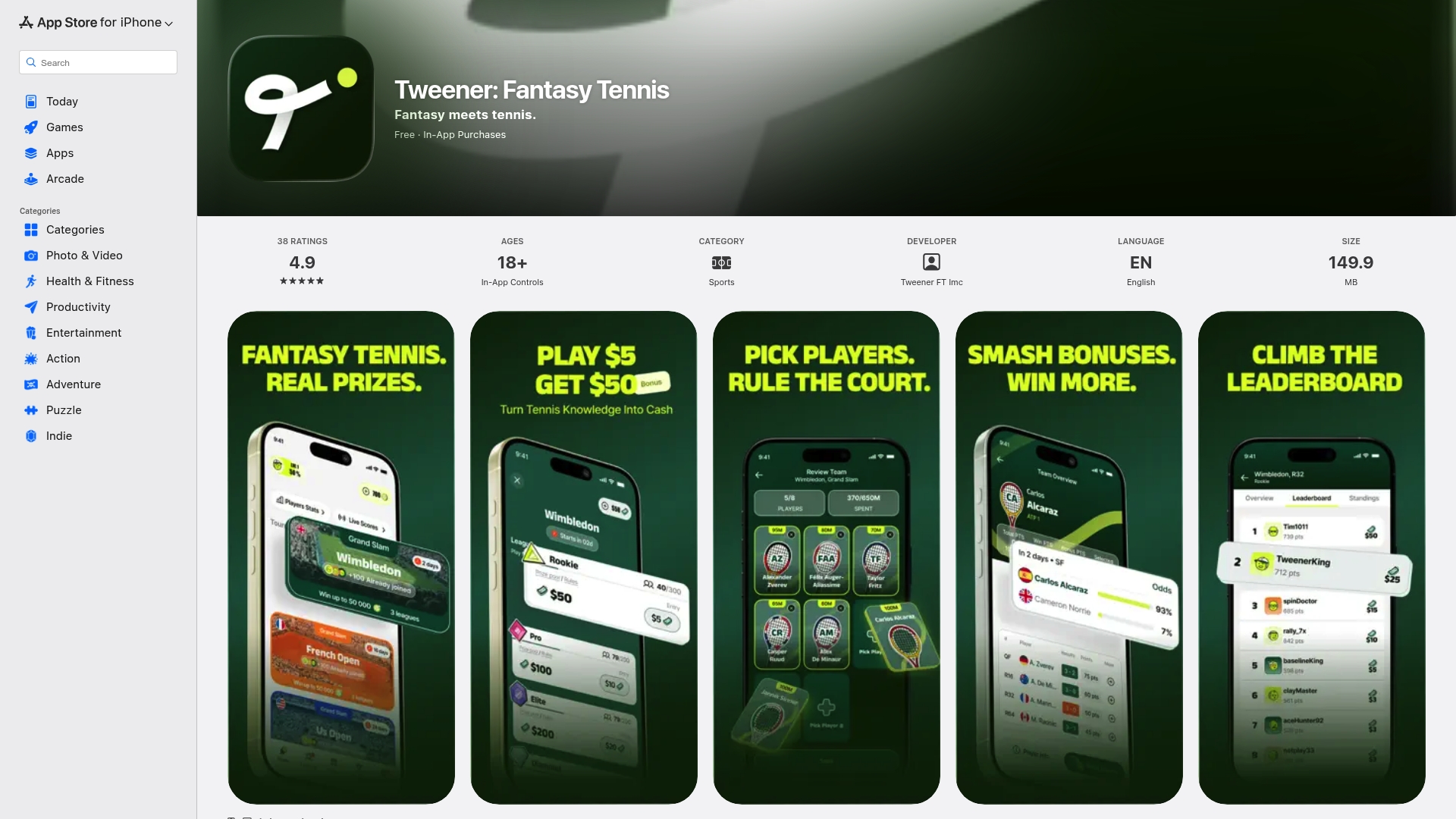
Inside Tweener, you get live break-point data, serve hold percentages, and real-time game flow — exactly the signals this checklist runs on. Join a public league or set up a private league with up to nine friends for any Grand Slam. The free mode lets you compete for gift cards using virtual coins; the cash mode offers real-money contests where permitted.
Download Tweener and put the momentum checklist to work in your next live contest.
Sources and further reading
- Momentum in tennis: Controlling the match — Dietl & Nesseler; control-theory basis for anti-momentum and next-set win probability
- Tennis Game Dynamic Prediction Model Based on Players' Momentum — MDPI AppliedMath; short-term vs. long-term predictive value, break-point reset switches, EWMA momentum modeling
- Modeling Tennis In-Match Momentum Using Probability Method — arXiv; Tennis Momentum Model (TMM), serve efficiency and rally count as primary drivers
- Nature: Indicators of momentum and tactical control in tennis — serve direction narrowing and defensive running distance as leading indicators
- What To Do When Momentum Shifts — Dr. Patrick Cohn; sports psychology of momentum containment and leader complacency
- Momentum Shift Meaning in Tennis — PlayTerms; practical definition and on-court manifestations (no numeric specifics)
- Capturing Momentum: Tennis Match Analysis Using Machine Learning — arXiv; HMM and XGBoost analysis of the 2023 Wimbledon final, feature importance ranking