

TL;DR:
- A break point is a situation where the receiver is one point away from winning a game on the server's serve. It occurs at scores of 0-40, 15-40, 30-40, and advantage receiver, with different pressures and probabilities of ending the game. The ability to convert or save break points significantly influences match momentum, psychological resilience, and predictive analytics in tennis.
A break point in tennis is defined as the moment when the receiver is one point away from winning a game on the server's serve. This is the single most pressure-loaded situation in a match, and understanding it separates casual viewers from serious fans. The scoring positions that create a break point are 0-40, 15-40, 30-40, and advantage receiver. Break point conversion percentage is a key metric analysts and fantasy players use to evaluate how well a player performs under maximum pressure.
What is a break point in tennis scoring?
A break point occurs within the standard tennis scoring system of 0, 15, 30, 40, and advantage. To understand it fully, you need to know how tennis scoring works and where break points fit inside a single game.
The server always starts with an advantage. Holding serve is the expected outcome in professional tennis. A break point flips that expectation. The receiver, who is statistically less likely to win the game, suddenly stands one point from doing exactly that.
Break points are distinct from set points and match points. A set point means a player is one point from winning a set. A match point means one point from winning the entire match. A break point is narrower: it only concerns whether the receiver wins the current game on the server's serve.
Here is a clear breakdown of the scores that produce break points:
| Score | Break Point Situation |
|---|---|
| 0-40 | Triple break point (receiver has 3 chances) |
| 15-40 | Double break point (receiver has 2 chances) |
| 30-40 | Single break point (receiver has 1 chance) |
| Advantage Receiver | Single break point after deuce |
If the receiver wins the break point, they "break serve" and take the game. If the server wins the point, the score resets or continues. At 30-40, a server win returns the game to deuce. At advantage receiver, a server win also returns to deuce. At 0-40 or 15-40, the server still has multiple chances to recover before the game is lost.
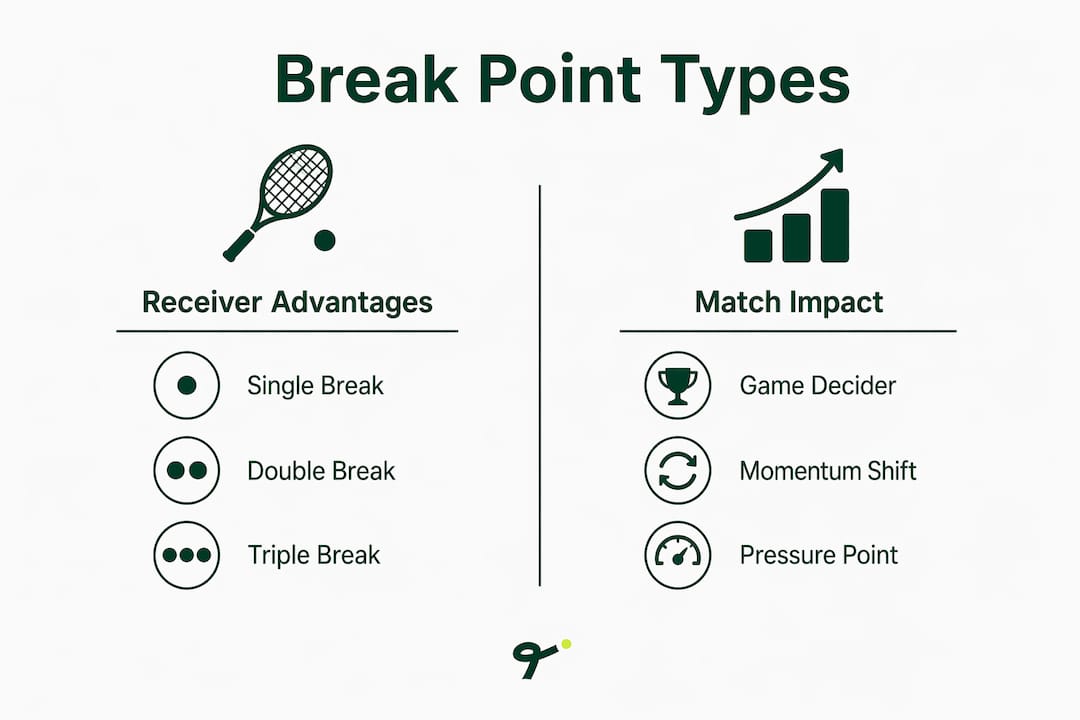
How do different types of break points affect a match?
Not all break points carry equal weight. The type of break point on the scoreboard tells you a great deal about the pressure each player is under.
A single break point at 30-40 or advantage receiver gives the server one chance to survive. A double break point at 15-40 gives the receiver two consecutive opportunities. A triple break point at 0-40 is the most extreme situation, where the server must win three straight points to hold.
Different types of break points have varying significance, with double break points providing two opportunities to break serve and match point break points potentially ending the match entirely.
A match point break point is the rarest and highest-stakes version. This occurs when the receiver is simultaneously one point from winning the game, the set, and the match. Novak Djokovic and Rafael Nadal have both faced and saved match point break points in Grand Slam finals, demonstrating that even the best servers in history are not immune.
The momentum impact of converting a break point is significant for several reasons:
- Two-game swing: Winning a break point game gives the receiver a game and denies the server one, creating a two-game shift in the set score.
- Psychological pressure: Converting one break point can shift the psychological balance in professional matches, forcing the server to press harder on their own serve.
- Momentum chain: Players who break serve often hold their next service game more easily because their confidence rises while the opponent's drops.
Pro Tip: Watch the score at 0-40 closely. Servers who survive triple break points often carry that momentum into the next several games. The psychological relief of escaping 0-40 is one of the most visible momentum shifts in tennis.
What tactics do servers and receivers use at break points?
Break points force both players to make tactical decisions they would not face at 40-0 or 40-15. The pressure changes what each player is willing to risk.

Servers face a specific trap. Servers often default to a safer first serve during break points to avoid faulting, which allows receivers to play more aggressively and exploit the situation. A cautious serve lands shorter and slower, giving the receiver a better look at the ball. The server's attempt to reduce risk actually increases it.
Receivers who recognize this pattern can step inside the baseline, take the ball early, and redirect it before the server has time to set up. Carlos Alcaraz is a textbook example of a player who attacks short serves at break points, using his footwork to take time away from the server.
The mental side is equally important. Break points challenge the natural expected dominance of the server and create some of the highest pressure moments in a match, with significant psychological and strategic shifts during these points. Servers who have a clear pre-point routine, like Djokovic's ball-bouncing ritual, use it to reset their focus and slow the moment down.
For receivers, the challenge is staying aggressive without overreaching. The instinct to go for a winner on every break point often leads to unforced errors. The smarter play is to construct the point, force the server into a difficult position, and let the pressure do the work.
Pro Tip: If you play competitive tennis, practice returning second serves at break point scores specifically. The mental context of a break point changes your decision-making more than you realize until you train for it directly.
Why do break point stats matter for analytics and fantasy tennis?
Break point conversion and break point save rates are two of the most telling statistics in professional tennis. They reveal how a player performs when the match is actually on the line, not just in routine rallies.
Players who fail to convert break points often lose matches despite winning more total points. This is one of the most counterintuitive facts in tennis analytics. A player can dominate a match statistically and still lose if they go 0-for-6 on break points. Total points won is a misleading number without break point context.
Break point save rate is equally revealing. Saving break points demonstrates resilience that distinguishes top-tier competitors, while creating break points forces servers into risky plays and potential errors. A server with a 70% break point save rate is significantly more reliable than one saving 50%, even if their first-serve percentage looks similar.
For fantasy tennis players, these numbers are critical inputs. Here is what to track:
- Break points created per match: Shows how often a player puts pressure on opponents' serves.
- Break point conversion rate: Shows how often they finish the job when they get the chance.
- Break points saved: Shows serve reliability under maximum pressure.
Understanding tennis player stats like these gives you a real edge when selecting players for fantasy competitions. A player with a high break point conversion rate on clay heading into Roland Garros is a far more reliable fantasy pick than their ranking alone would suggest.
Tracking break point conversion percentages is essential for competitive success, as consistently failing to convert break points can lead to losing matches despite winning more overall points. This is why analysts at the ATP and WTA level treat break point data as a primary performance indicator, not a secondary one.
Key takeaways
A break point is the single most decisive scoring situation in tennis, and mastering it separates elite players from the rest of the field.
| Point | Details |
|---|---|
| Break point definition | The receiver is one point from winning the game at 0-40, 15-40, 30-40, or advantage receiver. |
| Types carry different weight | Triple break points at 0-40 create the most pressure; single break points at 30-40 give the server one chance to recover. |
| Two-game momentum swing | Converting a break point shifts the set score by two games and often changes the psychological balance of the match. |
| Server tactics shift under pressure | Servers play safer first serves at break points, which receivers can exploit by stepping in and attacking aggressively. |
| Stats reveal true performance | Break point conversion and save rates are more accurate performance indicators than total points won or first-serve percentage alone. |
Break points are where matches are actually decided
I have watched thousands of professional matches, and the pattern is always the same. The player who controls break points controls the match. Not the player with the bigger serve. Not the one with the prettier groundstrokes. The one who converts when it counts.
What most fans miss is the value of the break points that do not convert. Even unsuccessful break point opportunities can pressure servers to make errors later in the match. A receiver who creates six break points and converts two has still done serious damage, even if the stat sheet shows four missed chances. Those four near-misses accumulate in the server's head.
The players who handle break points best are not necessarily the most talented. They are the most mentally organized. Djokovic's record in break point situations across his career is not just a product of skill. It is a product of a pre-point process he has refined over two decades. Younger players like Jannik Sinner have started showing the same composure, which explains their rapid rise in Grand Slam results.
If you are a competitive player, I would argue that practicing break point scenarios is more valuable than hitting 200 extra first serves. The serve you hit at 30-40 in a match is a completely different shot than the one you hit at 40-0. Train the context, not just the stroke.
— Nathan
Track break points where they actually matter
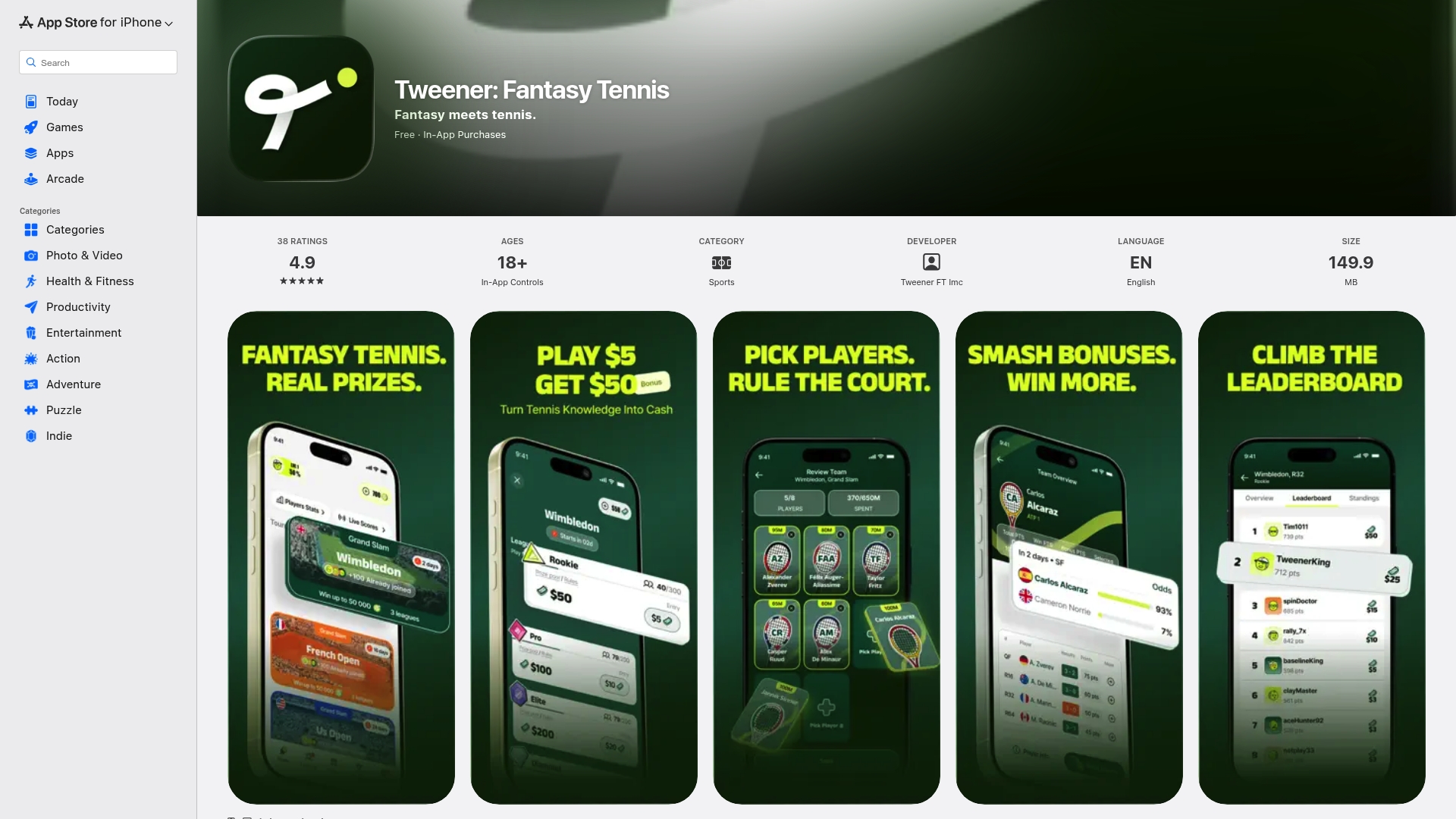
Understanding break points gives you a new lens for watching professional tennis. Tweener puts that lens to work. As a fantasy tennis platform built around real ATP and WTA match data, Tweener lets you build teams, join leagues, and compete based on exactly the kind of performance metrics that define match outcomes, including serve pressure, conversion rates, and player form across tournaments. Whether you play in free mode with virtual coins or enter cash contests for real payouts, your edge comes from knowing the stats. Download Tweener and start building your fantasy roster around the numbers that actually decide matches.
FAQ
What is a break point in tennis?
A break point occurs when the receiver is one point away from winning the game on the server's serve. The scoring positions that create a break point are 0-40, 15-40, 30-40, and advantage receiver.
How is a break point different from a set point or match point?
A break point only concerns winning the current game on the opponent's serve. A set point means one point from winning a set, and a match point means one point from winning the entire match.
What is a double break point?
A double break point occurs at 15-40, giving the receiver two consecutive chances to win the game on the server's serve before the score can return to deuce.
Why is break point conversion rate important in fantasy tennis?
Break point conversion rate shows how often a player wins the game when they have the chance to break serve. Players who fail to convert break points often lose matches despite winning more total points, making this stat a more reliable performance indicator than serve percentage alone.
What happens if the server wins a break point?
If the server wins the point at 30-40 or advantage receiver, the score returns to deuce and play continues. At 15-40, the score moves to 30-40, giving the server one more chance before deuce. The receiver must reach break point again to have another opportunity.