

Fantasy tennis leagues in the United States run on two reward streams: digital rewards (virtual coins, badges, XP, leaderboards, cosmetics) and monetary prizes (cash prize pools funded by pooled entry fees). Digital rewards are free to distribute and drive engagement between tournaments. Cash payouts require real money, and whether you can legally offer them depends on your state, your contest design, and whether your game meets the skill-based contest criteria under U.S. federal law.
Quick orientation before you build anything:
- Digital rewards work in every state, cost nothing to fund, and keep players logging in during the gaps between Grand Slams.
- Monetary prizes require entry fees, a published prize table, age verification, and jurisdictional clearance.
- Legal caveat: State law varies significantly. Some states prohibit paid fantasy contests entirely. Confirm your state's rules before collecting a single dollar.
Key Takeaways
The most important decision in fantasy tennis reward design is matching reward type to goal: digital rewards for engagement, cash prizes for monetization, and legal compliance as the non-negotiable foundation for any paid contest.
| Point | Details |
|---|---|
| Two reward streams | Digital rewards drive engagement; cash prize pools require entry fees, published tables, and jurisdictional clearance. |
| Rake and GPP mechanics | Operators typically retain a rake of 5%–15%; GPPs guarantee payouts but create overlay risk if entries fall short. |
| Legal compliance first | Confirm state law, verify player ages, geofence restricted states, and publish prize tables before any contest opens. |
| Payout UX matters | Show wallet balance, state payout minimums, and flag IRS 1099 obligations for prizes above reporting thresholds. |
| Tweener for tennis leagues | Tweener's dual play modes, private Grand Slam leagues, and built-in prize publishing cover both reward streams in one app. |
Table of Contents
- What types of rewards do fantasy tennis apps actually use?
- How are cash prize pools and GPPs funded and structured?
- What U.S. legal and compliance points do organizers need to know?
- How do you design a reward system that balances engagement, fairness, and budget?
- What payout methods and timelines should organizers plan for?
- Three reward templates you can adapt right now
- What the engagement vs. monetization trade-off actually looks like
- Tweener makes reward design straightforward for tennis leagues
- Sources
What types of rewards do fantasy tennis apps actually use?
Fantasy sports apps split rewards into two categories: digital rewards for free-play engagement and monetary prizes distributed from pooled entry fees after a contest closes. Understanding both is the starting point for any organizer designing a league.
Digital rewards: the engagement engine
Digital rewards cost nothing to issue and do most of the retention work. Common types include:
- Virtual coins/wallet credits redeemable for gift cards or free contest entries
- Badges and achievements tied to milestones (first win, five-match streak, upset pick)
- XP and levels that unlock profile features or contest access
- Leaderboard placement with public rankings visible to all league members
- Profile cosmetics such as avatars, banners, and seasonal titles
- Free entry tokens earned through daily logins or challenge completions
The behavioral case for these is well-documented. Academic research on gamification in sports apps finds that badges and leaderboards satisfy players' need for mastery and social comparison, keeping them active between major events. For a tennis app, that gap matters: the ATP and WTA calendar has natural dead zones between Slams where engagement can drop sharply.
Earn triggers matter as much as the rewards themselves. Daily login bonuses, win streaks, and challenge completions all create habitual return visits. Gated credits (credits that unlock only after a specific action) work better for retention than open wallets, because they give players a reason to come back. Keep redemption rules published and simple. Confusion about how to spend coins is one of the fastest ways to kill engagement.
Pro Tip: *Set a scarcity mechanic on seasonal titles and cosmetics. If every player can earn the "Roland Garros Champion" badge, it loses its social value.
How are cash prize pools and GPPs funded and structured?
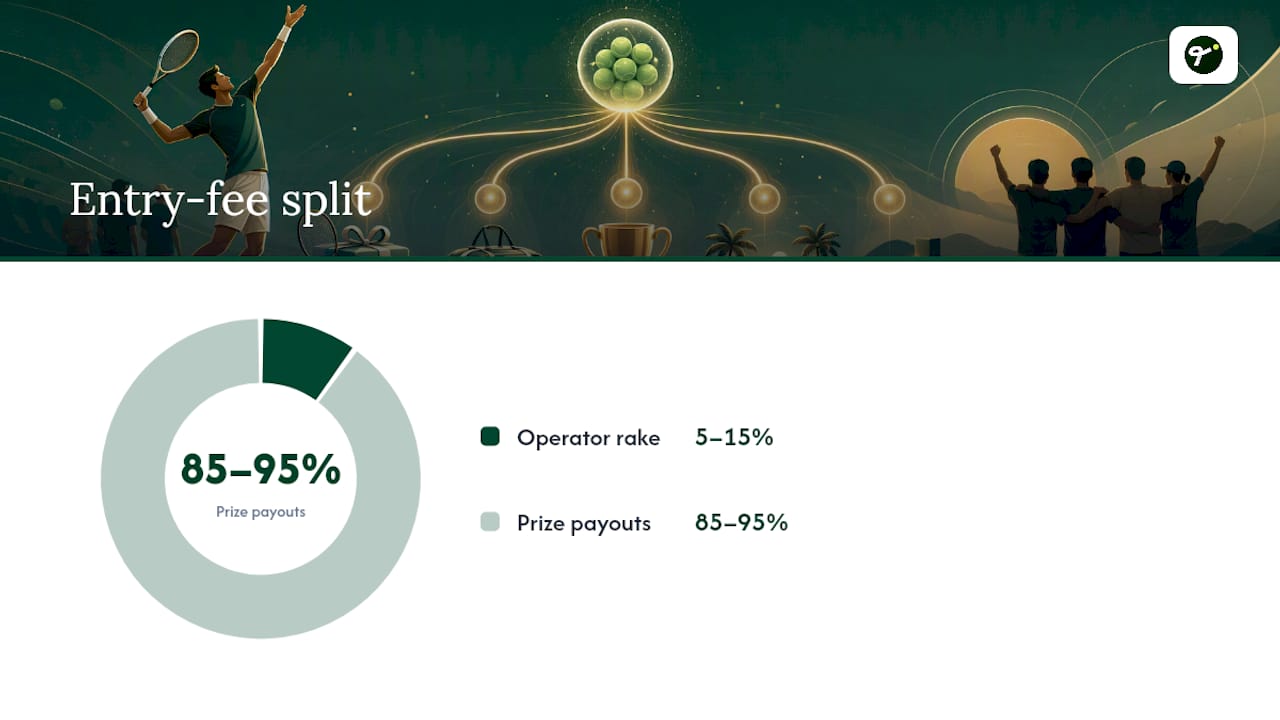
Monetary prizes in fantasy tennis contests are funded by pooling entry fees from all participants. The operator keeps a rake of roughly 5%–15% and distributes the remainder as prizes. Entry fees on established platforms cover a wide range from low to high amounts per contest.
Three contest formats commonly pay cash:
- Guaranteed Prize Pools (GPPs): The operator guarantees a fixed prize total regardless of entries. If fewer players enter than needed to cover the guarantee, the operator absorbs the shortfall — called an overlay. GPPs attract players because the prize is certain, but they carry real financial risk for organizers.
- Head-to-head paid contests: Two players each pay an entry fee; the winner takes roughly 80%–90% after rake.
- Private paid leagues: A closed group (say, eight friends for a Grand Slam) each pays a fixed buy-in; the prize pool is the sum of those fees minus any platform fee.
Key figure: Industry analysis of daily fantasy sports shows operators typically retain a rake of 5%–15% of the total entry-fee pool, with the remainder paid out as prizes. Entry fees on major platforms range from $0.25 to several thousand dollars per contest.
Operational requirements for any cash contest: publish the prize table before the contest opens, define exactly how winners are determined (skill-based scoring across multiple matches, not a single coin flip), and set clear start and lock times. Contest formats vary widely — season-long, single-day, and event-based models each have different payout profiles. For a tennis app built around Grand Slams, a two-week event-based GPP with daily scoring updates tends to generate the most sustained engagement.
What U.S. legal and compliance points do organizers need to know?
Legal status for paid fantasy contests cannot be assumed nationwide. The federal framework under 31 U.S.C. § 5362 carves out skill-based fantasy contests from certain gambling prohibitions, but it defers heavily to state law, and state variability is significant.
Compliance checklist for U.S. organizers:
- Confirm your state permits paid fantasy contests (several states prohibit or restrict them)
- Require age verification (18+ minimum; some states set higher thresholds)
- Implement geofencing to block entries from restricted states
- Complete KYC (Know Your Customer) checks before processing payouts
- Publish prize tables before any contest opens
- Retain contest records for potential audits
- Surface IRS 1099 guidance for players who win above reporting thresholds
The three-part skill criteria that support a contest's legal standing under federal exemption language: prizes must be established and published in advance, outcomes must be determined predominantly by player skill rather than chance, and results cannot be based on the outcome of a single real-world event. A multi-match Grand Slam scoring system that rewards correct player picks across 128-draw brackets satisfies all three.
Skill-versus-chance is the central legal test. The distinction between poker and fantasy sports is instructive here: fantasy tennis scoring across a full tournament draws on ATP/WTA stats, surface performance, and H2H records — not a single random outcome.
How do you design a reward system that balances engagement, fairness, and budget?
Match your reward mix to your organizer goal. Acquisition calls for low-friction digital rewards and free entry tokens. Retention favors XP systems, leaderboards, and cosmetic unlocks. Monetization requires cash contests with a sustainable rake and a published prize structure that players trust.
Budget discipline matters most in GPP design. Drop below that and you're covering the overlay from your own pocket.
Fairness controls:
- Lock lineups before the first match of each round
- Publish tiebreaker rules before the contest opens
- Monitor for suspicious entry patterns (multiple accounts, coordinated lineup copying)
Pro Tip: Before committing to a large GPP, run a small pilot: a $50 guaranteed pool with five to ten entries. Add a digital bonus (a badge or seasonal title) for all participants regardless of cash outcome. You get real data on entry rates and player behavior without meaningful financial exposure.
What payout methods and timelines should organizers plan for?
Winners can receive prizes through several channels, each with different processing times and operational requirements:
- In-app wallet credit: Instant, no banking integration needed; best for virtual coins and small cash amounts
- ACH/bank transfer: 2–5 business days; requires KYC verification and bank account details
- PayPal: 1–3 business days; widely preferred by players for speed and familiarity
- Gift cards: Near-instant digital delivery; no KYC required for smaller amounts
- Prepaid cards: Useful for players without bank accounts; slightly longer fulfillment
Promotional bonus funds — deposit matches or free entry credits — often carry wagering requirements before winnings become withdrawable. Make this explicit in your terms. A player who wins $40 from a bonus entry and then discovers they can't withdraw it without meeting a playthrough rule will not return.
UX basics that prevent disputes: show wallet balance on the home screen, provide a transaction history, state payout minimums clearly, and display expected time-to-pay at the moment a player requests a withdrawal. For cash payouts above $600, organizers should flag IRS 1099 reporting obligations to players. Clear prize tables and wallet rules reduce support tickets and legal exposure simultaneously.
Three reward templates you can adapt right now
Template A: Free social league
Designed for new users and casual players. No cash, no compliance overhead.
- Entry fee: $0
- Rake: 0%
- Rewards: Virtual coins (50 per win, 10 per daily login), seasonal badge for top finisher, leaderboard visibility
- Redemption: Coins redeemable for gift cards at published rates
Template B: Weekly paid GPP
For competitive players during ATP/WTA 250 or 500 events.
- Entry fee: $1–$5
- Rake: 10%
- Guaranteed pool: $100–$500
- Payout shape: Top 20% of field; 50% to first, 25% to second, 15% to third, 10% split among remaining paid spots
- Overlay risk: Covered by operator if entries fall short
Template C: Private Grand Slam pool
Eight friends, one Slam, top-heavy payouts.
- Entry fee: $20–$50 per player
- Rake: 5%–8%
- Top payout: ~60% of pool to first place
- Extras: Sponsor-backed merchandise prize or cosmetic reward for last place (keeps engagement alive through the final)
- Requirement: Published prize table sent to all participants before the draw
| Template | Entry fee | Rake | Typical top payout | Organizer revenue (8 players) |
|---|---|---|---|---|
| Free social league | $0 | 0% | Gift card (coins) | $0 cash |
| Weekly paid GPP | $1–$5 | 10% | $50–$500 | $1–$5 per player |
| Private Grand Slam pool | $20–$50 | 5%–8% | $100–$500 | $20–$50 total |
What the engagement vs. monetization trade-off actually looks like
The conventional advice is to start with cash contests because money motivates. From what Tweener has observed running tennis-first fantasy leagues, that framing gets the sequence backwards. Players who arrive for a cash prize and lose in round one have no reason to stay. Players who arrive for a leaderboard badge, earn coins, and then discover a $5 GPP during the US Open tend to convert to paid play organically.
Private Grand Slam pools are the clearest example. A group of eight friends competing through a two-week Slam generates daily check-ins, social sharing, and genuine investment in match outcomes — even when the prize is $160 split among the top three. The social layer is the product. The cash is the punctuation.
The practical lesson: document your terms before launch, not after a dispute. And iterate fast. A reward mix that works for Roland Garros may need adjustment for a 250-level event with a thinner draw and less casual interest.
Tweener makes reward design straightforward for tennis leagues
If you're building a fantasy tennis league and want both reward streams without building the infrastructure from scratch, Tweener handles the heavy lifting. The app runs dual play modes: a free virtual-coin mode where players earn and redeem coins for gift cards, and a cash contest mode for real-money payouts where legally permitted. Private leagues support up to nine players per Grand Slam, with built-in prize publishing and entry-fee handling.
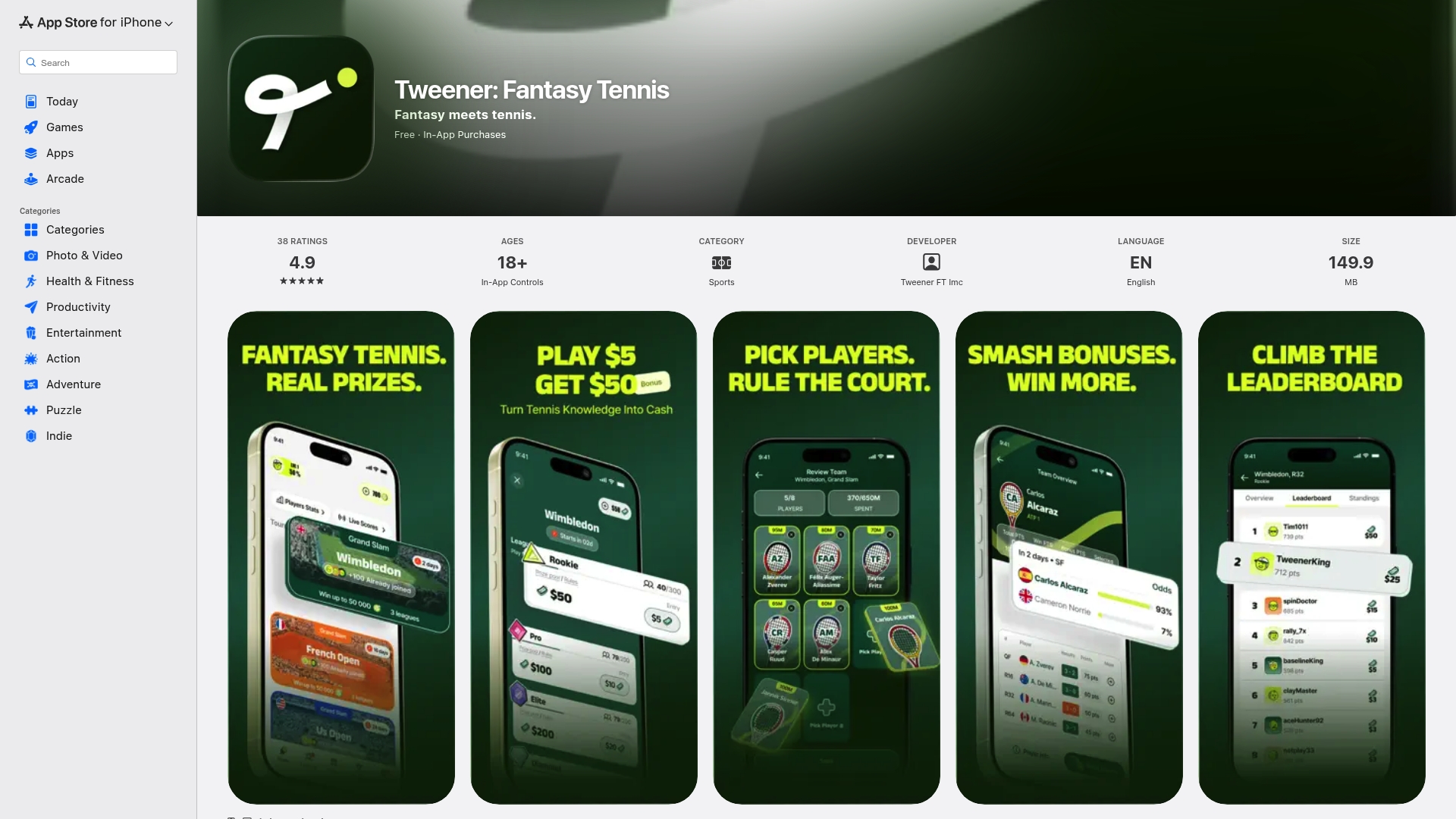
The organizer workflow is straightforward: create a private league, choose your reward template (free or paid), set your entry fee and payout table, and publish before the draw. Tweener surfaces the prize table to all participants automatically, satisfying the pre-contest disclosure requirement that underpins skill-game legal standing. For paid contests, consult a legal professional to confirm your state's rules before going live. Ready to set up your league? Download Tweener and get your Grand Slam pool running before the next draw.
Sources
- What Is a Fantasy Sports App? Types, Formats, and How They Work (Complete Guide)
- Gamification and player motivation in sports apps (academic study)
- 31 U.S. Code § 5362 - Definitions | U.S. Code | US Law | LII / Legal Information Institute
- Congress
- Regulating fantasy sports (excerpt) — Indiana Law Journal repository