

For fantasy value, serve consistency under pressure beats raw top speed. Prioritize pressure serve consistency (PSC) and surface context over chasing the biggest radar-gun number, and treat ace counts as scoring bonuses that matter more on fast courts or in ace-heavy formats. Mario Tennis Aces adds a wrinkle: character speed bands mean less than "NICE" timing and placement. The rest of this guide shows you exactly how to compute and apply that.
TL;DR:
- Serve consistency under pressure and surface context outweigh raw serve speed and ace counts in fantasy tennis scoring.
- Placement accuracy and maintaining speed at break points are more predictive of aces and winning than aggressive serve velocity alone.
- Filtering data within the past 52 weeks and by surface improves prediction accuracy, as career averages often ignore recent form and injury status.
- Mario Tennis Aces' mechanics highlight that "NICE" timing and placement can produce unreturnable serves, similar to how consistency matters more than raw speed in real tennis.
- Tailoring your roster with weighted metrics like PSC and ace rate to match your scoring system maximizes your chances of success in fantasy play.
Table of Contents
- What Do Serve Speed and Aces Fantasy Metrics Actually Mean?
- What Does the Research Actually Say About Aces and Serve Speed?
- How Do Mario Tennis Aces Serve Mechanics Compare to Real Tennis?
- How Do You Build a Fantasy Roster Around These Serve Metrics?
- Why Serve Stats Alone Never Tell the Whole Story
- Ready to Put PSC and Ace-Rate Analysis to Work?
- Sources
- FAQ
What Do Serve Speed and Aces Fantasy Metrics Actually Mean?
Before you can build a scoring model, you need to know what you're actually measuring. Tennis broadcasts throw around "serve speed" like it's one number, but there are at least two versions worth tracking separately.
Average serve speed is the mean velocity of a player's first serves over a match or season, usually pulled from Hawk-Eye or radar-gun tracking at ATP and WTA events. Max serve speed is the single fastest reading recorded, which makes for a great headline but tells you almost nothing about how a player performs on point 47 of a third-set tiebreak. An ace is any serve the returner fails to touch. Ace rate expresses that as a percentage of total service points, which is the number you actually want for projections, not raw ace counts, because it normalizes for match length. First-serve percentage measures how often the first serve lands in, and first-serve win rate measures how often the server wins the point when it does.
None of those numbers, alone, tells you who holds serve when it counts. That's where Pressure Serve Consistency (PSC) comes in. It's a derived metric that combines first-serve percentage with serve-speed variance specifically at break points, and it exists because raw speed data hides a critical pattern: players who only lose 1 to 2 mph off their first serve under break-point pressure tend to be far more reliable fantasy assets than a player who hits harder on average but loses 3 to 4+ mph when it matters, according to analysis of the serve speed paradox. A simple version you can build from public match logs:
PSC = (First-Serve % under normal points ÷ First-Serve % at break points) × (Average speed at break points ÷ Season average speed)
A PSC score close to 1.0 means a player barely changes under duress. A score dropping toward 0.85 or lower flags someone who can look dominant in stats but folds when the set is on the line.
Scoring systems vary widely across fantasy tennis platforms, and that variation should shape how you draft:
- Ace-heavy grids award a flat bonus per ace, which inflates the value of big servers regardless of match context.
- Progression-focused grids weight round advancement and games/sets won far more than any single serve stat.
- Balanced grids blend serve, return, and match-progression points, which is where PSC and ace rate both earn a seat at the table rather than one dominating.
Always check a platform's actual scoring rules before you draft. A player who's a strong ace-rate pick under one scoring system might be mediocre value under another.
One more filtering step matters more than most fantasy players realize: timeframe. Pulling career averages ignores form and injury recovery. Filtering to the last 52 weeks, and splitting by surface within that window, gives you a far more accurate read on current serve quality than lifetime numbers ever will, a point Tweener's own stats guide makes explicitly for fans building rosters around real ATP and WTA data.
What Does the Research Actually Say About Aces and Serve Speed?
The single most useful finding in professional tennis serve analytics has nothing to do with speed. A 2016 study published in the Journal of Sports Sciences analyzed men's professional matches and found that serve placement predicted aces far more reliably than velocity. Serves landing within roughly 15.27 centimeters of the service box line, and directed more than 5.88 degrees away from the returner's position, were the most likely to become aces.
That's a striking number for anyone who's ever assumed the hardest hitter automatically racks up the most aces. The paper effectively splits pro serves into four corner landing zones, each roughly 0.73 by 2.35 meters, and shows that hitting those precise corners matters more than shaving another 3 mph off a flat serve down the middle.
Statistic callout: Landing a serve close to the box line and angled away from the returner predicted aces with high classification accuracy in the study's model, dramatically outperforming raw speed as a predictor.
A newer analysis backs this up from a different angle. A 2025 causal-effect study published in BMC Sports Science, Medicine and Rehabilitation ran double machine learning across ATP men's singles matches from 2013 to 2024 and found that ace rate has only a modest and highly variable association with winning probability once you control for surface and ranking group. First-serve win rate and first-serve in rate swing meaningfully depending on whether you're looking at a top-20 player on grass versus a mid-ranked player on clay. Surface heterogeneity, not raw serve output, drove most of the variation the researchers measured.
That finding lines up with what's sometimes called the serve speed paradox: analysis of break-point and serve-variance data across multiple seasons shows that servers hitting above roughly 115 to 120 mph don't necessarily win more matches once you account for how consistent that speed stays under pressure. A big serve that collapses at 30 all is worth less than a moderate serve that holds its velocity and placement when the returner is one point from a break.
A few surface-level benchmarks are worth keeping in your back pocket when you're filtering by court type:
- Grass and fast hard courts amplify ace value because their surface characteristics reward big, flat serves that limit the returner's reaction time.
- Clay suppresses ace rate significantly since the higher bounce gives returners extra reaction time, favoring baseline consistency over raw serve power.
- Ace-rate ranges reported across pro tour data vary widely by surface and player type, which is exactly why a single "good ace rate" number is misleading without a surface tag attached.
Data-quality caveats matter here too. Radar-gun calibration differs between tournaments and broadcasters, non-tour exhibition speeds (the kind that generate viral headlines) often get miscoded, and one commonly cited figure, Sam Groth's reported 163.7 mph serve, was never ATP-recognized as an official tour reading. Treat outlier speed numbers with the same skepticism you'd apply to any unverified stat.
How Do Mario Tennis Aces Serve Mechanics Compare to Real Tennis?
If you play competitive Mario Tennis Aces, you already know the community has built its own informal serve-speed rankings, dividing characters into flat, topspin, and slice bands based on player-tested numbers rather than any official Nintendo data sheet. These community tables are useful, but treat them the way you'd treat a fan-run spreadsheet: helpful for a baseline, unreliable for anything precision-dependent, since testing conditions and character-matchup context vary from post to post.
The mechanic that actually swings outcomes is "NICE" timing, the game's precision-input window that boosts shot power and accuracy when you hit the button at the exact right moment. A character with a modest raw serve-speed rating can produce a functionally unreturnable serve if the player nails NICE timing and placement consistently, while a "fast serve" character mishitting that window regularly will underperform their listed stats. This maps almost perfectly onto the pro-tennis finding that placement beats velocity. Charge-meter mechanics add another layer, letting players trade windup time for power in a way that has no direct real-tennis analog, but functions similarly to how a pro server might sacrifice a slightly slower first serve for better location on a big point.

Translating in-game numbers into anything resembling a fantasy or competitive projection means converting discrete mechanics, NICE windows and charge levels, into probability adjustments rather than assuming a raw speed-band number scales like mph does in professional tennis. A character rated for a higher top serve speed doesn't carry a proportional ace-probability advantage the way a 130-mph pro serve edges out a 115-mph one; the in-game advantage is capped and highly conditional on execution.
If you're picking characters for ace-focused or consistency-focused formats, three rules keep you grounded:
- For ace-heavy formats, prioritize characters with strong flat-serve bands and forgiving NICE timing windows, since raw speed only pays off when you can consistently land the input.
- For consistency-focused formats, favor topspin or slice specialists whose serve reliability holds up across longer rallies, mirroring the PSC logic from pro tennis: steady output under pressure beats occasional big hits.
- Never draft or select purely on community speed-band tables without weighing matchup-specific placement data, since those numbers are unofficial and can shift with patch updates or meta changes.
How Do You Build a Fantasy Roster Around These Serve Metrics?
Turning all of this into an actual lineup takes five steps, and skipping any one of them is how fantasy players end up drafting a big server who quietly craters their team score in the quarterfinals.
- Read the scoring grid first. Before pulling a single stat, know whether your contest rewards aces heavily, weights match progression, or balances the two. This single step reshapes every decision after it.
- Set your surface and timeframe filters. Pull the last 52 weeks of data and split by surface. A player's clay numbers tell you almost nothing about their Wimbledon week.
- Compute ace rate per service point and PSC for your shortlist. Ace rate is aces divided by total service points. PSC, as outlined earlier, compares first-serve percentage and speed under break pressure against baseline performance.
- Apply a weighting template that matches your contest type. Don't use the same formula for an ace-bonus tournament that you'd use for a straight win-progression bracket.
- Cross-check recent form against the projection. A great PSC score from six months ago means less than a mediocre one from a player's last three matches.
Three weighting templates cover most fantasy formats you'll encounter:
| Template | Ace rate weight | PSC weight | First-serve in rate weight | Recent form weight |
|---|---|---|---|---|
| Ace-heavy | 40% | 20% | 15% | 25% |
| Win-progression | 15% | 35% | 20% | 30% |
| Balanced | 25% | 30% | 20% | 25% |
Two quick numeric examples show why this matters in practice.
But their PSC score sits at 0.82, meaning their first-serve percentage drops sharply and their speed falls off at break points.
Their raw ace-rate projection alone might sit around 5.5 points. Add the PSC weighting and their adjusted score climbs to roughly 7.1 points, edging out Player A once you account for who actually holds serve when the match tightens.
That gap, roughly a point and a half swinging in either direction, is the difference between a lineup that survives a third-set tiebreak and one that doesn't.
Pro Tip: When you're running cross-game formats that blend pro tennis stats with Mario Tennis Aces character picks, overweight the game-specific mechanics (NICE timing consistency, matchup history) for the in-game portion and lean on PSC for the pro-tennis portion. Treating both halves with the same formula is the fastest way to misjudge value on either side.
For deeper reading on how break points specifically stress-test a server, Tweener's guide to break points walks through the exact moments PSC is designed to capture. And if you want a broader framework for turning any of this into weekly roster decisions, Tweener's guide to optimizing fantasy picks for consistent wins covers the lineup-building logic in more depth.

Why Serve Stats Alone Never Tell the Whole Story
Here's what most fantasy tennis content gets backwards: it treats ace counts like a box-score stat you can draft around the way you'd draft a home-run hitter. Tennis doesn't work that way. A player can lead the tour in aces for a stretch and still be a trap pick if their PSC is falling apart quietly underneath that number, because break points, not aces, decide most close matches.
The uncomfortable truth for stats-obsessed fans is that the 2025 causal-effect research on ATP matches found ace rate's relationship to winning probability is genuinely modest once you strip out surface and ranking context, as detailed in Football Records: All-Time Top Scorers, Winners & Stats. That doesn't mean aces don't matter. It means they matter conditionally, and conditional value is exactly the kind of thing raw leaderboards hide and PSC-style modeling exposes.
Tweener was built around this exact gap. As a mobile fantasy sports app focused on professional tennis, it lets you build teams from real ATP and WTA players and compete based on live tournament results, which means the players and matches you're analyzing here translate directly into a roster decision, not just a spreadsheet exercise. The platform offers both free play using virtual coins redeemable for rewards and paid contests for real-money prizes where permitted. Both modes reward the same underlying skill this article has been building toward: reading serve consistency and surface context better than the person drafting across from you.
Tweener's own blog goes deeper into translating raw stat categories into fantasy decisions, covering serve, return, and pressure metrics in the same framework used here. That's not incidental. Fantasy tennis has lacked a serious, stats-driven format for years, and closing that gap means giving analytical fans tools that actually reward the kind of thinking this article just walked through, not just flashy ace totals.
— Nathan
Ready to Put PSC and Ace-Rate Analysis to Work?
Reading about pressure serve consistency is one thing. Drafting around it during a live Grand Slam, with real ATP and WTA players and a scoring grid you actually understand, is another. Tweener is built specifically for that jump: an app where analytical tennis fans use surface splits, H2H history, and form data to build teams, not guesswork. It's the closest thing tennis has had to a proper daily fantasy format, and it runs on the exact metrics this article covers.
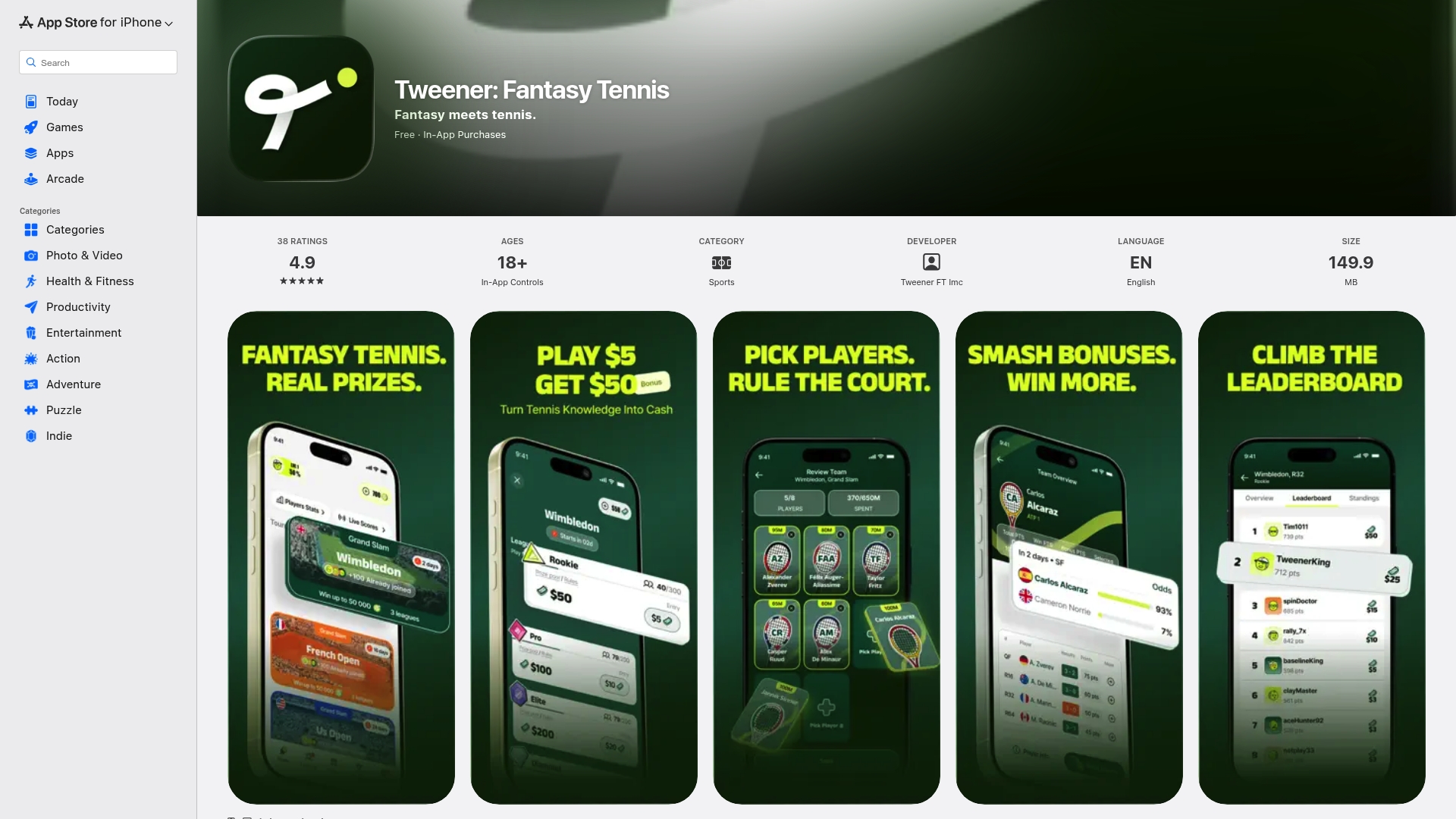
The app includes a draft mode for building full rosters from live tournament fields, and a pick'em mode for single-match contests offering a similar analytical experience. Users can create private leagues to compete with friends during major tournaments, with options for free coin play and cash contests available where allowed by law.
Before you draft, check the exact scoring breakdown on Tweener's game rules page so you know whether your contest rewards aces, match progression, or a balance of both. Then head to Tweener and build your first roster around a metric most fantasy players still aren't using correctly.
Sources
- Spatiotemporal and contextual features that predict aces in men's professional tennis (2016 DOI study)
- Fastest recorded tennis serves — Wikipedia
- Fantasy Tennis Stats & Data: Results to Projections — DailyMatchReport
FAQ
What Is the Hardest Serve in Tennis?
The largest reported reading belongs to Sam Groth, credited with a 163.7 mph (263.4 km/h) serve, though it was never officially recognized by the ATP. Among tour-verified readings, official radar figures from ATP events tend to sit noticeably lower.
What Is Coco Gauff's Serve Speed?
Coco Gauff's serve is not built around elite top-end speed; her game relies more on consistency, return skill, and movement than a dominant flat serve. Specific season-by-season average speed figures for Gauff aren't reliably published in a single verified source, so treat any exact number you see circulating with caution.
What Was Andy Roddick's Serve Speed?
Andy Roddick held one of the most famous fast-serve records of his era, with readings widely cited during his career near the high 140s to low 150s mph. Measurement standards have shifted since then, which is part of why direct comparisons to today's radar data need context.
What Is a Good Serve Speed in Tennis?
There's no single "good" number since serve speed only matters in combination with placement and consistency; a 2016 study found landing location predicted aces far better than raw velocity. On tour, first-serve speeds above roughly 115 to 120 mph are common and effective when paired with strong placement and a first-serve percentage that holds up under pressure.
Does Tweener Score Aces the Same Way Every Contest Does?
No. Scoring weights for aces, match progression, and other serve metrics vary by contest format inside Draft Mode and Pick'em Mode, so check the exact breakdown on Tweener's game rules page before drafting. Current pricing and contest details are listed directly on the app.