

A lucky loser is a player who lost in the final round of qualifying but gets slotted into the main draw after another player withdraws. The term is misleading. There's no luck involved beyond timing: the player still had to win multiple qualifying matches to even be in position for the call. What matters for fans and fantasy players is this: lucky losers earn ranking points and prize money equivalent to main-draw players for matches played.
Whether a player gets the nod depends on two things: when the withdrawal happens relative to qualifying, and where that player sits in the rankings among the other final-round losers. Here's what governs the process:
- Eligibility is limited to players who lost in the final round of qualifying.
- After qualifying wraps, the highest-ranked eligible loser gets first crack at any open slot.
- Before qualifying finishes, some tournaments use a random draw among the top losers instead.
Key Takeaways
Lucky losers earn identical ranking points and prize money to direct main-draw entrants, making late withdrawal news a real analytical edge, not a footnote.
| Point | Details |
|---|---|
| Eligibility is narrow | Only players who lost in the final round of qualifying can be selected as a lucky loser. |
| Timing decides the process | After qualifying ends, ranking order fills spots; before it ends, some events use a random draw. |
| Pay and points match exactly | A lucky loser's prize money and ranking points equal a direct entrant's for the same result. |
| Struff set the historic high point | Jan-Lennard Struff became the first lucky loser to reach an ATP Masters 1000 final, at Madrid in 2023. |
| Fantasy players should watch sign-ins | Match-sharp lucky losers can be strong late-swap value; use Tweener's late-swap tools to react fast. |
Table of Contents
- What Is a Lucky Loser in Tennis, and How Does Selection Work?
- Who Actually Qualifies for a Lucky Loser Spot?
- Alternates, Lucky Losers, and Withdrawal Timing: What Changes When
- The Most Memorable Lucky Loser Runs in Tour History
- Do Lucky Losers Get Paid and Ranked Like Everyone Else?
- How Fantasy Players Should Treat Lucky Loser Entries
- Clearing Up the Confusion Around Lucky Losers
- Why Lucky Losers Are My Favorite Wrinkle in Tennis
- Put Lucky Loser Intel to Work in Your Lineups
- Sources
What Is a Lucky Loser in Tennis, and How Does Selection Work?
Tournaments don't hand out lucky loser spots on a whim. The ATP Tour's own explainer lays out a selection order that's more mechanical than most fans realize, and it hinges almost entirely on one variable: has qualifying officially concluded yet?
Here's the sequence tournaments actually follow:
- Qualifying is complete. The highest-ranked player among all final-round qualifying losers fills the first vacancy. If a second spot opens, the next-highest-ranked loser gets it, and so on down the list.
- Qualifying is still in progress. Some events instead run a random draw among the top final-round losers, since a strict ranking order isn't always practical while matches are still being finalized. Picture a scenario where three players lose in the final qualifying round on the same afternoon a seed pulls out. Rather than waiting to rank them precisely, the tournament draws a name.
- Multiple withdrawals hit at once. Vacancies get filled one at a time, working down the ranked list of losers until the pool is exhausted.
This is where lucky losers diverge sharply from alternates. Alternates are reserve players brought in strictly for pre-draw withdrawals in the main draw itself, and they're assigned before the bracket is finalized. Lucky losers, by contrast, only exist because qualifying produced a surplus of players good enough to win matches but not quite good enough to claim one of the direct qualifying spots. According to reporting on the mechanism, tournaments built this two-tier system specifically so a draw can stay full without scrambling for wildcards on short notice.
The practical upshot: tracking a tournament's withdrawal news requires knowing whether qualifying has finished to determine who fills open slots. The rule genuinely flips depending on that timing.
Who Actually Qualifies for a Lucky Loser Spot?
Not every player who competed in qualifying gets a shot at this. The pool is narrower than most casual fans assume.
- Only players who lost in the final round of qualifying are eligible; earlier-round losers are not considered.
- Players must sign in and remain on-site after qualifying ends to maintain eligibility for lucky loser spots.
- If the top-ranked eligible loser declines, isn't reachable, or has already left, the offer moves down to the next-highest-ranked loser. In genuinely rare cases involving a wave of withdrawals, tournaments have reached back to players who lost in the penultimate qualifying round.
The final-round requirement is stricter than it sounds when you're scanning a draw sheet, because plenty of players who lost qualifying matches never had a realistic shot at the call.
Pro Tip: If you're following a tournament's qualifying rounds live, note who wins their semifinal qualifying match and loses the final. That short list, not the entire qualifying field, is your actual lucky loser pool for the week.
Alternates, Lucky Losers, and Withdrawal Timing: What Changes When
The mechanism a tournament uses to fill a gap depends entirely on when the withdrawal lands. Fans who mix up alternates and lucky losers usually get tripped up on timing, not definitions.
- Before the main draw is finalized: withdrawals get filled by alternates, players held in reserve specifically for this window. Lucky losers have no role here because qualifying may not have even wrapped.
- After the draw is set but before a player's first match: this is the lucky loser's window. The LL doesn't get a fresh slot. They inherit the exact position, and often the exact seeding treatment, of the player who withdrew.
- After play has already begun: if a player pulls out mid-tournament, that's handled as a walkover or a retirement, not a lucky loser situation. Nobody steps in to fill that spot.
That last distinction trips people up constantly, so it's worth being precise about it. A walkover happens before a match starts: the opponent advances, no ball gets struck, and the match doesn't count in official statistics. A retirement happens mid-match, when a player stops due to injury or illness after play has already begun; the match result stands as recorded up to that point. Neither situation opens a door for a replacement player. Once a bracket is live, it's live. This is also why "walkover vs retirement" and "lucky loser" get conflated in casual conversation but describe entirely separate tournament scenarios: one is about replacing a player before the match, the others are about how an unplayed or unfinished match gets recorded.
The Most Memorable Lucky Loser Runs in Tour History
Most lucky losers lose their first-round match and disappear from the storyline. That's what makes the rare deep run worth remembering.
- Jan-Lennard Struff, Madrid 2023. Struff entered the Madrid Open as a lucky loser and went on to become the first lucky loser in history to reach an ATP Masters 1000 final. No LL had ever gotten that far at the Masters level before. It's the single most cited example in tennis journalism whenever the term comes up.
- Heinz Gunthardt and Sergiy Stakhovsky. Both names surface regularly in tour history as lucky losers who went on to win events or reach finals at the tour level, part of a short but real list of players who turned a second chance into a title run.
- Donna Vekic. On the WTA side, Vekic's career includes a notable lucky loser breakthrough that helped establish her as a player capable of deep runs when given the opening.
Tour-level title wins by lucky losers remain historically rare, which is precisely why each occurrence gets remembered and retold for years. When it happens, it's treated as one of the sport's better underdog stories, not a fluke.
Do Lucky Losers Get Paid and Ranked Like Everyone Else?
Yes, fully. This is the part that surprises casual fans the most, and it's worth stating plainly: a lucky loser's ranking points and prize money are identical to what any direct main-draw entrant earns for the same result.
Win your first-round match as a lucky loser, and you bank the exact same points a top-32 seed would collect for the identical win. The tournament doesn't apply a discount because you got in through the back door.
Here's why that matters more than it might seem:
- A lucky loser who strings together two or three wins can pick up enough points to meaningfully shift their ranking heading into the next few months of the season.
- Prize money from a surprise run often outpaces what the player would have earned even by winning the entire qualifying tournament outright.
- A single deep LL run can be the difference between direct entry and qualifying at the next major event on the calendar, since ranking points compound across a season.
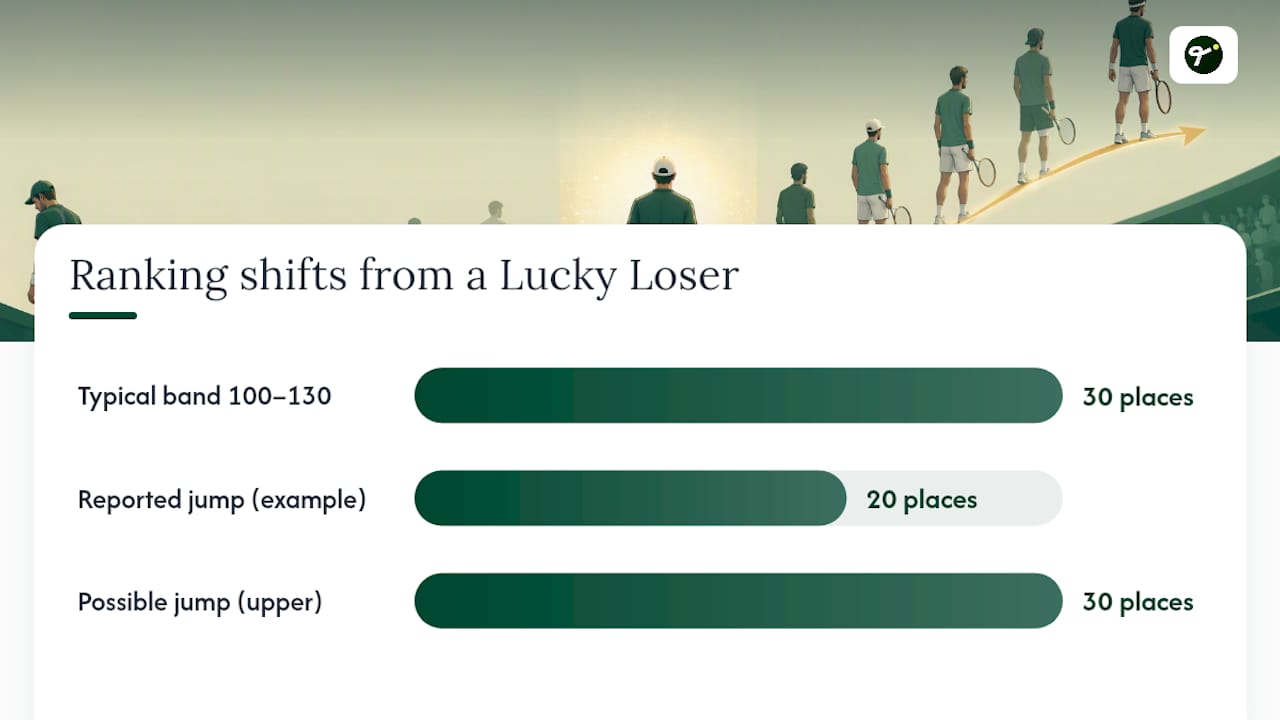
Think about what this means for a player ranked in the 100 to 130 range, often the exact band lucky losers come from. One unexpected run, like Struff's in Madrid, can jump a player 20 or 30 spots and change their entire trajectory for the rest of the year. That's not a minor footnote. It's why tournament withdrawal news is worth watching closely if you care about the depth of a field, not just the marquee names at the top of the bracket.
How Fantasy Players Should Treat Lucky Loser Entries
Lucky losers create a genuine analytical edge for fantasy tennis, and most casual players completely miss it. Here's the logic: a player who just won multiple qualifying matches is, by definition, match-sharp in a way that a direct entrant coming off a bye or a long layoff simply isn't.

That freshness matters. A lucky loser walking into round one has already logged real minutes on tour-level courts against live competition, while their first-round opponent might be shaking off rust from a first-round bye or an early exit at the previous event. If you're building lineups on Tweener, that match sharpness is exactly the kind of edge stats-driven fantasy players look for, and it rarely gets priced into casual fan expectations.
The catch is variance. Lucky loser slots open on short notice, sometimes the morning of a match, which means:
- Roster construction should treat LL entries as high-upside, high-variance plays, not safe floor picks.
- Keep exposure to any single late-notice player capped across your lineups rather than loading up on one storyline.
- Prioritize LLs who beat opponents with a playing style similar to what they'll face next; recent form against comparable competition is more predictive than ranking alone.
Pro Tip: Check tournament sign-in sheets and official withdrawal announcements the morning of first-round matches. Tweener's late-swap windows exist precisely for scenarios like this, where a roster decision made the night before can go stale by the time the draw actually gets played.
This is also where private leagues shine during majors. When you're competing against a small group of friends who all saw the same withdrawal news, being the one who actually acted on it, rather than just noticing it, is what separates a win from a near-miss.
Clearing Up the Confusion Around Lucky Losers
A few terms get tangled together constantly, so here's the short version.
- A lucky loser plays a match; it counts in the record books and pays real points and prize money.
- A walkover means no match happens at all; the opponent advances and nothing gets added to the stat sheet.
- A retirement means the match started but ended early, usually due to injury, with the result recorded up to that point.
- Not every player who competed in qualifying is LL-eligible. Only those who lost the final round qualify for consideration.
- The word "lucky" is a misnomer. Reaching the final round of qualifying, and being viewed by the tour as an earned second chance rather than a handout, already means you beat several capable opponents. The break is timing, not talent.
Why Lucky Losers Are My Favorite Wrinkle in Tennis
Struff's run through Madrid in 2023 is the story I bring up whenever someone tells me qualifying rounds don't matter. He lost his qualifying final, packed for a quiet week, and instead played his way into an ATP Masters 1000 final. That's the entire appeal of this rule in one sentence: tennis built a mechanism where the guy who technically lost still gets to write one of the sport's better upset stories.
What I find underrated is how predictable the unpredictability actually is. Lucky losers aren't random names pulled from a hat. They're battle-tested players sitting one match away from the main draw, and that's exactly the kind of signal analytics-minded fans should be hunting for instead of ignoring.
Put Lucky Loser Intel to Work in Your Lineups
Tennis still doesn't have a real Fanduel or DraftKings equivalent, which is exactly the gap Tweener was built to fill. Lucky loser news is the kind of edge that rewards fans who actually watch qualifying and sign-in sheets instead of setting a lineup and walking away. Tweener's late-swap windows let you react the morning a withdrawal breaks, and its private leagues let you go head-to-head with up to nine friends through an entire Grand Slam, so the person who caught the LL news first actually gets rewarded for it.

If you want to see how scoring, entry rules, and roster changes work before your next tournament, check the game rules or download the Tweener app and build your first lineup before the next round of withdrawals hits.
Sources
- Lucky loser: Explaining the greatest term in tennis — ATP Tour
- Lucky-loser legal loophole — Last Word on Sports
- What is a lucky loser in tennis — Global Tennis News
- Walkover — Wikipedia