

TL;DR:
- Tennis prize money increases exponentially with each tournament round and tier, rewarding players' progression.
- Most earnings are funded by broadcast rights, sponsorships, and ticket sales, which are much higher for prestigious events.
Tennis prize money is allocated based on the round a player reaches in a tournament, with payouts escalating sharply at more prestigious events and later stages. A first-round exit at the 2026 French Open still earns a player over $100,920, while the singles champion collects $3,248,000. That gap tells you almost everything about how tennis prize money works: progression is rewarded exponentially, and the tournament tier determines the ceiling. This guide breaks down the full structure, from Grand Slam pools to doubles splits, payout logistics, and what fans often miss when they read the headline numbers.
How tennis prize money works by tournament tier and round
The ATP and WTA tours organize events into distinct tiers, and each tier carries a defined prize pool. Tournament tiers and ranking points are directly aligned, so the biggest prize pools sit at the top of the competitive pyramid.
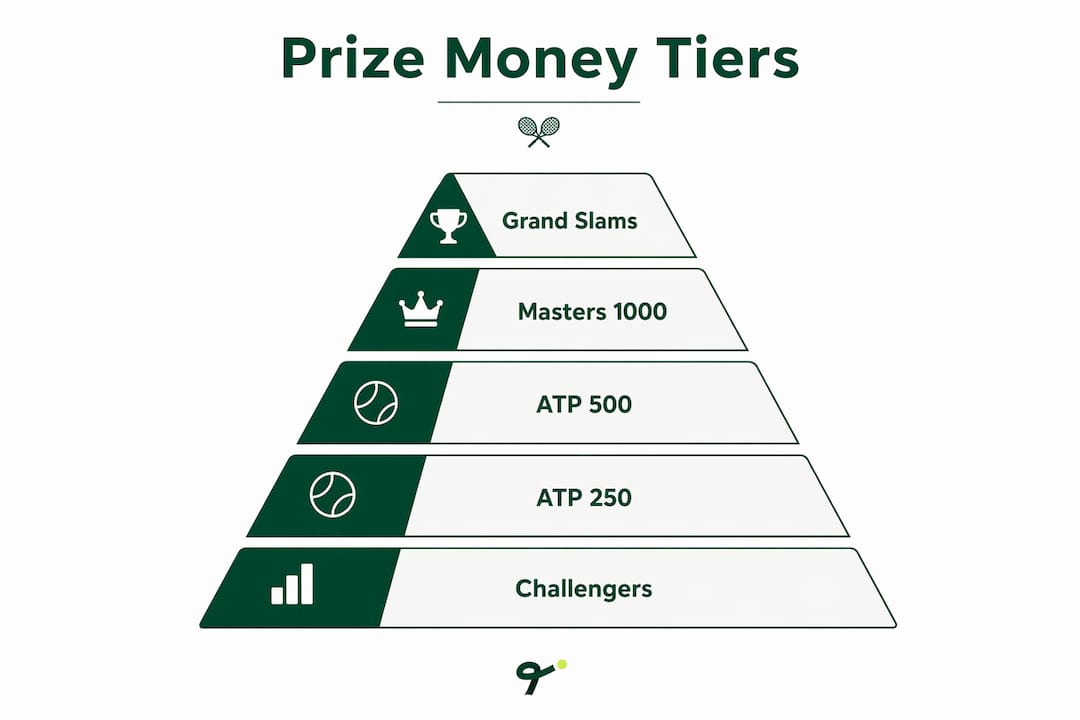
The five main tiers on the men's tour are Grand Slams, ATP Masters 1000s, ATP 500s, ATP 250s, and Challengers. At the 2025 U.S. Open, the singles winner earned $5 million. An ATP 250 event winner in the same year earned $109,640. That is a 45x difference for the same outcome: winning a tournament. The gap reflects the commercial scale of each event, not just prestige.
Within each tier, payouts escalate geometrically round by round. Reaching the quarterfinal at a Grand Slam does not earn you four times the first-round prize. It earns you many times more. This structure is intentional. It concentrates financial reward at the top of each draw and creates strong incentives for players to push through every match.
Here is a snapshot of how prize money scales across tiers in 2026:
| Round | Grand Slam (approx.) | ATP Masters 1000 (approx.) | ATP 250 (approx.) |
|---|---|---|---|
| First round loss | $100,920+ | $15,000–$25,000 | $5,000–$8,000 |
| Quarterfinal | $400,000–$600,000 | $80,000–$120,000 | $20,000–$35,000 |
| Finalist | $1,500,000+ | $400,000–$600,000 | $60,000–$90,000 |
| Winner | $3,000,000–$5,000,000 | $1,000,000+ | $100,000–$120,000 |
Pro Tip: When building a fantasy team on Tweener, players who consistently reach quarterfinals and semifinals at Masters 1000 events earn far more prize money than players who occasionally win ATP 250s. That consistency also signals better fantasy point potential across a full tournament.
Where does the prize money actually come from?
Prize pools do not appear from nowhere. They are funded by the commercial machinery surrounding each tournament, and the scale of that machinery explains why Grand Slams pay so much more than smaller events.
The primary revenue streams that fund tennis prize pools include:
- Broadcast rights: Global television deals are the single largest driver of prize money growth since the Open Era began in 1968. The expansion of broadcast markets since then has been the primary engine behind rising purses.
- Ticket sales: Grand Slams sell out weeks in advance across two weeks of competition. The Australian Open, Roland Garros, Wimbledon, and the U.S. Open each attract hundreds of thousands of on-site attendees.
- Sponsorships and commercial partnerships: Title sponsors, equipment brands, and hospitality packages all contribute to the overall revenue pool that tournaments draw from when setting prize money.
- Streaming and digital rights: Newer platforms bidding for live tennis content have added a competitive layer to rights negotiations, pushing values higher.
The result of all this commercial activity is visible in the numbers. The 2026 Australian Open set a record total prize pool of $111.5 million. That figure represents decades of compounding broadcast value, sponsorship growth, and audience expansion across Asia, Europe, and North America.
How singles and doubles prize money differ
Singles prize money and doubles prize money follow very different structures, and most fans do not realize how significant the gap is.
Singles payouts are calculated per player. A singles finalist at a Grand Slam earns their full share individually. Doubles prize money, by contrast, is awarded per team and then split between the two players. At the 2026 French Open, doubles winners share nearly $700,000 per team, meaning each player takes home roughly $350,000. A singles finalist at the same event earns over $1.5 million individually.
Here is what that means in practice for player income strategy:
- Doubles as income insurance: Playing doubles supplements income for players who exit singles early. A player knocked out in the first round of singles can still earn meaningful prize money by advancing in doubles.
- Year-end bonus pools: Top ATP players benefit from year-end bonus pools totaling roughly $21 million annually as of 2025, distributed based on final rankings and tournament participation. These bonuses can significantly shift a player's annual earnings.
- Appearance fees: These are rare on the main ATP and WTA tours. They are negotiated separately from prize money and are far more common at exhibitions and smaller invitational events.
Pro Tip: Doubles specialists are often undervalued in fantasy tennis. If a player you are tracking enters both singles and doubles draws, their total tournament earnings and match volume are higher, which can translate to more fantasy points across a week.
How and when players actually receive their prize money
Understanding the payout process matters because the headline number on a tournament website is not what lands in a player's account.
- Tournament conclusion: Prize money is not paid on-site or in cash. Players receive their earnings via bank transfer only after the tournament officially concludes.
- Processing delays: There is often a processing period following the event's end before funds clear. This can range from days to a few weeks depending on the tournament and the player's banking arrangements.
- Agent and coach deductions: Most professional players pay agents between 10% and 20% of their prize money. Coaches often receive a percentage on top of that. These costs come directly out of prize earnings.
- Tax obligations: Players are taxed in the country where the tournament takes place, and potentially again in their country of residence. A Grand Slam winner taking home $3 million on paper may net considerably less after international tax obligations.
- Net income reality: After agents, coaches, travel, accommodation, and taxes, players' net income can be a fraction of the gross prize money figure. This is why understanding tennis earnings requires looking beyond the trophy ceremony check.
Real prize money examples from 2026 events
Concrete numbers make the structure tangible. Here is how prize money broke down at two major 2026 events.
2026 French Open (Roland Garros) singles breakdown:
| Round | Prize money |
|---|---|
| First round loss | $100,920 |
| Second round loss | $155,000 (approx.) |
| Quarterfinal | $500,000 (approx.) |
| Finalist | $1,600,000 (approx.) |
| Champion | $3,248,000 |
2026 Madrid Open (ATP Masters 1000) comparison:
The Madrid Open 2026 total prize pool sits at €8,235,540, with the singles winner earning approximately €1 million. That is roughly one-third of the French Open winner's payout, from a total pool that is a fraction of Roland Garros's budget.
The contrast between these two events illustrates the tier system in action. A first-round loss at the French Open pays more than reaching the quarterfinal at many ATP 500 events. That is the financial reality of Grand Slam prestige.
One more structure worth knowing: the ATP Finals pays differently from every other event. It uses a round-robin group stage before knockout rounds, and in 2023, the winner earned $4.8 million. The ATP Finals is often the highest single-event payout of the year, and its unique format means players earn prize money for wins during the group stage, not just for advancing through a bracket. Understanding how prize structures shape fantasy teams at events like the ATP Finals is a genuine strategic edge.
Key takeaways
Tennis prize money rewards progression, with payouts scaling geometrically by round and multiplying dramatically across tournament tiers from ATP 250 events to Grand Slams.
| Point | Details |
|---|---|
| Round-based escalation | Prize money increases sharply with each round, rewarding deep runs far more than early exits. |
| Tier determines the ceiling | Grand Slams pay 30–45x more than ATP 250 events for the same result: winning the title. |
| Doubles pays per team | Doubles prize money is split between partners, making individual earnings significantly lower than singles. |
| Year-end bonuses matter | Top players earn from a $21 million annual bonus pool based on rankings and participation. |
| Net income is much lower | Agents, coaches, taxes, and travel costs reduce gross prize money substantially for most players. |
Why the headline numbers only tell half the story
Most coverage of tennis prize money stops at the winner's check. That is the least interesting part of the story.
What I find genuinely fascinating is how the tier system creates completely different financial realities for players at different ranking levels. A player ranked 80th in the world might earn $500,000 in a year from prize money alone, which sounds impressive until you factor in 30 weeks of travel, a full coaching team, and tax obligations in a dozen countries. The financial realities of pro tennis are far more complex than the trophy ceremony suggests.
The growth of broadcast rights since the Open Era is the story most fans overlook. Prize money did not grow because tennis became more popular with fans at the venue. It grew because television networks and streaming platforms paid enormous sums for global rights, and tournaments passed a portion of that value back to players. The 2026 Australian Open's $111.5 million prize pool is a direct product of that commercial chain.
Year-end bonuses are another underappreciated layer. A player who finishes the year ranked in the top 10 collects a meaningful bonus on top of their tournament earnings. This influences scheduling decisions in ways fans rarely see. A player protecting a top-10 ranking in November is not just chasing ranking points. They are protecting a significant financial bonus tied to that position.
For fans using Tweener to build fantasy teams, understanding this structure is a real edge. Players who enter both singles and doubles draws, compete at multiple Masters 1000 events, and stay healthy through the year-end stretch are optimizing their earnings in ways that also translate to fantasy point volume. The tennis tournaments calendar and prize money structure are not separate topics. They are the same topic.
— Nathan
Put your tennis knowledge to work on Tweener

Understanding how prize money is allocated across tournament tiers and rounds gives you a real analytical edge, and Tweener is where that edge pays off. Tweener is the leading fantasy tennis platform built specifically for fans who follow the ATP and WTA closely. You pick real players, compete in public or private leagues with up to 9 friends, and earn points based on actual match results across live tournaments. The same knowledge that helps you understand why a player's schedule matters, which events carry the biggest prize pools, and how deep runs compound financially also helps you build winning fantasy lineups on Tweener. Free-to-play and cash contest modes are both available. Download Tweener and compete during the next Grand Slam.
FAQ
How is tennis prize money calculated per round?
Prize money is assigned to each round of a tournament, with amounts increasing geometrically as players advance. At the 2026 French Open, a first-round loser earns over $100,920, while the champion earns $3,248,000.
Do doubles players earn the same as singles players?
No. Doubles prize money is awarded per team and split between partners, making individual earnings significantly lower than singles payouts. At the 2026 French Open, doubles winners share nearly $700,000 as a team.
When do tennis players actually get paid?
Prize money is paid via bank transfer after the tournament concludes, with no on-site cash payments. Processing delays and deductions for agents, coaches, and taxes reduce the net amount players receive.
What is the highest-paying tennis event?
The ATP Finals is often the highest single-event payout, with the 2023 winner earning $4.8 million. Its round-robin format also pays players for group-stage wins, unlike standard knockout draws.
Do all professional tennis players earn significant prize money?
Players at the top of the ATP and WTA rankings earn substantial prize money, but players outside the top 100 often struggle to cover travel and coaching costs from prize earnings alone. Year-end bonus pools and doubles income help supplement earnings for players in the 50 to 150 ranking range.