

TL;DR:
- Deuce in tennis is a 40-40 tie within a game that requires winning two consecutive points to claim victory. It can repeat an unlimited number of times until one player wins two points in a row, making the game potentially very long.
Deuce in tennis is defined as the tied score of 40-40 within a single game, triggering a rule that requires one player to win two consecutive points to claim that game. This rule is standardized by both the USTA and the ITF, making it universal across professional ATP and WTA events, recreational leagues, and Grand Slam tournaments alike. Understanding how deuce works in tennis separates casual spectators from fans who truly follow the sport. The tennis scoring system has no other moment quite like it: a game that could theoretically never end.
How does deuce work in tennis?
Deuce occurs the moment both players reach 40 points in the same game. At that point, the standard scoring progression stops. Neither player can win the game by taking just one more point. Instead, deuce requires two consecutive points from the same player to end the game, with no limit on how many times the score can return to deuce.

This "win by two" rule is what makes deuce unique in sports scoring. A game at deuce could cycle back and forth five times, ten times, or more. The score never advances past advantage until one player holds it and wins the very next point.
One common misconception worth clearing up: deuce only applies at 40-40, not at 30-30. The term "deuce" is sometimes used informally at 30-30 in recreational play, but official rules reserve it strictly for 40-40 and any subsequent tied states after that.
Advantage in and advantage out explained
After deuce, the player who wins the next point earns "advantage." The terminology here is specific. "Ad-in" means the server holds the advantage. "Ad-out" means the receiver holds it. If the player with advantage wins the following point, they win the game. If they lose it, the score resets to deuce immediately.
This back-and-forth can repeat without limit. A single game can pass through deuce a dozen times in a tight match. Extended deuce sequences have produced some of the longest game moments in tennis history, occasionally exceeding 30 cycles between deuce and advantage. That open-ended feature is unique to tennis among major sports.
Pro Tip: Watch the score board closely during long deuce games. Broadcasters often display the number of deuces reached, which tells you exactly how much pressure both players are absorbing.
Key mechanics of advantage scoring:
- Winning the first point after deuce grants advantage, not the game
- The advantaged player must win the very next point to close the game
- Losing that next point returns the score to deuce, not to 40-30
- "Ad-in" and "ad-out" are the official calls used by chair umpires
- There is no cap on how many times deuce can repeat in one game
Deuce vs. no-ad scoring: what is the difference?
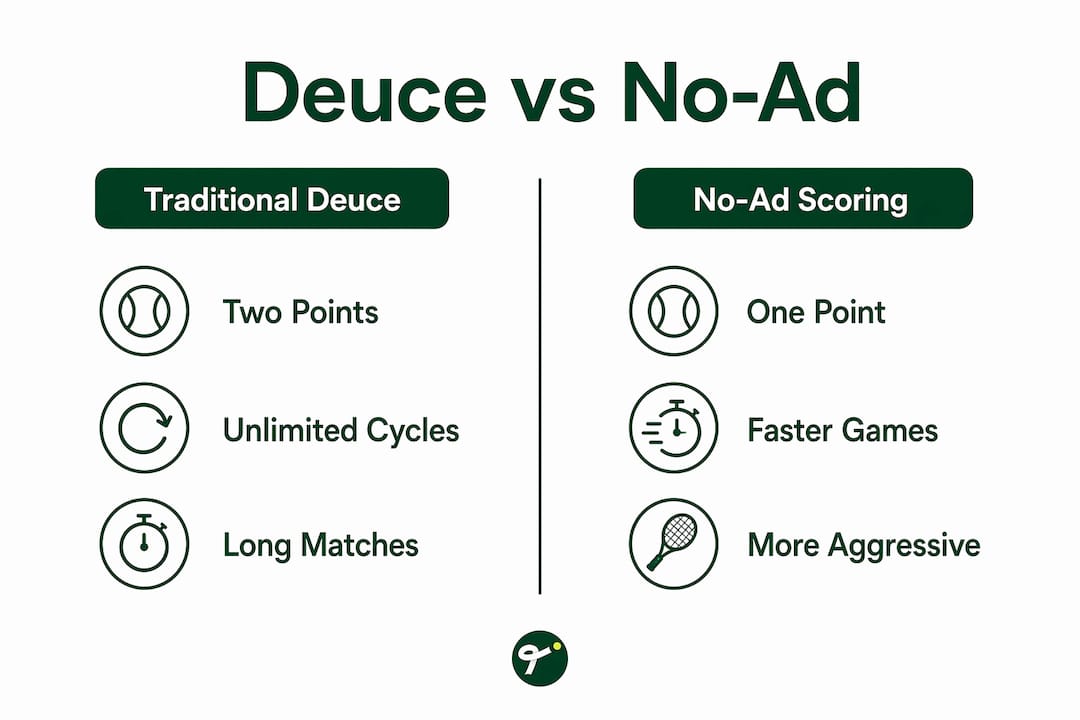
No-ad scoring is an alternative format where a single deciding point is played at deuce instead of requiring two consecutive points. The receiver gets to choose which side of the court the serve is delivered to, adding a tactical wrinkle to that deciding moment. No-ad scoring was created by James Van Alen to shorten match durations and is widely used in World TeamTennis and select professional doubles formats.
The practical effect is significant. No-ad games end faster, which shortens overall match time and reduces physical fatigue in doubles formats where multiple sets are played in quick succession. Tournament organizers use no-ad scoring as a deliberate tool to control scheduling and viewer experience.
Pro Tip: If you play recreational doubles, check your league's rules before your first match. Many recreational leagues use no-ad scoring without announcing it clearly, and not knowing can cost you a game.
| Feature | Traditional deuce | No-ad scoring |
|---|---|---|
| Points needed to win after 40-40 | Two consecutive | One deciding point |
| Receiver's choice of serve side | No | Yes |
| Common format | Singles and doubles | Professional doubles, recreational leagues |
| Match length impact | Longer games possible | Shorter, more predictable |
| Psychological pressure | Extended, cumulative | Concentrated in one moment |
No-ad scoring changes the game dynamic significantly, favoring more aggressive play from both server and receiver. The receiver's ability to choose the serve side removes one of the server's biggest advantages at that critical moment.
The psychology and strategy of playing deuce points
Deuce creates a pressure point unlike any other moment in a tennis game. Both players have fought to 40-40, meaning neither has been able to pull away. What happens next often comes down to mental composure as much as physical skill.
The server faces higher emotional pressure at deuce because losing the game means conceding a service break. A service break is one of the most damaging outcomes in tennis, often deciding sets and matches. Servers under this pressure frequently shift to more conservative serving patterns, which receivers can anticipate and attack.
Common tactical adjustments players make at deuce:
- Servers often target the body or the T to reduce the receiver's angle
- Receivers look to neutralize the serve and extend the rally rather than go for winners
- Players with strong net games use deuce as a moment to approach and apply pressure
- Mentally, the goal is to treat each deuce point as a fresh start, not as accumulated pressure
- Recreational players benefit from slowing their breathing and resetting their focus between points
Players who handle deuce cycles well gain a measurable competitive edge in tight matches. Momentum shifts dramatically when a player converts advantage after multiple deuces. Winning a long deuce game can visibly deflate an opponent and energize the crowd.
The mental challenge at deuce is real. Novak Djokovic and Rafael Nadal are both known for their ability to reset mentally at deuce and play their best tennis precisely when the pressure is highest. Recreational players can develop the same habit by practicing deuce scenarios in training, not just full games from the start.
How is deuce different from a tiebreak?
Deuce and a tiebreak are two completely different scoring mechanisms, and confusing them is one of the most common mistakes among newer tennis fans. Deuce occurs within a single game. A tiebreak occurs at the end of a set when both players reach six games each (or in some formats, at a different threshold).
Unlike tiebreaks, which end sets, deuce is an open-ended scoring state within a game requiring two consecutive points to conclude. A tiebreak has its own separate scoring system, typically played to seven points with a two-point margin required to win. You can read a full breakdown of tiebreak rules and formats to understand how that system works alongside deuce.
Key distinctions to know:
- Deuce happens inside a game. A tiebreak replaces a game at the end of a set.
- Deuce requires winning two consecutive points. A tiebreak requires reaching seven points with a two-point lead.
- A tiebreak has a defined scoring structure. Deuce is open-ended.
- A "break point" is a separate concept: it refers to a point where the receiver can win the game and break the server's serve. Break points often arise directly from deuce situations. Learn more about break point strategy to see how they connect.
Understanding these distinctions matters when you watch live matches. Commentators use all three terms, often in quick succession, and knowing what each one means makes the broadcast far more engaging.
Key Takeaways
Deuce in tennis is a 40-40 tie within a game that requires one player to win two consecutive points, with no limit on how many times the score can return to deuce.
| Point | Details |
|---|---|
| Deuce definition | Deuce occurs at 40-40 and requires two consecutive points to win the game. |
| Advantage terminology | "Ad-in" means the server leads; "ad-out" means the receiver leads after deuce. |
| No-ad scoring | A single deciding point replaces the two-consecutive-points rule in some formats. |
| Psychological pressure | Servers face higher stakes at deuce because losing means conceding a service break. |
| Deuce vs. tiebreak | Deuce happens inside a game; a tiebreak ends a set and uses a separate scoring system. |
Why deuce moments define matches more than people realize
I have watched hundreds of matches where the scoreline looked lopsided but the real story was buried inside a single deuce game in the second set. One player holds on through four or five deuces, converts advantage, and suddenly the entire match shifts. The scoreboard shows one game won. The momentum shows something much bigger.
Recreational players tend to treat deuce as a frustrating delay. I think that is the wrong frame entirely. Deuce is where matches are actually decided. The player who stays calm, picks a clear tactical plan, and executes under pressure almost always comes out ahead over the course of a full match.
My honest advice: stop trying to end deuce games quickly. The instinct to go for a big winner on advantage is understandable, but it leads to unforced errors at the worst possible moment. Play the point you know you can win, not the point you hope will be spectacular. Patience at deuce is not passive. It is the most aggressive thing you can do to an opponent who is already feeling the pressure.
— Nathan
Tweener brings tennis scoring to life
Tennis scoring is more than rules on paper. Every deuce, every advantage point, every break of serve carries real weight when you have skin in the game.
Tweener is a fantasy tennis app built for fans who follow the sport closely. You build teams from real ATP and WTA players, compete in public or private leagues, and earn points based on how your picks perform in live tournaments. When you understand how deuce and advantage points shape match outcomes, your player selections get sharper. Tweener rewards that kind of analytical thinking. Download Tweener and compete in fantasy leagues built around the tournaments you already watch.
FAQ
What is deuce in tennis?
Deuce is the score of 40-40 in a tennis game. From deuce, a player must win two consecutive points to win the game.
How many times can deuce repeat in one game?
There is no limit. A game can return to deuce an unlimited number of times until one player wins two consecutive points.
What does "ad-in" and "ad-out" mean?
"Ad-in" means the server has the advantage after deuce. "Ad-out" means the receiver holds the advantage.
How is no-ad scoring different from traditional deuce?
In no-ad scoring, a single deciding point is played at deuce instead of requiring two consecutive points. The receiver chooses which side the serve is delivered to.
Is deuce the same as a tiebreak?
No. Deuce occurs within a single game at 40-40. A tiebreak is a separate scoring format used to decide a set when both players reach six games each.