

TL;DR:
- Joining fantasy-tennis communities transforms passive spectatorship into active competition and social connection. Participants improve their analytical and tactical skills while strengthening bonds through shared rituals and chat interactions.
Joining app-based fantasy-tennis communities turns passive watching into active competition, social belonging, and sharper tennis knowledge. The benefits are concrete and immediate:
- Active engagement: Every point in a Djokovic tiebreak or Swiatek clay-court run carries real strategic weight for your roster.
- Social belonging: Drafts, league chats, and shared rituals build genuine friendships around a shared obsession.
- Analytics literacy: Tracking surface form, H2H records, and draw brackets makes you a smarter fan and a better fantasy manager.
- Skill transfer: The pattern recognition you build in fantasy leagues sharpens how you read live matches.
- Rewards and competition: Free coin-based leagues and real-money contests give you something to play for beyond bragging rights.
Table of Contents
- 1. Joining tennis fan communities improves your well-being
- 2. Fantasy tennis turns passive watching into strategic engagement
- 3. What community features actually matter for competitive fans
- 4. How to get the most from your tennis fan community
- 5. Real-money modes, legal rules, and responsible play for U.S. fans
- 6. How to join or create your first tennis fantasy league
- Key Takeaways
- Why the social side of fantasy tennis is underrated
- Tweener brings all of this together in one app
- Useful sources and further reading
1. Joining tennis fan communities improves your well-being
The psychological case for fan communities is stronger than most people realize. Research by Yuhei Inoue and Mikihiro Sato links social identification with a sports group to measurable gains in well-being, specifically through in-group trust, shared norms, and a sense of collective purpose. When you identify with a league of fellow ATP/WTA fans, you gain access to a ready-made social network with its own culture and mutual accountability.
That belonging is also what keeps people coming back. A Journal of Sport Behavior study found that social belonging, not prize money or competitive ranking, is the primary driver of long-term fantasy sports participation. The drafts, the trash-talk threads, the pre-Wimbledon prediction rituals: these aren't just fun. They're the scaffolding that sustains engagement across seasons.
The American Heart Association has also noted cognitive benefits tied to fantasy sports, including regular analysis, critical thinking, and information synthesis. Playing fantasy tennis isn't passive entertainment. It's a weekly exercise in reading data and making decisions under uncertainty.
Key well-being benefits at a glance:
- Increased in-group trust and sense of collective purpose
- Sustained social contact through ritualized interaction (drafts, chats, season rituals)
- Cognitive stimulation from weekly analysis and roster decisions
- Reduced social isolation through consistent group engagement
Many Gen Z fantasy sports participants reported stronger emotional connections to live sport through fantasy play, a notably higher rate than older demographics.
2. Fantasy tennis turns passive watching into strategic engagement
Without a roster on the line, watching Alcaraz grind through a five-setter is entertaining. With one, it's something else entirely. Fantasy play converts each point into strategic value, forcing you to pay attention to details most casual fans miss: serve percentages on second serves, break-point conversion rates, how a player historically performs on indoor hard courts in the third set.

Picture this: it's the Roland Garros quarterfinals, and you've rostered Casper Ruud against a hard-hitting opponent with a weak clay record. The match goes to a deciding set. You're not just watching, you're tracking Ruud's topspin backhand consistency, his opponent's double-fault rate under pressure, and whether the conditions favor the grinder or the power hitter. That level of attention is what smart team selection produces.
Viewing behaviors that shift when you play fantasy tennis:
- You watch matches involving lower-ranked players you'd normally skip
- You track H2H records and surface-specific win rates before tournaments
- You notice tactical adjustments mid-match rather than just the scoreline
- You follow draw brackets and scheduling to anticipate fatigue and matchup dynamics
- You pay attention to injury reports and practice session news
3. What community features actually matter for competitive fans
The features that separate a good fantasy-tennis community from a forgettable one come down to three things: social infrastructure, competitive depth, and analytical tools. Here's what to look for:
- Private leagues: Invite up to 9 friends for a Grand Slam-length competition. These sustain the deepest bonds because the stakes are personal.
- Public tournaments: Open contests let you test your picks against a wider field and discover how your strategy holds up at scale.
- Draft modes (auction and pick'em): Auction drafts reward research; pick'em formats reward quick reads on form. Both build different skills.
- Live scoring: Points that update in real time as ATP/WTA matches progress keep you glued to the action.
- Leaderboards: Persistent rankings create ongoing motivation and a clear measure of improvement over time.
- Integrated chat: Fantasy leagues and group chats become lasting social institutions when the conversation runs between tournaments, not just during them.
- Surface and H2H analytics: Clay vs. grass performance splits and head-to-head records are where real strategic edges come from.
- In-app currency and rewards: Virtual coins redeemable for gift cards give casual players a reason to stay engaged without financial risk.
- Cash contest mechanics: Paid entry contests with real-money payouts for U.S. players who want higher stakes.
Pro Tip: Before committing to a league, check whether it has a code of conduct and active chat moderation. A community with clear norms and a responsive admin produces a better experience than one with higher prize pools but no culture.
4. How to get the most from your tennis fan community
Regular participation compounds. The fans who build the strongest networks and the sharpest analytical skills are the ones who show up consistently, not just during Grand Slams.
- Attend your first live draft. Auction drafts especially reward preparation. Review surface records and recent form for your target players before the clock starts.
- Introduce yourself in the league chat. A single post with your tennis background and a bold pick for the tournament breaks the ice and signals you're engaged.
- Share one stat-based insight per match week. Pull a surface win percentage or a tiebreak conversion rate and post it with your reasoning. This builds your reputation as an analytical contributor, not just a lurker.
- Set a weekly ritual. Watch a featured match with the chat open. Real-time reactions during a Medvedev vs. Sinner match create the kind of shared experience that keeps leagues alive for years.
- Rotate small prizes or recognition. Weekly "best pick" callouts or a running season leaderboard keep engagement high between major tournaments.
Pro Tip: Trash-talk is part of the culture, but keep it about the picks, not the person. "Your Zverev pick aged badly on clay" lands differently than anything personal. The best leagues run on competitive banter that everyone can laugh at.
Using the analytics tools built into the app to generate shareable insights, surface splits, recent form charts, draw difficulty scores, give you content that sparks conversation and position you as someone worth following in the league.
5. Real-money modes, legal rules, and responsible play for U.S. fans
Cash contests involve entry fees and real payouts, so understanding the rules before you deposit is non-negotiable. The risks of fantasy sports betting are manageable with the right habits, but ignoring them creates problems.
- Responsible play: — The American Heart Association's reporting notes that players who spend the most time in fantasy systems can show worse mental-health outcomes, while experienced players tend to report fewer problems. Set a session budget and stick to it.
6. How to join or create your first tennis fantasy league
You can be live in a league within 15 minutes. Here's the sequence:
- Create and verify your account. Download the app, register with your email, and complete any required identity verification for cash modes.
- Browse public leagues or create a private one. For a Grand Slam like the US Open, a private league with 4–9 friends gives you the most personal competition. Public leagues work if you want to test your picks against a larger field immediately.
- Join a draft or contest in free mode first. Use virtual coins to practice roster construction before committing real money. Live tournaments power your fantasy outcomes, so understanding the timing and scoring before a major is worth the extra session.
- Set your roster using surface and H2H data. Don't just pick the top-ranked players. Check who's in form on the current surface and who has a favorable draw.
- Post a short intro in the league chat. One sentence about your tennis background and your boldest pick for the tournament is enough to start building your community presence.
Key Takeaways
Joining an app-based fantasy-tennis community delivers active engagement, social belonging, and analytical skill growth, with Tweener providing the private leagues, live scoring, and both free and cash modes that make those benefits accessible to U.S. ATP/WTA fans.
| Point | Details |
|---|---|
| Social belonging drives retention | Research shows belonging, not prize money, is the primary reason fans stay in fantasy leagues long-term. |
| Fantasy play sharpens viewing | Rostering real ATP/WTA players shifts your attention to surface form, H2H data, and tactical patterns. |
| Start free, then scale | Free coin-based leagues let you build skills before entering cash contests, which require state-level legal checks. |
| Community rituals sustain engagement | Drafts, weekly chat rituals, and leaderboards keep leagues active between Grand Slams, not just during them. |
| Tweener covers the full stack | Private Grand Slam leagues, live scoring, surface analytics, and both free and cash modes in one app. |
Why the social side of fantasy tennis is underrated
Most coverage of fantasy sports focuses on strategy and prizes. The part that actually keeps people playing for years is harder to quantify: the group chat that becomes a standing social institution, the draft night that turns into an annual ritual, the friend who started as a league rival and became someone you text about every Wimbledon upset.
Research on sports fandom consistently shows that community membership raises self-esteem and sense of belonging, but the mechanism is more specific than that. It's the shared norms and mutual accountability of a group that actually knows its stuff. A fantasy-tennis league of serious ATP/WTA followers is a different social environment than a generic sports chat. The conversation is sharper, the analysis is deeper, and the relationships that form around it tend to last.
What I'd push back on is the idea that you need to be a stats expert before joining. The analytical skills develop through participation. You learn what surface splits matter by getting burned by a clay-court specialist on grass. You learn draw difficulty by watching your top pick exit in the third round against a qualifier. The community accelerates that education in a way that solo watching never does.
Tweener brings all of this together in one app
Tennis has never had a true DFS platform built specifically for the sport. Tweener fills that gap: private Grand Slam leagues for up to 9 friends, public contests against a wider field, live scoring tied directly to ATP/WTA match results, and surface and H2H analytics built into the roster selection process.
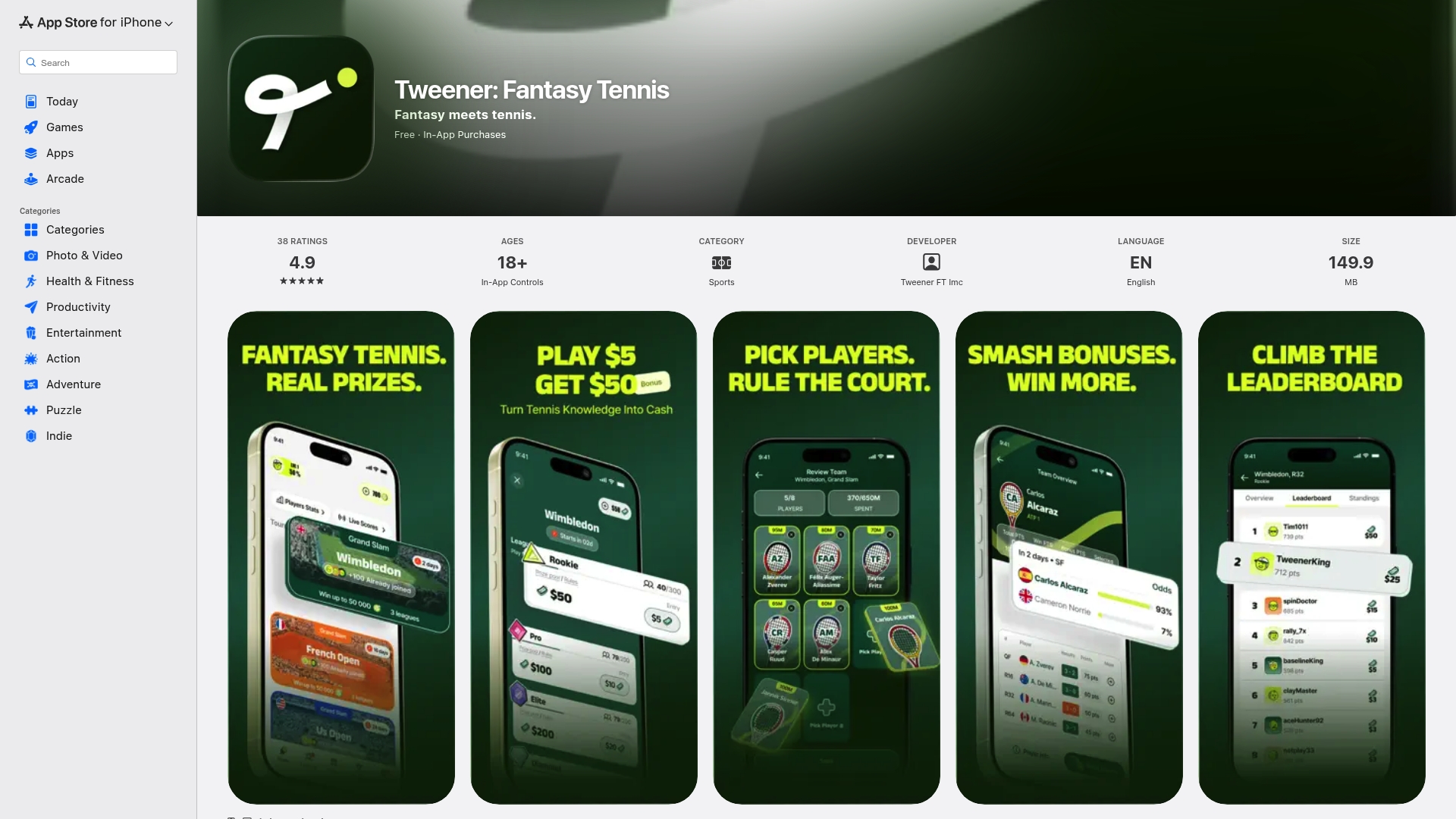
The free mode uses virtual coins, redeemable for gift cards, so there's no financial barrier to starting. Cash contests are available for U.S. players where legally permitted, with transparent payout rules and fair-play enforcement. Whether you want to compete with close friends through a private Wimbledon league or test your picks in a public US Open contest, the structure is already there.
Download Tweener and join a free league before the next Grand Slam. The draft takes 15 minutes. The group chat lasts years.
Useful sources and further reading
The claims in this article draw on academic research, sports psychology reporting, and Tweener's own analysis of fantasy tennis engagement. The sources below are worth reading directly if you want to go deeper on the psychology, the mechanics, or the legal landscape.
- Social identification with a team boosts fans' social well-being — University of Illinois research by Inoue and Sato on belonging and well-being
- A Qualitative Examination of the Social Manifestations of Participating in Fantasy Sports — Journal of Sport Behavior on rituals, camaraderie, and long-term retention
- The real-life health effects of fantasy sports — American Heart Association on cognitive and mental-health outcomes
- Affective Outcomes of Membership in a Sport Fan Community — Frontiers in Psychology on self-esteem and belonging in fan communities
- The Fantasy Baseball Ties That Bind — The Ringer on fantasy leagues as lasting social institutions
- Advantages of fantasy team competitions for tennis fans — Tweener's analysis of engagement and analytics benefits
- Risks of Fantasy Sports Betting: Tennis Players Must Know — Tweener's guide to legal and responsible-play considerations for U.S. players