

TL;DR:
- The WTA Tour is a tiered women's professional tennis circuit based on tournament levels and points. It features four main categories, with the highest being Grand Slams, which award 2,000 points. Player rankings depend on their top 18 results over a 52-week rolling period, encouraging consistent deep runs.
The WTA Tour is the organizing body for women's professional tennis, built around a tiered tournament system that assigns ranking points based on event level and round reached. The WTA tour structure explained simply: four main tournament categories sit above a developmental circuit, and a player's world ranking reflects her best 18 results over a rolling 52-week period. The 2026 season spans 57 events across six continents, from january through late november, culminating in the WTA Finals. Understanding this system makes every match more meaningful, whether you follow the tour casually or compete in fantasy tennis on Tweener.
What are the WTA Tour tournament categories?
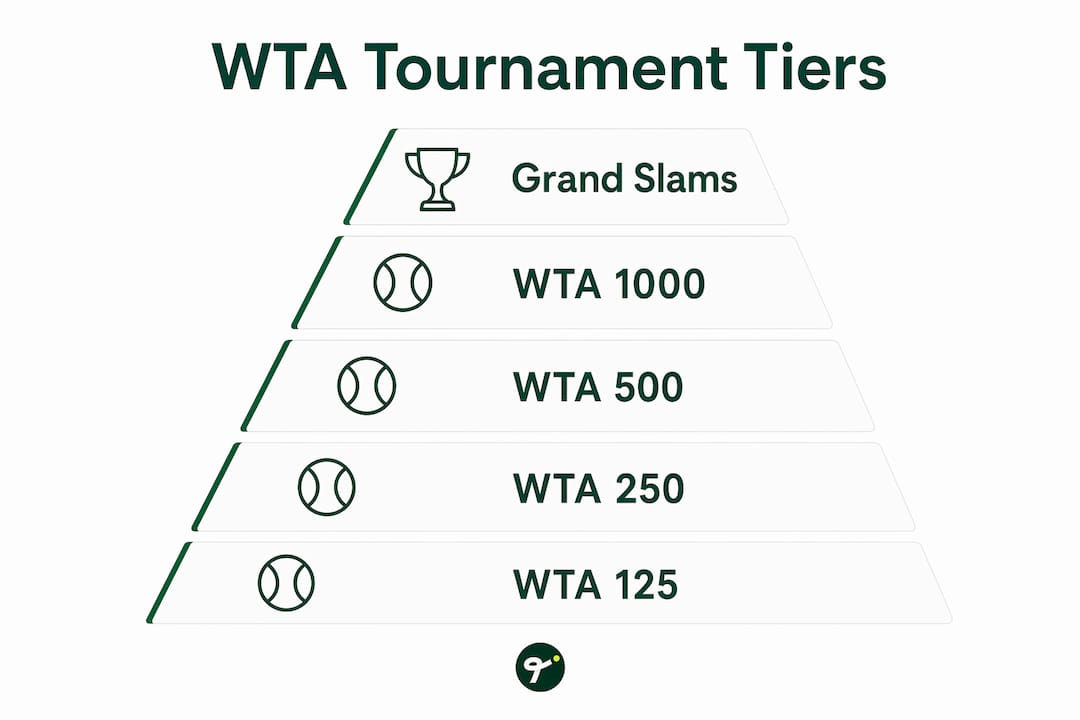
The WTA Tour organizes its four main tiers by the maximum ranking points a winner can earn. Each tier also carries a different prize money range and field size.

| Tournament tier | Max points (winner) | Field size |
|---|---|---|
| Grand Slam | 2,000 | 128 players |
| WTA 1000 | 1,000 | 96 players |
| WTA 500 | 500 | 56 players |
| WTA 250 | 250 | 32–56 players |
Grand Slams sit at the top. The Australian Open, Roland Garros, Wimbledon, and the US Open each award 2,000 points to the champion. They carry the largest prize pools and the most prestige. Every top player must enter, and results here define careers.
WTA 1000 events are the next tier. The 2026 season includes 10 WTA 1000 events, with tournaments like Indian Wells, Miami, Madrid, and Beijing in this group. Winning one earns 1,000 points. Missing a mandatory WTA 1000 event still counts as a result in a player's ranking calculation, which is a detail many fans miss.
WTA 500 and WTA 250 events fill the bulk of the calendar. The 2026 season features 17 WTA 500 events and 22 WTA 250 events. These tournaments matter more than their point values suggest. A WTA 500 title in a week without a Grand Slam can shift a player's ranking significantly. WTA 250 events are where rising players build their point totals and earn entry into bigger draws.
Since 2021, the WTA aligned its tournament naming with the ATP system. The old Premier and International labels gave way to the 250, 500, and 1000 structure. That change made it easier for fans to compare men's and women's tour events side by side.
Pro Tip: The WTA Finals, held at the end of the season, is an invitation-only event for the top eight ranked singles players and top eight doubles teams. It crowns the year-end champion and awards points that count toward the following season's rankings.
Below the main tour, the WTA 125 series acts as a secondary professional circuit, awarding 125 points to event champions. Below that, the ITF World Tennis Tour provides the entry-level circuit for players still building their professional careers.
How does the WTA ranking points system work?
WTA rankings use a rolling 52-week cumulative system built from a player's best 18 singles results. That number includes mandatory entries at the four Grand Slams and six or seven designated WTA 1000 events. Rankings update every Monday.
Here is how points accumulate across a typical Grand Slam:
- Winner: 2,000 points
- Runner-up: 1,300 points
- Semifinalist: 780 points
- Quarterfinalist: 430 points
- Round of 16: 240 points
- Round of 32: 130 points
- Round of 64: 70 points
- Round of 128 (first round exit): 10 points
Points are awarded per round, not just to the winner. This means a quarterfinalist at a Grand Slam earns 430 points regardless of who she loses to. Consistent deep runs build rankings faster than occasional titles followed by early exits.
The rolling 52-week cycle creates a constant pressure to perform. Points expire weekly, dropping off exactly one year after they were earned. A player who won a WTA 500 event in march 2025 must defend those points in march 2026 or her ranking falls. This is why you see top players carefully managing their schedules around events where they performed well the previous year.
Pro Tip: Track a player's "points to defend" heading into a tournament. If Iga Swiatek won a WTA 1000 event last year and skips it this year, she loses 1,000 points from her total. That single decision can shift her ranking by several spots.
Mandatory events add another layer. If a top-ranked player skips a mandatory WTA 1000 event without a medical exemption, she still receives a ranking score for that event. That score is typically zero, which counts as one of her 18 results. The rule pushes the best players to compete regularly and keeps the tour competitive throughout the season. Understanding how rankings are calculated is the foundation of smart fantasy tennis decisions.
What are the player participation pathways through WTA levels?
Entry into WTA Tour main draws depends on world ranking. The top-ranked players receive direct acceptance into every event. Below that threshold, players enter through protected rankings, wild cards, or qualifying draws.
The pathway from developmental tennis to the main WTA Tour follows a clear progression:
- ITF World Tennis Tour: The entry point for professional players. Events award ITF ranking points, which convert to WTA points at a lower rate. Players here are typically ranked outside the top 200.
- WTA 125 series: The bridge between the ITF circuit and the main tour. Winning a WTA 125 event earns 125 points and provides a direct boost toward main draw eligibility at WTA 250 events.
- WTA 250 qualifying: Players ranked just outside the main draw cutoff can enter qualifying rounds. Two or three wins in qualifying earns a main draw spot and the chance to earn full WTA ranking points.
- WTA 250 main draw: The first full WTA Tour level. A strong run here, like reaching a semifinal, can move a player from outside the top 100 to inside it within a single week.
- WTA 500 and WTA 1000 events: Accessible once a player's ranking clears the direct acceptance threshold, which varies by tournament size and the field that week.
Ranking points at smaller 250-level events play a critical role for rising players. A player ranked 120th in the world can reach the top 80 by winning a WTA 250 event outright. That jump opens the door to direct acceptance at WTA 500 events, where prize money and exposure increase substantially.
The WTA 125 circuit is often overlooked by casual fans, but it produces the next generation of top-10 players. Players like Emma Raducanu and Mirra Andreeva used smaller events to build the ranking points needed to compete at the highest level. The ATP and WTA tour structures mirror each other closely at this developmental level, making it easier to follow both tours simultaneously.
How is the WTA Tour schedule structured across the season?
The 2026 WTA Tour calendar runs from early january through late november, covering 57 events across six continents. That global spread means the tour visits hard courts in Australia, clay in Europe, grass in England, and hard courts again in North America and Asia, all within a single season.
Combined ATP/WTA events are a defining feature of the modern schedule. Indian Wells and Miami host both men's and women's draws concurrently at the same venue. These events draw the largest crowds of any non-Grand Slam tournaments and give fans the chance to watch the best men's and women's players in the same week. The logistical efficiency of combined events also benefits broadcasters and sponsors, which helps fund the overall prize money pool.
| Month | Key events |
|---|---|
| January | Australian Open (Grand Slam) |
| March | Indian Wells, Miami (combined WTA 1000) |
| May | Madrid, Rome (WTA 1000), Roland Garros (Grand Slam) |
| June–July | Wimbledon (Grand Slam) |
| August–September | US Open (Grand Slam), Cincinnati (WTA 1000) |
| October–November | Beijing, WTA Finals |
The WTA Finals cap the season. Only the top eight ranked players in singles qualify. The format uses a round-robin group stage followed by semifinals and a final, meaning every player is guaranteed at least three matches. Points earned at the WTA Finals count toward the following season's rankings, giving the year-end champion a head start on the next year's standings.
For fans tracking the full tournament schedule, the geographic spread also matters for fantasy tennis. Surface changes between swing phases affect player performance significantly. A clay specialist like Barbora Krejčíková peaks in may and june, while a hard-court player like Coco Gauff tends to perform best in march and august.
Key Takeaways
The WTA Tour assigns ranking points by tournament tier and round reached, and a player's world ranking reflects her best 18 results over a rolling 52-week period.
| Point | Details |
|---|---|
| Four tournament tiers | Grand Slams, WTA 1000, WTA 500, and WTA 250 events award 2,000, 1,000, 500, and 250 points respectively. |
| Rolling 52-week rankings | Players must defend points earned the previous year or their ranking drops, creating constant competitive pressure. |
| Round-by-round points | Every round reached earns points, not just the title, rewarding consistent deep runs across the season. |
| Developmental pathway | ITF and WTA 125 events feed players into the main tour, with WTA 250 events as the first full ranking step. |
| 57-event global calendar | The 2026 season spans six continents, with combined ATP/WTA events at Indian Wells and Miami drawing the largest non-Slam crowds. |
Why the WTA structure rewards fans who pay attention
Most tennis fans watch the Grand Slams and tune out between them. That is a mistake, and I say that as someone who has spent years tracking the tour week by week.
The WTA ranking system punishes inconsistency in a way that makes the mid-season calendar genuinely dramatic. When a player like Aryna Sabalenka heads into a WTA 1000 event defending a title from the previous year, the stakes are real. She is not just trying to win. She is trying to hold her ranking position against players who have nothing to lose. That dynamic plays out every single week from january through october, and most fans miss it entirely.
The combined events at Indian Wells and Miami are the most underrated weeks on the tennis calendar. You get Grand Slam-level fields, fast courts, and both tours running simultaneously. For anyone building a fantasy tennis roster on Tweener, these are the weeks where the right picks separate good players from great ones. Surface form, recent results, and points-to-defend data all converge in a way that rewards preparation.
The WTA 125 circuit is where I spend time looking for value. A player ranked 150th who just won a WTA 125 event is not a longshot at a WTA 250 the following week. She is in form, she has momentum, and her ranking is about to jump. That is the kind of edge that matters in WTA fantasy leagues.
The 2026 season's 57-event calendar gives fans more entry points than ever. Pick a surface swing, learn the players who dominate it, and the tour becomes a completely different sport to watch.
— Nathan
Tweener puts your WTA knowledge to work
Understanding the WTA Tour structure is one thing. Using it to beat your friends in a fantasy tennis league is another.

Tweener is the fantasy tennis app built for fans who actually follow the tour. You build teams from real WTA players, earn points based on their live match results, and compete in public or private leagues throughout each tournament. The ranking tiers, surface swings, and combined events you just read about are exactly the data points that separate sharp Tweener picks from guesswork. Join a WTA fantasy league on Tweener, put your tour knowledge to the test, and compete for real prizes during the biggest events of the 2026 season.
FAQ
What is the WTA Tour structure?
The WTA Tour organizes women's professional tennis into four tiers: Grand Slams, WTA 1000, WTA 500, and WTA 250 events. Each tier awards a different maximum number of ranking points to players based on how far they advance.
How are WTA rankings calculated?
WTA rankings use a player's best 18 singles results over a rolling 52-week period, including mandatory Grand Slams and certain WTA 1000 events. Points expire weekly, exactly one year after they were earned.
What is the WTA Finals?
The WTA Finals is an invitation-only year-end championship for the top eight ranked singles players. It uses a round-robin format followed by semifinals and a final, with points counting toward the next season's rankings.
How do players qualify for WTA Tour main draws?
Players enter main draws based on world ranking, with the highest-ranked players receiving direct acceptance. Players outside the cutoff can qualify through qualifying draws, wild cards, or protected rankings.
What is the WTA 125 series?
The WTA 125 series is the secondary professional circuit sitting between the ITF World Tennis Tour and the main WTA Tour. Event winners earn 125 ranking points, which help players build the ranking needed to enter WTA 250 main draws.