

TL;DR:
- A wildcard in tennis is a discretionary entry granted by tournament organizers for players who do not qualify through ranking or qualifying rounds. It allows officials to favor local players, returning stars, or promising juniors, balancing competition and commercial interests. Wildcards are not guaranteed and differ from qualifiers and protected rankings, which are merit-based or injury-based entry paths.
A wildcard in tennis is a discretionary entry granted by tournament organizers to a player who does not qualify through the standard ATP or WTA ranking system. This invitation bypasses the normal cutoff, allowing players to compete in the main draw without meeting the usual ranking or qualifying criteria. Wildcards appear in every tier of professional tennis, from ATP Challenger events to Grand Slams like Wimbledon and the US Open. Understanding how they work gives you a sharper eye for tournament draws and a real edge when you are building fantasy tennis lineups.
What is a wildcard in tennis, exactly?
A wildcard entry is an official spot in a tournament draw reserved for players who receive a direct invitation from the organizing body. Wildcards are awarded at tournament director discretion to players who fail automatic entry via ranking or miss entry deadlines for commercial, national, or development reasons. That discretion is the defining feature. No ranking threshold triggers a wildcard automatically. The tournament committee chooses who gets one and why.

The formal industry term you will see in ATP and WTA rulebooks is "wild card," though "wildcard" as one word is widely accepted in fan and media usage. Both refer to the same mechanism. The key distinction from every other entry type is that wildcards are not earned through match results or ranking points alone. They are granted based on judgment.
Wildcards serve three broad purposes. They allow returning stars to re-enter the tour after injury. They give promising juniors or local favorites a shot at the main draw. They also let tournament directors protect the commercial appeal of their event by securing a recognizable name in the bracket.
How are wildcards awarded and who decides?
Tournament directors hold final authority over wildcard allocation. No player has a right to a wildcard, and no governing body mandates who must receive one. The ATP and WTA set the number of spots available at each event level, but the selection itself belongs to the host organization.
The criteria directors use fall into three categories:
- Commercial value: A former Grand Slam champion returning from injury draws fans and media. Directors use wildcards to secure those names even when their current ranking does not qualify them automatically.
- National interest: Tournament hosts often use wildcards for "soft nationalism," boosting local player participation to increase attendance and fan interest. A French wildcard at Roland Garros or a British wildcard at Wimbledon is a deliberate crowd strategy.
- Player development: Governing bodies sometimes allocate a portion of wildcards to top-ranked juniors or players showing strong form on the Challenger circuit. This gives emerging talent a test against the best.
Players usually must apply for wildcards within a defined window, often 5 days after the entry deadline, but final allocation remains with tournament committees. That 5-day window matters because high-ranked players sometimes skip events to rest, then decide late they want to compete. A wildcard request covers that gap.
Pro Tip: When a top-10 player misses an entry deadline but later appears in a draw, they almost certainly received a wildcard. Check the official draw sheet for the "WC" designation next to their name.
Players can also request wildcards) if they miss entry deadlines, which is common among high-ranked players managing fitness or points between events. This is not a loophole. The ATP and WTA built this flexibility into the system deliberately.
How do wildcards differ from qualifiers and protected rankings?
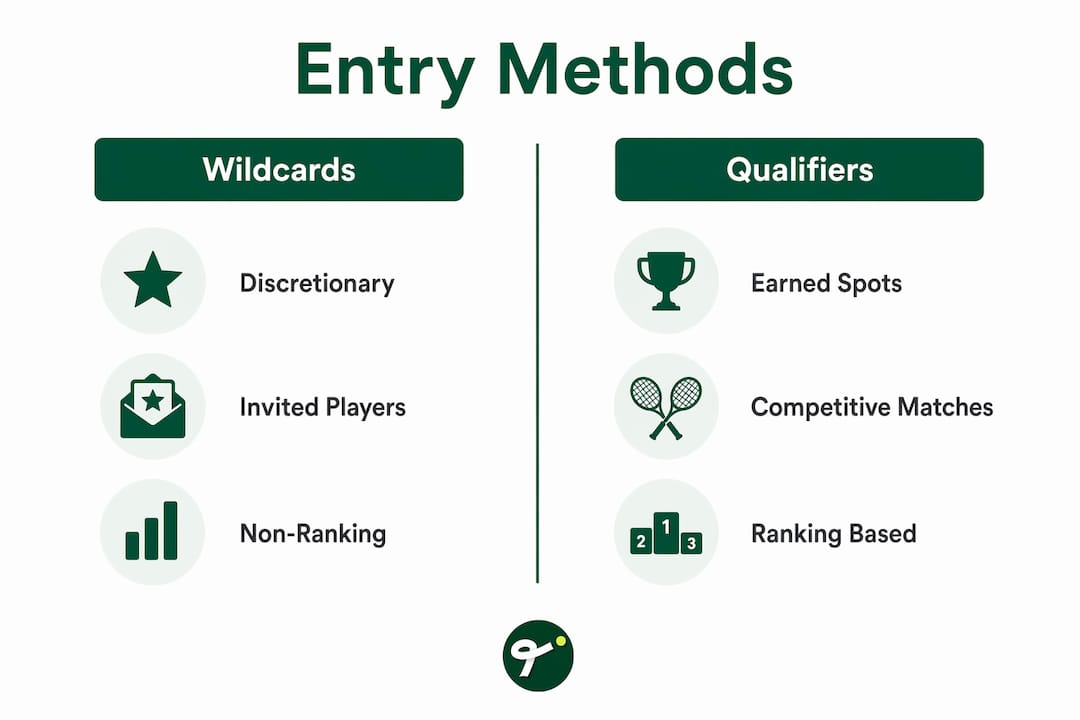
Three entry paths get players into a main draw: direct acceptance by ranking, qualifying rounds, and wildcards. Each works differently, and confusing them leads to real misunderstandings about how a draw is constructed.
| Entry method | How it works | Guaranteed? | Based on merit? |
|---|---|---|---|
| Direct acceptance | Ranking falls inside the cutoff at the entry deadline | Yes, if ranking qualifies | Yes |
| Qualifying rounds | Player wins matches in a pre-tournament qualifying event | Earned through results | Yes |
| Wildcard | Tournament committee grants a direct invitation | No, discretionary | Partially |
| Protected ranking | Injured player uses a frozen ranking to enter after return | Yes, within time limits | Yes |
Qualifiers earn entry through competitive matches prior to the main draw, arriving match-ready, while wildcards are discretionary bets on player value or potential. That distinction matters for fantasy purposes. A qualifier has already won two or three matches that week. A wildcard recipient may not have played a competitive match in months.
Protected rankings differ from wildcards in one critical way: they guarantee entry. An injured player who uses a protected ranking has a right to enter events based on their ranking at the time of injury. A wildcard can be denied. No player is owed one. You can read more about how qualifying rounds work in this guide to qualifying rounds to see exactly how those match-based entry paths compare.
The competitive fairness debate centers on this gap. Qualifiers and direct entrants earned their spots through results. Wildcard recipients did not, at least not in the conventional sense. That tension is real, and it fuels most of the controversy around the system.
How many wildcards do tournaments allocate?
The number of wildcard spots varies by event size and tier. Grand Slam tournaments reserve 8 spots in a 128-player main draw for wildcards. ATP and WTA 1000 events allocate up to 8 wildcards. Smaller events at the 250 and 500 level typically offer 2–4 spots.
| Tournament tier | Draw size | Wildcard spots |
|---|---|---|
| Grand Slam | 128 players | 8 |
| ATP/WTA 1000 | 96 players | Up to 8 |
| ATP/WTA 500 | 48–56 players | 2–4 |
| ATP/WTA 250 | 28–32 players | 2–4 |
National tennis federations also play a role. Governing bodies like the USTA, Tennis Australia, and the LTA receive a portion of the wildcard allocation at their home Grand Slams. The USTA, for example, distributes several US Open wildcards to American players through its own selection process. This creates a two-track system: some wildcards go to the tournament director's picks, others go through the national federation's program.
Reciprocal wildcard agreements between federations add another layer. The ATP sometimes arranges exchanges where a player from one country receives a wildcard at a foreign event in return for a similar arrangement at a home event. These agreements reflect the tournament structures that govern professional tennis at every level.
What are the benefits and controversies of tennis wildcards?
Wildcards deliver real value to the sport, but they also attract legitimate criticism. Both sides of the argument deserve a clear look.
The case for wildcards:
- They give fans a reason to attend. A local hero or a returning legend in the draw sells tickets and generates media coverage that a journeyman qualifier simply cannot.
- They support player development. Junior champions and Challenger-level standouts get a chance to test themselves against top-100 opposition, accelerating their growth.
- They keep the sport commercially viable. The wildcard system balances meritocracy with commercial and developmental needs, addressing goals that a pure ranking-based system would miss entirely.
- They have produced memorable results. Wildcard recipients have reached Grand Slam finals and won titles, proving that discretionary entries can produce genuine sporting drama.
The criticisms:
- Favoritism is a real risk. When a director picks a personal favorite or a commercially safe choice over a more deserving player, the system loses credibility.
- Wildcards can displace players who earned their spot through months of grinding on the Challenger circuit.
- Transparency is inconsistent. Not all tournaments publish their selection criteria, which makes it hard for fans or players to evaluate whether a choice was fair.
Pro Tip: When analyzing a tournament draw for fantasy purposes, always check which players entered on wildcards. A wildcard recipient who has not played in two months carries more uncertainty than a qualifier who just won three matches.
The commercial rationale behind wildcards is not cynical. Tournaments need revenue to exist, and revenue requires fans. Wildcards are one tool directors use to protect that equation. The controversy is real, but so is the necessity.
Key Takeaways
A wildcard in tennis is a discretionary tournament entry that balances competitive merit with commercial, developmental, and national interests, making it a structural feature of professional tennis rather than an exception to the rules.
| Point | Details |
|---|---|
| Definition | A wildcard is a direct invitation to a main draw, granted outside the standard ranking or qualifying system. |
| Who decides | Tournament directors and national federations hold discretion; no player is guaranteed a wildcard. |
| Allocation by tier | Grand Slams offer 8 wildcard spots; smaller events offer 2–4 depending on draw size. |
| Key difference from qualifiers | Qualifiers earn entry through match results; wildcards are granted based on judgment and criteria. |
| Fantasy relevance | Wildcard recipients often carry more performance uncertainty than direct entrants or qualifiers. |
Wildcards reward the system's complexity, not its flaws
The wildcard debate frustrates fans who want tennis to be purely meritocratic. I understand that instinct. But after watching hundreds of tournaments, I am convinced that a system without wildcards would be worse for the sport, not better.
Consider what a pure ranking-based draw produces at a national event. You get a field full of players from the top-producing countries, with no local representation and no narrative hook for the host market. Attendance drops. Broadcast interest follows. The tournament weakens. Wildcards prevent that outcome. They are not a concession to favoritism. They are a structural tool for keeping professional tennis financially healthy enough to exist at the level it does.
What I think fans get wrong is treating every wildcard as a gift. Some are. But many are calculated decisions by directors who understand their market better than any ranking algorithm does. When Wimbledon gives a wildcard to a British player ranked 150th, they are not ignoring merit. They are recognizing that tennis is also entertainment, and entertainment requires local stakes.
The controversy is worth watching, though. Transparency in selection criteria would reduce the perception of favoritism without changing the system's function. Fans deserve to know why a specific player received a spot. That accountability would make wildcards easier to defend and harder to abuse.
Wildcards matter in fantasy tennis too
Understanding how players enter a tournament changes how you build a fantasy lineup. A wildcard recipient who has been off the tour for three months is a different risk profile than a top seed who has played six events in a row.
Tweener is built for fans who think this way. The platform lets you create fantasy teams from real ATP and WTA players and compete in leagues based on live tournament results. You can read the game rules to see exactly how player performance translates into points. Whether you play in free mode with virtual coins or enter cash contests for real payouts, Tweener rewards the fans who pay attention to draw details, entry paths, and player form. Wildcards are part of the picture. Tweener gives you a place to act on what you know.
FAQ
What is a wildcard in tennis?
A wildcard in tennis is a direct invitation to a tournament's main draw, granted at the discretion of tournament organizers to players who do not qualify through standard ranking or qualifying criteria.
How many wildcards does a Grand Slam give out?
Grand Slam tournaments reserve 8 wildcard spots in a 128-player main draw, with allocations split between tournament directors and national tennis federations.
Who decides which players get wildcards?
Tournament directors and national governing bodies like the USTA or LTA hold discretion over wildcard selection, using criteria that include commercial value, local player support, and player development goals.
How is a wildcard different from a protected ranking?
A protected ranking guarantees entry for an injured player based on their frozen ranking, while a wildcard is discretionary and can be denied. No player has a right to a wildcard.
Can a wildcard recipient win a Grand Slam?
Yes. Wildcard recipients have reached Grand Slam finals and won titles, which is part of what makes the system both controversial and compelling for fans and fantasy players alike.