

TL;DR:
- Most tennis leagues tend to disband within two months due to insufficient structure rather than waning interest. Establishing clear plans, consistent schedules, and effective communication are essential for long-term player retention. Utilizing appropriate formats, digital tools, and fostering community engagement significantly enhances league sustainability and enjoyment.
Most tennis groups fall apart within two months. Not because the players lose interest, but because whoever started the league underestimated how much structure it takes to keep 16 people showing up every week. Setting up custom tennis leagues sounds straightforward until you realize you need to settle on a format, balance skill levels, keep schedules from collapsing, and make sure nobody rage-quits over a scoring dispute. This guide covers every decision point, from your first planning session to running a season that players actually want to rejoin.
Table of Contents
- Key takeaways
- Setting up custom tennis leagues: what to figure out first
- Choosing and customizing your league format
- Scheduling and season structure
- Scoring systems and standings management
- Digital tools and community engagement
- My honest take on what makes leagues last
- Take your tennis community further with Tweener
- FAQ
Key takeaways
| Point | Details |
|---|---|
| Plan before you recruit | Nail down your format, court availability, and player count before announcing the league. |
| Match format to group size | Ladder leagues suit 10+ players; round robin works better for smaller, tighter groups. |
| Keep scheduling predictable | The same day and time every week is the single biggest driver of player retention. |
| Use clear scoring rules | Publish standings formulas before the season starts to prevent disputes mid-season. |
| Digital tools reduce friction | Apps that handle scheduling and score submission free you to focus on community, not admin. |
Setting up custom tennis leagues: what to figure out first
Before you send a single text to potential players, you need three things locked in: how many people are joining, where you're playing, and what you're actually trying to build. A clear starting objective is what separates leagues that run three seasons from leagues that collapse after four weeks.
Start with a realistic headcount. Eight players is a viable minimum for most formats. Beyond 30, you'll need divisions. Anything in between gives you real flexibility. Skill range matters just as much as raw numbers. A group with six competitive 4.5-rated players and four casual beginners will generate frustration unless you either split them or use a handicap system.
Here's what to confirm before you finalize anything:
- Court access: How many courts do you have, and for how many hours per week? This directly limits how many simultaneous matches you can run.
- Player commitment level: Are people signing up for a competitive league or a social hit? The answer shapes every format decision you make.
- Communication channel: WhatsApp group, email thread, or a dedicated app. Pick one and stick to it from day one.
- Entry fee or free: Collecting even a small fee creates accountability. Players who pay almost always show up.
- Legal considerations: If you're collecting money or running on club property, check whether you need a facility agreement or basic liability coverage.
| Factor | Low complexity | High complexity |
|---|---|---|
| Player count | 8 to 16 | 20 or more |
| Skill range | Narrow (one tier) | Wide (multiple tiers needed) |
| Court availability | Dedicated weekly slot | Variable, shared access |
| Admin capacity | One organizer | Committee or software needed |
Pro Tip: Survey your potential players before launching. A simple Google Form asking availability, skill level, and competitive vs. social preference will save you from format regret.
Choosing and customizing your league format
This is where most organizers either get it right or create a structure that frustrates everyone. There is no universal best format. The right choice depends on your group size, competitive goals, and how often players can realistically show up.
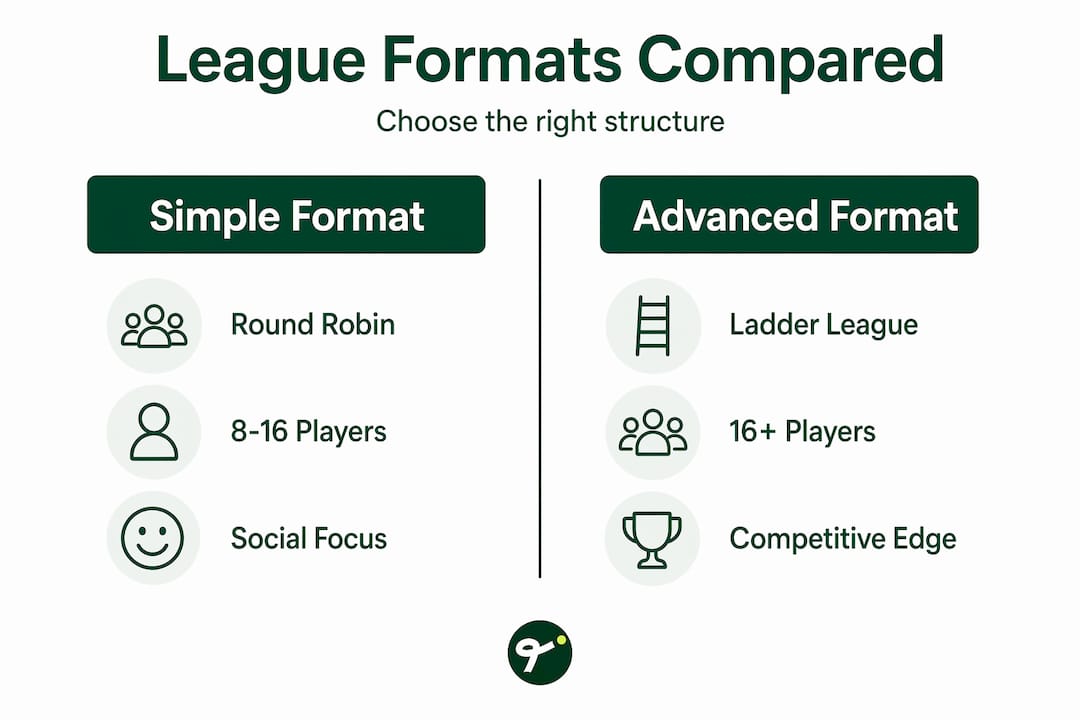
Ladder leagues work well when you have 12 or more players and want ongoing competition without rigid scheduling. Each player holds a ranked position, and anyone can challenge someone ranked above them. The key customization here is the challenge range. A challenge range of 2 to 3 spots above a player's current position, with a limit of 1 to 2 challenges per week, prevents burnout and keeps matches competitive. You should also build in a re-challenge cooldown. A 1 to 2 week cooldown period after a challenge result stops the same two players from grinding against each other every week.
Round robin leagues are the gold standard for social groups of 8 to 16 players. Everyone plays everyone. The standings are transparent, the format feels fair, and it's easy to explain to new players. The tradeoff is inflexibility. If one person drops out mid-season, you have a scheduling hole.
Flex leagues offer a middle path. You assign players to a group, set a window (typically two weeks per round), and let them schedule matches at mutual convenience. This suits groups with irregular availability. The downside is that without deadlines, matches go unplayed. Set firm forfeiture rules in advance.
Team-based leagues add a social layer that individual formats lack. Pair players into doubles teams or create small clubs that compete for points. These work especially well for family clubs or corporate tennis groups.
| Format | Best group size | Competitive level | Scheduling flexibility | Admin effort |
|---|---|---|---|---|
| Ladder | 12 to 30+ | High | High | Medium |
| Round robin | 8 to 16 | Medium | Low | Low |
| Flex league | 10 to 24 | Medium | Very high | Medium |
| Team-based | 12 to 24 | Variable | Low | High |
Once you've selected a format, customize the rules for your group. For round robin, decide whether players earn points per set won or only per match won. For ladder leagues, decide whether promotion and relegation between divisions happens every 3 to 4 weeks to keep things dynamic.
Pro Tip: If your group mixes strong and casual players, consider a handicap scoring modifier. A 4.0-rated player might need to win by two games more than a 3.0-rated player to earn full ladder points. You can find useful frameworks for understanding player skill tiers that apply directly to real-world division setup.
Scheduling and season structure
The single most reliable predictor of a league's survival is whether matches happen on a predictable, recurring schedule. Consistent day and time scheduling every week dramatically increases participation because players can plan around it. "Every Tuesday at 7pm" beats "we'll figure it out each week" every single time.

For season length, the research-backed sweet spot is 8 to 12 weeks. Short enough that players commit for the full run, long enough to produce meaningful standings. Anything under six weeks doesn't give the ladder time to settle. Anything over 14 weeks and you'll see dropout rates climb as schedules shift.
Follow this sequence when building your season calendar:
- Set the season start and end dates first. Work backwards from there to figure out how many rounds or match windows you have.
- Block out holidays and local conflicts (local tournaments, school breaks) before assigning rounds.
- Assign round deadlines at least two weeks in advance so players can schedule their own matches in flex formats.
- Build in one bye week around the midpoint. It relieves scheduling pressure without losing momentum.
- Publish the full calendar before the season starts. Use a shared Google Sheet or your league management app so everyone can see exactly what's coming.
- Set a score submission deadline within 48 hours of match completion. Delayed results kill standing accuracy and create disputes.
For match format timing, matches that run 60 to 90 minutes fit most recreational schedules and court booking windows. A best-of-three sets format with a match tiebreak replacing the third set is the most practical choice. If court time is tight, short sets (first to four games) keep things moving and let you run two rotations per court per evening.
Pro Tip: Send a "week ahead" reminder every Sunday evening with the upcoming match pairings, court assignments, and score submission link. This one habit cuts no-shows by a significant margin.
Scoring systems and standings management
Nothing kills a league faster than a scoring system that feels arbitrary or a standings page nobody trusts. Clarity before the season starts is non-negotiable.
The most reliable standings formula for recreational leagues ranks players in this order: match wins first, then set differential, then head-to-head results. This structure rewards winning while giving a meaningful tiebreaker that doesn't just flip a coin.
Here's what your written scoring rules should address before the first ball is struck:
- Default wins: If a player forfeits without 24 hours notice, the opponent gets a walkover win counted as a 6-0, 6-0 result for set differential purposes.
- Late score submission: Set a clear penalty, such as a deducted set point, if scores aren't submitted within your deadline.
- Disputed results: Require both players to submit scores independently. Disagreements go to the organizer, whose decision is final.
- Incomplete matches: Decide in advance whether a match abandoned due to weather counts, is replayed, or results in a split point.
| Scoring element | Recommended rule |
|---|---|
| Match format | Best-of-three sets with match tiebreak (10 points) at 1-1 |
| Standings priority | Match wins → set differential → head-to-head |
| Defaults | Walkover recorded as 6-0, 6-0 |
| Score submission | Within 48 hours via designated platform |
Distribute the full scoring document to every player via email or your league app before day one. Players who understand the rules feel the competition is fair. Players who don't will blame the system every time something goes against them.
Digital tools and community engagement
Running a league on group texts and a spreadsheet works until someone updates the wrong cell or a message gets buried. Digital platforms for scheduling and score submission cut administrative time significantly and keep your data accurate. If you want to explore specific tennis league software solutions that simplify the management side, there are several apps built specifically for this.
Beyond the admin tools, community engagement is what keeps players coming back season after season. A league with good vibes and mediocre organization will outlast a perfectly run league where nobody talks to each other. Posting standings publicly creates accountability and sparks conversation. People check the leaderboard when they know others are watching it.
Tactics that genuinely work:
- Weekly match summaries: A two-sentence recap of notable results sent to the group creates a sense of shared story.
- Season awards: Most improved player, most matches played, and best upset of the season cost nothing and mean everything to recipients.
- Post-match social rituals: Even a standing offer to grab a drink at the club bar after matches builds the social glue that keeps attendance high.
- Rotating doubles nights: Slot in one doubles round per season where the organizer assigns random pairings. It breaks up rivalries and creates new connections.
For mixed-skill groups, the UTR rating system and similar level-based frameworks take the guesswork out of division placement. Objective ratings generate far less conflict than self-reported skill levels.
Pro Tip: Set up a league "wall of fame" photo in your group chat at the end of each season. Tag the champion, runner-up, and most-matches-played winner. People screenshot those and share them. That social proof recruits your next season's players.
My honest take on what makes leagues last
I've watched a lot of tennis leagues get launched with genuine enthusiasm and dissolve by week six. The pattern is almost always the same. The organizer started with too much flexibility and not enough structure.
In my experience, the groups that try to accommodate every scheduling preference end up accommodating nobody. When you're too loose with timing, committed players feel disrespected and casual players use the flexibility as permission to skip. Consistency is not a constraint. It's the thing that makes the whole structure possible.
The other thing I've noticed is that skill mismatches are less of a problem than people assume, if you address them creatively. Handicap scoring, thoughtful bracket seeding, and mixed-doubles nights can make a 3.0 player feel genuinely competitive against a 4.5. What destroys leagues is not the skill gap itself but the feeling that the system isn't designed to give everyone a fair shot.
I'd also push back gently on the idea that more technology equals better community. Apps help enormously with logistics. But the leagues I've seen run the longest almost always have one charismatic organizer who sends personal check-in messages, celebrates players publicly, and treats the league like a club, not a bracket generator. The tech is a tool. The human element is the product.
If you're building something that players will want to rejoin next season, focus on making them feel seen. Small recognitions, a consistent rhythm, and a format that gives everyone something to compete for. That's the formula.
— Nathan
Take your tennis community further with Tweener
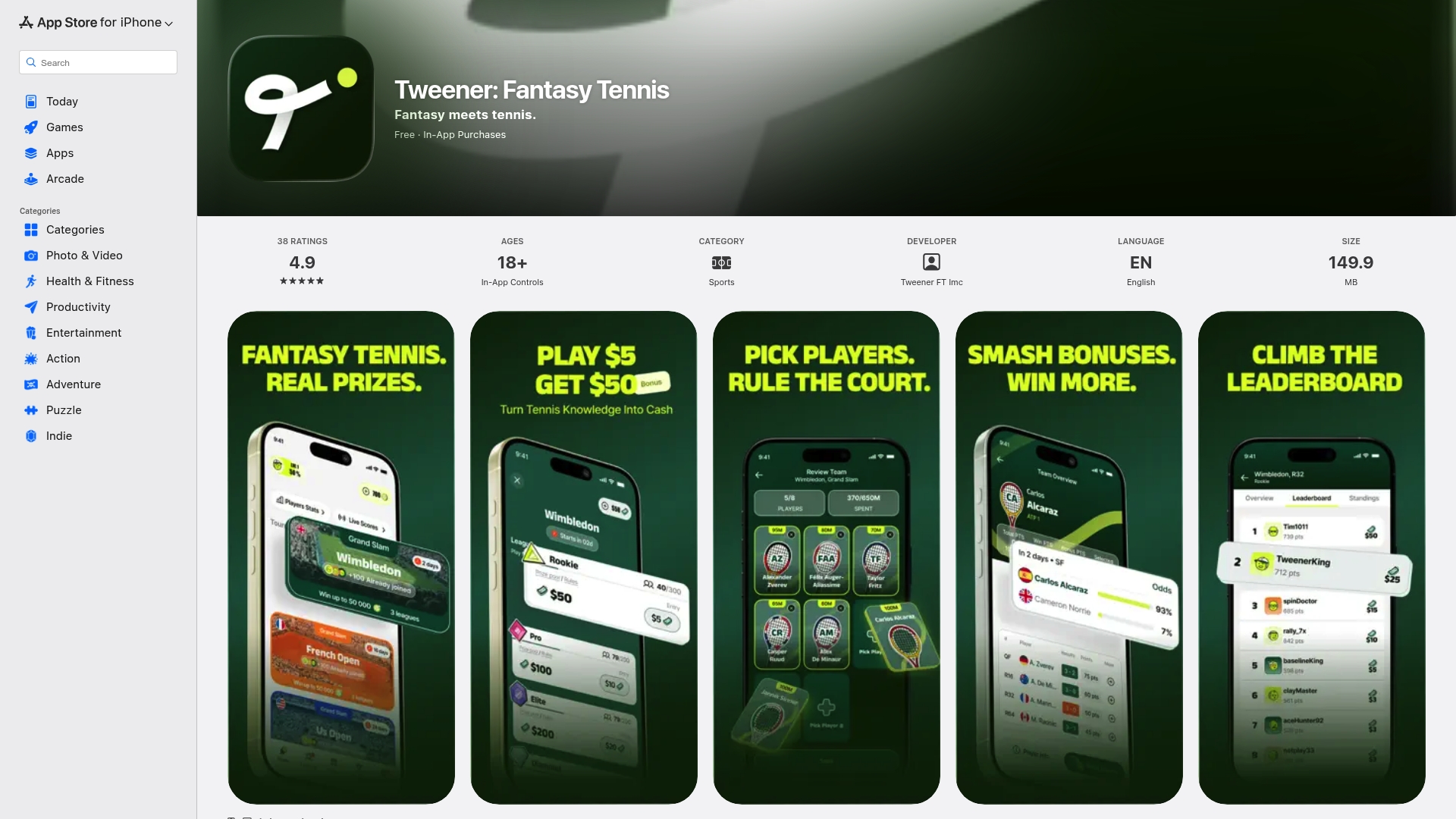
Once your custom league is running and players are hooked on competing, Tweener gives you a natural next level to explore. Tweener is the premier fantasy tennis app built specifically for serious fans who want a strategic, data-driven way to compete around real ATP and WTA tournaments. You can create private fantasy leagues with up to nine friends, draft real professional players, and earn points based on live match results during Grand Slams and tour events. It's the competitive layer that transforms watching tennis into playing tennis, without ever picking up a racket. Whether you use Tweener to complement your physical league or run standalone fantasy contests, it brings the same community energy you're building on the court into every tournament week.
FAQ
How long should a custom tennis league season run?
The optimal season length is 8 to 12 weeks, with matches scheduled on the same day and time each week. This duration is long enough to produce meaningful standings while keeping player dropout rates low.
What league format works best for small groups?
Round robin is the best choice for groups of 8 to 16 players. Every player faces every other player, standings are transparent, and the format is easy for newcomers to understand.
How do I handle defaults and no-shows in my league?
Set a clear policy before the season starts. A common approach is recording uncontested forfeits as a 6-0, 6-0 loss for standings purposes, which disincentivizes casual dropouts without punishing genuine emergencies unfairly.
What scoring formula prevents disputes in standings?
Rank players by match wins first, then set differential, then head-to-head results. This three-tier formula is the most widely used in recreational leagues and produces outcomes most players accept as fair.
Do I need special software to run a tennis league?
Not necessarily for small groups, but digital tools for scheduling and score tracking significantly reduce administrative friction as your league grows past 12 players. Dedicated platforms handle notifications, standings updates, and score submission automatically.