

A protected ranking (called "special ranking" on the WTA) lets an injured or absent player enter tournaments using their average ranking from before they left the tour, rather than whatever number they've fallen to. It solves one problem only: getting into the draw. Neither tour uses protected ranking tennis rules for seeding, and usage is capped by a strict number of tournaments and a hard expiration window.
TL;DR:
- Protected rankings allow injured or absent players to enter tournaments based on their old average ranking, but do not grant seedings or automatic draw protection.
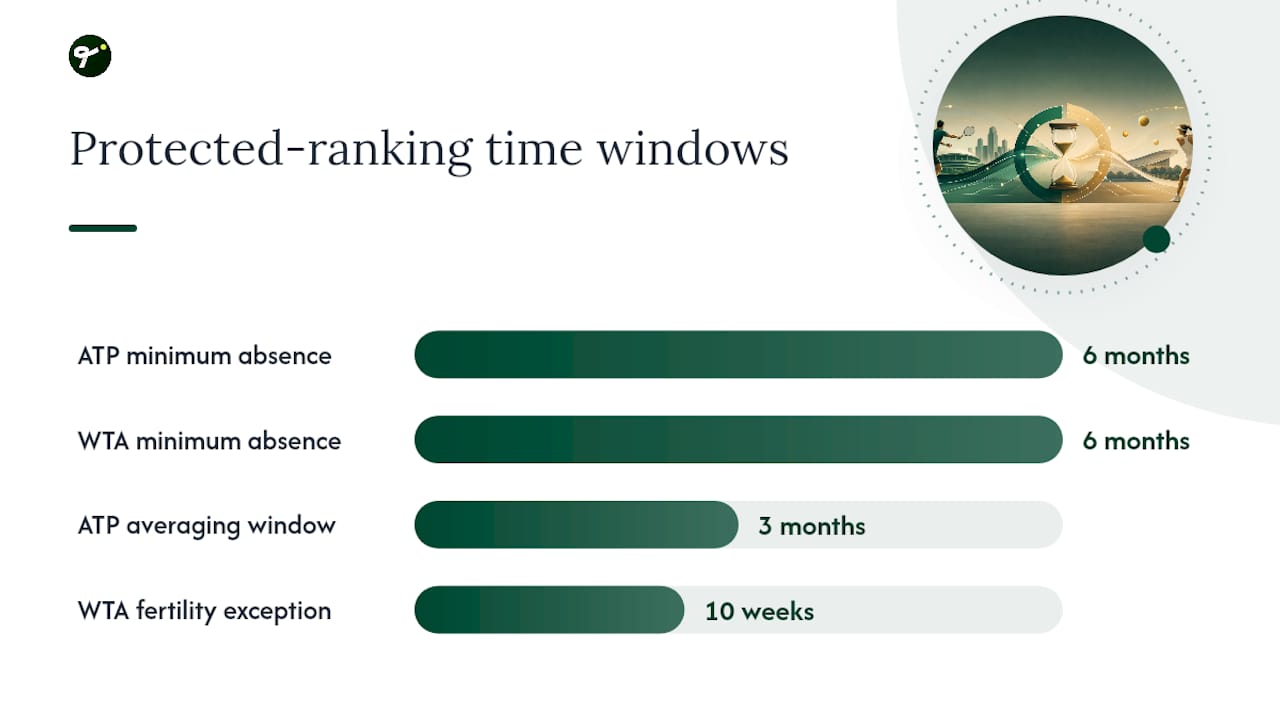
- The ATP calculates the protected number as an average of the player's best three months after their last event, with a six-month minimum absence, while WTA rules vary more and include fertility-related provisions.
- Players must apply within strict timeframes after injury or absence, providing limited tournament entries based on how long they've been out, with a three-year expiration window from their last match.
- Using a protected ranking often involves sacrificing seed status, making early-round draws unpredictable and potentially tough for the returning player.
- Fans and fantasy players should weigh recent match activity and surface fit more heavily than the protected number itself, as it can overstate a player's current form.
Table of Contents
- What Is Protected Ranking in Tennis, and How Does ATP Differ From WTA?
- Who Qualifies for a Protected Ranking, and How Do You Apply?
- How Many Tournaments Does a Protected Ranking Cover?
- What Do Protected-Ranking Comebacks Look Like in Practice?
- How Should Fantasy Players Handle Protected-Ranking Entrants?
- Where to Verify These Rules Yourself
- Nathan's Take: Rules Are Clean, Comebacks Never Are
- Sources
- FAQ
What Is Protected Ranking in Tennis, and How Does ATP Differ From WTA?
The ATP and WTA built similar tools for the same problem, but the mechanics diverge in ways that matter to anyone trying to predict a comeback. Both systems exist because a six-month absence with a torn ACL shouldn't mean rebuilding from zero, ranked outside the top 500, forced through qualifying at every stop.
The differences show up in the numbers.
| Factor | ATP protected ranking | WTA special ranking |
|---|---|---|
| Minimum absence | a minimum period of about six months | about half a year |
| Filing window | Within 6 months of last event | Set by WTA rankings rules |
| Ranking calculation | Average ranking over first 3 months after last event | Reference-week ranking or fertility-case averaging |
| Usage cap (shorter absence) | limited number of tournaments over a similar time span | limited combined tournament entries |
| Usage cap (longer absence) | limited number of tournaments over an extended time span | limited combined entries |
| Seeding | Not permitted | Not permitted, with a top-100 additional-seed exception at some events |
| Special provisions | None | Fertility Protection Special Entry Ranking for shorter absences |
The ATP rulebook's chapter on rankings sets the protected number as a player's average ranking position across the first three months following their last tournament. That averaging window matters. A player limping out of the game after a rough three-month stretch gets a lower protected number than one who was riding a hot streak right before injury.
The WTA's rankings rules scale usage by how long a player has been away, with combined caps on total entries and specific limits on how many WTA 1000 events a special ranking can unlock. The WTA also runs something the ATP doesn't: a Fertility Protection Special Entry Ranking, letting players return after just 10 weeks in fertility treatment cases, according to Global Tennis News.
Neither protected number buys a seed. That's the detail most casual fans miss, and it's the reason a returning Grand Slam champion can draw a top-five player in the first round.
Who Qualifies for a Protected Ranking, and How Do You Apply?
Eligibility isn't automatic. A player has to meet eligibility criteria and file paperwork within required deadlines to access protected ranking status.
Qualifying reasons generally include:
- A documented injury or illness confirmed by medical records
- Pregnancy or fertility treatment (WTA-specific provisions)
- Any absence that meets the minimum threshold: 6 months for ATP, 26 weeks for WTA
Here's how the petition process actually works:
- Confirm the absence threshold. ATP players need an absence of about six months; WTA players require a similar minimum absence period.
- Gather medical documentation. This goes to the ATP Medical Services Committee, which reviews and forwards a recommendation to the ATP CEO for final approval, per the ATP rankings FAQ.
- File within the window. ATP petitions must be submitted within a set window following the player's last tournament; missing this window means losing access to the protected ranking benefit, regardless of injury validity.
- Wait for calculation and confirmation before entering events using the protected number.
The lesson for fans watching entry lists: a six-month deadline sounds generous until a player spends four of those months in surgery recovery and rehab, leaving a narrow filing gap. Managers who miss it lose access entirely.
How Many Tournaments Does a Protected Ranking Cover?
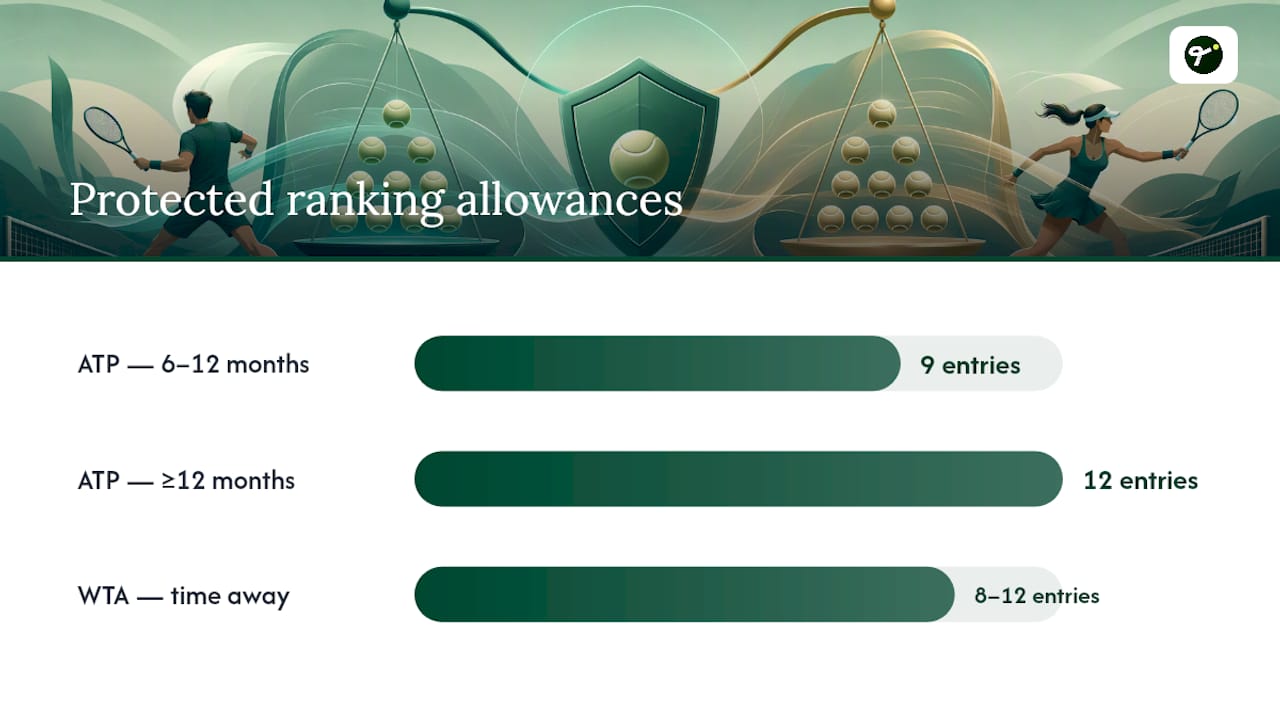
Protected ranking tennis rules treat the benefit like a rationed resource, not an open pass. The ATP scales the allowance to the length of the absence: nine tournaments over nine months for players out 6 to 12 months, and 12 tournaments over 12 months for anyone sidelined a full year or longer, according to the ATP rulebook. The WTA runs a similar sliding scale, with combined usage caps between 8 and 12 entries depending on time away.
Pro Tip: Watch the clock, not just the count. A protected ranking expires three years after the player's last competitive match, so a player who waits too long to attempt a comeback can burn through the eligibility window before ever using the allowance.
A few rules govern how that clock and count actually behave:
- The three-year activation window starts from the last event played, per ATP entry-protection rules, and freezes are permitted for re-injury but can't push past that three-year cap.
- Once a player accepts a spot in a draw or takes on-site prize money at an event, that tournament counts against the allowance, even if the player withdraws before playing a single point.
- Every accepted entry, win or loss, chips away at the total. A player who enters and immediately retires still spends one of their nine or 12 chances.
That last point changes how smart teams plan a return. Enter too many low-value events chasing match rhythm, and the allowance runs out before the ranking has recovered through actual results.
What Do Protected-Ranking Comebacks Look Like in Practice?
Nick Kyrgios has been one of the most visible recent examples of protected ranking use, entering tournaments on a pre-injury number while his live ranking sat far outside where his talent usually lands, as BBC Sport detailed. Belinda Bencic and Naomi Osaka have also used variations of these provisions around maternity returns, illustrating how differently the WTA's rules apply to that specific situation.
Because protected entries skip seeding entirely, they scramble draws in ways regular entries don't:
- A protected player can land across the net from a top-five seed in round one, at a Grand Slam or a WTA 1000, purely by the luck of the draw.
- Tournament directors sometimes lean on wild cards to soften that blow for a marquee returning name, but the base rule stands: no seed, no protection from a brutal first round.
- Managers face a real trade-off: burn a protected entry at a big event for ranking points and prize money, or spend it at a smaller event where the player is more likely to actually win matches and rebuild a live ranking.
For fans, a protected entry is itself a signal. It tells you the player's actual match fitness is unproven, no matter how good they looked in an exhibition.
How Should Fantasy Players Handle Protected-Ranking Entrants?
A protected-ranking player represents a high-variance pick in fantasy tennis lineups. You're drafting reputation and talent, not recent form, because there often isn't recent form to draft. That's the entire problem and the entire opportunity.
The smart approach: treat the limited tournament allowance as a countdown clock. A player with one or two protected entries left is under real pressure to perform now, which can mean either a statement run or an early exit if the body isn't ready. Check for surface fit before you bet on either outcome. A protected-ranking clay specialist returning at a hard-court event is a much bigger gamble than the same player walking into Roland Garros.
Pro Tip: If a returning player has posted real match minutes in a lower-tier or exhibition event right before their protected-ranking tournament, weight that recent evidence over their old ranking number. Rust shows up fast in tennis.
Since protected entries carry no seed, check the draw for brutal early matchups before locking in your roster, and revisit how tennis seeds are determined to see exactly what a returning player is up against.
Where to Verify These Rules Yourself
Official rulebooks and reputable explainers back everything covered here, and they're worth bookmarking if you follow comeback storylines closely.
- The ATP rulebook's Entry Protection chapter lays out every calculation method, usage cap, and freeze provision in full legal language.
- The WTA rankings rules document covers special ranking eligibility, maternity, and fertility protections in detail.
- BBC Sport's explainer breaks down real-world application using the Kyrgios case, useful for readers who want the rules explained through a headline example.
- Global Tennis News offers a readable side-by-side of ATP and WTA differences, including recent WTA fertility-protection additions.
For a broader look at how tournament results shape ranking math generally, the ranking mechanics explainer at BetsyScore is a decent outside reference point.
Nathan's Take: Rules Are Clean, Comebacks Never Are
The rulebooks make protected ranking tennis sound mechanical: hit the absence threshold, file the paperwork, get your number, use your allowance. What the rulebooks can't capture is how messy the actual comeback looks on court, and that's exactly where fans and fantasy managers get seduced into bad decisions.
The conventional read on a protected-ranking entrant is "former top-20 player, still dangerous." That's often wrong. A three-month averaging window on the ATP side can hand a player a protected number that overstates where their game actually is post-injury, especially after a long layoff from a serious physical problem. I'd rather see one competitive match from a returning player than trust the number the rulebook assigns them.
The bigger mistake fans make is ignoring the no-seeding rule entirely. A protected entry means the draw gods owe that player nothing. If you're building a lineup or just picking a bracket winner, the absence of seeding protection should worry you more than the ranking number reassures you.
— Nathan
Sources
- IX. PIF ATP RANKINGS — 2026 ATP rulebook chapter 9
- Nick Kyrgios: What is a protected ranking in tennis? — BBC Sport
- How protected rankings work in tennis: ATP and WTA rules explained — Global Tennis News
FAQ
Why Does Nick Kyrgios Have a Protected Ranking?
Kyrgios qualified for ATP entry protection after an extended absence from injury, which let him enter tournaments using his average ranking from before he stopped competing rather than his diminished live ranking, as BBC Sport reported.
Has Anyone Ever Won a Match 6-0, 6-0, 6-0?
Extremely lopsided results happen occasionally at the lowest levels of professional tennis, but a triple bagel is exceptionally rare at ATP or WTA tour level, where skill gaps rarely run that wide between two ranked professionals.
Does Serena Williams Have a Protected Ranking?
Serena Williams has used maternity-related ranking provisions during her career, part of the same family of rules that today includes the WTA's broader special ranking and fertility protection system covered in the WTA rankings rules.
What Is Alex Eala's Current WTA Live Ranking?
Live WTA rankings update weekly and are not something this article tracks in real time. Check the official WTA rankings page directly for Alex Eala's current live number.
Can a Protected Ranking Get a Player a Seed in a Tournament?
No. Neither the ATP nor the WTA allows a protected or special ranking to be used for seeding, though the WTA does grant an additional-seed exception for certain top-100 returning players at some events.