
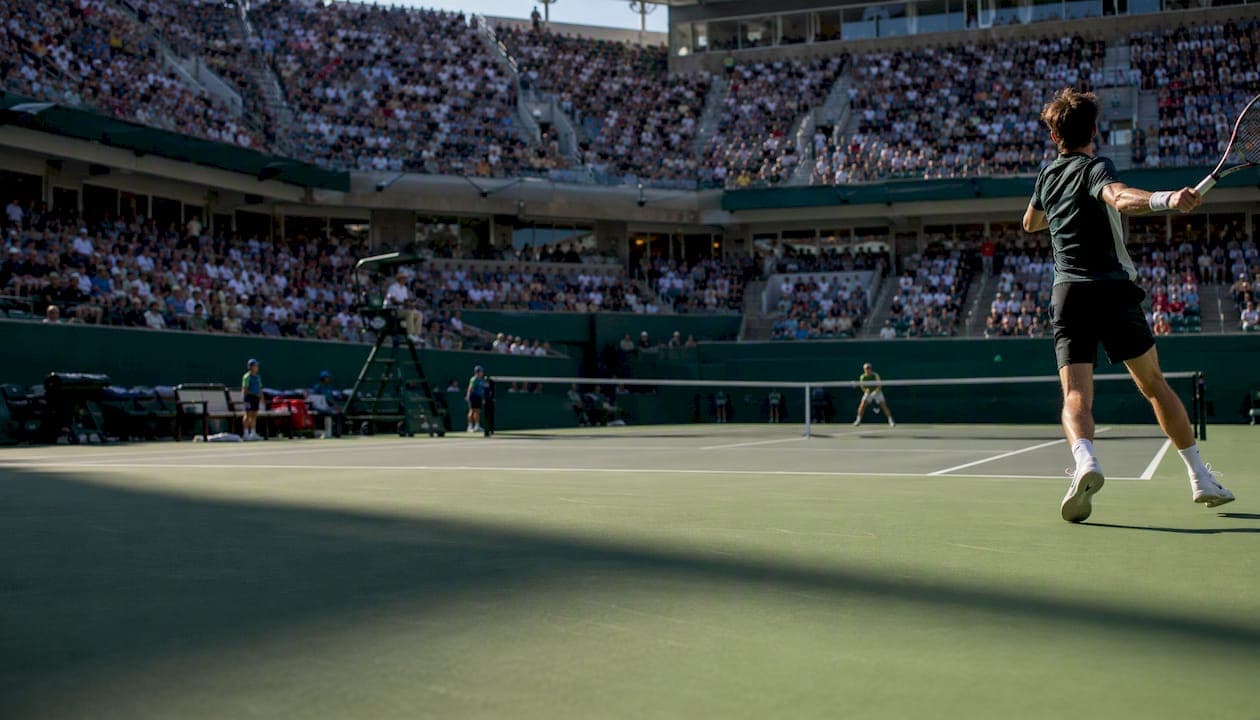
If you only follow a handful of tennis events this season, make these the four Grand Slams (Australian Open, Roland Garros, Wimbledon, US Open), the nine ATP Masters 1000 events, and the Nitto ATP Finals. These are the full must-watch ATP tournaments shortlist, and here's the quick case for each tier:
- Australian Open (January, Melbourne) — the season opener with the best night-session atmosphere in tennis
- Roland Garros (May/June, Paris) — clay-court chess at its most dramatic; Nadal built his legend here
- Wimbledon (June/July, London) — grass, tradition, and the most iconic venue in the sport
- US Open (August/September, New York) — the loudest crowd in tennis; night sessions under Arthur Ashe lights are unlike anything else
- Indian Wells (March, California) — the "fifth Slam," best Masters 1000 to attend in person
- Miami Open (March/April) — back-to-back with Indian Wells; completing both is the "Sunshine Double"
- Monte-Carlo Masters (April) — clay season opener on the French Riviera; scenery and tennis quality in equal measure
- Madrid Open (May) — high-altitude clay that scrambles rankings and produces upsets
- Rome (Internazionali BNL d'Italia) (May) — the last clay Masters before Roland Garros; a genuine form guide
- Canadian Open / National Bank Open (August, Toronto/Montreal) — combined ATP/WTA event with electric crowds
- Cincinnati Open / Western & Southern Open (August) — the final hard-court tune-up before the US Open
- Shanghai Masters (October) — the premier Asian swing stop; massive prize fund, top-10 fields
- Paris Masters (October/November) — the only indoor Masters 1000; fast conditions flip the rankings before year-end
- Nitto ATP Finals (November, Turin) — top-8 only, round-robin format, and the season's closing argument
Key Takeaways
The Grand Slams and Masters 1000 events are the non-negotiable core of any tennis fan's watch list, covering every surface and delivering the most complete fields in the sport.
| Point | Details |
|---|---|
| Grand Slams are the foundation | Australian Open, Roland Garros, Wimbledon, and the US Open offer the deepest fields and longest scoring windows. |
| Masters 1000 events are mandatory | Nine events award 1,000 points and require top-ranked players to enter, guaranteeing elite fields every time. |
| Surface knowledge is your edge | Clay, grass, and hard courts reward different player types; matching specialists to surfaces sharpens both viewing and fantasy picks. |
| Sunshine Double signals dominance | Winning Indian Wells and Miami back-to-back is a rare benchmark; Sinner completed it in 2026 without dropping a set. |
| Tweener adds a strategic layer | Tweener's private leagues and stats tools let you apply surface and form analysis directly to fantasy contests during these tournaments. |
Table of Contents
- Why tournament categories shape what you should watch
- The complete guide to every must-watch ATP tournament
- How to pick which tournaments to follow this season
- How fantasy players get the most from these tournaments
- Why these events still give me chills every year
- Tweener makes these tournaments worth more than just watching
- Sources
Why tournament categories shape what you should watch
Not every ATP event carries the same weight, and understanding the category structure tells you exactly which tournaments to block out on your calendar. The ATP Tour calendar runs four tiers that matter most to fans: Grand Slams, Masters 1000, ATP 500, and ATP 250.
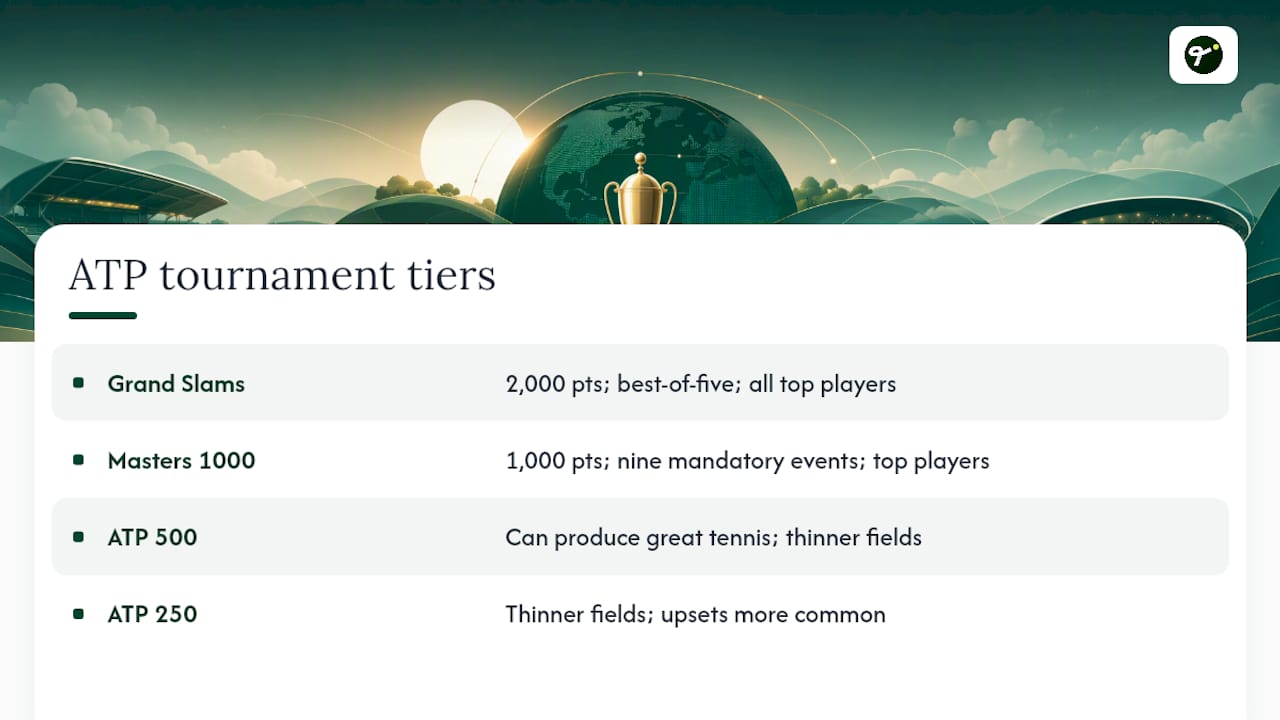
Grand Slams award the most ranking points (2,000 to the champion), run best-of-five sets for men, and draw every top player. Masters 1000 events sit just below that ceiling: nine mandatory stops that award 1,000 points and require top-ranked players to enter. This mandatory attendance rule is what makes them so reliable. You're almost guaranteed to see Jannik Sinner, Carlos Alcaraz, Novak Djokovic, and the rest of the top 10 competing in the same draw. ATP 500 and 250 events can produce great tennis, but the fields are thinner and upsets from lower-ranked players are more common.
For fantasy players, the Masters 1000 tier is where the real edge lives. Predictable fields mean you can model matchups with confidence. Grand Slams add best-of-five scoring depth. The ATP Finals rewards players who peaked late in the season, which creates its own selection puzzle.
The complete guide to every must-watch ATP tournament
Australian Open
Surface: Hard (Rebound Ace) | Typical dates: January | Category: Grand Slam
Melbourne in January is the season's first major statement. The retractable roofs on Rod Laver Arena and Margaret Court Arena mean rain rarely interrupts play, and the night sessions run late into the Australian summer. The crowd is famously rowdy and diverse, reflecting Melbourne's international population. For US viewers, the time difference (roughly 15–16 hours ahead of Eastern) means early-morning streaming is the move; ESPN and Tennis Channel carry full coverage.
Best for: TV/streaming (night sessions are appointment television), fantasy players who want a long scoring window across two weeks.
Roland Garros (French Open)
Surface: Clay | Typical dates: Late May to early June | Category: Grand Slam
No surface rewards patience and physicality like clay, and Roland Garros is its cathedral. The slow red dirt extends rallies, punishes flat ball-strikers, and historically favored Rafael Nadal to a degree that defies statistical belief. Post-Nadal, the event is genuinely open again, which makes it more interesting to watch and harder to predict for fantasy. Court Philippe-Chatrier has some of the best in-person sightlines in tennis.
Best for: In-person attendance (Paris in late May is hard to beat), clay specialists in fantasy lineups.
Wimbledon
Surface: Grass | Typical dates: Late June to early July | Category: Grand Slam
Grass is the fastest surface in tennis and the most unpredictable for fantasy. Big servers dominate, matches can end in under an hour, and lower-ranked players with big games can upset anyone in the first week. The traditions, from the all-white dress code to strawberries and cream, are genuine rather than manufactured. Centre Court's atmosphere during a tight fifth set is as good as sport gets.
Best for: In-person attendance (bucket-list experience), TV viewers who enjoy fast, serve-dominated tennis.
US Open
Surface: Hard (DecoTurf) | Typical dates: Late August to early September | Category: Grand Slam
Arthur Ashe Stadium at night is the loudest venue in tennis. New York crowds are opinionated, engaged, and occasionally chaotic, which creates an atmosphere that genuinely affects play. The US Open also has the most accessible ticket market of the four Slams for American fans. For fantasy, the hard surface and predictable player attendance make it one of the more reliable scoring events of the year.
Best for: Attending (easiest US access), fantasy players targeting hard-court specialists.
Indian Wells (BNP Paribas Open)
Surface: Hard | Typical dates: March | Category: Masters 1000
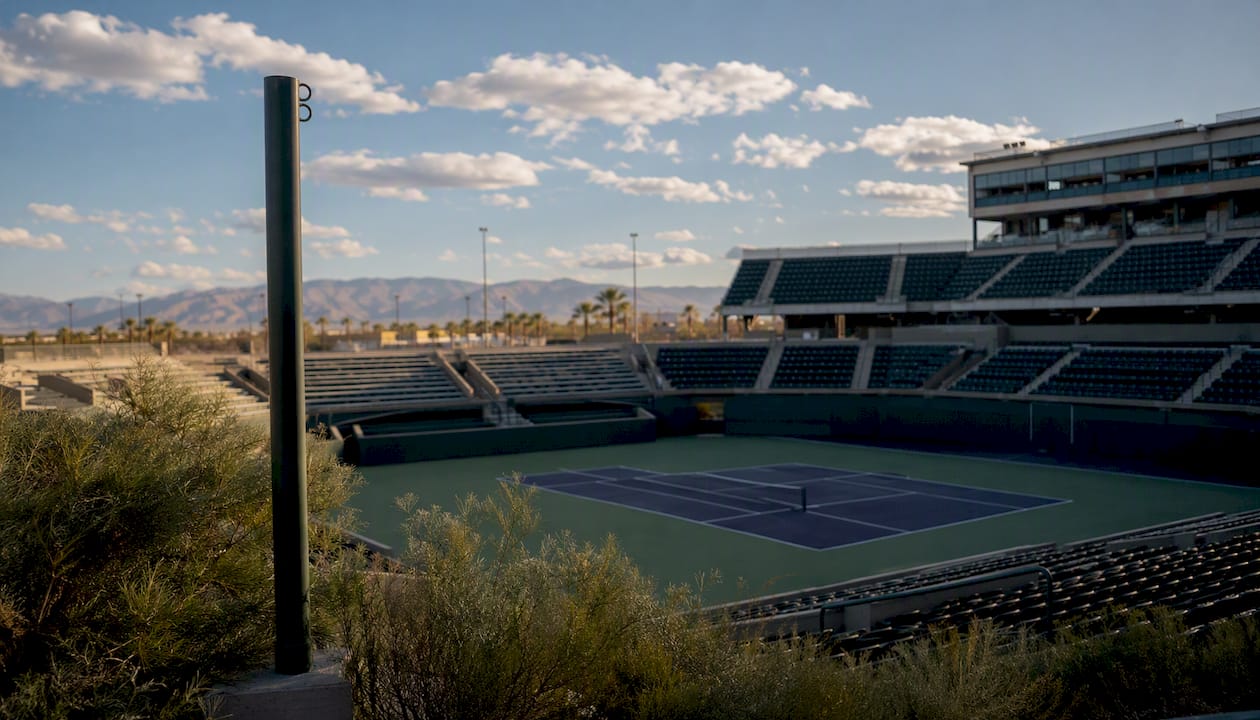
Indian Wells is the best Masters 1000 to attend, full stop. The desert setting, the stadium capacity, and the two-week format give it a Grand Slam feel that no other Masters event matches. ATP records document that in 2026 Jannik Sinner completed the "Sunshine Double" by winning both Indian Wells and Miami without dropping a set, a rare benchmark of dominance that underlines why these two events matter.
Best for: Attending (the best Masters 1000 venue experience), fantasy players who want a long scoring window.
Miami Open
Surface: Hard | Typical dates: Late March to early April | Category: Masters 1000
Paired with Indian Wells as the Sunshine Double, Miami runs immediately after and draws the same top-tier field. Hard Rock Stadium's tennis facility has been upgraded significantly and the South Florida atmosphere adds a distinct energy. The back-to-back scheduling with Indian Wells means players who perform well in the California desert often carry momentum straight into Miami, a pattern worth tracking for fantasy.
Best for: Attending (South Florida in March is genuinely pleasant), fantasy players tracking form continuity.
Monte-Carlo Masters
Surface: Clay | Typical dates: April | Category: Masters 1000
Monte-Carlo opens the clay season and does it from one of the most scenic venues in tennis, perched above the Mediterranean. The Masters 1000 series is distributed across surfaces and seasons, and Monte-Carlo's position as the first clay stop means players are still finding their footing on the dirt. That transition period creates upsets and surprises that make for compelling watching.
Best for: TV viewers who appreciate atmosphere and scenery, fantasy players targeting early clay-season specialists.
Madrid Open (Mutua Madrid Open)
Surface: Clay (high altitude) | Typical dates: May | Category: Masters 1000
Madrid's altitude, roughly 2,100 feet above sea level, makes the ball travel faster and bounce higher than at sea level. That single variable scrambles the normal clay-court hierarchy. Big servers and flat hitters who struggle on standard clay can thrive here, which means the draw produces upsets that don't happen in Rome or Paris. The Madrid Open overview shows a full Masters 1000 draw with prize money that attracts the complete top-10 field.
Best for: Fantasy players who want to exploit surface-condition edges, TV viewers who enjoy upset-heavy draws.
Rome (Internazionali BNL d'Italia)
Surface: Clay | Typical dates: May | Category: Masters 1000
Rome is the last clay Masters before Roland Garros, which makes it the definitive form guide for the French Open. Players who win or go deep in Rome arrive in Paris with momentum and confidence. The Foro Italico venue, set against Roman ruins, is one of the most atmospheric in tennis. For fantasy, Rome's field is as strong as any clay event outside Roland Garros itself.
Best for: Attending (the venue is extraordinary), fantasy players building clay-court lineups ahead of Roland Garros.
Canadian Open (National Bank Open)
Surface: Hard | Typical dates: August | Category: Masters 1000
The National Bank Open alternates annually between Toronto and Montreal, drawing both ATP and WTA fields in a combined event that creates a festival atmosphere. The WTA Tour's coverage of combined events shows how the dual-draw format amplifies crowd energy and broadcast scale. For US viewers, the Canadian time zones align well with evening coverage on ESPN.
Best for: TV viewers in the Eastern time zone, fantasy players who want a combined ATP/WTA scoring opportunity.
Cincinnati Open (Western & Southern Open)
Surface: Hard | Typical dates: August | Category: Masters 1000
Cincinnati sits one week before the US Open and functions as the final hard-court preparation event. The field is always strong because players use it to sharpen their game before the Slam. For fantasy, the timing is ideal: you can observe form and fitness heading into the US Open and carry those insights directly into your Slam lineup decisions.
Best for: Fantasy players using it as a US Open preview, TV viewers on Eastern time.
Shanghai Masters
Surface: Hard (indoor) | Typical dates: October | Category: Masters 1000
Shanghai is the centerpiece of the Asian swing and draws a full top-10 field with a prize fund that reflects its status. The indoor hard courts play fast and favor aggressive baseliners. For US viewers, the time difference (Shanghai is 12–13 hours ahead of Eastern) means live coverage is early morning, but highlights and replays are widely available on ESPN+.
Best for: Fantasy players targeting indoor hard-court specialists, TV viewers comfortable with replay viewing.
Paris Masters (Rolex Paris Masters)
Surface: Hard (indoor) | Typical dates: Late October to early November | Category: Masters 1000
Paris is the only indoor Masters 1000 and the last before the ATP Finals. Fast indoor conditions reward big servers and aggressive players, often producing results that look nothing like the outdoor hard-court season. The AccorHotels Arena draws a passionate French crowd that creates a unique atmosphere for an indoor event. Players use Paris to secure or protect their ATP Finals qualification spots, which adds genuine stakes to every match.
Best for: Fantasy players who track year-end qualification races, TV viewers who enjoy fast indoor tennis.
Nitto ATP Finals (Turin)
Surface: Hard (indoor) | Typical dates: November | Category: ATP Finals
The ATP Finals is the season's closing event and the most exclusive field in tennis: only the top 8 players in the year-end rankings qualify. The round-robin format means every player is guaranteed multiple matches, which is unusual at this level and creates a different strategic dynamic. For fantasy, the small field and guaranteed match volume make roster construction more precise than at any other event.
Best for: Fantasy players who want a compact, high-quality scoring event, TV viewers who want to see the season's best players at their peak.
How to pick which tournaments to follow this season
Start with the Grand Slams and Masters 1000 events as your baseline. That's 13 tournaments covering the full calendar from January through November, and the ESPN ATP schedule makes it easy to map them against your own calendar. From there, narrow down based on these steps:
- Identify your favorite players. Check which surfaces they perform best on and map those to the calendar. A Sinner fan follows the hard-court season closely; an Alcaraz fan watches everything.
- Pick two or three surfaces you understand well. Clay, hard, and grass each reward different playing styles. Knowing one surface deeply gives you a real edge in fantasy and makes watching more rewarding.
- Map your time zones. Australian Open and Shanghai require early mornings for US viewers. European clay events run afternoon Eastern. US events are prime time. Build your watch list around what you can actually watch live.
- Slot in two or three ATP 500 events that align with your favorite players or surfaces. Barcelona (clay), Halle (grass), and Washington (hard) are the most popular additions.
- Build a fantasy calendar. Prioritize tournaments with predictable fields and dense match days. Grand Slams run two weeks; Masters 1000 events run one to two weeks. Both give you sustained scoring opportunities.
Pro Tip: For in-person attendance, Indian Wells and the US Open give American fans the best combination of access, atmosphere, and ticket availability. For pure fantasy ROI, target the Masters 1000 hard-court events (Indian Wells, Miami, Cincinnati, Shanghai) where fields are predictable and surface-based modeling is most reliable.
How fantasy players get the most from these tournaments
The core principle is simple: pick tournaments where the top players actually show up and where the surface lets you predict performance. Masters 1000 events check both boxes. Grand Slams add best-of-five scoring depth that can produce massive point swings in a single match.
Surface-based selection is the sharpest edge in fantasy tennis. Clay specialists like Casper Ruud and Stefanos Tsitsipas consistently outperform their hard-court rankings at Monte-Carlo, Madrid, and Rome. Grass-court specialists like Taylor Fritz and Grigor Dimitrov punch above their seedings at Wimbledon. Knowing these patterns before you draft is the difference between a lucky pick and a calculated one. The ATP and WTA league structures explain how tournament types translate into fantasy scoring formats.
Early-round volatility at Grand Slams creates sleeper opportunities. Top players often ease into the first week, while lower-ranked players on favorable surfaces can rack up wins before facing elite competition. Targeting a clay-court specialist in rounds one and two at Roland Garros, before they inevitably face a top-5 seed, is a classic positive expected-value move.
For Grand Slam fantasy leagues, picking ATP fantasy teams requires a different approach than Masters 1000 events. At Slams, you need depth across 14 days. At Masters 1000 events, you need peak-form players who can win six or seven matches in eight days. The roster construction logic is genuinely different.
Pro Tip: For live contests with roster swap options, target tournaments where the late-round schedule is predictable. Masters 1000 events typically post quarterfinal and semifinal schedules 24 hours in advance, giving you a window to swap in players who are peaking at the right moment.
Why these events still give me chills every year
There's a version of this article that ranks tournaments by prize money or ranking points and calls it done. That's not what makes these events must-watch.
What actually makes them unmissable is the combination of stakes, setting, and the specific kind of pressure that only elite tennis produces. A fifth set at Roland Garros, clay-caked and exhausted, with the crowd shifting between languages and allegiances, is a different sport from a first-round hard-court match in January. The Masters 1000 events carry that same weight in a compressed format. When Sinner completed the 2026 Sunshine Double without dropping a set, it wasn't just a statistical achievement. It was a statement about where the sport's power had shifted, and you felt it watching live.
From a fantasy perspective, these tournaments are where the real decisions happen. Picking a clay specialist before Monte-Carlo, or identifying a grass-court dark horse before Wimbledon, and watching that call pay off across a week of matches, is a genuinely satisfying analytical exercise. It's the closest thing tennis has to the kind of strategic depth that football and basketball fantasy players take for granted.
The tennis power rankings guide captures this well: form, surface, and scheduling alignment are the three variables that separate informed picks from guesses. These 14 tournaments are where those variables matter most.
Tweener makes these tournaments worth more than just watching
If you're already tracking form, surface stats, and head-to-head records to decide which matches to watch, you're halfway to playing fantasy tennis seriously.
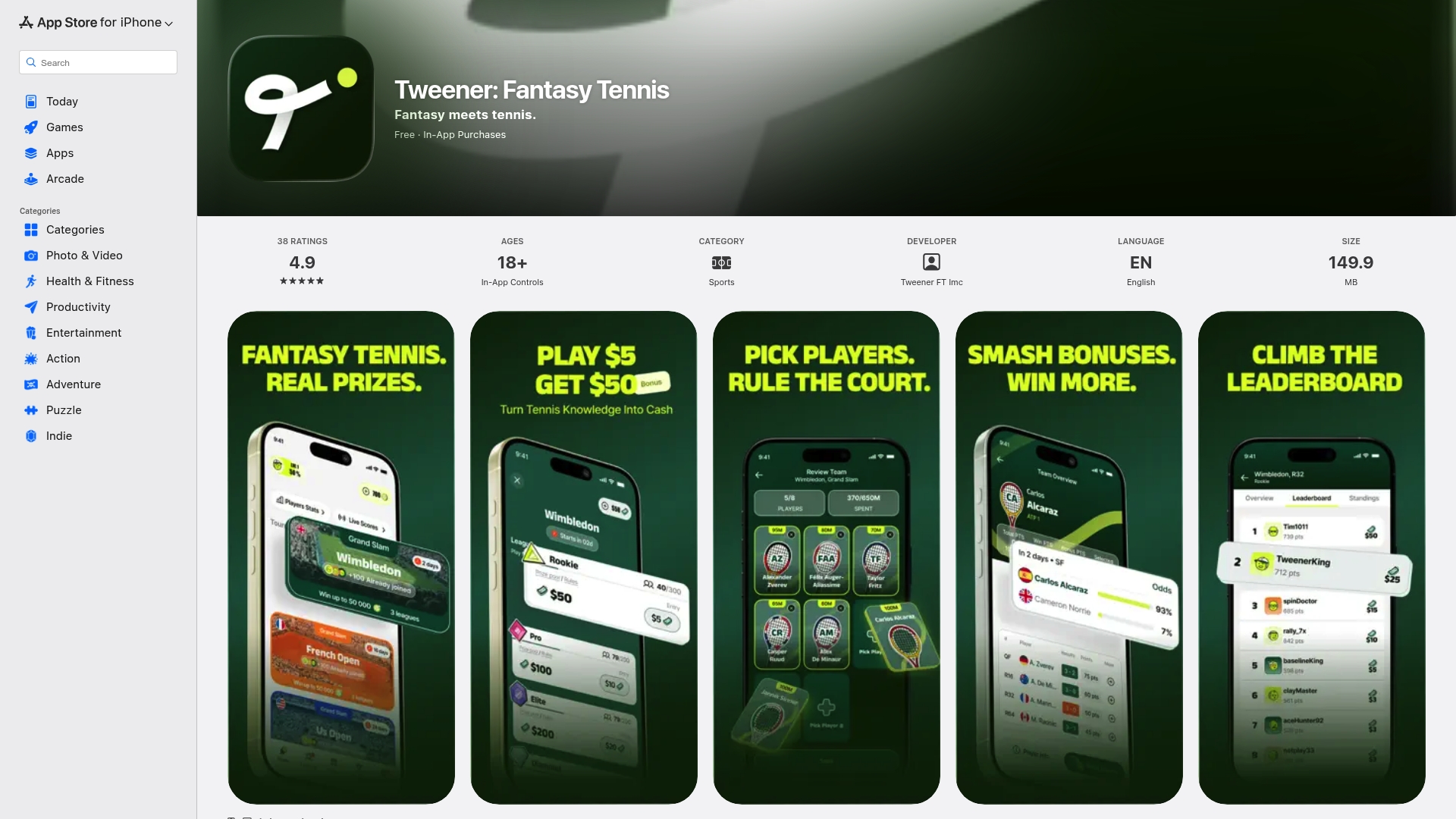
Tweener is the fantasy tennis app built for exactly this kind of fan. You create private leagues with up to 9 friends for Grand Slams, draft real ATP and WTA players, and score points based on actual match results. There's a free mode using virtual coins and a cash contest mode for real-money play where legally permitted. The stats tools inside the app let you apply the surface-based and form-based logic from this article directly to your roster decisions. No other platform offers this level of tennis-specific depth for fantasy play.
Ready to turn your tournament knowledge into a competitive edge? Download Tweener and set up your first private league before the next Grand Slam.
Sources
- ATP Masters 1000: Tournaments, Records, Stats | ATP Tour | Tennis
- ATP Schedule - 2026 Season - ESPN
- ATP Masters 1000 Madrid | Overview | ATP Tour | Tennis
- ATP Masters 1000 tournaments