

TL;DR:
- Multi-tournament tennis fantasy formats include One & Done, season-long squads, Multi-Draft, and hybrid types, each suited to different commitment and strategy levels. Setting appropriate usage limits, transfer rules, and scoring ensures balanced competition, while format choice depends on league size and engagement goals. Tweener supports these structures with private leagues, limited-use mechanics, and comprehensive leaderboards for ATP/WTA events.
Multi-tournament fantasy mode options fall into four clear families: One & Done / Pick X, season/series-long squads, Multi-Draft/series drafts, and hybrid formats. Your best choice depends on how much roster control, time commitment, and strategic depth your league wants.
Quick picks by player type:
- One & Done / Pick X — best for casual groups; low weekly effort, high drama per pick
- Season/Series-long squads — best for fans who follow the full ATP/WTA calendar and want sustained competition
- Multi-Draft — best for competitive groups who want one draft to carry them through a whole series
- Hybrid (pick'em + limited uses) — best for analytics-driven leagues that want maximum customization
Table of Contents
- What are the main multi-tournament fantasy formats?
- How do the core mechanics actually work?
- Which format fits your league?
- Commissioner setup checklist and copy-paste presets
- How to win by format: allocation and timing tactics
- How Tweener supports multi-tournament play
- Common challenges in running multi-tournament leagues
- How to customize formats for different tournament types
- What prize structures work best for multi-tournament leagues?
- Key Takeaways
- Why series formats make fantasy tennis worth playing
- Tweener brings these formats to life for tennis fans
- Useful sources and further reading
What are the main multi-tournament fantasy formats?
Every fantasy tournament format in the multi-event space is a variation on one of these four families:
- One & Done / Pick X: You select one player per event, but each player can only be used a set number of times across the season. Pick Djokovic for the Australian Open, and depending on your league's rules, you may not be able to use him again until Wimbledon. Usage limits are commonly configurable from 1 to 10 uses per season; most leagues choose 2–4 uses for balance.
- Season/Series-long squads: One squad, managed across the entire series. You make transfers when form dips or injuries hit, but your budget is finite. A 33-match tournament paired with 75 free transfers is a real-world example of how this plays out.
- Multi-Draft: Everyone drafts once before the series begins, and that squad accumulates points across 2–14 matches. No weekly re-drafts. Depth at draft day matters enormously.
- Hybrid formats: Variants like "Two & Thru," "Let It Ride," and "Pick 3 Classic" layer in mulligans, Sunday substitutions, and double-points starters. On the ATP clay swing, for example, a Pick 3 Classic lets you start three players with one substitution available after the quarterfinals.
How do the core mechanics actually work?
Player-usage limits and transfer rules
Usage limits stop one dominant player from anchoring every roster all season. Set them too low (1 use) and casual players feel punished for picking a favorite; set them too high (8+) and the format loses its strategic tension. Most competitive tennis leagues use 2–4 uses per season per player for balance.
Transfer allowances work differently. Season-long formats give you a fixed budget for the whole series. Spend transfers reactively every time a player loses a set, and you'll run dry before the Masters finals. Phased edit windows, where you can only make changes during designated windows, add another layer. Some platforms use sell tokens and captain swap limits tied to match phases to control roster churn.
Scoring and leaderboard compounding
Cumulative leaderboards reward consistency. A player who scores 40 points across five events beats one who scores 60 in one event and disappears. Captain multipliers (2× points) and vice-captain multipliers (1.5×) are free to change before each match in most season-long formats, making captaincy the highest-leverage decision you make every round. Per-tournament bonuses, like a finishing bonus for reaching a semifinal, can shift incentives and create late-season drama.
Three sample rule presets
Casual pool:
- Roster: Pick 1 per event
- Usage limit: 4 per season
- Transfers: Unlimited, max 2 per week
- Scoring: Standard points per round, no multipliers
Competitive private league (12 events):
- Roster: Pick 3 per event, captain designated
- Usage limit: 3 uses per season per player
- Transfers: 25 total for the series
- Scoring: Round points + semifinal/final bonus multiplier
Analytics league (full ATP/WTA season):
- Roster: Pick 5, captain + vice-captain
- Usage limit: 5 uses per season per player
- Transfers: 75 for the season, net-billed per window
- Scoring: Full stat-based scoring (aces, break points, sets won)
Pro Tip: Balance usage limits and transfer allowances together. Most leagues set usage limits at 2–4 per season. If you choose 2 per season, loosen transfers so players can adapt. Tight limits plus tight transfers creates front-loading — everyone burns their best picks in the first three events.
Which format fits your league?
| Dimension | One & Done / Pick X | Season-long squad | Multi-Draft | Hybrid |
|---|---|---|---|---|
| Commitment level | Low — one pick per event | Medium — weekly transfers | Low after draft day | Medium — depends on variant |
| Strategic depth | Moderate | High | High | High |
| Roster turnover | None (usage limits only) | Continuous (transfer budget) | None | Limited (mulligans/subs) |
| Scoring complexity | Simple | Moderate to complex | Moderate | Complex |
| Best league size | — | — | 4–12 | — |
| Social fit | Casual to competitive | Competitive | Competitive | Analytics-driven |
| Ideal prize structure | Per-event + season champion | Season champion | Series winner | Hybrid per-event + season |
Casual friend groups gravitate toward One & Done because the weekly decision is one pick, full stop. Stat-head leagues prefer season-long squads or analytics hybrids, where surface data, head-to-head records, and load management all feed into decisions. High-stakes private groups often choose Multi-Draft because one draft session creates a shared event, and the series plays out without constant admin.
Commissioner setup checklist and copy-paste presets
Every commissioner needs to lock in these decisions before opening registration:
- Tournament selection — which ATP/WTA events are in scope (all four Slams, Masters 1000s only, clay swing only)
- Mode family — One & Done, season-long, Multi-Draft, or hybrid
- Roster size — pick 1, pick 3, or pick 5 per event
- Usage limits — how many times each player can appear across the series
- Transfer rules — total allowance, per-window cap, and whether captain changes are free
- Scoring rules — points per round, bonus multipliers, stat-based additions
- Tie-breakers — head-to-head points, most wins, or a designated tiebreaker event
- Prize distribution — per-event payouts, season champion prize, or hybrid
Casual preset (copy-paste):
mode: one-and-done | roster: 1 | uses: 4 | transfers: unlimited (2/week)
scoring: round-points | tiebreaker: most-wins | prize: season-champion-only
Competitive preset:
mode: season-long | roster: 3 + captain | uses: 3 | transfers: 25 total
scoring: round-points + bonus-multiplier | tiebreaker: h2h | prize: per-event + season
Analytics preset:
mode: hybrid-pick5 | uses: 5 | transfers: 75 (net-billed) | captain: free-per-match
scoring: stat-based (aces, BPs, sets) | tiebreaker: total-points | prize: hybrid
How to win by format: allocation and timing tactics
One & Done / Pick X
Map your player usage to the calendar before the season starts. Identify the four or five events where your top picks have the strongest draw probability, surface advantage, or historical record. Holding Carlos Alcaraz for Roland Garros and Wimbledon rather than burning him at Indian Wells is the kind of calendar-mapping that separates winners.
- List your top 5 players and their best surfaces.
- Cross-reference with the ATP/WTA draw schedule.
- Assign tentative usage slots before the season opens.
- Reserve at least one use of each ace for a playoff or finale event.
Season/Series-long squads
Stagger substitutions. Swapping three players after one bad week burns your transfer budget fast. Instead, identify which underperformers are genuinely out of form versus temporarily unlucky, and move only on the former.

Multi-Draft
Prioritize depth over stars. A multi-draft format rewards consistency across the series, so a player ranked 15th who reaches semifinals regularly outscores a top-5 player who exits early twice. Draft for fixture density and workload, not just ranking.
Pro Tip: Monitor ATP/WTA entry lists and withdrawal announcements the week before each event. Late withdrawals open roster value that most leagues haven't priced in yet — especially in season-long formats where a well-timed transfer can lock in a sleeper before rivals notice.
How Tweener supports multi-tournament play
Tweener is built for exactly this kind of season-long competition. The app's core features map directly to multi-tournament formats:
- Private leagues for Grand Slams and Masters events, with invite codes for up to 9 friends
- Limited-use pick mechanics that mirror One & Done and Pick X formats
- Cumulative leaderboards that track points across the full ATP/WTA calendar
- Virtual coin prizes redeemable for gift cards (free mode), plus real-money cash contests where legally permitted
To join or create a multi-tournament league on Tweener:
- Download the Tweener app and create an account.
- Select "Create League" and choose your tournament scope (single Slam, Masters series, or full season).
- Set your roster size, usage limits, and scoring rules.
- Share the invite code with up to 9 friends.
- Draft your players before the first event's deadline.
- Track cumulative points on the live leaderboard throughout the series.
Common challenges in running multi-tournament leagues
Player withdrawals mid-series are the biggest headache. Build a transfer reserve — don't spend your full allowance in the first half of the season. A withdrawal from a top seed at a Masters event can collapse a roster that had no backup.
Engagement drop-off hits season-long formats hardest. Commissioners can counter this with per-event mini-prizes or a "weekly winner" bonus that keeps mid-table players invested even when the season title looks out of reach.
Scoring disputes usually trace back to ambiguous rules set at launch. Lock in your scoring table before the season opens and publish it to all participants. Retroactive rule changes destroy trust fast.
Roster stacking — one player dominating every team — is solved by usage limits. If your league has a stacking problem, drop the per-player usage ceiling by one and see if diversity improves.
How to customize formats for different tournament types
The ATP/WTA calendar has natural breakpoints that suggest different format structures. The clay swing (Monte Carlo through Roland Garros) is long enough for a season-long squad format. A single Masters 1000 event suits a One & Done or Multi-Draft. Grand Slams work well with hybrid formats because the draw size creates genuine uncertainty across seven rounds.
For commissioners adapting formats from other sports: the key variable is match frequency. Tennis produces results every day during a Slam, which means daily captain changes and frequent transfer windows are realistic. A format borrowed from weekly NFL fantasy will feel slow. Lean into tennis-specific calendar mapping and build your rules around how often meaningful results actually land.
What prize structures work best for multi-tournament leagues?
Prize structures fall into three models. Per-event payouts reward consistency and keep every tournament meaningful. Season champion prizes create a single high-stakes finish. Hybrid structures combine both: smaller per-event payouts keep engagement high throughout, while a larger season prize motivates long-term planning.
For private leagues with friends, non-cash incentives work surprisingly well. A trophy, a custom prize, or even bragging rights tied to a season leaderboard can drive more engagement than a small cash payout. For cash contests, Tweener's paid mode lets players compete for real-money payouts where legally permitted, with prize pools structured around individual events or series totals.
Key Takeaways
The most effective multi-tournament fantasy setup matches your format's usage limits and transfer budget to the ATP/WTA calendar's natural rhythm, then locks in scoring rules before the season opens.
| Point | Details |
|---|---|
| Match format to commitment | One & Done suits casual groups; season-long squads and Multi-Draft reward deeper engagement. |
| Usage limits prevent stacking | Set player uses at 2–4 per season to keep rosters diverse without punishing casual players. |
| Transfer budget is finite | In season-long formats, save transfers for genuine form collapses, not quiet matches. |
| Hybrid prize structures sustain engagement | Per-event mini-prizes plus a season champion prize keep mid-table players invested all series. |
| Tweener for implementation | Tweener's private leagues, limited-use picks, and cumulative leaderboards support all four format families across ATP/WTA events. |
Why series formats make fantasy tennis worth playing
The conventional wisdom in fantasy sports is that daily contests are the most exciting format because every decision feels urgent. After watching how ATP/WTA series formats play out, I'd argue the opposite. A season-long squad or a Multi-Draft series creates something daily games can't: a narrative. You're not just picking Jannik Sinner for one match. You're managing him across a clay swing, deciding whether his Roland Garros form justifies burning a usage slot, watching your leaderboard position shift week by week.
That sustained tension is what makes fantasy tennis genuinely strategic rather than luck-adjacent. Surface data, head-to-head records, and draw analysis all compound across a series in ways that a single-match contest never rewards. Tweener's approach, building skill-based competition around real ATP/WTA results rather than simulated outcomes, fits this model well. The formats described here are the infrastructure. The strategy you build on top of them is what actually separates winners.
Tweener brings these formats to life for tennis fans
If you've read this far and want to actually run one of these formats, Tweener is the place to do it. The app gives you private leagues for Grand Slams and Masters events, limited-use pick mechanics, and cumulative leaderboards that track the full ATP/WTA season. Free mode lets you compete with virtual coins; cash mode opens real-money contests where permitted. No other fantasy app is built specifically around professional tennis at this level.
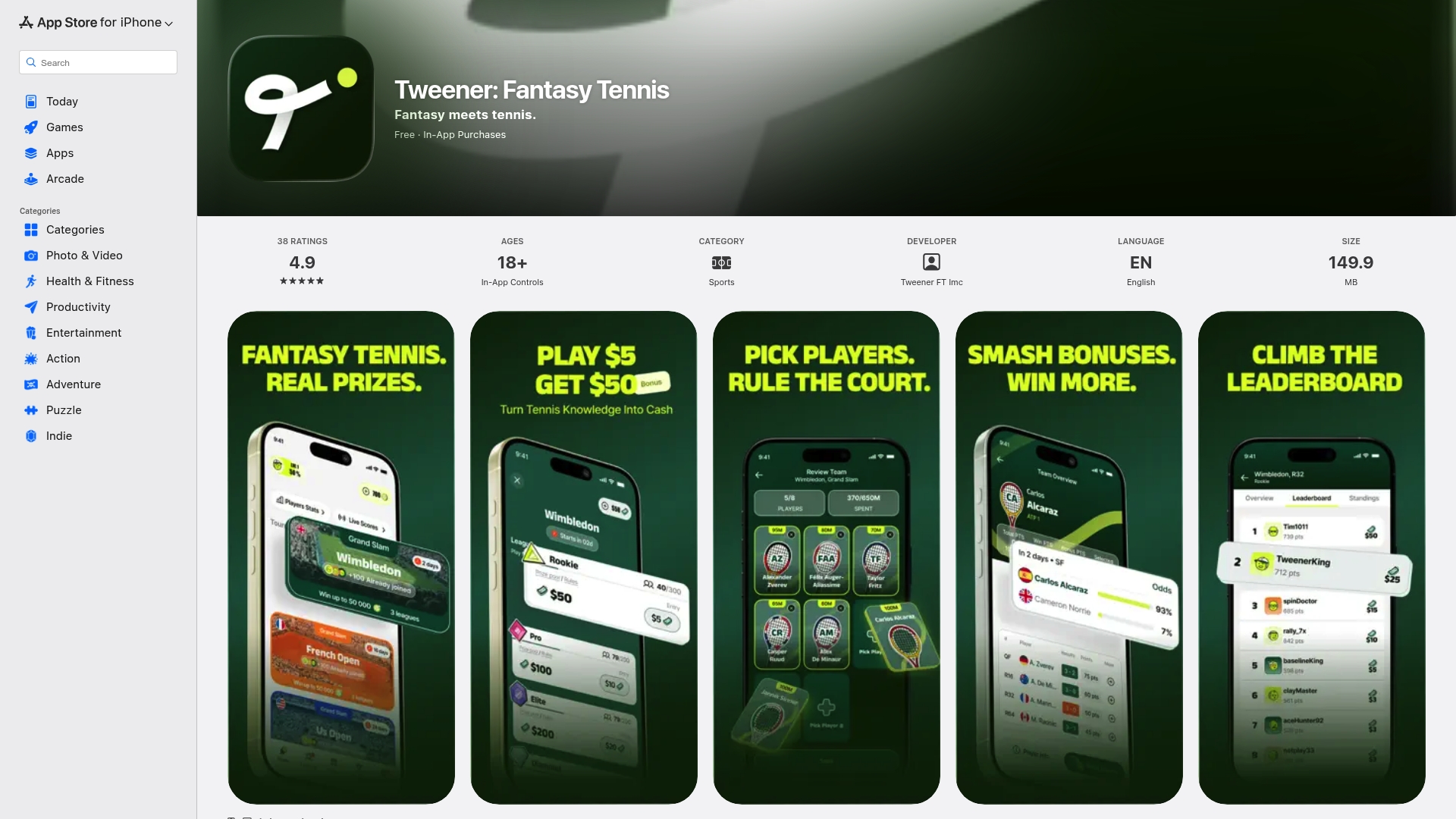
Download Tweener and start your league before the next Grand Slam draw drops. Set your roster, invite up to 9 friends, and let the ATP/WTA calendar do the rest.
Useful sources and further reading
- Game Formats | Pro Tour Fantasy Golf 2026 — best reference for One & Done, Pick X, and hybrid variant mechanics including mulligan tokens and Sunday sub rules.
- Season Fantasy | CricketDream — clearest explanation of transfer budgets, net-billing windows, and captain multiplier strategy in a season-long format.
- Multi-Draft Explained | CricketDream — covers why multi-draft rewards consistency and how squad depth outperforms star-heavy rosters across a series.
- RunYourPool.com Golf Pool Hosting — useful for prize structure models: per-event standings, aggregated year-to-date totals, and hybrid payout examples.
- MyFantasyLeague — reference for commissioner UI options across draft-only, salary-cap, and elimination formats; good for understanding the full range of configurable league settings.