

If you want to try interactive fantasy tennis right now, download Tweener, draft a roster of real ATP and WTA players, and score points as they win matches, hit aces, and break serve live. That's the core loop behind every good example of interactive sports gaming in tennis. Beyond Tweener, the format splits into a few distinct types: salary-cap tournament contests, season-long drafts, and pick'em prediction games.
- Salary-cap tournament contests: build a roster under a credit budget for one event, like the Australian Open.
- Season-long drafts: draft once, manage your team across multiple tournaments with waivers.
- Pick'em/prediction games: pick match winners or stat lines without managing a full roster.
Start in free mode with virtual coins before you risk anything in a cash contest.
Key Takeaways
Interactive fantasy tennis works because it turns individual match stats, aces, break points, and set wins, into a live, skill-based score you control through smart roster decisions.
| Point | Details |
|---|---|
| Start in free mode | Use virtual coins to test lineup ideas before entering any cash contest. |
| Match format to goal | Pick salary-cap contests for single events, season-long drafts for ongoing rivalries. |
| Prioritize surface over ranking | A lower seed with strong surface form often outscores a higher-ranked player. |
| Build anchor-and-attacker rosters | Pair stable, high-floor picks with one or two high-upside surface specialists. |
| Try Tweener for live scoring | Tweener combines ATP/WTA pools, live match updates, and private leagues up to nine friends. |
Table of Contents
- What Are Examples of Interactive Sports Gaming in Tennis?
- What Are the Main Types of Fantasy Tennis Games?
- What Features Make Fantasy Tennis Genuinely Interactive?
- What Strategy Actually Wins Fantasy Tennis Contests?
- How Do You Pick the Right Fantasy Tennis App?
- How Does a Live Fantasy Tennis Match Actually Play Out?
- How Does Fantasy Tennis Compare to Other Interactive Sports Games?
- What Should Beginners Know Before Opening the Tweener App?
- What Mistakes Do New Fantasy Tennis Players Make?
- The Real Advantage Analytical Fans Have in Fantasy Tennis
- Try Tweener for Your Next Fantasy Tennis League
- Frequently Asked Questions
- Sources
What Are Examples of Interactive Sports Gaming in Tennis?
Interactive fantasy tennis means drafting or selecting real ATP and WTA players, then earning points as those players perform in live matches. It's the tennis equivalent of daily fantasy football, minus the play calling. You're not predicting scores from the sidelines. You're building a roster and watching your fate tied to a real backhand landing in or out.
Scoring usually rewards match wins, sets won, and aces, while penalizing double faults and lopsided losses, like a 6-0 bagel. A typical rule set might award two points per ace and ten for a straight-sets win, then deduct points for double faults and blowout set losses. Tie that back to a real event, like Wimbledon or the Miami Open, and suddenly every rally matters to your standings, not just the players on court.
What Are the Main Types of Fantasy Tennis Games?
Not every fantasy tennis format works the same way, and picking the wrong one for your schedule is the fastest way to lose interest. Here's how the main types break down.
- Salary-cap tournament contests. You get a credit budget and build a roster for a single event. This format rewards fans who want a short-term commitment tied to one Grand Slam or Masters event, and it forces real decisions about which higher seed to skip in favor of a cheaper, in-form player.
- Season-long drafts. You draft once, typically in a snake draft against a private league, then manage your roster across multiple tournaments with waivers and trades. Season-long formats run across the full calendar, which suits fans who want a running commissioner-league rivalry with friends rather than a one-off contest.
- Pick'em and prediction games. You forecast match winners, set counts, or ace totals without managing a full roster. These are fast, casual, and ideal for fans who want a quick, low-commitment way to have skin in a match.
- Market-value or credit systems. Player values shift event to event based on recent form, so a specialist coming off a strong clay-court run gets pricier before the French Open. This format rewards active managers who track news and adjust rosters as prices move.
You'll also choose a player pool: ATP-only for men's tour purists, WTA-only for women's tour specialists, or combined pools that let you mix and match across both tours in the same league.
What Features Make Fantasy Tennis Genuinely Interactive?
Interactivity comes down to how much real-time information you get and how much control you have while a match is live. A few features separate a genuinely interactive platform from a glorified prediction form.
- Live scoring with lock-screen updates. Tweener's Live Activities feature pushes set and game-level scoring straight to your lock screen, so you don't have to reopen the app every changeover.
- Deep stat feeds. Aces, double faults, break points, head-to-head history, and surface splits all feed the in-app strategy tools that help you decide who to start.
- Roster controls. Lineup locks at match start, alternates for late scratches, and swap rules that let you adjust before a player takes the court.
- Private leagues and social features. Draft rooms, leaderboards, and league chat turn a solo hobby into a running competition with friends.
- Transparent free and cash modes. Every scoring action maps to a fixed point value, whether you're playing with virtual coins or real money.
Pro Tip: The two features that improve in-match decisions the most are live break-point alerts and head-to-head surface data. Together they tell you not just who's winning, but who's about to.
What Strategy Actually Wins Fantasy Tennis Contests?
Winning consistently isn't about picking the highest seeds and hoping. It's about treating your roster like a portfolio, with defined roles for each slot.
Split your lineup into anchors and attackers. Anchors are your stable floor: top-four seeds with strong recent form who rarely lose early. Attackers are higher-variance picks, like a surface specialist who might flame out early but could also rack up ace and break-point bonuses against a favorite. RotoWire's draft analysts recommend exactly this mix, pairing safe early picks with later high-upside targets rather than loading up on name recognition.
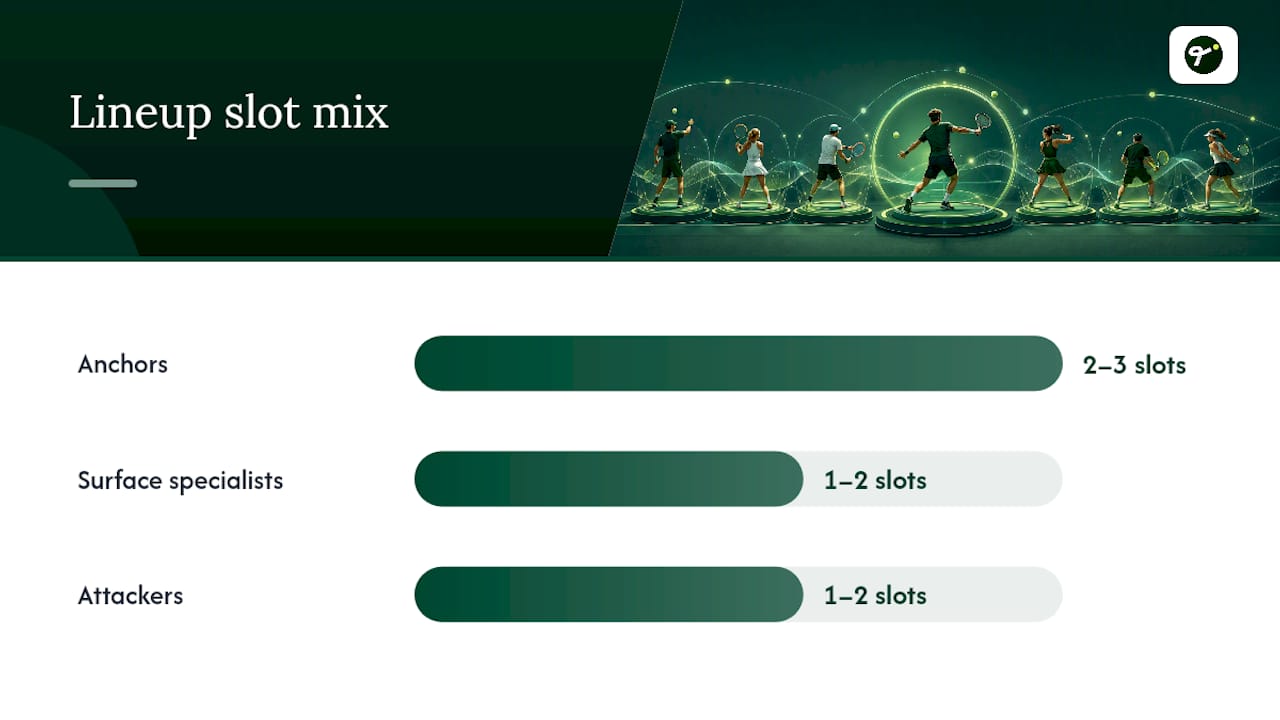
Surface matters more than ranking in salary-cap formats. A player ranked outside the top 20 who owns a strong clay-court record can outscore a higher seed who's a poor fit for the surface. Check head-to-head records on that specific surface, not just career H2H.
Here's a simple checklist for building a tournament lineup:
- Lock in two or three anchors from players with strong recent form and a favorable draw.
- Add one or two surface specialists whose skill set fits the tournament's court type.
- Check ownership; if a popular pick has a tough early-round matchup, consider fading them for a lower-owned player with a cleaner path.
- Review your budget or roster spots and fill remaining slots with value picks under the radar.
A sample lineup for a hard-court Masters event might anchor with a top-five seed and a consistent top-15 grinder, then add a big-serving attacker who thrives in tiebreaks. Pro Tip: Avoid chasing whoever won last week's headlines. Consistent managers focus on repeatable, surface-specific performance instead of recent hype. Test any new framework in free mode before you commit cash.
How Do You Pick the Right Fantasy Tennis App?
Match the platform to what you actually want out of a season, not just the first app that shows up in a search.
- Format fit: do you want a single-tournament salary-cap sprint or a season-long draft with a friend group?
- Player pool: ATP-only, WTA-only, or combined rosters.
- Live scoring depth: does the app show ace and break-point data as it happens, or just a final score?
- League mechanics: public pools versus private leagues you control.
- Free versus cash availability: can you practice before risking money?
- Mobile experience: is the app built for quick, in-match decisions?
Tweener checks most of these boxes for analytical fans: combined ATP and WTA pools, live scoring with lock-screen updates, private leagues for up to nine friends per Grand Slam, and both free-coin and cash contest modes. Start by drafting a free-mode team for the next Masters event, get comfortable with the scoring rules, then graduate to a small private cash league once you understand how your picks translate to points.
Why Trust This Guide to Fantasy Tennis Examples
. Three product facts back the recommendations here: Tweener's Live Activities and on-device pick rationale, its free-coin and cash contest modes, and its live stat feeds covering aces, double faults, and break points. Practice in free mode before you ever deposit cash.
How Does a Live Fantasy Tennis Match Actually Play Out?
Picture a Grand Slam quarterfinal about to start. You've already locked your roster before the scheduled first serve, since most platforms freeze lineups once a match begins. As the match unfolds, every ace, break point, and completed set feeds into your score in real time rather than after the fact.

Your app pushes a lock-screen update the moment your player breaks serve in the second set. You check it between errands or during a commercial break, not glued to a live stream the whole time. That's the actual value of live scoring: it lets you follow a tournament you'd otherwise miss while still feeling every swing in momentum.
By the time the match ends, your point total reflects the full arc of that specific contest, not just who won. A player who lost in three tight sets but racked up aces and break points can still outscore a straight-sets winner who barely served well. That's the mechanic that keeps fantasy tennis distinct from a simple bet on the outcome; you're scored on performance detail, not a binary result. Multiply that across a full day of tournament play, and your dashboard becomes a live leaderboard shifting court by court.
How Does Fantasy Tennis Compare to Other Interactive Sports Games?
Fantasy football and fantasy basketball dominate the interactive sports gaming conversation, and for good reason: massive rosters, weekly schedules, and years of DFS infrastructure. Tennis works differently, and that difference is the appeal for the audience that gravitates toward it.
A tennis roster is small, often just five to eight players, so every single pick carries far more weight than a 15 or 20 person football roster. There's no bye week to hide a bad pick behind, and no committee of role players diluting your decisions. You either read a draw correctly or you don't.
Tennis is also an individual sport under continuous scoring, which means fantasy points accumulate point by point, game by game, set by set, rather than resetting weekly. That structure rewards fans who understand surface splits and head-to-head history the way NFL fantasy rewards fans who understand target share. Other interactive formats built around technology and physical play, like tech-enhanced arcade sports experiences, share the same appetite for real-time feedback, but they're built for a venue, not a season-long strategic rivalry. Fantasy tennis gives that same instant feedback loop without leaving your couch, tied to majors most fans already watch closely.
What Should Beginners Know Before Opening the Tweener App?
The interface rewards a little upfront exploration before your first draft. Spend five minutes in free mode before you touch a cash contest.
Start by browsing the current tournament's player pool before you draft anything. Note which seeds have favorable early-round draws and which surface specialists are entering good form. Tweener's player profiles surface recent match stats and head-to-head data, so check those before locking a roster rather than defaulting to the highest seed.
Set up a private league with friends for the next Grand Slam if you want a running rivalry instead of a single public pool. Private leagues cap at nine friends, which keeps the competition personal and the leaderboard easy to track throughout a two-week event.
Turn on live notifications before the first matches start. That's how you catch a break-point swing or a lock-screen score update without babysitting the app all day. Finally, treat your virtual coin balance from free mode as a real trial run. Redeem what you earn for rewards, and use the experience to figure out which game type, salary-cap tournament play or season-long drafts, actually fits how you watch tennis.
What Mistakes Do New Fantasy Tennis Players Make?
The most common mistake is drafting off name recognition instead of matchup fit. A top-five seed with a brutal draw against a surface specialist is a worse pick than a top-20 player with a clean path to the quarterfinals. Rankings measure overall career strength, not this week's matchup.
A related misconception is assuming a full roster of favorites guarantees points. Fantasy scoring rewards performance detail, aces, break points, and set margins, not just wins. A grinder who wins ugly in five sets can underperform a player who loses in a tight three-setter but serves lights out.
New players also underestimate how fast a lineup can go stale. Injuries, retirements, and surprise upsets happen constantly during a two-week Slam, and a roster locked at the start of the tournament without any plan for alternates leaves you exposed. Check swap rules and roster locks before you draft, not after your top pick retires mid-match.
Finally, don't skip free mode. It's tempting to jump straight into a cash contest to make things feel real, but testing lineup ideas with virtual coins first is the cheapest way to learn how scoring actually behaves before real money is on the line.
The Real Advantage Analytical Fans Have in Fantasy Tennis
Most fantasy sports content treats tennis as an afterthought to football and basketball, and that's a mistake. Tennis is arguably the best sport for skill-based fantasy play precisely because it's an individual sport with continuous, granular stats. There's no offensive line masking a bad quarterback and no bench depth hiding a weak roster decision. Every pick is fully yours to defend or regret.
The conventional advice, chase the top seeds, ignore surface data, treat every tournament the same, undersells how much surface specialization actually matters. A clay-court grinder ranked outside the top 30 can be the best value pick of the season at the right event, and most casual players never check that data before drafting. That gap between what casual fans do and what the stats actually support is where real edge lives.
If you take one thing from this guide, prioritize surface-specific form over ranking every single time you draft. It's the single biggest lever most new players ignore, and it's also the easiest one to fix starting with your very next lineup.
Try Tweener for Your Next Fantasy Tennis League
Tweener is built specifically for tennis, not retrofitted from a football or basketball fantasy engine, which is exactly the gap this article's comparisons kept surfacing. You get combined ATP and WTA player pools, live scoring with lock-screen updates during matches, and private leagues that cap at nine friends so every Grand Slam becomes a real rivalry instead of an anonymous public pool.
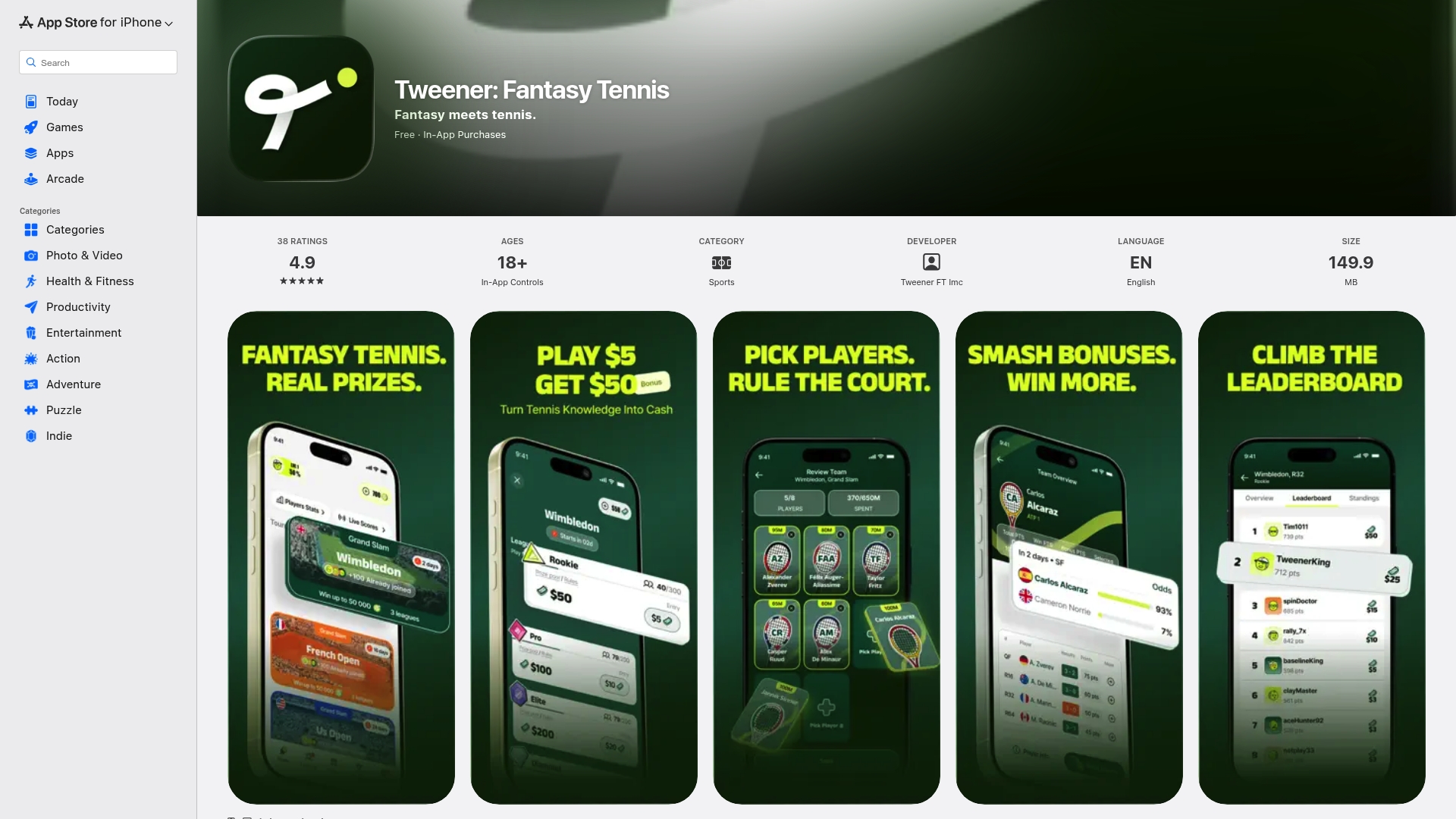
Start free. Draft a roster with virtual coins, learn how aces, break points, and set wins translate into your score, then redeem your coins for real rewards once you're comfortable. When you're ready to test your read on a draw with real stakes, move into a cash contest with the same lineup logic. Download Tweener and build your first roster before the next tournament's first serve.
Frequently Asked Questions
What is the best example of interactive sports gaming for tennis fans? Tweener is the clearest example: you draft real ATP and WTA players, join private or public leagues, and score points from live match events like aces, break points, and set wins.
How do interactive fantasy tennis games score points? Most platforms award points for match wins, sets won, and aces, with penalties for double faults and lopsided set losses. Exact values vary by app, so check the scoring rules before you draft.
Should I play free mode or cash mode first? Start in free mode. It lets you learn scoring mechanics and test lineup strategies with virtual coins before you risk real money in a cash contest.
Is fantasy tennis different from sports betting? Yes. Fantasy tennis rewards roster construction and matchup analysis over multiple stat categories, rather than a single win/loss outcome, which makes it a skill-based alternative rather than a straight wager.
Can I play with just ATP or just WTA players? Many platforms, including Tweener, let you choose ATP-only, WTA-only, or combined pools, so you can specialize in the tour you follow most closely.
Sources
- Tweener: Fantasy Tennis App - App Store
- Fantasy Tennis 2026: Best Season-Long Platforms for French Open Fans | RotoWire