

Captain the rostered player who combines peak recent form, the clearest path through the bracket, and the strongest fit with Tweener's scoring rules this week.
Quick checklist before you lock:
- Your Tweener-rostered player is in peak form across the last three events
- That player faces the easiest projected path to the quarterfinals or beyond
- Their playing style matches what Tweener rewards most heavily this scoring period
Smart captain picks can significantly lift your weekly score. The framework below shows you exactly how to get there.
Key Takeaways
| Point | Details |
|---|---|
| Form beats rankings | Use last three events and service/return metrics, not ATP/WTA ranking position. |
| Draw analysis is decisive | Count projected wins based on bracket path, not just opponent ranking. |
| Match scoring rules to player style | Surface and scoring emphasis together determine which archetype to captain. |
| Template vs. differential | Protect rank with the consensus pick; chase rank with a low-owned player who has a clean draw. |
| Tweener | Use Tweener's scoring rules page and live updates to confirm your captain pick before every lock. |
Table of Contents
- Why the captain pick is your highest-leverage weekly decision
- How to select tennis captains: a repeatable weekly framework
- How to read the draw and spot easy paths to late rounds
- Does your captain's style match Tweener's scoring this week?
- Template vs. differential: when to play it safe and when to swing
- Your 6-step captain workflow before lock
- Red flags that should remove a player from captain consideration
- Three examples of the framework in action
- Why most players get captain selection wrong
- Tweener gives you the tools to execute this every week
- Useful sources and further reading
Why the captain pick is your highest-leverage weekly decision
In any multiplier format, doubling one player's points concentrates your entire week's variance into a single choice. Get it right and you jump the leaderboard. Get it wrong and you're fighting from behind with no recovery mechanism.
Up to 25% weekly points uplift from captain selection alone, making it the single biggest strategic lever between a winning and a mediocre week.
Three practical consequences follow from that concentration:
- A correct captain pick protects your rank in cash games by adding a reliable floor of doubled points
- A bold differential captain creates the upside needed to climb private-league ladders in one week
- Your captain choice should shape the rest of your roster, not the other way around
How to select tennis captains: a repeatable weekly framework
Stop defaulting to the highest-ranked name on your roster. Rankings lag form by weeks, sometimes months. A player who just pushed a top-5 seed to three sets is a stronger captain candidate than a higher-ranked player grinding through a slump.
Weight these variables in roughly this order when you optimize your fantasy picks:
- Form (30%): Last three events. Look at win-loss record, service hold %, and return break % — not just the scoreline.
- Draw (25%): Path to the quarterfinals. Count likely wins based on ranking gaps and head-to-head records.
- Scoring fit (20%): Does this player's style generate the stats Tweener rewards most this week?
- Surface (10%): Hard, clay, or grass? Check the player's surface win rate over the past two seasons.
- Ownership (10%): Are you the only one captaining them, or is everyone else doing the same?
- Motivation and fitness (5%): Any rotation risk, injury report, or scheduling fatigue?
To check these quickly on Tweener, pull up the player's profile for recent match stats, cross-reference the live draw bracket, and confirm the scoring rules page before lock.
Pro Tip: In cash games, prioritize floor: captain the player with the highest probability of winning two or three matches. In GPPs and private leagues where you need to climb, shift weight toward ceiling: a lower-owned player with a favorable draw and a high-variance style.
How to read the draw and spot easy paths to late rounds
Top fantasy players weight draw analysis over raw ranking. A lower-ranked player in an easier bracket section often collects more multi-round points than a top seed who faces a dangerous opponent in round two.
- Check the first two rounds. Who does your candidate play in rounds one and two? Look at ranking gaps and recent form, not just ATP/WTA numbers.
- Scan the section for seeded threats. Which seeds are in the same quarter of the draw? A top-8 seed on the opposite side of the bracket means your player could reach the semis without facing elite competition.
- Map the projected quarterfinal matchup. If the likely QF opponent is a player your candidate has beaten recently or holds a strong H2H record against, that's a green light.
- Count expected wins. A realistic three-win path before a tough match scores far more fantasy points than a two-win path followed by an early exit against a dangerous seed.
Example: Imagine a player ranked 22nd placed in a quarter with three opponents ranked 60th or lower, while the top seed faces the 8th seed in round three. The 22nd-ranked player's expected round count is higher. Per the ATP fantasy framework, assigning your multiplier to the player with the clearest bracket path is the most consistent strategy in large-event formats.
Does your captain's style match Tweener's scoring this week?
Scoring rules shift what matters. An ace-heavy server on grass is worth far more in a format that rewards aces and service winners than in one that weights break conversions and games won.
| Scoring emphasis | Player archetype to prioritize | Surface fit |
|---|---|---|
| Aces and service winners | Big servers (Opelka-style, Karlovic-style) | Grass, fast hard |
| Break conversions | Aggressive returners (Djokovic, Alcaraz) | Clay, slow hard |
| Games won (match length) | Grinders with high hold % | Clay, slow hard |
| Winners and short points | Aggressive baseliners | Hard, grass |
Before you lock, open Tweener's scoring rules page and confirm which stats carry the most weight this week. Surface shifts this meaningfully: on grass, ace value spikes and return-game stats matter less. On clay, break conversion and games-played totals dominate.
Pro Tip: When scoring rewards aces, don't rely on raw ace totals alone. Check the ace-to-double-fault differential. A server racking up aces but also gifting double faults is less efficient than one with a clean service game under pressure.
- Confirm the current scoring period's rules before every lock, not just at the start of a tournament
- Surface advantage analysis shows surface fit and scoring alignment are multiplicative: a player who matches both can outperform raw expectations by a wide margin
Template vs. differential: when to play it safe and when to swing
The template captain is whoever most of your league captains this week. The differential is the lower-owned player with upside. Choosing between them depends entirely on your league position and contest type.
Captain the template when:
- You're in a cash game or head-to-head format where finishing above 50% is the goal
- You're leading a private league and protecting your margin matters more than gaining ground
- The template pick has a clear form, draw, and scoring advantage with low injury risk
Go differential when:
- You're trailing in a private league and need to close a gap fast
- The template captain has a tough draw or a surface mismatch you can exploit
- A lower-owned player has equivalent or better form and a cleaner bracket path
As a rough ownership threshold: treat any captain chosen by a large share of your league as the template. A much lower ownership with a credible case for deep-round progression is your differential window. This mirrors the FPL captaincy logic that governs multiplier decisions in other fantasy formats: protect rank with the template, chase rank with the differential.
Pro Tip: In private Grand Slam leagues on Tweener, you often know your opponents' tendencies. If everyone in your group defaults to the top seed, a well-researched differential can swing the whole week in one match.
Your 6-step captain workflow before lock
- 48+ hours out: Shortlist two or three candidates based on form (last three events) and draw position. Check lineup construction principles to confirm your captain fits the roster story.
- 24 hours out: Confirm surface fit and scoring alignment. Pull up Tweener's scoring rules and map each candidate's style to this week's point weights.
- 12 hours out: Check ownership trends if visible. Is your preferred pick becoming the consensus? Adjust if your league position calls for a differential.
- 6 hours out: Scan for injury news, withdrawal reports, and fitness updates. A single physio call-out at this stage removes a player from captain consideration immediately.
- 1 hour out: Final ownership check and draw confirmation. Any late seeding changes or walkovers can shift bracket paths overnight.
- Minutes before lock: Confirm your player is in the starting lineup and no late scratches have been reported. Lock with confidence.
On timing: Tweener's live prediction updates allow you to adjust captain picks and live selections during matches when the platform supports mid-match changes. If that feature is available this scoring period, monitor the first set before committing your multiplier to a struggling player.
Red flags that should remove a player from captain consideration
- Injury or fitness report: Any mention of a physical issue in the 48 hours before lock is a hard no
- Tough early draw: A round-one or round-two matchup against a top-15 player in form kills expected round count
- Rotation or rest risk: Players managing a heavy schedule sometimes withdraw or tank early rounds
- Surface mismatch: A clay specialist on grass in a scoring format that rewards aces is a double penalty
- Low first-serve %: Below 55% first-serve percentage in recent matches signals a player who will struggle to generate the service-side stats that drive fantasy scoring
- Weather interruptions: Suspended matches and rain delays compress scheduling and can force withdrawals or diminished performance
If a late withdrawal hits after you've locked, check whether Tweener allows a captain swap. When it doesn't, that's exactly why your second-choice candidate should always be rostered.
Three examples of the framework in action
1. Top seed with a tough draw (cash game, protect rank)
Carlos Alcaraz enters a Masters 1000 on clay in peak form, but his quarter of the draw includes Jannik Sinner in the third round. Scoring rewards break conversions heavily. Alcaraz fits the surface and scoring profile, but the expected round count drops if Sinner is in form. In a cash game, you captain Alcaraz for the floor: two near-certain wins before the tough matchup still doubles a high point total. In a GPP, you look elsewhere.
2. Lower-ranked player in an easy section (differential win)
A player ranked 28th draws a quarter with no seed higher than 14th and two opponents ranked outside the top 50. Recent form shows three consecutive wins on the same surface. This is the differential case: the DFS surface and draw framework supports captaining players whose bracket path projects three or four wins before a difficult match. The upside here outweighs the template pick.
3. Ace-heavy server on grass (scoring alignment win)
A big server enters a grass-court event where Tweener's scoring heavily weights aces and service winners. His recent ace-to-double-fault differential is strong, and he faces two opponents who struggle on fast surfaces. This is a scoring-alignment captain: the style matches the rules, the surface fits, and the draw is clean. In both cash and GPP formats, this player is a strong captain candidate. The outcome differs by contest type only in how much ownership matters.
Why most players get captain selection wrong
Most fantasy tennis players captain by instinct: pick the highest-ranked player on the roster and move on. The problem is that rankings are a lagging indicator. They reflect results from weeks or months ago, not current form or this week's draw.
The framework in this guide asks you to do something different: treat captain selection as a weekly research task, not a reflex. Form, draw, scoring fit, and ownership each carry weight, and the right answer changes every scoring period. A player who was the obvious captain at Roland Garros may be a liability at Wimbledon two weeks later.
One more thing most guides miss: the captain choice should shape your roster, not follow from it. Once you've identified your captain candidate, build the rest of your lineup around that anchor. That's the difference between a coherent team and a collection of good players who don't add up to anything.
Tweener gives you the tools to execute this every week
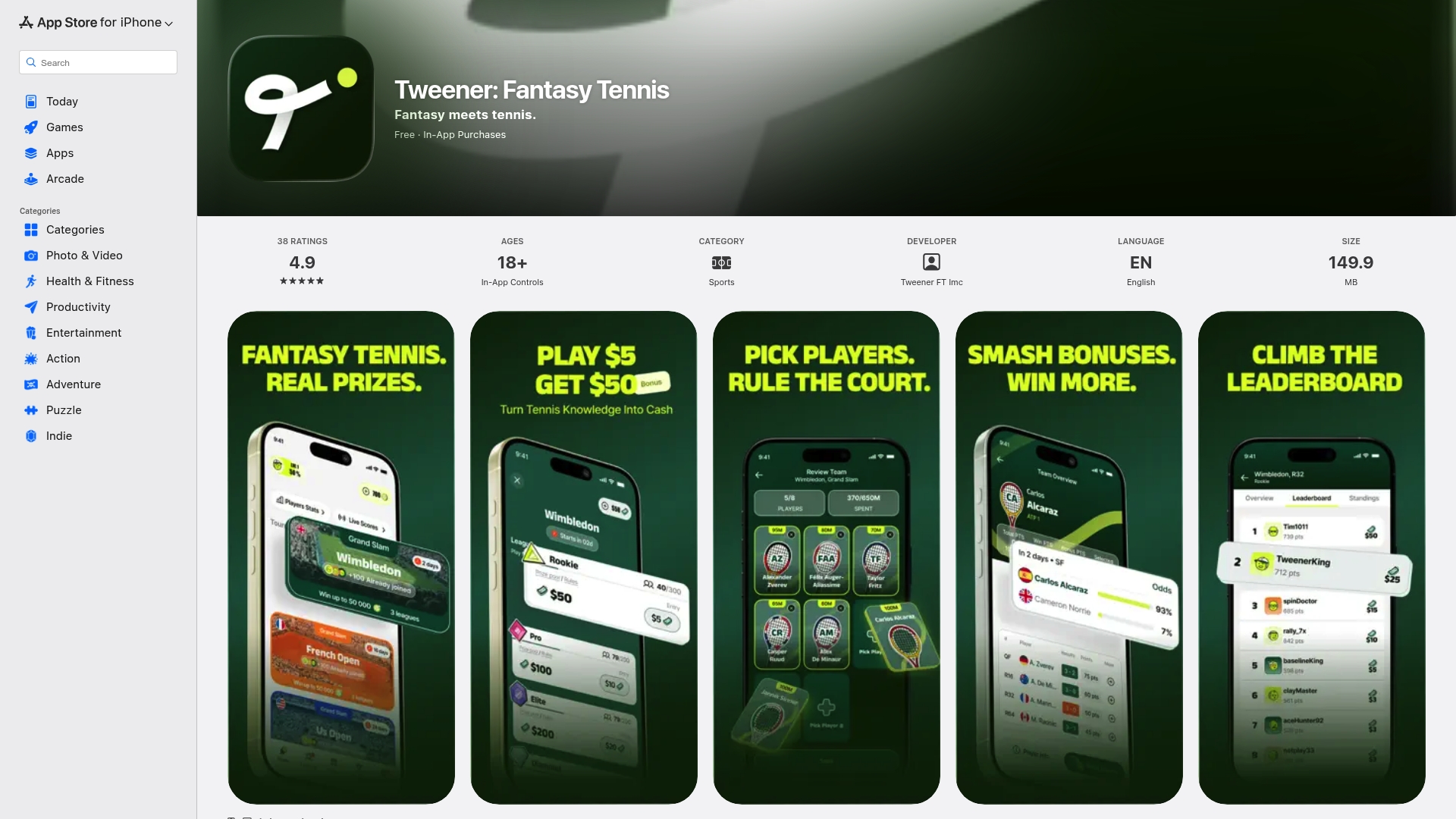
Tweener is built for exactly this kind of analytical play. The app surfaces scoring rules clearly before each lock, delivers live match updates so you can act on mid-match captain swap opportunities, and lets you run private Grand Slam leagues with up to nine friends where template vs. differential decisions actually matter.
Every step in this guide maps to a feature in the app: draw analysis, live predictions, scoring transparency, and easy captain management. You don't need a spreadsheet. You need the right platform.
Download Tweener and put this captain framework to work before your next lock.
Useful sources and further reading
- Surface advantage in tennis: what it means and why it matters — Deep dive on surface performance and how it multiplies scoring alignment
- ATP fantasy — everything you need to know about the new tennis game — TennisNerd's overview of multiplier formats and the consistent strategy for assigning captain bonuses
- Tennis DFS guide: how to build winning daily fantasy tennis lineups — DFS-focused breakdown of surface, serving ability, and ownership as captain drivers