

TL;DR:
- Tennis fans can now compete through flexible leagues, prediction contests, fantasy platforms, and live event participation. These options emphasize analytical skill, strategic thinking, and social engagement beyond just watching matches. Combining multiple formats offers a richer, more interactive fan experience tailored to different interests and schedules.
Watching Jannik Sinner grind through a fifth set or Carlos Alcaraz uncork a tweener on match point is genuinely thrilling. But for a growing number of fans, spectating alone no longer feels like enough. The good news is that there are more ways tennis fans can compete today than at any point in the sport's history. From flexible local leagues to fantasy platforms and bracket prediction contests, the options have expanded well past just hitting balls at the club. This guide breaks down nine of the best, with concrete details so you can find what actually fits your schedule, skill level, and competitive personality.
Table of Contents
- Key takeaways
- 1. Ways tennis fans can compete in USTA Flex Leagues
- 2. UTR Flex Leagues and challenge match play
- 3. Online bracket prediction contests
- 4. Fantasy tennis platforms with player construction
- 5. Tweener: daily fantasy tennis tied to live tournaments
- 6. Rise Open and live fan event participation
- 7. Social media and online tennis communities with competitive elements
- 8. Club-level tournaments and open draws
- 9. Comparing formats: which competition fits you best
- My take on where fan competition is headed
- Take your tennis competition to the next level with Tweener
- FAQ
Key takeaways
| Point | Details |
|---|---|
| Flex leagues remove scheduling barriers | USTA and UTR Flex Leagues let you schedule matches on your own time against skill-matched opponents. |
| Bracket contests reward foresight | Prediction games like Served Bracket Challenge lock picks before matches start, testing real analytical skill. |
| Fantasy tennis is strategy, not luck | Building a team from ATP and WTA players during live tournaments rewards research and pattern recognition. |
| Multiple formats stack well together | Combining local leagues, fantasy play, and prediction contests creates richer, year-round fan competition. |
| Tweener fills a real gap | Tennis has no Fanduel or DraftKings equivalent, and Tweener is the closest thing serious fantasy fans have. |
1. Ways tennis fans can compete in USTA Flex Leagues
USTA Flex Leagues are one of the most practical on-court options available to recreational players. Instead of locking you into a fixed weekend schedule, USTA Flex Leagues let you coordinate match times directly with opponents through a dedicated app, playing when it actually works for both parties. That removes the single biggest reason recreational players drop out of traditional leagues: life gets busy.
The format supports both singles and doubles, which matters if your game partner is more reliable than your solo consistency. Skill-based matching keeps matches competitive. You are not going to show up and face someone three levels above you because the bracket filled unevenly.
Key benefits of USTA Flex Leagues:
- Schedule matches around work, travel, and family commitments
- Singles and doubles formats for different preferences
- Structured league standings and seasonal records to track progress
- App-based coordination removes the back-and-forth of scheduling emails
Pro Tip: Download the USTA Flex app before your first season starts. Setting your availability windows in advance cuts scheduling delays in half and keeps your matches from piling up at the end of the season.
2. UTR Flex Leagues and challenge match play
UTR Flex Leagues take the flexible scheduling concept a step further by tying it directly to your Universal Tennis Rating. Every match result feeds back into your UTR score, and the system dynamically reassigns opponents mid-season if your rating shifts significantly. That means a hot streak actually changes who you face. No more coasting against weaker opponents because you were seeded favorably at the season's start.
The challenge match system is a particularly underused feature. You can add extra matches beyond your standard league slate whenever you want, either to improve your rating or simply to get more court time. That turns a once-a-week commitment into something you can scale up or down based on how competitive you are feeling in a given month.
UTR-based matching also avoids the blowout problem. Matches where one player dominates every set are demoralizing for both sides and tend to drive recreational players away from organized competition. Rating-based equity keeps matches close enough to matter.
3. Online bracket prediction contests
If you are not ready to pick up a racket but still want genuine competition, online bracket prediction contests are one of the sharpest ways to test your tennis knowledge. Served Bracket Challenge is the best known option for Grand Slam events. It is free to enter, requires no money stakes, and lets you compete against a global field of fans purely on prediction accuracy.

The mechanics are straightforward. You create a free account, study the draw when it is released, and lock in your picks before matches begin. Points are weighted by round, so correctly predicting a semifinalist is worth more than nailing a first-round result. That weighting is what makes it genuinely skill-based. Anyone can guess that the top seed wins in Round 1.
What separates good bracket players from casual ones is surface analysis. Picking correctly at Roland Garros requires different thinking than at Wimbledon. Who has been on clay for six weeks? Who is riding form on grass but has a shaky second serve under pressure? That analytical process is exactly what the locked-pick format rewards.
Pro Tip: Study the draw and first-round matchups the same day they are released, not the night before the tournament starts. Early information on injury withdrawals and surface records can shift your picks significantly.
You can also read more about advantages of prediction games to understand how these contests sharpen your analytical eye for live tennis.
4. Fantasy tennis platforms with player construction
This is where fan competition gets genuinely interesting for the analytically minded fan. Tennis Fantasy Tour lets you build a custom player by selecting individual skills from real ATP and WTA professionals. You might take Carlos Alcaraz's serve, Iga Swiatek's forehand, and Novak Djokovic's return game to construct a composite player. Points accumulate based on how those actual players perform in real tournaments.
The skill-based construction model creates a layer of strategy you simply do not get in traditional sports fantasy formats where you draft whole players. In tennis, understanding which skills are most valuable on which surfaces is a genuine edge. A dominant serve is worth more on grass at Wimbledon than on clay at Roland Garros.
There are also restrictions on how many top-ranked players you can draw from. That design choice matters because it prevents every team from just stacking the world's top five and calling it a strategy. You have to make smart decisions about where you spend your picks.
Benefits of skill-based fantasy tennis:
- Rewards deep knowledge of individual player strengths
- Private leagues let you compete directly against friends and family
- Scoring tied to real ATP, WTA, and Grand Slam results
- Restrictions on elite player picks force genuine strategic trade-offs
Pro Tip: Focus on under-the-radar skills from players ranked 15 to 40 in the world. Those players perform consistently enough to score points but are overlooked by casual participants who load up on name recognition.
For a deeper look at building winning teams, check out essential fantasy tennis skills that separate strategic players from the rest.
5. Tweener: daily fantasy tennis tied to live tournaments
Tweener is the closest thing tennis has to a dedicated DFS platform. You select real ATP and WTA players for your fantasy team, and those players earn you points based on their actual match results during live tournaments. The Grand Slams, Masters events, and WTA Premier tournaments all become something you are actively invested in.
The private league feature is what makes Tweener especially compelling for groups. You and up to nine friends can create a private league around a specific tournament, making every match a direct competition against people you actually know. That is very different from anonymous public leagues where the stakes feel abstract.
Tweener also runs two modes. Free mode uses virtual coins earned through gameplay, which can be redeemed for gift cards. Cash mode lets you deposit and compete for real payouts where legally available. Both reward the same core skill: studying player form, surface records, and head-to-head data before making your selections. That is strategic depth that casual betting on match outcomes simply does not offer.
6. Rise Open and live fan event participation
Fan-centric tournament experiences are not just about watching anymore. The Rise Open ATP Challenger series runs events from May through August 2026 and combines professional match play with fan festivals, player access, and interactive activities that go well beyond sitting in the stands.
Events like these offer something genuinely rare: proximity to professional players at a scale where fan interaction is actually possible. ATP Challenger events are smaller than Masters or Grand Slam tournaments, which means shorter distances to the practice courts and more accessible player appearances.
What to look for at live fan events:
- Open or club-level amateur tournaments running alongside pro draws
- Fan meetups and organized watch parties for key matches
- Player signing sessions and practice court access
- Social tennis activations where fans can play on tournament courts
Traveling to a local ATP Challenger is one of the more underrated ways to engage in tennis rivalries with other fans in person, especially when organized watch groups start competing informally on predictions and match calls.
7. Social media and online tennis communities with competitive elements
Online tennis communities have developed real competitive structures around tournament play. Twitter and Reddit communities organize prediction threads, statistical debates, and bracket challenges around every major event. The competition is informal but real. People track records, call out bad predictions, and build reputations over time.
These spaces reward the same skills as formal prediction contests. Knowing that a specific player's second-serve percentage drops sharply on fast indoor courts, or that a particular ATP player has never beaten a top-five seed at a Masters 1000, is the kind of detail that wins arguments and earns credibility in serious fan communities.
The analytical culture in tennis communities is notably strong compared to other sports, largely because tennis data is both accessible and nuanced. Surface splits, H2H records, break point conversion rates — these numbers actually predict outcomes better than gut feeling.
8. Club-level tournaments and open draws
Most tennis clubs run internal club championships or open tournaments at least once or twice per year. These are structured competitions with draws, scheduling, and trophies. They are also one of the most direct ways to participate in tennis contests against players in your immediate community.
Club tournaments often use NTRP rating sections or open draws, and many clubs now organize round-robin formats that guarantee every participant multiple matches regardless of early results. That format shift has made club tournaments significantly more appealing to players who previously avoided them because a first-round loss meant traveling for one match.
If your club does not currently run a well-organized annual tournament, proposing one is easier than it sounds. Platforms for setting up custom leagues provide templates and guidance for organizing fair, engaging competitions at any skill level.
9. Comparing formats: which competition fits you best
Understanding the options is one thing. Matching the right format to your actual life is another. Here is a direct comparison of the main fan competition formats:
| Format | Skill involved | Social interaction | Time commitment | Best for |
|---|---|---|---|---|
| USTA/UTR Flex Leagues | High (on-court) | Medium | Moderate, flexible | Active players with varied schedules |
| Bracket prediction contests | High (analytical) | Low to medium | Low (one-time setup) | Fans who prefer off-court analysis |
| Skill-based fantasy tennis | High (strategic) | High (private leagues) | Moderate, ongoing | Analytical fans and friend groups |
| Tweener DFS | High (strategic) | High (public and private) | Moderate, tournament-based | Competitive fans wanting real stakes |
| Club tournaments | High (on-court) | High | Low to moderate | Social players wanting direct competition |
| Live event participation | Medium | Very high | Low to high (travel dependent) | Fans wanting immersive experiences |
No single format dominates across all categories. The most engaged tennis fans typically combine two or three. A common pattern: Flex League play during the regular season, fantasy competition during the Grand Slams, and bracket contests as a low-effort overlay on top of both.
My take on where fan competition is headed
I have watched the options for competing as a tennis fan change considerably over the past decade, and what strikes me is how much the shift toward skill-based formats has been driven by fans who were frustrated with passive engagement.
The rise of UTR-based matching and fantasy platforms reflects something real. Fans do not just want to watch Djokovic or Swiatek. They want to prove they understand what makes those players dominant. That is a fundamentally different relationship with the sport. In my experience, the fans who get most deeply invested in tennis are the ones who have found a competitive outlet that mirrors the analytical demands of the game itself.
The one thing I would push back on is the assumption that you have to choose one format. I have seen fans treat flex leagues and fantasy tennis as competing time commitments, but they actually reinforce each other. Playing more tennis makes you a better analyst. Being a better analyst makes you a sharper player. The formats that seem most sustainable are the ones that create a feedback loop between watching, competing, and thinking about the game.
The next frontier I expect to see grow is private league culture around specific tournaments. The format Tweener has built for Grand Slam private leagues points at exactly what a deeper competitive fan community could look like.
— Nathan
Take your tennis competition to the next level with Tweener
Tennis finally has a fantasy platform built specifically for how the sport actually works. Tweener lets you draft ATP and WTA players, compete in private leagues with friends during live tournaments, and use real match data to make strategic picks that actually matter.
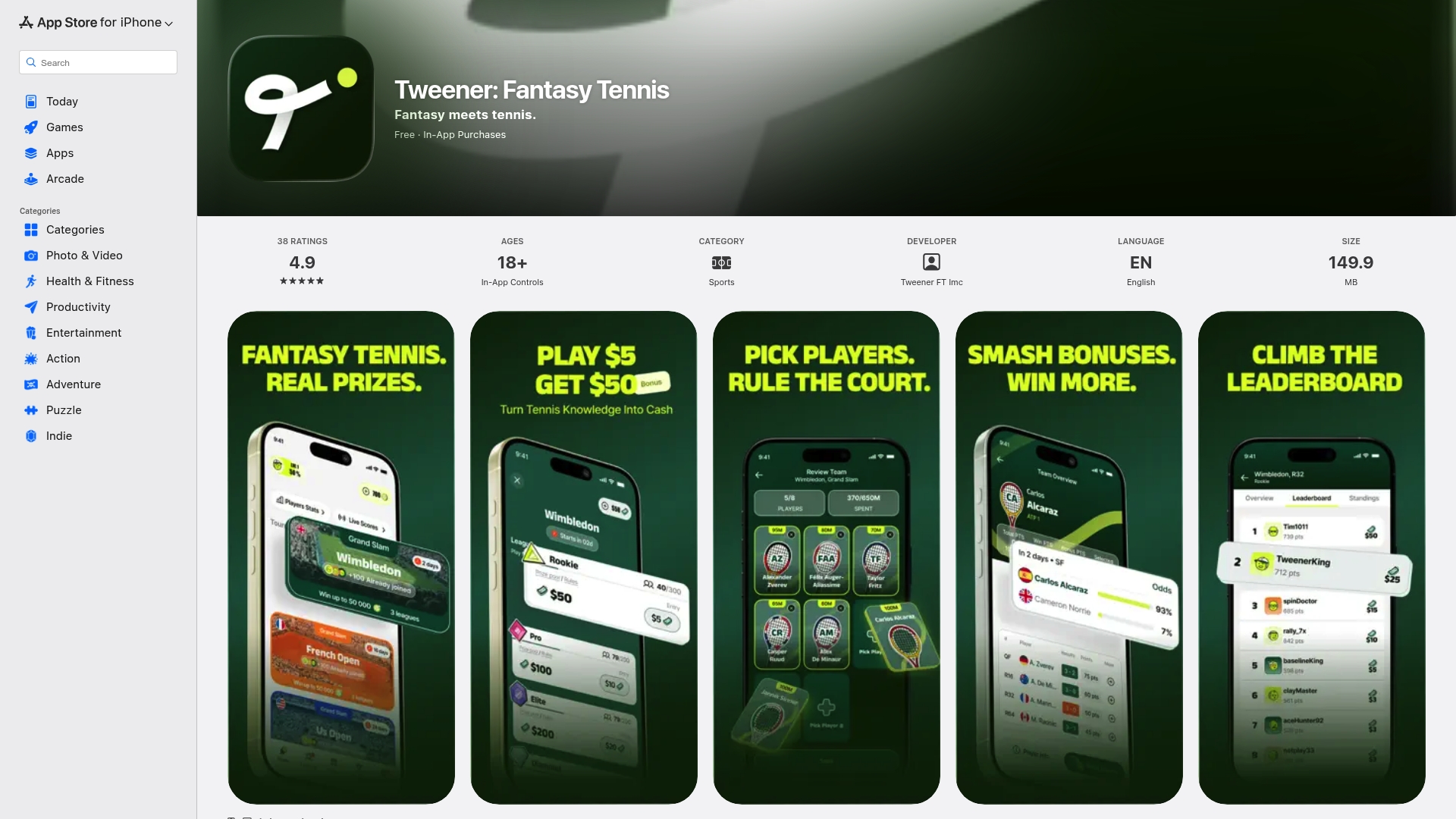
Whether you want to compete in fantasy leagues with your friends during the French Open or test your analytical edge in public contests, Tweener is the platform that rewards real tennis knowledge. You can play for free using virtual coins and redeem them for rewards, or enter cash contests where permitted. For fans who want the strategy and community without the randomness of traditional sports betting, Tweener is the answer. Take a look at the 2026 winning guide to get started on the right foot.
FAQ
What are the best ways tennis fans can compete off-court?
The strongest off-court options are online bracket prediction contests like Served Bracket Challenge, skill-based fantasy tennis platforms, and DFS apps like Tweener, all of which reward analytical tennis knowledge without requiring you to pick up a racket.
How do USTA and UTR Flex Leagues work for recreational players?
Both leagues let players schedule matches on their own timeline against skill-matched opponents, using ratings to maintain competitive equity and avoid lopsided results.
Is fantasy tennis actually skill-based or mostly luck?
Fantasy tennis rewards knowledge of player form, surface splits, and head-to-head records, making it far more skill-dependent than chance-based formats, especially over the course of a full Grand Slam tournament.
Can I compete in tennis prediction contests without spending money?
Yes. Served Bracket Challenge is completely free and awards community recognition and bragging rights rather than cash prizes, making it a clean skill-based option for any fan.
What makes Tweener different from general fantasy sports apps?
Tweener is built specifically around professional tennis, with scoring tied directly to ATP and WTA match results, private Grand Slam leagues for up to nine friends, and both free and cash competition modes tailored to tennis fans.