

TL;DR:
- Live tennis betting demands precise timing due to feed delays that often reach 40 seconds, making stoppages the optimal moments to place bets.
- Preparation, scenario planning, and tracking bets are essential to distinguish genuine edges from reactive, emotion-driven decisions.
- Specializing in specific surfaces and markets enhances accuracy, while automation and disciplined review practices improve overall performance.
Live tennis moves at a pace that punishes hesitation and rewards preparation. If you've ever tried to make live tennis picks and found yourself betting on stale information, chasing momentum that already passed, or freezing when odds swing wildly during a tiebreak, you're not alone. This guide to making live tennis picks cuts through the noise and gives you a structured approach: what to prepare before a match, how to read the action in real time, when to pull the trigger, and how to track your results so you actually improve over time.
Table of Contents
- Key takeaways
- Your guide to making live tennis picks: the essential setup
- Step-by-step execution during a match
- Common mistakes in live tennis betting
- How to evaluate your live tennis pick performance
- What I've actually learned about live tennis picks
- Take your tennis analysis further with Tweener
- FAQ
Key takeaways
| Point | Details |
|---|---|
| Feed delay is your biggest enemy | TV and stream feeds lag 20–40 seconds, so bet during stoppages, not mid-rally. |
| Pre-plan your scenarios | Define entry conditions before the match starts to avoid emotional, reactive betting. |
| Serve status drives everything | A struggling server creates odds discrepancies that smart live bettors exploit. |
| Avoid tiebreaks for live picks | High variance and rapid odds swings make tiebreaks the worst window for live bets. |
| Track every bet you place | Logging outcomes separates genuine edge from random variance and sharpens your strategy. |
Your guide to making live tennis picks: the essential setup
Before you watch a single ball in play, you need the right infrastructure. Most bettors skip this and pay for it later.
The feed delay problem
TV and stream feeds typically run 20 to 40 seconds behind live action, but sportsbooks update their odds much faster. That gap is critical. If you're watching a broadcast and reacting to what you see, you're often betting on information the market already priced in 30 seconds ago. The only reliable fix is to focus your live betting windows on moments when feed delay doesn't matter: serve changes, set breaks, and medical timeouts, where no points are resolving.
Tools and resources to use before and during a match
Here's a comparison of the core resources serious live tennis bettors use:
| Resource | What it gives you | Priority |
|---|---|---|
| Live scoring apps (e.g., FlashScore) | Real-time point-by-point data, serve stats | High |
| Sportsbook odds comparison tools | Identify stale lines across multiple books | High |
| ATP/WTA official stats pages | Surface records, H2H history, recent form | High |
| Match charting databases | Serve speed trends, double fault patterns | Medium |
| Multiple sportsbook accounts | Access to odds discrepancies across slow updaters | Medium |
Pre-match research is not optional. You need to know each player's first-serve percentage on the surface they're playing, their head-to-head history in best-of-three versus best-of-five formats, and whether either player has shown physical vulnerability recently. A player like Carlos Alcaraz on clay looks very different from Alcaraz on hard court in terms of expected serve dominance and baseline endurance.
Pro Tip: Set up your sportsbook accounts before the match starts. Pre-type your stake sizes and enable auto-accept odds changes so you don't lose bets to minor price movements during fast-moving moments.
Bankroll setup matters just as much. Decide your unit size before the match, not during it. If your total live tennis budget for a session is $200, a single unit should be no more than $10 to $20. This keeps you in the game long enough to catch genuine edges rather than blowing your budget on the first overreaction.
Step-by-step execution during a match
Now you're set up. Here's how to actually work through a live tennis match and make picks with discipline.
-
Define your scenarios before serve one. Write down two or three specific conditions under which you'd bet. For example: "If Player A drops the first set but holds serve to open the second, back them at +110 or better." Pre-planned entries keep you from chasing random momentum swings that feel meaningful but aren't.
-
Watch serve patterns in the first four games. Serving status is the single most reliable signal in live tennis. A player who loses serve early is under more pressure than the scoreboard suggests, and odds often lag that reality. First-serve percentage dropping below 50%, double faults clustering, and serve speed dipping are all signs the market hasn't fully adjusted yet.
-
Time your bets to stoppages. Bet at set breaks, changeovers, or after medical timeouts. These are the windows where feed delay is irrelevant and you're working from the same information the market has. Live stats like double fault clusters and serve speed trends are especially useful to check during changeovers when you have 90 seconds to act.
-
Exploit odds delays across books. When one sportsbook is slow to update after a momentum shift, you get a brief window to secure a better price. Monitoring odds across multiple books and moving fast during those windows is a skill that takes practice but adds real value over time.
-
Avoid tiebreaks entirely. This is not a soft suggestion. Close tiebreakers produce dramatic odds swings in seconds, and feed delay makes betting them a near-certain exercise in stale information. Sit them out.
Here's a quick comparison of the most common live bet types in tennis:
| Bet type | Best window | Variance level | Edge potential |
|---|---|---|---|
| Match winner | Between sets | Low to Medium | High with serve data |
| Set winner | Start of set, changeovers | Medium | Medium |
| Next game winner | Changeovers only | Medium | High if serve edge spotted |
| Point winner | Mid-rally | Very High | Very Low (feed delay) |
| Tiebreak winner | Tiebreak start | Very High | Minimal |
The pattern is clear: the further a bet is from immediate resolution, the more your edge survives feed delay. Match winner and next game winner bets at changeovers are your bread and butter. Point winner bets are essentially gambling blind.

Common mistakes in live tennis betting
Even bettors with solid preparation fall into patterns that destroy their edge. These are the ones that show up most often.
- Betting on stale information. If you're reacting to what you just watched, the market already moved. Bets resolving faster than your feed delay are nearly always a disadvantage.
- Chasing momentum without a scenario. A player wins three games in a row and you feel compelled to back them. That's not a strategy. That's emotion. Scenario planning before the match is specifically designed to prevent this.
- Ignoring bet rejections as a signal. If a sportsbook keeps rejecting your bets or delaying confirmation, they know something about the current state of play that your setup doesn't. Step back and reassess.
- Betting too many markets simultaneously. Spreading across match winner, next game, and set winner at the same time multiplies variance without multiplying edge. Limit your concurrent wagers and specialize in the market where your pre-match research applies best.
- Letting losses trigger bigger bets. This is tilt, and it's the fastest way to end a session badly. Set a stop-loss before you start and honor it.
Pro Tip: Keep a simple checklist open during the match: feed clear, scenario triggered, odds acceptable, unit size correct. If all four boxes aren't checked, don't bet. Professional bettors use checklists exactly like this to remove impulsive decisions from the equation.
Technical issues compound emotional ones. If your sportsbook imposes a five-second confirmation delay, factor that into your timing. Sportsbooks typically impose around a five-second bet delay. During fast-moving moments like a service break, five seconds can mean a completely different odds landscape.
How to evaluate your live tennis pick performance
Making picks without tracking them is how bettors stay stuck at the same level for years. Evaluation is where real improvement happens.
- Log every bet immediately. Record the match, market, odds, stake, and outcome. Do this in a spreadsheet or a dedicated app. Memory is unreliable and will distort your perception of how well you're doing.
- Separate variance from edge. A losing week on match winner bets where you consistently found favorable odds is different from a losing week where your scenario entries were sloppy. One is bad luck. The other is a process problem. Only your logs tell you which is which.
- Review your serve-based picks specifically. If you're using serve and return stats to spot edges, check how those specific bets performed against your other picks. Strong performance there validates the approach.
- Take breaks after significant losing runs. Three or four consecutive losing sessions often signal either a genuine strategy flaw or emotional interference. Either way, a pause and a log review beats pressing through.
- Adjust scenario plans every two to four weeks. Surface transitions on tour, player form cycles, and injury reports all shift the conditions under which your scenarios were built. Stale plans are almost as dangerous as no plans.
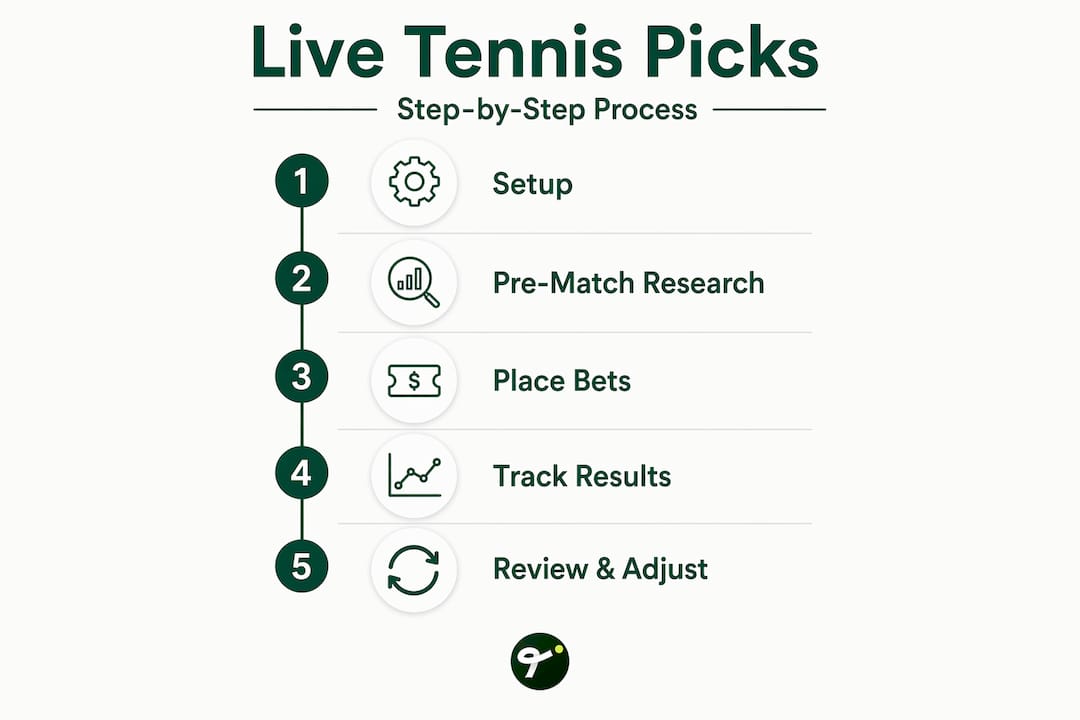
The goal is to build a feedback loop: plan, execute, log, review, adjust. Most live tennis bettors operate without the log and review steps, which means they're running the same mistakes on a loop without realizing it.
What I've actually learned about live tennis picks
I've watched a lot of bettors fail at live tennis, and almost none of them failed because they couldn't read a match. They failed because they bet into a feed lag they didn't know existed, or they let a bad set trigger a series of emotional bets that wiped out a solid session.
The counterintuitive truth about making live tennis picks is that doing less almost always performs better. Waiting patiently for your pre-defined scenario to appear, then executing quickly and cleanly at a changeover, beats frantically scanning four markets for 90 minutes. I've seen bettors make two bets per match and outperform people placing twelve.
Automation matters more than people admit. Getting auto-accept configured and your stakes pre-typed isn't a minor convenience. It's the difference between executing on a genuine edge and watching the odds move while you're still typing. The technical side of live betting is underrated.
My strongest recommendation: specialize. Pick one surface, one match type (ATP best-of-three, for example), and one or two markets. Get very good at reading serve dynamics in that context before expanding. Generalists in live tennis betting almost always lose to specialists. The sport rewards depth of knowledge over breadth.
— Nathan
Take your tennis analysis further with Tweener
If you're serious about reading tennis matches at this level of detail, Tweener is built for exactly that kind of analytical engagement. The platform gives tennis fans a way to put their match-reading skills to work in competitive fantasy leagues built around real ATP and WTA results.
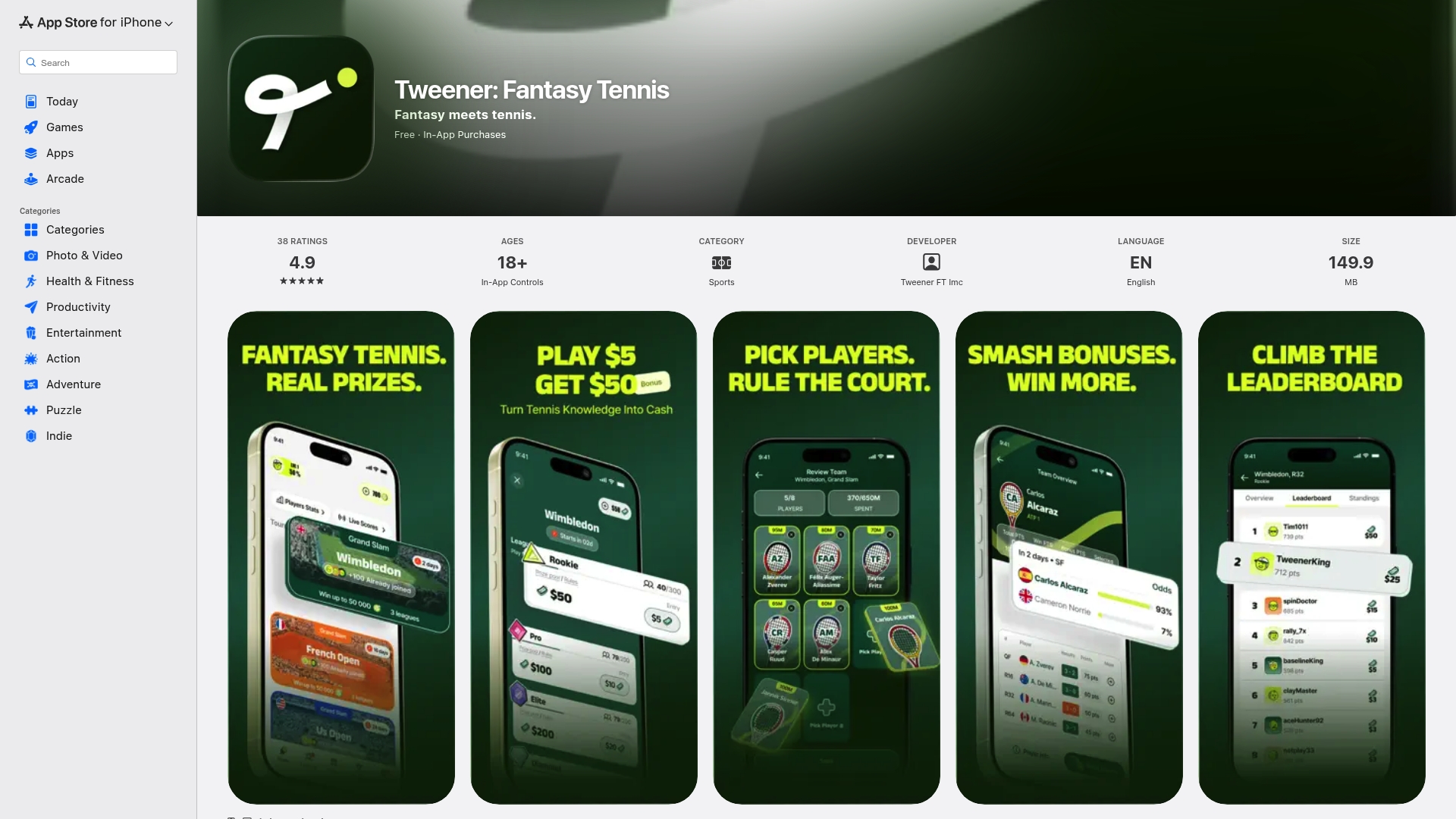
You can build teams, track player performance across tournaments, and compete in private leagues with up to nine friends during Grand Slams and other major events. It's the depth of engagement that makes you sharper at everything related to tennis analysis, whether you're making fantasy picks or thinking through match dynamics before a live bet. Download Tweener and start competing in skill-based fantasy tennis, or get the app directly to jump into your first league today.
FAQ
What is the biggest risk in live tennis betting?
Feed delay is the most overlooked risk. TV and stream feeds lag 20 to 40 seconds behind live action, meaning bets placed during rallies are almost always based on stale information.
When is the best time to place a live tennis bet?
The best windows are during changeovers, set breaks, and other stoppages, when no points are being resolved and your information is as current as the market's.
Should you bet during tiebreaks?
No. Close tiebreaks create extreme odds volatility combined with maximum feed delay risk. Skip them and focus on earlier, lower-variance windows.
How do you read momentum in a live tennis match?
Focus on serve statistics. A dropping first-serve percentage, double fault clusters, and reduced serve speed are signals that odds often lag, creating brief windows for value bets.
How many live bets should you make per match?
Fewer than you think. Professional live bettors prioritize identified edges over volume, typically limiting themselves to two to four well-defined opportunities per match rather than betting continuously.