

TL;DR:
- Most fantasy sports managers confuse leaderboards with player rankings and predictive projections. A leaderboard reflects actual team performance results, whereas rankings predict player value before and during the season. Proper understanding of these differences enables strategic roster adjustments and improves competitive outcomes.
Most fantasy sports managers use the words "leaderboard," "rankings," and "standings" like they mean the same thing. They don't. Understanding what is a leaderboard in fantasy sports, and how it differs from player rankings or predictive projections, is one of the most overlooked edges in competitive leagues. Get this wrong and you'll make roster moves based on the wrong data at the wrong time. Get it right and you'll understand exactly where you stand, what it takes to advance, and how to adjust your strategy week by week.
Table of Contents
- Key Takeaways
- What is a leaderboard in fantasy sports?
- Types of fantasy leaderboards
- Leaderboards in large tournaments and multi-round formats
- How to use leaderboards to improve your results
- My take on leaderboards and why most managers get them wrong
- Compete smarter with Tweener's real-time leaderboards
- FAQ
Key Takeaways
| Point | Details |
|---|---|
| Leaderboards track performance | A leaderboard shows team standings based on actual results, not projected value. |
| Rankings serve a different purpose | Use player rankings for drafting decisions, not for measuring where your team stands. |
| Format changes the rules | Head-to-head and rotisserie leaderboards require completely different competitive strategies. |
| Tournaments use leaderboards for advancement | In large contests, your leaderboard position determines whether you advance or are eliminated. |
| Multiple sources sharpen your edge | Combining platform leaderboards with consensus data leads to smarter in-season decisions. |
What is a leaderboard in fantasy sports
A leaderboard in fantasy sports is a ranked display of competing teams, ordered by their performance results within a league or tournament. It reflects what has already happened. In head-to-head leagues, leaderboard standings update weekly based on matchup outcomes, showing each team's win/loss record. In rotisserie leagues, the leaderboard accumulates category points across the full season. Either way, the leaderboard is a scoreboard for results already on the books.
This is where a lot of managers go wrong. They confuse the leaderboard with player rankings. Rankings and leaderboards serve entirely different purposes. Rankings are analyst-built projections used before and during the season to assess player value for drafting or waiver decisions. Leaderboards show you how teams are actually performing once real games have been played. One looks forward. The other looks back.
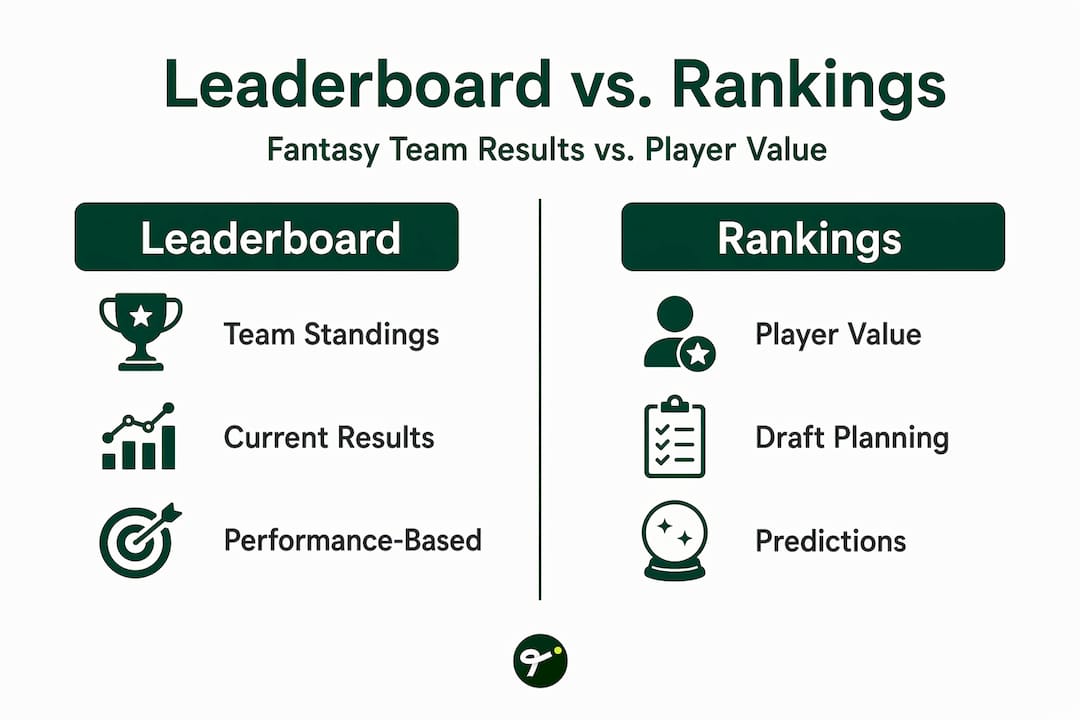
There is also a distinction worth drawing between leaderboards and scoring leaders. A league standings page and a scoring leaders page do completely different jobs. Standings track your team's competitive record in the league. Scoring leaders identify which individual players are producing the most points, which is useful for waiver pickups and trade targets. Both are valuable, but mixing them up costs you.
Pro Tip: Bookmark your league's standings page and your platform's scoring leaders page separately. Check the standings for strategy and the scoring leaders for lineup decisions. Treating them as the same screen is one of the most common mistakes in fantasy sports.
Types of fantasy leaderboards
Not every leaderboard works the same way, and the format your league uses should directly shape how you build and manage your roster.
Head-to-head leaderboards
In head-to-head leagues, your leaderboard position reflects weekly matchup wins and losses. You face one opponent each week, and the result, win or loss, gets recorded in your standings. This format rewards boom-or-bust roster construction because a big week against the right opponent matters more than grinding consistency. If you put up 180 points in a week and your opponent scores 181, you get nothing from it in the standings.

Head-to-head leaderboards encourage risk-taking in a way that rotisserie formats simply do not. The ceiling of your roster matters more than its floor.
Rotisserie leaderboards
Rotisserie, or "roto," leaderboards rank teams by cumulative points earned across multiple statistical categories over the entire season. Every week counts equally. There are no opponents to beat each week. Instead, every stat you accumulate either moves you up or keeps you in place across the category rankings. Falling apart in a two-week stretch can slide you down several spots in the overall standings in ways that are hard to recover from.
Rotisserie formats demand balanced consistency rather than stacking your roster for one or two dominant categories. A team that is elite in three categories but last in four others will lose to a team that is solid across the board.
Hybrid formats
Some leagues combine both systems, awarding a win or loss based on head-to-head matchup results while also assigning points based on overall weekly scoring rank. This hybrid approach creates a more layered leaderboard that rewards both hot weeks and season-long consistency.
| Format | How leaderboard updates | Strategy required |
|---|---|---|
| Head-to-head | Weekly, based on matchup results | High ceiling, boom-or-bust roster |
| Rotisserie | Continuously across season | Balanced depth across categories |
| Hybrid | Weekly win/loss plus points ranking | Combination of both approaches |
Pro Tip: Before the season starts, read your league's scoring rules carefully. A rotisserie leaderboard penalizes the same roster moves that a head-to-head leaderboard rewards. Your draft strategy should reflect the format you're actually playing.
Leaderboards in large tournaments and multi-round formats
The role of leaderboard in competitions changes significantly when you move from private leagues into large-scale fantasy tournaments. Here, leaderboards are not just a way to track bragging rights. They determine whether you advance or go home.
Best Ball tournaments are a clear example. In these formats, you draft a roster at the start of a tournament and make no further moves. Your best performers each week are automatically selected. The leaderboard tracks your cumulative score, and your position in the standings determines whether you survive group stages or qualify for championship rounds. The 2026 season has seen fantasy tournaments with over 940,000 entries and prize pools exceeding $20 million, which makes understanding how leaderboards drive advancement practically a financial skill.
Leaderboards in these formats also influence a strategic concept called "final-only" thinking. Because managers know which group-stage positions advance, they draft specifically for late-round explosiveness rather than steady scoring. A team that lurks in the middle of the leaderboard through the early rounds but spikes late can advance, while a team that led for most of the contest gets knocked out if it cannot sustain production.
A few important mechanics to understand about leaderboards in large tournaments:
- Leaderboard visibility is sometimes restricted to top performers. Some contests cap their public leaderboard at the top 100 entries, so managers below that threshold need personalized tracking tools to know exactly where they stand.
- Advancement thresholds vary by contest. Knowing the cutoff line for your specific tournament tells you whether to play conservatively or swing for ceiling outcomes.
- Real-time leaderboards during live sporting events require checking frequently, especially when scores are live and updating, since position can shift dramatically within hours.
For tennis fans using multi-round tournament tracking, leaderboard monitoring between rounds becomes part of the competitive experience itself.
How to use leaderboards to improve your results
Knowing what a leaderboard is only gets you halfway there. Using it well is where the actual competitive advantage lives. Here is a practical framework for managers who want to extract more from their leaderboard data.
-
Separate your tools by purpose. Use player rankings and projections when making roster decisions, trades, and waiver wire moves. Use the leaderboard to assess your team's overall standing and playoff trajectory. Confusing rankings with leaderboards leads to flawed moves, such as picking up a high-ranked player you don't need simply because he is trending, rather than addressing the weakness your leaderboard position actually reveals.
-
Track weekly movement, not just absolute position. A team sitting fifth in the standings tells you less than a team that has climbed from ninth to fifth in three weeks. Direction of movement is often more meaningful than where you are right now. A rising team has momentum and is making correct decisions. A falling team needs to diagnose what changed.
-
Use leaderboard position to calibrate risk tolerance. If you're comfortably inside a playoff position with three weeks to go, protect that position with safer lineup choices. If you're on the bubble or outside the playoff picture, your leaderboard position tells you that you need higher-upside plays even if that means more variance. The leaderboard is not just informational. It is a decision-making input.
-
Combine platform leaderboards with external consensus data. Top fantasy managers aggregate rankings from multiple expert sources alongside their league's leaderboard to form a more complete picture. No single data source gives you everything. Your platform leaderboard shows you where your team stands. Live data tools show you why, and what to do about it.
-
Revisit your leaderboard before every lineup decision. The standings context should frame every roster choice you make. A player who is a good start in a vacuum may be the wrong start given what your leaderboard position actually requires.
Pro Tip: If you manage multiple teams across different leagues, create a weekly habit of checking each team's leaderboard before you check any player stats. Context first, data second.
My take on leaderboards and why most managers get them wrong
I've spent years managing fantasy teams across multiple sports, and the single most consistent mistake I see is treating every number on a fantasy platform as if it serves the same purpose. Rankings, projections, scoring leaders, and leaderboards are four completely different lenses. Using them interchangeably is like checking the weather forecast to see how yesterday's game went.
The deeper issue is that most managers check their leaderboard emotionally, as a mood indicator, rather than analytically. They feel good when they're up. They panic when they're down. What they should be doing is reading their position as a strategic signal. Are you ahead in a head-to-head format? Consider protecting your lead. Are you behind in a roto format? Identify which specific categories are dragging your ranking down and make targeted moves.
In tennis specifically, this matters even more. The surface, the draw, the form of a player heading into a Grand Slam, all of these feed into the leaderboard dynamics in ways that predictive analytics in fantasy sports can help quantify. On platforms like Tweener, the leaderboard is not just a scoreboard. It reflects real-time decisions made against a field of other analytical managers. Every point matters because the margin between advancing and going home can come down to one match result.
The managers who finish at the top are not always the ones who picked the best players. They are often the ones who read their leaderboard accurately and adjusted accordingly.
— Nathan
Compete smarter with Tweener's real-time leaderboards
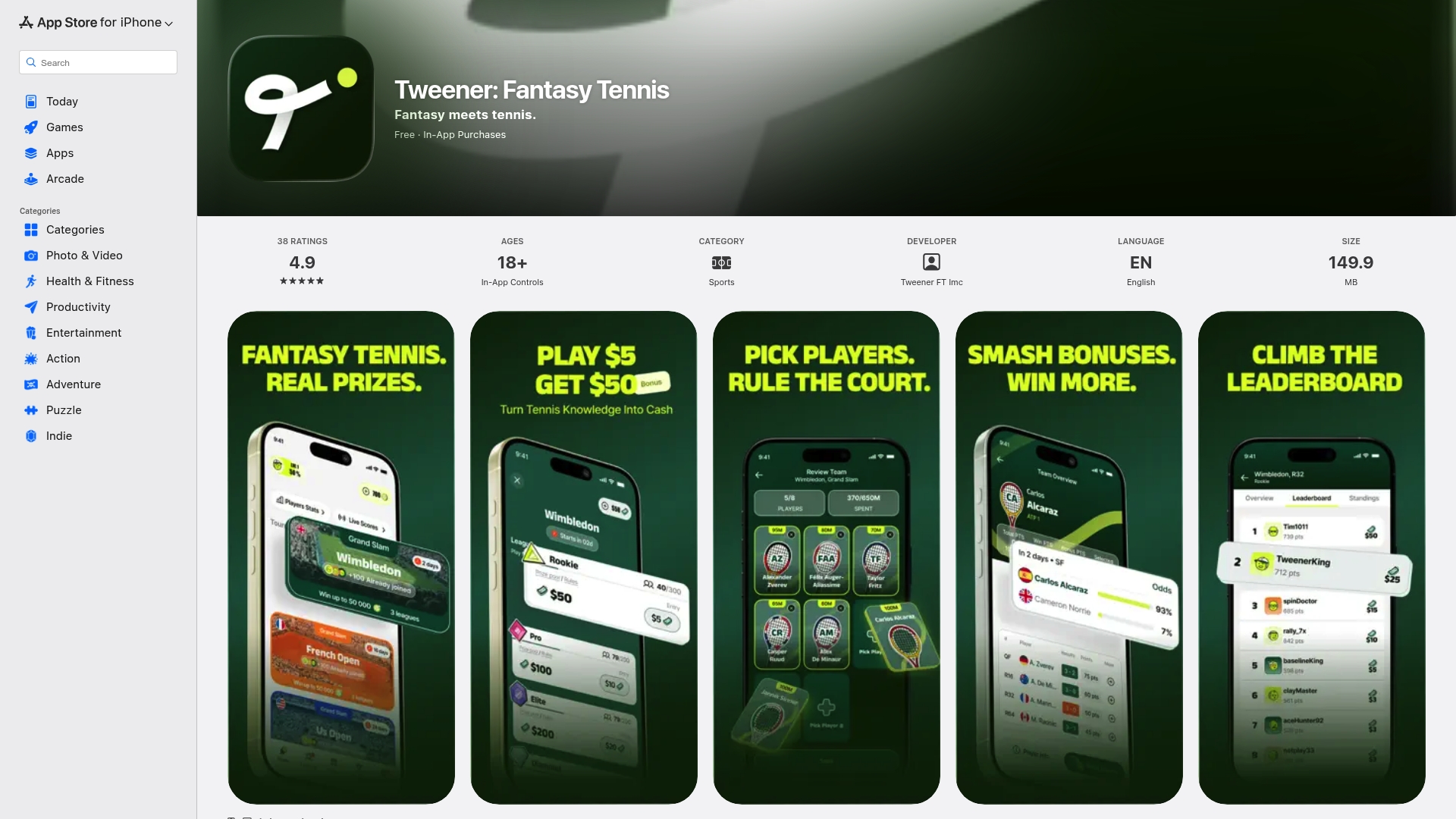
If you want to experience what a well-designed fantasy leaderboard actually feels like in competition, Tweener is built for exactly that. Tweener is the only high-quality daily fantasy sports platform focused entirely on professional tennis, and its leaderboard mechanics are built for analytical players who want more than a static scoreboard. Real-time standings update as ATP and WTA matches conclude. Private Grand Slam leagues let you compete with up to nine friends throughout a full tournament, with leaderboard positions shifting round by round. Whether you play in free coin mode or enter cash contests for real-money payouts, the leaderboard is always live, always accurate, and always competitive. Download the Tweener app and see where you rank.
FAQ
What is a leaderboard in fantasy sports?
A fantasy sports leaderboard is a ranked display of all teams in a league or tournament, ordered by their actual performance results. In head-to-head leagues it reflects win/loss records, while in rotisserie leagues it reflects cumulative category points across the season.
How is a leaderboard different from fantasy sports rankings?
Rankings predict player value before and during the draft, while leaderboards track how your assembled team actually performs in competition. Rankings look forward. Leaderboards look backward at what has already happened.
How often do fantasy league standings update?
In head-to-head formats, leaderboards typically update weekly after each matchup concludes. In rotisserie leagues, standings update continuously as real game stats accumulate throughout the season.
Can my leaderboard position change my lineup strategy?
Yes, and it should. A team safely inside playoff positioning should prioritize consistency, while a team on the bubble needs higher-upside plays. Your leaderboard standing tells you how much risk your situation actually requires.
What is the role of a leaderboard in large fantasy tournaments?
In large-scale contests, leaderboard position determines advancement through group stages and qualification for championship rounds. With prize pools exceeding $20 million in some 2026 tournaments, understanding how advancement thresholds work on the leaderboard is a critical competitive skill.