

TL;DR:
- Understanding tennis schedules requires recognizing that only the first match on each court has a fixed start time, while subsequent matches depend on earlier results and delays. Match formats, weather, and tiebreak rules introduce variability that fans must anticipate for accurate viewing plans. Combining the order of play with real-time live scores enhances scheduling accuracy and strategic viewing or fantasy decisions.
Tennis schedules are structured documents that tell you which players compete on which courts, in what order, and on which days of a tournament. Knowing how to interpret tennis schedules separates fans who catch every key match from those who miss the ones that matter most. Wimbledon, the US Open, Roland Garros, and the Australian Open each publish daily order-of-play documents alongside broader tournament calendars. These two schedule types work together, and understanding both gives you a genuine edge as a viewer, a ticket holder, or a Tweener fantasy player building a lineup around real match results.
How to interpret tennis schedules: the order of play explained
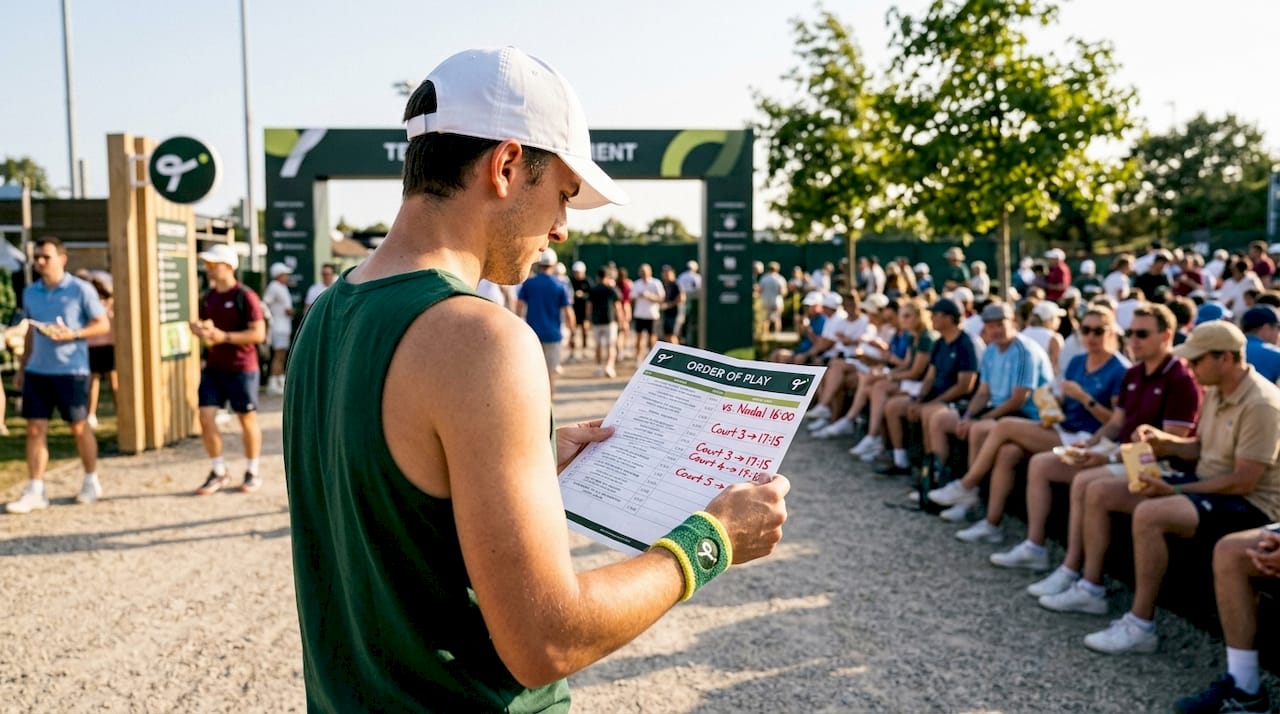
The order of play is the official court-by-court daily schedule showing which matches are planned for each court and in what sequence. Wimbledon publishes the full order of play the night before each day's play, available after 8pm. That timing matters because it gives you roughly 12 hours to plan your day before the first ball is struck.
Reading the order of play correctly means understanding three things: the court name, the match sequence number, and the listed start time.
- Court name: Each court runs its own independent schedule. Centre Court, No. 1 Court, and the outside courts at Wimbledon all operate simultaneously with different match lineups.
- Match sequence: Matches are listed 1st, 2nd, 3rd, and so on. The first match on each court has a fixed start time. Every match after that starts when the previous one finishes.
- Start times: At Wimbledon, outside courts start at 11:00am, No. 1 Court at 1:00pm, and Centre Court at 1:30pm on Days 1 through 12. These are the only times you can treat as firm.
The most reliable variable for estimating when a later match begins is simply counting how many matches are scheduled before it on the same court. Two long matches ahead of yours means a potentially significant delay. The order of play is best used as a guide to sequence and day shape, not as a precise timetable.
Pro Tip: Check the order of play the night before and identify your target match's position on the court. If it's listed 3rd or later, build in at least 90 minutes of buffer beyond the court's fixed start time.
How match formats and tiebreak rules affect schedule timing
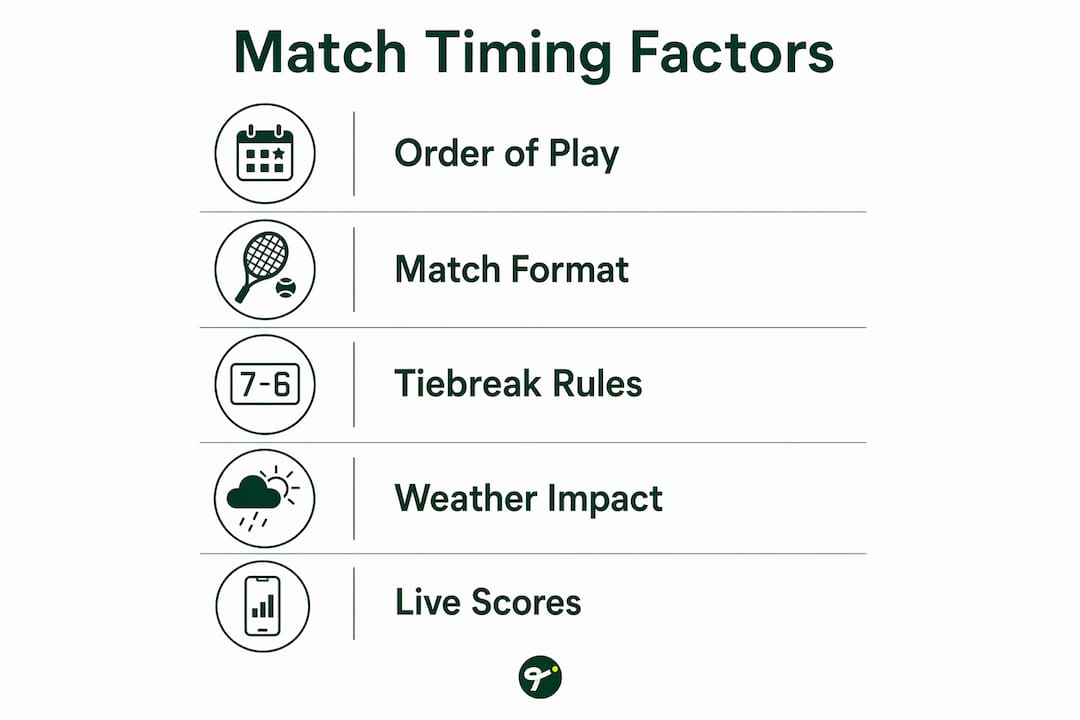
Match format is the single biggest driver of schedule variability, and most fans underestimate its impact. The difference between a best-of-three and a best-of-five match is not just two extra sets. It can mean the difference between a 75-minute match and a four-hour marathon.
| Format | Sets played | Typical duration | Used at |
|---|---|---|---|
| Best-of-three | 2 or 3 sets | 75 to 150 minutes | WTA singles, ATP doubles, mixed doubles |
| Best-of-five | 3 to 5 sets | 90 to 270+ minutes | Men's Grand Slam singles |
At the US Open, women's singles and doubles are best-of-three, while men's singles is best-of-five. A men's quarterfinal on Arthur Ashe Stadium can run three hours longer than a women's match on the same court earlier in the day. That gap cascades through every subsequent match on the schedule.
Tiebreak rules add another layer of complexity. Grand Slams now use a 10-point tiebreak at 6-6 in the deciding set, won by two points. This format was adopted at the Australian Open in 2019 and extended to the other three majors in 2022. Before this rule existed, deciding sets could go on indefinitely. The famous Isner vs. Mahut match at Wimbledon 2010 lasted 11 hours and 5 minutes across three days. The tiebreak rule caps that extreme variability, but a deciding-set tiebreak still adds 20 to 40 minutes to a match that might otherwise have ended in straight sets.
Understanding match format and tiebreak rules helps you anticipate schedule predictability and shifts before the day even begins. If the first match on a court is a men's Grand Slam singles match between two baseliners known for long rallies, treat every subsequent match time as a rough estimate.
Pro Tip: Before a tournament day, check the ATP and WTA player profiles for the matches scheduled before yours. Two clay-court specialists in a best-of-five match on Court Philippe-Chatrier at Roland Garros will almost certainly run long.
How weather and delays impact tennis schedules and viewing plans
Weather is the wildcard that no schedule can account for. Rain delays can turn a planned two-hour match into a six-hour event, multiplying total duration significantly and compressing the rest of the day's schedule into a narrow window. This is not a rare edge case. At Wimbledon and Roland Garros, rain interruptions are a near-annual reality.
Beyond weather, several other factors create schedule drift that fans need to plan around:
- Extended matches: A five-set battle that runs three hours longer than expected pushes every subsequent match on that court back by the same amount.
- Medical timeouts and injury breaks: These are unscheduled and can add 10 to 20 minutes per occurrence.
- Court preparation: After rain, courts need drying time before play resumes, adding further delay.
- Tournament curfews: Wimbledon enforces an 11pm curfew, meaning matches that cannot finish before that time are suspended and resumed the following day. This can split a match across two separate schedule days.
For fans attending in person, the practical advice is straightforward. Arrive at the court's fixed start time, not at the estimated time for your target match. If you are watching from home, broadcasters like Sky Sports list later matches with "not before" qualifiers. Treat those times as the earliest possible start, not a guaranteed one. Interpreting "not before" scheduling terms correctly is the key to building realistic viewing plans around live match variability.
How to read the broader tournament day-by-day schedule
The order of play and the tournament schedule are two different documents that serve different purposes. The order of play tells you what happens today. The tournament schedule tells you what happens across the full two weeks, which rounds fall on which dates, and when the biggest matches are likely to occur.
Wimbledon 2026 publishes a full schedule showing dates for men's and women's singles, doubles, juniors, and wheelchair events. Roland Garros follows the same structure. Reading this broader calendar lets you identify the days worth prioritizing as a viewer.
| Tournament day | Typical round | What to expect |
|---|---|---|
| Days 1 to 3 | First round | High volume of matches, upsets possible, outside courts active |
| Days 4 to 7 | Second and third rounds | Field narrows, top seeds enter full stride |
| Days 8 to 10 | Round of 16 and quarterfinals | Marquee matchups, prime-time scheduling on main courts |
| Days 11 to 14 | Semifinals and finals | Single-match days, maximum intensity |
Tournament rounds progress as a draw-elimination format, with seedings designed to protect top players from meeting each other until the later rounds. This means the quarterfinals and semifinals are where the schedule becomes most predictable and most rewarding for viewers. Understanding this progression is what the tournament schedule as a fantasy weapon concept is built on. You can plan your Tweener lineup decisions around which rounds feature the highest-stakes matches.
Doubles, juniors, and wheelchair events run concurrently with singles throughout the tournament. If you are attending in person, the outside courts during the first week offer the best access to multiple matches in a single day.
Why live scores are the missing piece of schedule reading
The order of play tells you when a match starts. Live scores tell you when it ends, and everything that happens in between. Live scores reveal whether a match is on serve or involves breaks, which is the real-time narrative that no schedule document can provide.
Understanding what you see in a live score requires knowing a few key concepts:
- On serve: Both players are holding their service games. The match is competitive and likely to go the distance.
- Break of serve: One player has won a game on the opponent's serve. This is the most significant momentum shift in tennis and often predicts the set result.
- Double break: A player leads by two breaks. The set is likely to close quickly, shortening the match.
- Tiebreak: The set has reached 6-6 and a tiebreak is underway. This is the highest-pressure moment and can swing the match either way.
Tracking break-point momentum and consolidations during a match significantly improves your ability to predict match duration and schedule flow. If Jannik Sinner is double-breaking his opponent in the second set after winning the first, the match is likely to finish within the next 30 minutes. That information tells you exactly when to switch courts or tune in to the next scheduled match.
For Tweener players, live scoring is not just a viewing tool. It is a strategic input. Knowing which of your fantasy players is in a tight third set versus cruising to a straight-set win changes how you think about your lineup's point trajectory for the day.
Pro Tip: Combine the live scoring advantages with the order of play to build a real-time viewing map. Check the score of the match ahead of yours every 15 minutes to get an accurate read on when your target match will begin.
Key takeaways
Reading tennis schedules accurately requires separating fixed session start times from the variable match durations caused by format, weather, and tiebreak rules.
| Point | Details |
|---|---|
| Order of play is a sequence guide | Only the first match on each court has a fixed start time; all others are estimates. |
| Match format drives duration variance | Best-of-five men's Grand Slam matches can run three hours longer than best-of-three matches. |
| Weather and curfews create real disruption | Rain delays and 11pm curfews at Wimbledon can split matches across two schedule days. |
| Tournament schedules show the full picture | Day-by-day round progressions help fans identify which days feature the highest-stakes matches. |
| Live scores complete the picture | Tracking breaks and momentum tells you in real time how much longer a match will last. |
Reading schedules is a skill, not a given
Most fans treat the order of play like a TV guide. They look up the time, tune in, and wonder why the match hasn't started yet. I've done it myself. The shift that changed how I follow tennis was treating the schedule as a probability map rather than a fixed timetable.
The first match on Centre Court at Wimbledon starts at 1:30pm. That is a fact. The third match on the same court starting at 5:00pm is a guess. Once you internalize that distinction, you stop being frustrated by delays and start using them strategically. You know to check the live score of the second match at 4:00pm to see whether it's heading into a deciding set or wrapping up in straight sets.
The other thing most guides don't tell you is that the broader tournament schedule is where the real planning happens. Knowing that Roland Garros quarterfinals fall on a Tuesday and Wednesday in the second week means you can block those days in your calendar months in advance. The order of play fills in the details the night before. The tournament calendar sets your priorities weeks out.
For Tweener players specifically, this two-level reading of schedules is the foundation of smart fantasy decisions. The tournament calendar tells you which rounds generate the most points. The order of play tells you which of your players is likely to be on court first. Combine both with live scoring and you are not just watching tennis. You are analyzing it.
— Nathan
Take your schedule reading further with Tweener
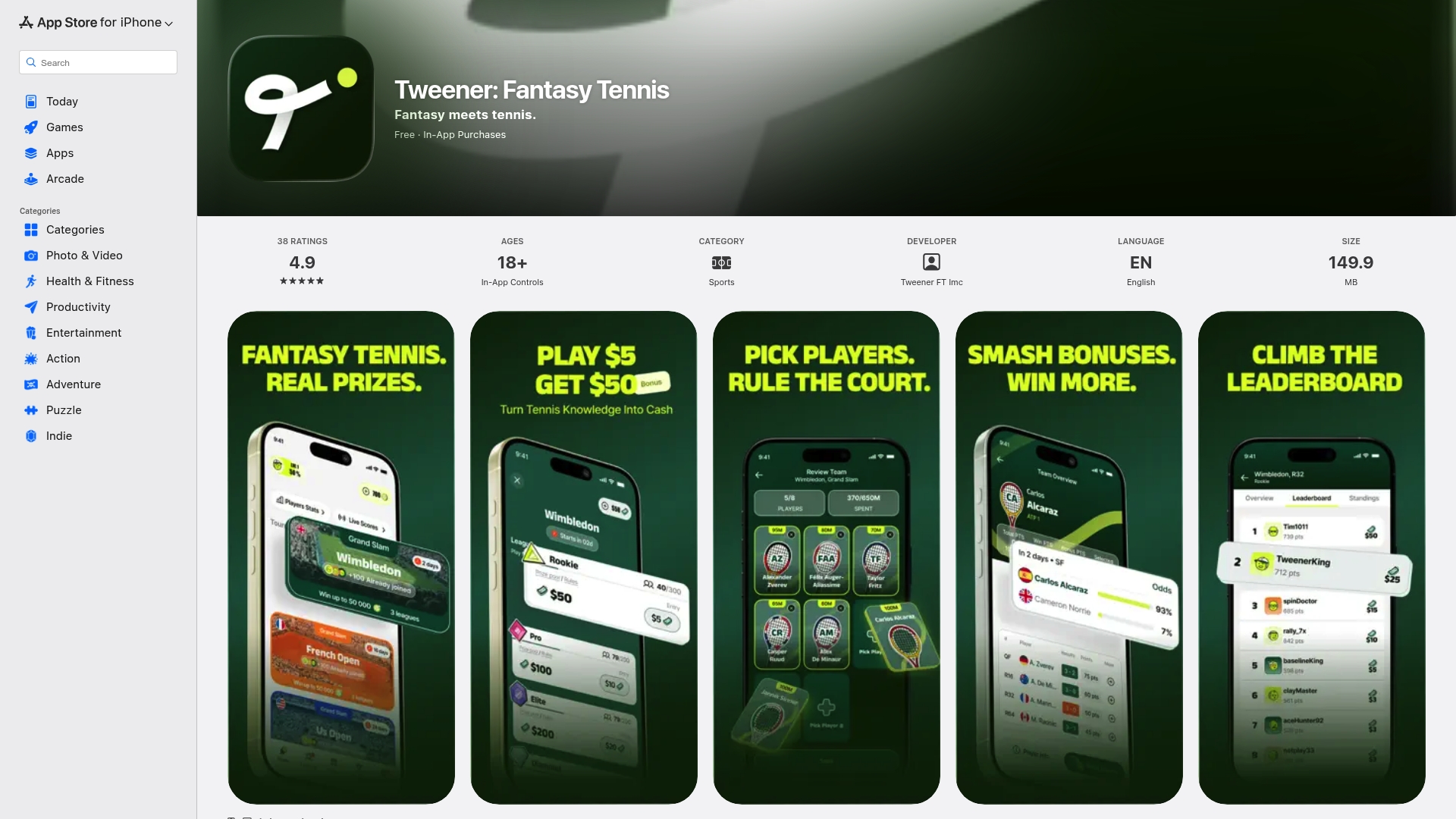
Tweener is built for fans who want more than a passive viewing experience. The app connects directly to real ATP and WTA match results, so every match you track on the order of play feeds directly into your fantasy team's performance. When Aryna Sabalenka or Carlos Alcaraz wins a match you spotted on the schedule, your Tweener lineup earns points in real time. You can join public leagues or set up a private league with up to nine friends for Grand Slam tournaments, competing across the full two weeks as the draw unfolds. Whether you play in free mode with virtual coins or enter cash contests for real-money payouts, Tweener turns schedule reading from a passive habit into a competitive skill.
FAQ
What is the order of play in tennis?
The order of play is the official daily schedule listing which matches are planned on each court and in what sequence. Wimbledon publishes it the night before, after 8pm.
Why don't later matches have fixed start times?
Only the first match on each court has a guaranteed start time. Later matches begin when the previous one finishes, so delays from long matches or weather push every subsequent match back.
What does "not before" mean on a tennis schedule?
"Not before" means a match will not start earlier than the listed time, but it could start later. Broadcasters like Sky Sports use this qualifier to signal variable start windows fans should interpret flexibly.
How do match formats affect schedule timing?
Men's Grand Slam singles are best-of-five sets, which can run over four hours. Women's singles and doubles are best-of-three. A long men's match early in the day can delay every subsequent match on that court by hours.
How can live scores help me follow a tennis schedule?
Live scores show whether a match is on serve or involves breaks, giving you a real-time read on how much longer it will last. Tracking this alongside the order of play lets you predict when your target match will actually begin.