

TL;DR:
- Choosing between free and cash fantasy modes impacts your risk tolerance, strategy, and use of tools, as cash mode involves real money on the line. Free mode allows bold experimentation and skill development without financial pressure, while cash mode requires disciplined, consistent decision-making supported by advanced analytics. Transitioning between both wisely and understanding their differences enhances long-term competitiveness in fantasy sports.
Choosing between free vs cash mode fantasy isn't just about whether you want to risk money. It changes your entire strategy, your mindset, and the tools you need to win. Most players assume cash mode is simply the "serious" version and free mode is for beginners killing time. That framing misses a lot. The real difference between free and cash fantasy modes runs deeper than prize money. It touches your risk tolerance, how you build lineups, and what kind of competitive edge you're actually chasing. This guide breaks down exactly what separates the two modes and how to decide which one fits your game.
Table of Contents
- Key takeaways
- The core difference between free and cash fantasy modes
- How risk tolerance shapes your strategy in each mode
- Tools and analytics: what you actually get at each tier
- When to play free mode and when to go cash
- Common myths about free and cash fantasy modes
- My take on playing both modes the right way
- Try both modes on Tweener
- FAQ
Key takeaways
| Point | Details |
|---|---|
| Risk tolerance drives mode choice | Free mode rewards bold experiments; cash mode demands calculated, disciplined decisions to protect real money. |
| Free mode competition is real | Skilled players fill free contests too, so treating free mode as easy practice can leave you unprepared. |
| Paid tools sharpen cash mode edge | A single quality paid analytics subscription typically outperforms several free tools in high-stakes contests. |
| Regulation can force the switch | Laws like India's 2025 gaming bill show that cash mode access can disappear overnight, making free mode skills non-negotiable. |
| Hybrid approaches work best | Mixing modes based on your goals, bankroll, and tournament phase is the most sustainable long-term strategy. |
The core difference between free and cash fantasy modes
At the most basic level, the difference between free and cash fantasy modes comes down to what you put in and what you can get out. Free mode has no entry cost. You compete for virtual currency, leaderboard recognition, or non-cash rewards like gift cards. Cash mode requires a real-money deposit to enter, and winning means real-money payouts.
The range of stakes in cash mode is wide. Paid contest entry fees can run from $0.25 all the way to $10,000 depending on the format and platform. That spectrum matters because it means cash mode is not a single experience. A $0.25 head-to-head contest plays very differently from a $500 tournament with hundreds of entrants.
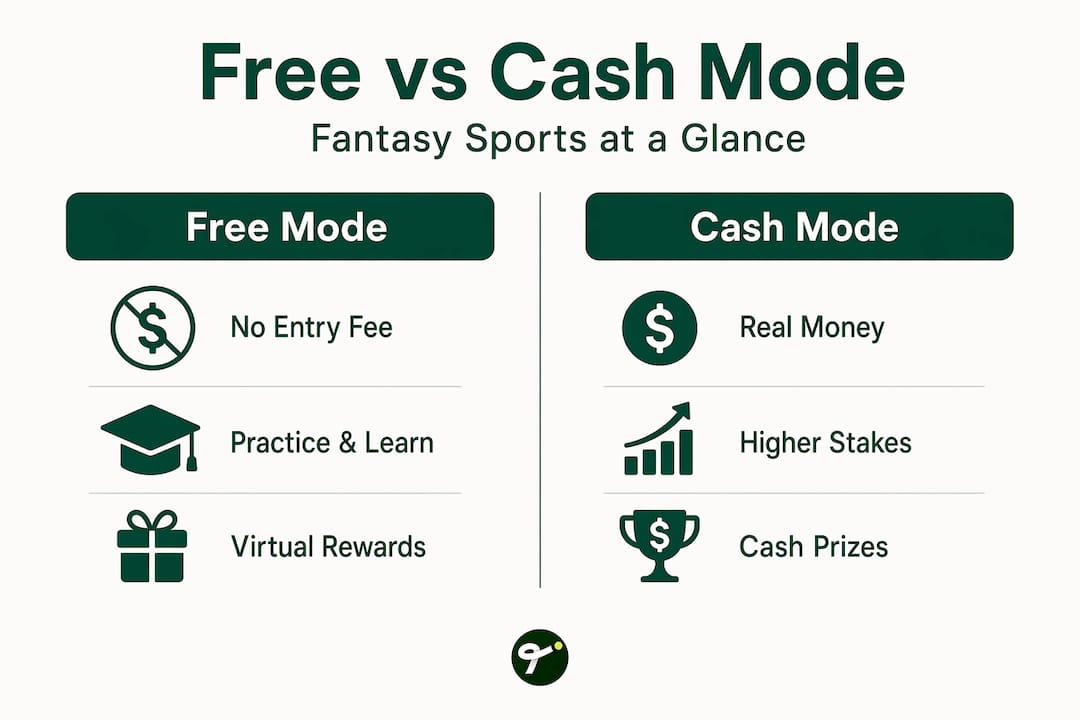
Here is a direct comparison of the two modes across the dimensions that affect your strategy most:
| Dimension | Free mode | Cash mode |
|---|---|---|
| Entry cost | None | Real money deposit required |
| Prize type | Virtual coins, gift cards, leaderboard glory | Real-money payouts |
| Competitive intensity | Mixed skill levels | Skewed toward experienced players |
| Strategy approach | Experimental, high-upside picks | Calculated, floor-focused decisions |
| Emotional stakes | Low | High |
| Legal availability | Universally accessible | Varies by region and regulation |
Free mode is designed for skill-building and attracts a broad mix of player types. Cash mode pulls in experienced users running advanced strategies and, often, premium analytics tools. That difference in the player pool alone changes how you need to approach each contest.
How risk tolerance shapes your strategy in each mode
This is the psychological core of the whole debate. Risk tolerance is the primary difference between how players approach free and cash fantasy modes, and it affects every decision from lineup construction to tournament selection.
In free mode, you can afford to be aggressive. Picking a lower-ranked player who you believe is on a hot streak costs you nothing if you are wrong. That freedom to experiment is genuinely valuable. It is how you discover edges you would never find if you were protecting a bankroll. Free mode encourages the kind of bold, hypothesis-testing that sharpens your read on the game over time.
Cash mode flips that logic. When real money is on the line, the goal shifts from maximizing upside to managing downside. You look for players with high floors, not just ceiling potential. A single disastrous pick in a head-to-head cash contest can sink your entry fee before the round is over.
There are a few strategic adjustments that follow directly from this psychological split:
- Lineup construction: Free mode favors contrarian, high-variance picks. Cash mode rewards ownership of reliable performers with consistent point outputs.
- Tournament format: In cash mode, Best Ball formats require precise draft strategy from pick one since there are no waivers or trades to bail you out. Every selection has to serve a purpose.
- Bankroll management: Cash mode players need to treat their deposit like an investment portfolio, not a single bet. Spreading entries across multiple contests at different stakes reduces variance.
Pro Tip: If you are new to cash mode, start with the lowest entry fee available and play head-to-head contests instead of large-field tournaments. Head-to-heads only require you to beat one opponent, which is far more manageable while you are still calibrating your approach.
Beginners almost always benefit from building their read in free mode first. The absence of financial pressure means you can test theories, track results, and learn what actually predicts performance before putting money behind your conviction.

Tools and analytics: what you actually get at each tier
One area where the free vs cash mode fantasy debate gets concrete fast is analytics. The tools available to you in free mode versus paid tiers are not even close to equivalent, and that gap has a direct impact on your win rate in cash contests.
Free fantasy tools typically offer generic player rankings and basic stats. Paid third-party fantasy tools cost between $8 and $40 per month, and what you get in return includes proprietary projection models, real-time injury updates, granular matchup data, and lineup optimization engines. In a cash contest where your opponent is using a paid tool and you are relying on free resources, you are starting at a structural disadvantage.
The counterintuitive part: more tools do not mean better results. One high-quality paid subscription consistently outperforms using several free tools at the same time. Free tools are built for the median player. Paid tools are built for edge cases, which is exactly where cash mode competition lives.
| Feature | Free tools | Paid tools |
|---|---|---|
| Player rankings | Basic, consensus-driven | Proprietary, model-based |
| Real-time updates | Delayed or absent | Live integration |
| Matchup analysis | Surface-level | Granular H2H and conditions data |
| Lineup optimization | Manual only | Algorithm-assisted |
| Projection models | Generic | Customized with injury and form weighting |
| Cost | Free | $8 to $40 per month |
Pro Tip: Before subscribing to any paid tool, run a two-week test in free mode using only that tool's projections. Track your projected scores against actual results to confirm the model fits the sport and format you are playing.
For tennis specifically, the gap is even wider. Surface performance, head-to-head records, and recent form on different court types are the variables that actually move outcomes at the ATP and WTA level. A generic sports analytics tool misses all of that nuance.
When to play free mode and when to go cash
The right mode is not fixed. It depends on where you are in your development, what your goals are, and what the platform and regulatory environment allow.
Here are practical scenarios that map to real player situations:
- You are brand new to fantasy tennis. Start in free mode, full stop. Use it to learn how ATP and WTA players accumulate points, which tournaments reward serve-heavy play, and how different tournament draw sizes affect volatility. Build your mental model before you build a bankroll.
- You are a casual fan who watches Grand Slams and wants to add engagement. Free mode is the right fit. The virtual coin rewards and private league competition with friends give you exactly the social and competitive experience you want without financial risk.
- You have played free mode for at least one full Grand Slam cycle and your picks are consistently competitive. This is the natural entry point for cash mode. Start at minimum stakes and treat your first few paid contests as a calibration exercise, not a payday.
- You are an experienced player with a proven track record in free contests. Cash mode is where your edge translates into returns. Focus on head-to-head formats first, then expand to GPP tournaments as your bankroll grows.
- You play in a market where cash mode has been restricted. This is not hypothetical. India's government passed the Online Gaming Bill 2025, forcing platforms to shut down paid contests by August 2025. Players there shifted entirely to free-to-play models with merchandise and experience prizes. Having a strong free mode game is not a fallback. For millions of players, it is the only game available.
The hybrid approach deserves more credit than it gets. Many experienced players run free mode as a low-stakes laboratory during the regular season and reserve cash mode entries for specific high-confidence tournament situations, like a Grand Slam draw where the top half is clearly weaker. That kind of selective deployment protects your bankroll while still capturing the upside of your best reads. Learning how prize structures influence teams also helps you decide when cash mode contests are worth entering based on prize-to-field ratios.
Common myths about free and cash fantasy modes
Several misconceptions circulate in fantasy communities that genuinely hurt player development. Worth addressing directly.
- "Free mode is not competitive." Wrong. Free contests attract skilled players across a wide range of experience levels. Treating free mode as a warmup against beginners will leave you underprepared for cash contests.
- "Cash mode is mostly luck." Also wrong. Cash mode rewards discipline, research, and consistent execution. Luck exists in any sport-based game, but over a large enough sample, skill separates the profitable players from the losing ones.
- "More entries in cash mode means more chances to win." This one costs people real money. Without the analytical edge to back high-volume entry, you are just multiplying your exposure to bad decisions. Volume only helps when your baseline accuracy is already strong.
- "You need to win big to justify cash mode." Many cash players build returns through consistent small wins in head-to-head contests rather than chasing tournament payouts. The math on steady head-to-head winning rates adds up faster than most players realize.
- Emotional control is underrated. Cash fantasy play requires disciplined bankroll management and emotional steadiness. A losing streak in cash mode triggers bad decisions at exactly the moment you need to be most rational. This is the challenge that free mode practice cannot fully replicate.
The transition from free to cash mode is less about acquiring knowledge and more about managing how pressure affects your decision-making. That is worth taking seriously before you deposit.
My take on playing both modes the right way
I have seen a lot of players treat the free vs cash mode choice as binary, and that framing almost always leads to a suboptimal experience. The players who get the most out of fantasy sports are the ones who treat the two modes as different tools rather than competing options.
What I find genuinely undervalued about free mode is the permission it gives you to be wrong. In cash mode, a bad lineup hurts your wallet and your confidence at the same time. In free mode, a bad lineup is just data. Some of my sharpest reads on player form and surface tendencies came from stretches where I was deliberately picking contrarian rosters in free contests to test a theory. You cannot do that kind of structured experimentation when money is riding on every decision.
That said, free mode alone does not build cash mode readiness. The emotional discipline required to manage a losing run in paid contests, the bankroll strategy required to survive variance, the tool fluency you need for an edge in cash contests. None of that gets tested in free play.
My honest recommendation: treat free mode as your research and development phase, and cash mode as your deployment phase. The players who understand that rhythm and move between modes with intention are the ones who stay competitive across a full season. Chasing prizes before building a process just accelerates the timeline to burning out.
— Nathan
Try both modes on Tweener
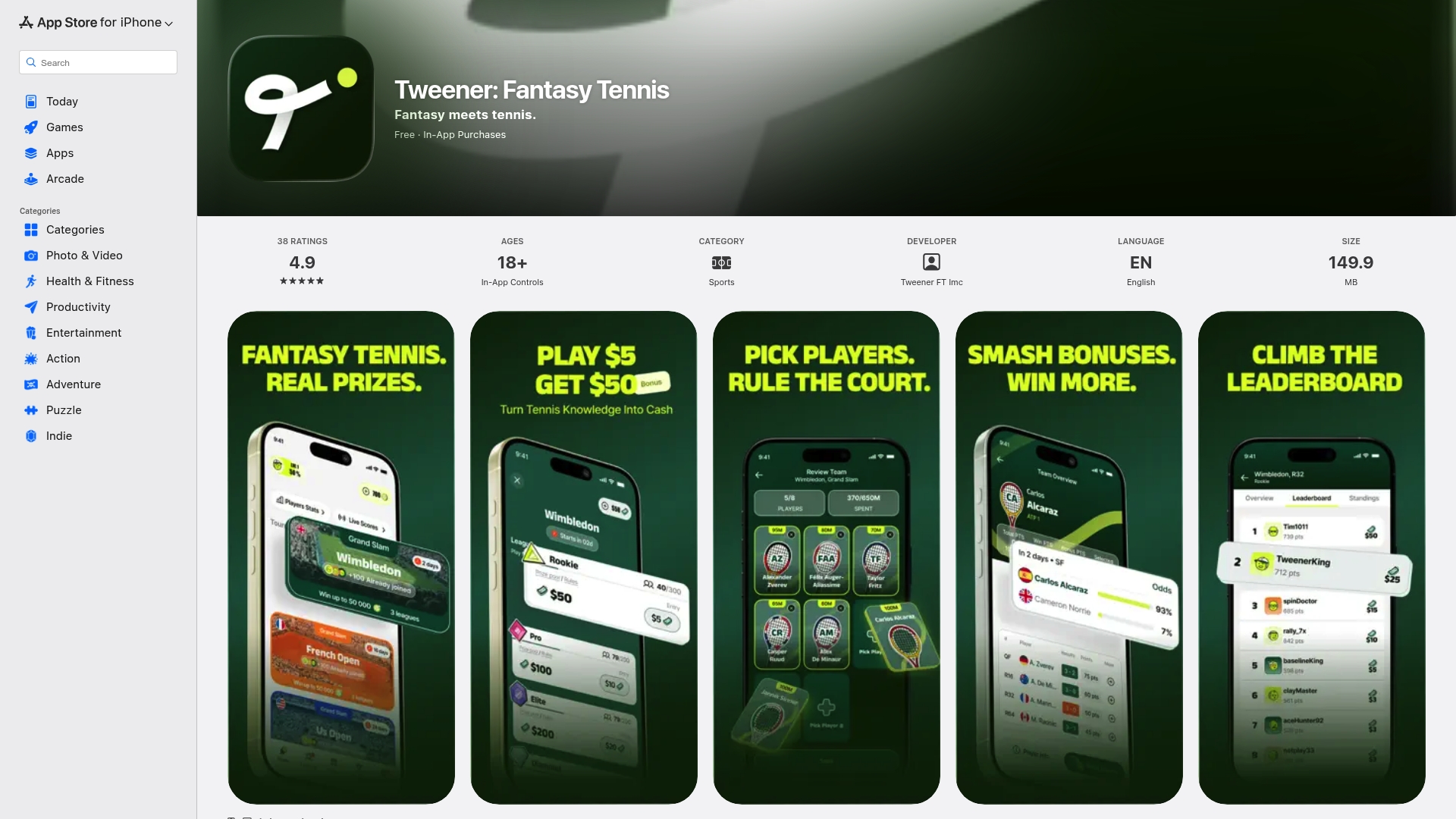
Tweener is the only fantasy sports app built specifically around professional tennis, and it supports both free and cash modes within the same platform. In free mode, you earn virtual coins through gameplay and competition, which can be redeemed for gift cards. In cash mode, where legally available, you deposit real money and compete for real payouts in tournament-length contests. The strategic layer is the same in both: building ATP and WTA lineups based on real match results, surface stats, form, and head-to-head data. Whether you are calibrating your approach in free mode or testing your edge against paid competition, Tweener gives you the platform to do it. Ready to play? Download the app and start with whatever mode fits where you are right now.
FAQ
What is the main difference between free and cash fantasy modes?
Free mode requires no entry cost and offers virtual or non-cash rewards, while cash mode requires a real-money deposit and pays out real-money prizes. The strategic approach, risk tolerance, and tool requirements differ significantly between the two.
Is free mode worth playing if you are serious about fantasy sports?
Yes. Free mode is where you build the pattern recognition and lineup instincts that make cash mode profitable. Even experienced players use free vs paid strategy frameworks to test new approaches without financial exposure.
Do you need paid tools to compete in cash fantasy contests?
Not always, but paid tools provide a real edge. Paid fantasy analytics subscriptions costing $8 to $40 per month offer proprietary projections and real-time data that free tools simply do not match, which matters most in cash contests against experienced opponents.
Can regulations affect access to cash mode?
Yes, and it happens. India's Online Gaming Bill 2025 forced major platforms to shut down real-money contests entirely. Cash mode availability depends on local laws, which means every serious fantasy player should maintain strong free mode skills as a baseline.
How do you transition safely from free to cash mode?
Start with the lowest stake available, focus on head-to-head contests instead of large-field tournaments, and treat your first paid entries as calibration rather than profit opportunities. Build up gradually as your cash mode win rate confirms your edge.