
The best fantasy tennis apps win on five features: live voice-enabled draft rooms with timed pick queues, synchronized live scoring tied to score-linked microchallenges, persistent private leagues with in-app chat and shareable results, rich player cards showing head-to-head and surface splits, and a visible rewards economy that mixes virtual coins with real-money contests where the law allows it. The fantasy sports market has topped $34 billion, and the operators pulling ahead are the ones treating engagement as a system, not a feature list. Tweener builds around this exact stack for ATP and WTA competition.
These features work together because tennis, unlike a Sunday-only sport, hands you a near-continuous calendar to build habits around.
- Voice-enabled draft rooms with pick queues and countdown timers
- Live scoring synced to in-match predictions and challenges
- Private leagues with persistent chat and shareable results
- Player cards with H2H, surface splits, and form data
- Rewards wallet with virtual coins and optional cash contests
Stat check: Draft rooms with live voice complete at 85 to 95 percent, compared to 40 to 60 percent for text-only drafts. That gap alone explains why the draft is where retention gets won or lost.
Key Takeaways
Fantasy tennis apps retain users when draft rooms, live scoring, private leagues, and player analytics work together as one connected behavioral loop, not as isolated features.
| Point | Details |
|---|---|
| Voice drafts beat text drafts | Voice-enabled draft rooms complete at 85 to 95 percent versus 40 to 60 percent for text-only drafts. |
| Watch parties drive retention | Synchronized watch parties correlate with roughly 3x higher weekly retention than score-checking alone. |
| Player cards teach strategy | H2H records and surface splits turn casual fans into sharper, more engaged drafters. |
| Compliance is non-negotiable | Cash contests require local legal counsel since real-money rules vary by state. |
| Tweener implements this stack | Tweener runs private leagues, voice-ready drafts, player analytics, and both coin and cash modes for ATP and WTA play. |
Table of Contents
- Why These Features Work: Behavioral Loops Across Pre, During, and Post Match
- Prioritized Inventory: What Good Looks Like for Tennis
- Community Features That Reduce Churn and Fuel Organic Growth
- Player Cards and Analytics: Education as an Engagement Pillar
- Monetization Models and Legal Guardrails
- How to Measure Engagement and Run Experiments That Move KPIs
- Roadmap: MVP to Six-Month Rollout for Early Retention
- What Tennis Fans Actually Want From These Apps
- Try the Features That Actually Drive Fantasy Tennis Engagement
- Sources
Why These Features Work: Behavioral Loops Across Pre, During, and Post Match
Engagement in a fantasy tennis app isn't one feature doing one job. It's a loop that fires three separate times around every match: before it starts, while it's live, and after it ends. Miss any one stage and the loop breaks, and the user drifts back to just checking scores on ESPN.
Pre-match: predictions, polls, and draft reminders pull users in before the first serve. During match: live scoring, score-linked microchallenges, and synchronized watch parties keep them locked in. Post-match: leaderboards, coin payouts, and highlight recaps close the loop and set up the next one.
Watch-party features with synchronized playback correlate with roughly 3x higher weekly retention compared to users who only check scores. Personalization multiplies this: a notification about your drafted player's break point matters more than a generic "match is live" push. Layer in a little education (a surface-split stat, a form trend) and casual fans start behaving like analytical ones.
Prioritized Inventory: What Good Looks Like for Tennis
Not every feature deserves the same engineering budget. Here's the order that actually moves retention, ranked by impact.
1. Live draft rooms (voice, pick queues, timers). This is the single highest-leverage feature in the stack. Voice chat during the draft, a visible pick queue, and a countdown timer turn a solitary roster-building task into a shared event. Target sub-200ms audio latency so voice feels natural, not laggy.
2. Synchronized live scoring plus microchallenges. Scores need to update within seconds of a point being won, not minutes. Layer in microchallenges: "Will Sinner win this game to love?" turns a routine service game into a live decision point.
3. Persistent private leagues with chat and moderation. A league that disappears after one tournament has no reason to exist. Persistent chat, pinned messages, and simple moderation tools (mute, report, dispute flag) keep a group of nine friends coming back Slam after Slam.
4. Rich player cards. H2H record, surface splits, recent form, and injury flags belong on the card, not buried three taps deep.
5. Watch parties with scoring overlays. Syncing a live match stream with real-time fantasy point overlays gives fans a reason to stay in the app instead of switching to a broadcast feed.
6. Rewards wallet and virtual economy. Coins earned through gameplay, redeemable for gift cards, plus optional cash contests where legally permitted, give the loop a tangible payoff.
7. Smart push notifications. "Your player just broke serve" beats "Check your fantasy team" every time. Trigger notifications off actual match events, not a generic schedule.
8. Onboarding and educational flows. A first-time user who doesn't understand scoring rules churns fast. Short, contextual tutorials during the first draft outperform a wall of rules text.
9. Accessibility and moderation tools. Screen-reader support, adjustable text size, and color-contrast options aren't optional extras. Neither is a working report-and-block system.
10. Shareable results and social integration. A one-tap share of your league standings to Instagram or X turns every good week into a recruitment ad.
Common MVP checklists for fantasy tennis also flag real-time updates, push alerts, leaderboards, and basic payment flow as table stakes, which lines up with what's above but underweights the draft-room experience most operators still treat as an afterthought, according to development guidance for fantasy tennis apps.
Pro Tip: Schedule your private league draft like an actual event. Set a fixed start time, enable voice chat, and let the league talk trash while picks come in. A scheduled "draft party" with nine friends does more for season-long engagement than any push notification ever will.
Community Features That Reduce Churn and Fuel Organic Growth
A private league is the cheapest retention tool a fantasy app has, and it's also a growth engine. Persistent league chat with reactions and threads gives friend groups a reason to open the app between matches, not just during them. Commissioner tools, pinning a rule, muting a troll, resolving a scoring dispute, keep small leagues functional without needing a support ticket.
- Referral bonuses for inviting friends into a private league
- Shareable milestone cards (top-3 finish, perfect draft, coin payout)
- Social features that treat every league as an acquisition channel, not just a retention tool
Pro Tip: Give commissioners a reason to recruit. A simple bonus, extra coins, a badge, for filling a nine-person league turns your most engaged users into your unpaid marketing team.
Player Cards and Analytics: Education as an Engagement Pillar
Casual fans become sharp drafters the moment a player card actually teaches them something. The data that matters: head-to-head record against the current opponent, surface performance splits (a clay specialist's hard-court numbers tell a different story), recent form over the last five matches, and any fatigue or injury flag from recent tournament play.
- H2H record against the upcoming opponent
- Surface-specific win rate and points-per-match
- Last-five-match form trend
- Injury or fatigue flags pulled from recent schedule load
The best UX pattern keeps this scannable: a compact card with the top three stats, then a drilldown for anyone who wants the full box score. Discovery work on fantasy tennis products consistently points to analytics-first player cards as the feature that separates a casual scoring app from a genuine strategy tool. On Tweener, a player card showing a rival's poor record on clay has talked more than one user out of an obvious but wrong pick, exactly the kind of small save that builds trust in the data.
Monetization Models and Legal Guardrails
Engagement features and revenue aren't separate conversations. Entry fees for cash contests, in-app purchases, and tournament-tied sponsorships all depend on users trusting the scoring is fair. Virtual coins solve for casual engagement without regulatory friction; cash contests solve for the fans who want stakes.
- Entry fees for skill-based cash contests
- In-app purchases for cosmetic or convenience features
- Sponsorships tied to Grand Slam or Masters events
- Coin-based rewards for free-to-play users
Transparent scoring and an auditable results log protect the "skill over luck" positioning that separates fantasy tennis from a betting product. Growth engineering research also flags personalization and visible reward systems as the highest-leverage retention levers, monetization included.
One necessary caveat: real-money contest legality varies by state and structure in the US, so any operator running cash contests needs local legal counsel, not a blog post, to confirm compliance.
How to Measure Engagement and Run Experiments That Move KPIs
Track DAU/MAU ratio, match-day return rate, draft completion rate, reward-redemption rate, and churn broken out by cohort (casual coin players versus cash-contest players). LTV for paying users should be tracked separately from free-mode engagement, since the two groups respond to different levers.
- A/B test voice drafts against text drafts and measure completion rate
- Stagger the launch of watch parties to isolate their retention effect
- Build separate onboarding flows for casual fans versus stat-driven drafters
Pro Tip: Run experiments for at least two to four weeks around a full tournament cycle, not a single weekend. A one-off Masters event will overstate engagement; a full Slam-to-Slam window shows what actually sticks.
Roadmap: MVP to Six-Month Rollout for Early Retention
- MVP: live scoring with an overlay, timed-pick draft queues, private leagues with chat, basic player cards, onboarding, and push notifications. This is the baseline most fantasy tennis builds start with.
- Months 2 to 3: voice-enabled draft rooms and watch parties. Ship voice as soon as draft-completion data justifies the engineering lift.
- Months 4 to 6: rewards wallet expansion, advanced analytics drilldowns, and full accessibility and moderation tooling. Move a feature from beta to full release once it clears a defined retention threshold in cohort testing.
What Tennis Fans Actually Want From These Apps
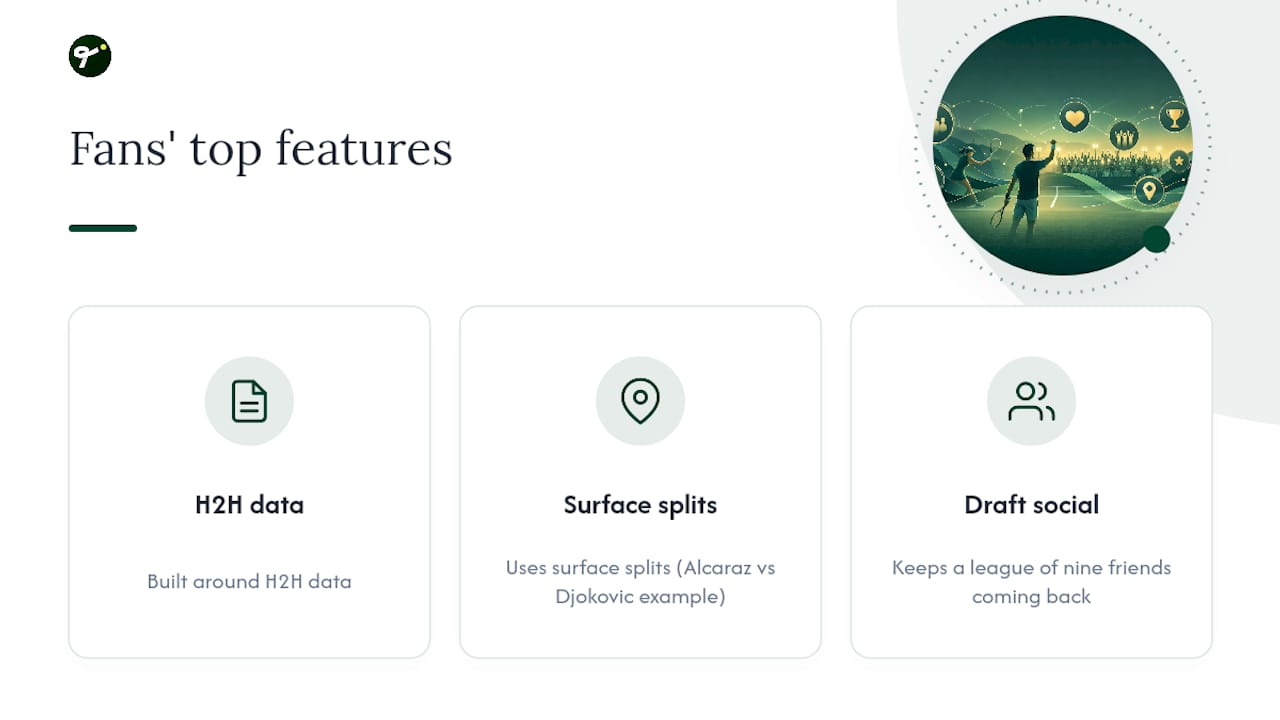
Tennis doesn't have a Fanduel or DraftKings-caliber product built specifically for it, and that gap is the whole opportunity. The features that matter aren't flashy, they're the ones that respect a fan who already knows Alcaraz struggles more on fast hard courts than Djokovic does. Building Tweener around H2H data, surface splits, and draft-as-social-event mechanics reflects internal product testing on what actually keeps a league of nine friends coming back tournament after tournament, not just guesswork about what sounds engaging.
Try the Features That Actually Drive Fantasy Tennis Engagement
Tweener already runs the stack this article just walked through: private leagues capped at nine friends per Grand Slam, player cards with H2H and surface splits, a coin-based free mode, and cash contests where state law permits them. You're not choosing between a generic sports app and a real fantasy tool. You're choosing a fantasy tennis product built specifically around the analytics and social mechanics that keep tennis fans, not just sports fans in general, coming back match after match.
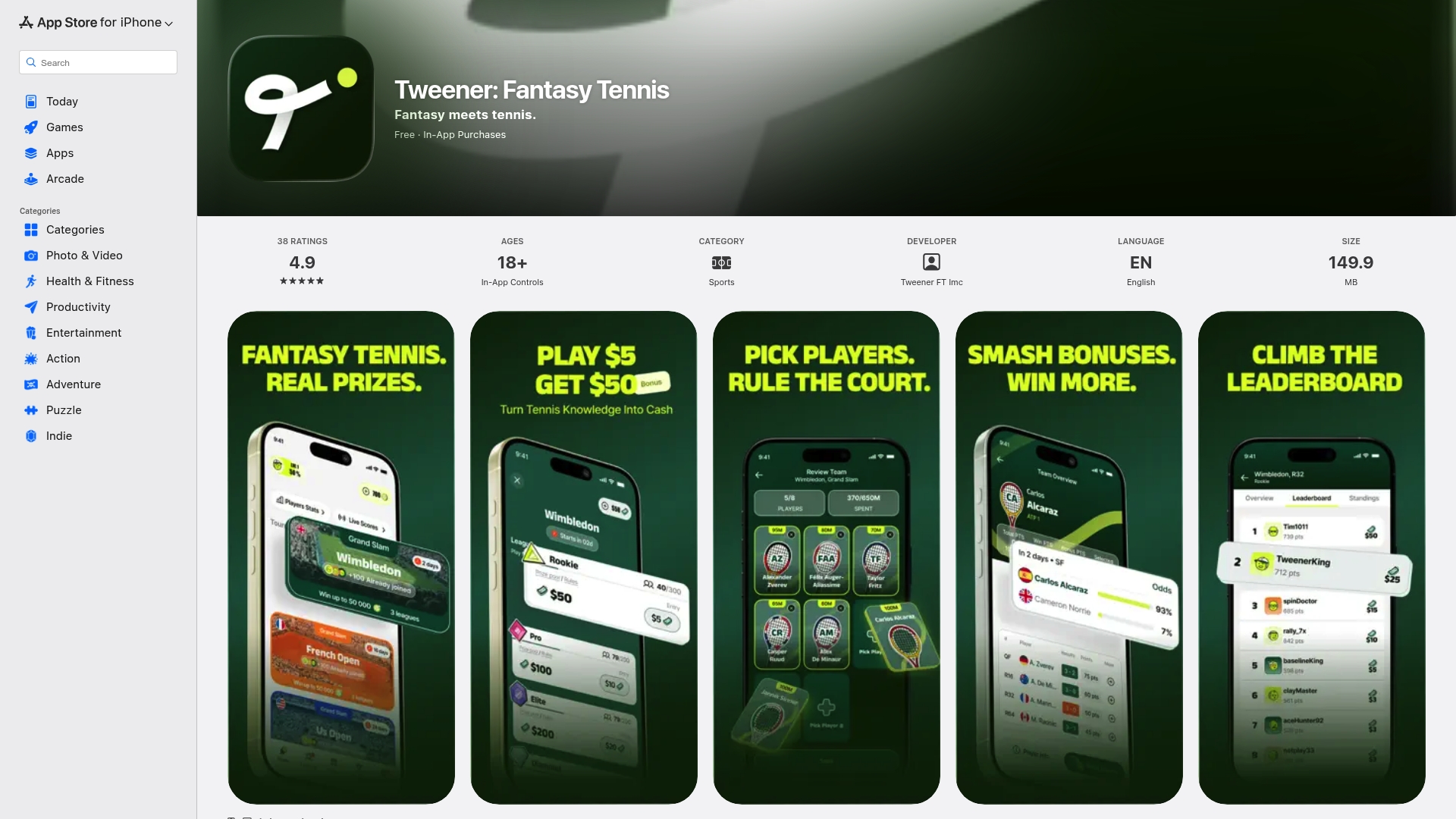
If you want a strategic edge instead of a coin flip, pair Tweener's scoring transparency with outside tools like Athlo for live match data while you build your draft board. Ready to see it for yourself? Download Tweener and set up your first private league before the next Slam starts.
Sources
- Fantasy Sports App Development: Draft, Chat & Watch Parties
- Fantasy Tennis App Discovery: Tech Stack, Costs & Development Roadmap | Uinno
- Why Growth Engineering Is Essential for Scaling a Fantasy Sports Platform
- How To Develop A Fantasy Tennis App?
Explore more tennis-specific strategy on the Tweener blog for deeper draft and scoring guides.