
The reward mechanics that actually move the needle for a fantasy tennis app are narrow and specific: virtual coins, free-entry tickets, match-day power-ups, achievement badges, tiered leaderboard prizes, cosmetic items, limited-time event badges, and gift-card redemptions. That's the list. Each one taps a different reason players log in, and the timing behind them matters as much as the reward itself. Mobile Premier League saw click-through rates jump 20 to 30 percent after fixing the timing of its push notifications using CleverTap's best-time automation, not by adding new rewards. Separately, retention case studies show match-timed notifications driving up to 5x retention gains on some platforms. Tweener's own coin economy and private leagues already lean on several of these mechanics. Here's how each one works, who it's for, and what to test first.
Key Takeaways
Reward mechanics only work when they're matched to a specific player motivation and delivered at the right moment, not when they're distributed evenly across the whole player base.
| Point | Details |
|---|---|
| Pace badge releases | Space achievement badges at least a week apart to avoid flattening their perceived value. |
| Separate power-ups from core scoring | Keep purchased boosts from outperforming skill-based lineup decisions to protect competitive integrity. |
| Time notifications to lineup locks | Send push alerts 30 to 60 minutes before lineup lock, following the timing pattern behind MPL's 20 to 30 percent CTR lift. |
| Segment before rewarding | Match leaderboard prizes to competitive players and coin bonuses to casual players rather than using one reward for everyone. |
| Test one mechanic per cohort | Run isolated experiments, like free tickets versus coins, before scaling any reward change across Tweener's full player base. |
Table of Contents
- Examples of User Engagement Rewards That Fit Fantasy Tennis
- What Each Reward Type Does and Who It's For
- How to Match Rewards to Player Segments
- Building the Reward Engine: Pacing, Scarcity, and Fair Play
- When to Send Rewards Around Match Day
- A 6-Week Reward Rollout Plan Worth Copying
- Try These Reward Mechanics In Your Next Tweener League
- Frequently Asked Questions
- Sources
Examples of User Engagement Rewards That Fit Fantasy Tennis
Every reward type below serves a different itch. Virtual currency rewards patience and repeat play. Badges reward mastery and give players something to show off. Leaderboards reward competitiveness directly. Cosmetics reward identity and self-expression. None of them work the same way, and treating them interchangeably is how reward systems go stale fast.
- Virtual coins — earned through gameplay, streaks, or daily logins, redeemable for entries or gift cards. Tennis fans who grind free contests between Grand Slams respond well here because coins turn casual play into a savings account.
- Free-entry tickets — a no-cost pass into a paid-style contest. This works especially well after a strong finish in a free league, nudging players toward Tweener's cash mode without any pressure.
- Match-day power-ups — small, temporary boosts (extra points for a correct upset pick, a lineup swap window) tied to a specific live match.
- Achievement badges — permanent markers for milestones like a perfect clay-court prediction streak or drafting the eventual Grand Slam finalist.
- Tiered leaderboard prizes — rewards scaled to finishing position within a private or public league.
- Cosmetic items — avatar skins, profile borders, or team crests with zero gameplay effect.
- Limited-time event badges — scarce, tournament-specific rewards only available during Wimbledon fortnight or the US Open.
- Gift-card and merch redemptions — the end point of the coin economy, converting grind into something tangible.
Research on gamified fantasy sports backs the split in how these perform: a 2024 study found that badges, points, and leaderboards raise interactivity overall, but badge acquisition rate alone didn't predict spending. Players who accumulate points more slowly tend to interact and spend more than players who blow through milestones fast. That's a strong argument for pacing badge releases rather than front-loading them.
What Each Reward Type Does and Who It's For
Virtual coins solve the instant gratification problem. A player who correctly benches a struggling seed instead of a form player wants proof that decision paid off immediately, and coins deliver that faster than a leaderboard update ever could. Tennis fans obsessing over head-to-head records and surface splits are exactly the type who'll grind for a coin bonus tied to correctly predicting an upset.
Free-entry tickets work as a bridge product. A player earns one from a free coin league, uses it to enter a small cash contest, and experiences Tweener's paid mode with zero financial risk. That's a low-friction way to convert a casual free-mode player into someone who understands the cash side without ever asking them to deposit first.
Power-ups reward tactical thinking mid-tournament. A boost that doubles points for a correctly predicted five-set match plays directly into what makes tennis scoring formats different from team sports: single-elimination pressure, surface specialists, and momentum swings within a match. It's the mechanic most tailored to Tweener's actual sport.
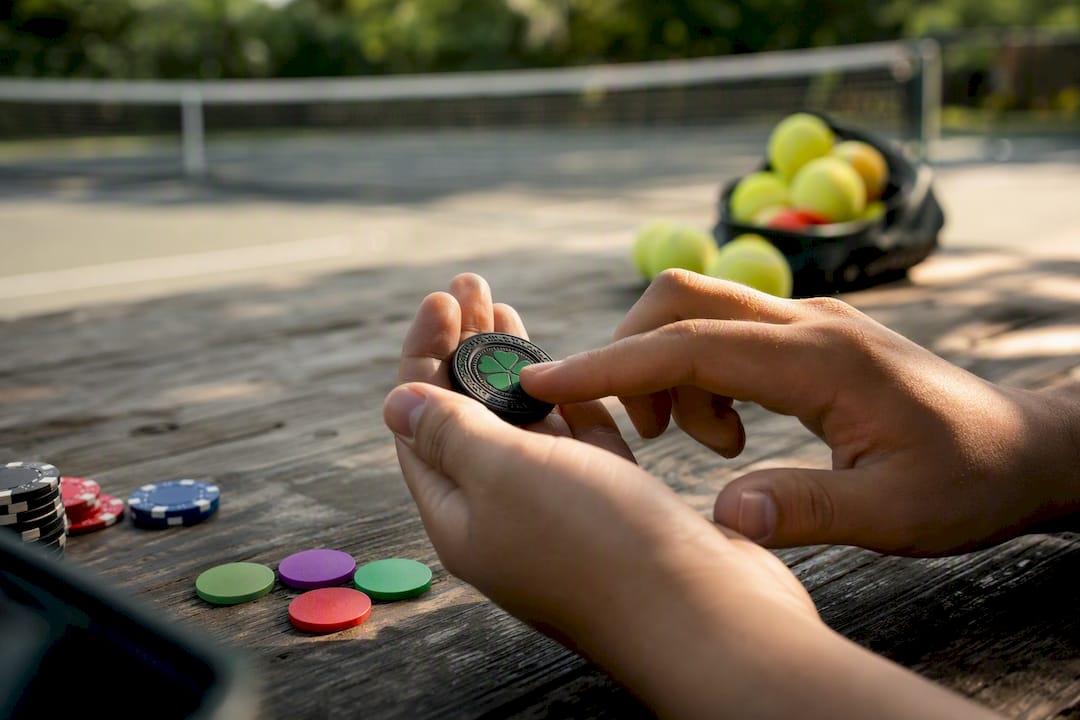
Badges function as social signals more than currency. Research on gamified fantasy sports platforms frames badges as tools for goal setting and social comparison rather than direct spend drivers, and that distinction matters for how you deploy them. A badge for correctly picking a Grand Slam finalist from outside the top 10 seeds gets shared and screenshotted precisely because it signals analytical skill, not luck.
Leaderboards reward the competitive segment most directly, especially in private leagues where up to nine friends compete for tournament-long bragging rights. Cosmetics reward identity, letting completionists and long-tenured players differentiate themselves without touching the scoring engine. Limited-time event badges create scarcity around calendar moments tennis fans already care about. Gift-card redemptions close the loop, turning weeks of grinding into something real.
Pro Tip: Space badge releases at least a week apart during a single tournament. Dumping five achievement badges in the same weekend flattens their value and trains players to expect constant rewards instead of working toward one.
How to Match Rewards to Player Segments
Not every player wants the same reward, and sending a cosmetic skin to a stats-obsessed leaderboard climber wastes the opportunity. Four segments show up consistently in fantasy sports behavior, and each responds best to a different lever.
- Competitive / high-skill players chase leaderboard position and skill-matched contests. Research on AI-driven skill-based matchmaking found it creates a stronger sense of challenge for highly competitive users specifically, with acceptance tracking closely to how much a player already craves competition.
- Social / team players respond to private league prizes and referral-based rewards shared with friends.
- Casual / occasional players need low-friction wins: daily login coins, small streak bonuses.
- Completionists / collectors chase badge sets and cosmetic collections tied to full-tournament participation.
Targeting signals worth tracking include win streaks, leaderboard position, days since last session, and league type (public versus private). A player who hasn't opened the app in five days needs a re-engagement nudge, not another badge.
| Player Segment | Best Reward Type | KPI to Monitor |
|---|---|---|
| Competitive / high-skill | Leaderboard prizes, skill-matched contests | Retention, DAU |
| Social / team players | Private league prizes, referral rewards | Conversion, league creation rate |
| Casual / occasional | Coins, streak bonuses | D1/D7 retention |
| Completionists / collectors | Badge sets, cosmetics | ARPDAU, session frequency |
Building the Reward Engine: Pacing, Scarcity, and Fair Play
Delivery matters as much as design. Rewards should surface through a visible in-app wallet, backed by push notifications for time-sensitive prizes and a simple in-app popup for instant wins. Practitioner guidance on sports gamification is blunt about the biggest failure mode here: rewards that feel abstract or hard to redeem get ignored, no matter how generous they are on paper. Tie earning to decisions players already enjoy making, like accurate lineup picks, and keep the redemption flow to two taps or fewer.
Pacing rules of thumb: daily rewards for login streaks, weekly rewards for leaderboard tiers, and strictly time-boxed rewards for tournament-length events. Scarcity works best when it's tied to a real calendar moment, not manufactured urgency. A badge available only during the Australian Open's first week creates legitimate FOMO because the event itself is finite.
Anti pay-to-win safeguards matter more in fantasy tennis than most categories, since Tweener's core pitch is skill over luck. Keep power-ups separate from core scoring logic; a purchased boost should never outperform a well-researched lineup pick. Earnable coins should always be able to unlock the same power-ups as purchased ones, just on a slower timeline.
Reward-driven re-engagement gets measured with a specific KPI set:
- D1/D7/D30 retention after a reward is claimed
- Match-day return rate (does the player come back for the next live match?)
- Rewards engagement rate (percentage of eligible players who claim a reward)
- Conversion from free coin mode to paid contests
- ARPDAU and LTV shifts over a rolling 30-day window
MPL's experience is the clearest evidence point here: after cutting notification delivery latency and adopting best-time send automation, click-through rates rose 20 to 30 percent and conversions rose roughly 5 percent, without changing what the rewards actually were. Timing was the lever, not the prize.
When to Send Rewards Around Match Day
Tennis has natural attention spikes that most reward calendars ignore. Four moments consistently outperform generic daily notifications:
- Pre-match lineup lock — a reminder 30 to 60 minutes before lineups close, when players are actively deciding.
- Set breaks and mid-match momentum shifts — a live update tied to a power-up window.
- Post-match recap — showing points earned within minutes of the final point, while the outcome is still fresh.
- Tournament milestones — quarterfinal, semifinal, and final-day triggers where engagement naturally spikes anyway.
MPL's push notification overhaul is worth studying closely: by reducing delivery latency and using automated best-time sends, the platform saw CTR gains of 20 to 30 percent. The takeaway for Tweener notifications isn't "send more." It's "send at the exact minute a decision needs to be made," particularly around lineup locks before a live match starts.
A 6-Week Reward Rollout Plan Worth Copying
Roll out new reward mechanics on a schedule, not all at once. A six-week structure gives enough time to see real retention signal without letting a bad experiment run too long.
Weeks 1 to 2: pilot one reward type on a single segment (start with competitive players and a leaderboard prize test). Weeks 3 to 4: expand to a second segment if early data holds, while watching for reward fatigue signals like declining claim rates. Weeks 5 to 6: scale to the full player base or roll back based on clear gating criteria, like a drop in D7 retention versus the control group.
Five experiments worth running in that window:
- Free-entry ticket vs. extra coins as a leaderboard prize. Primary KPI: conversion to cash mode.
- Skill-matched contests plus a badge reward, testing whether pairing matchmaking with recognition boosts re-engagement among competitive players specifically.
- A limited-time cosmetic drop during a Grand Slam. Primary KPI: DAU during the event window.
- Match-day push timing (30 minutes pre-lock vs. 2 hours pre-lock). Primary KPI: CTR and lineup completion rate.
- Streak badges vs. milestone badges. Primary KPI: session frequency over 14 days.
Keep one reward variable per cohort. Stacking multiple changes on the same group of players makes it impossible to know which mechanic actually moved the number.
What Actually Works, In Nathan's Experience
The two patterns I keep coming back to are match-day power-ups and seasonal badges tied to a specific Grand Slam. Tennis fandom is built around calendar moments, not a flat season grind, and rewards that respect that rhythm outperform generic daily nudges. Tweener's ATP and WTA depth and private league format make both mechanics easy to build on.
Try These Reward Mechanics In Your Next Tweener League
Tweener already runs on several of the reward types covered here. Virtual coins earned through free-mode gameplay convert into gift cards. Cash contests give competitive players a real-money leaderboard to chase. Private leagues let up to nine friends compete for tournament-long bragging rights, which is exactly the kind of social reward structure that keeps casual players engaged without needing a cash incentive.
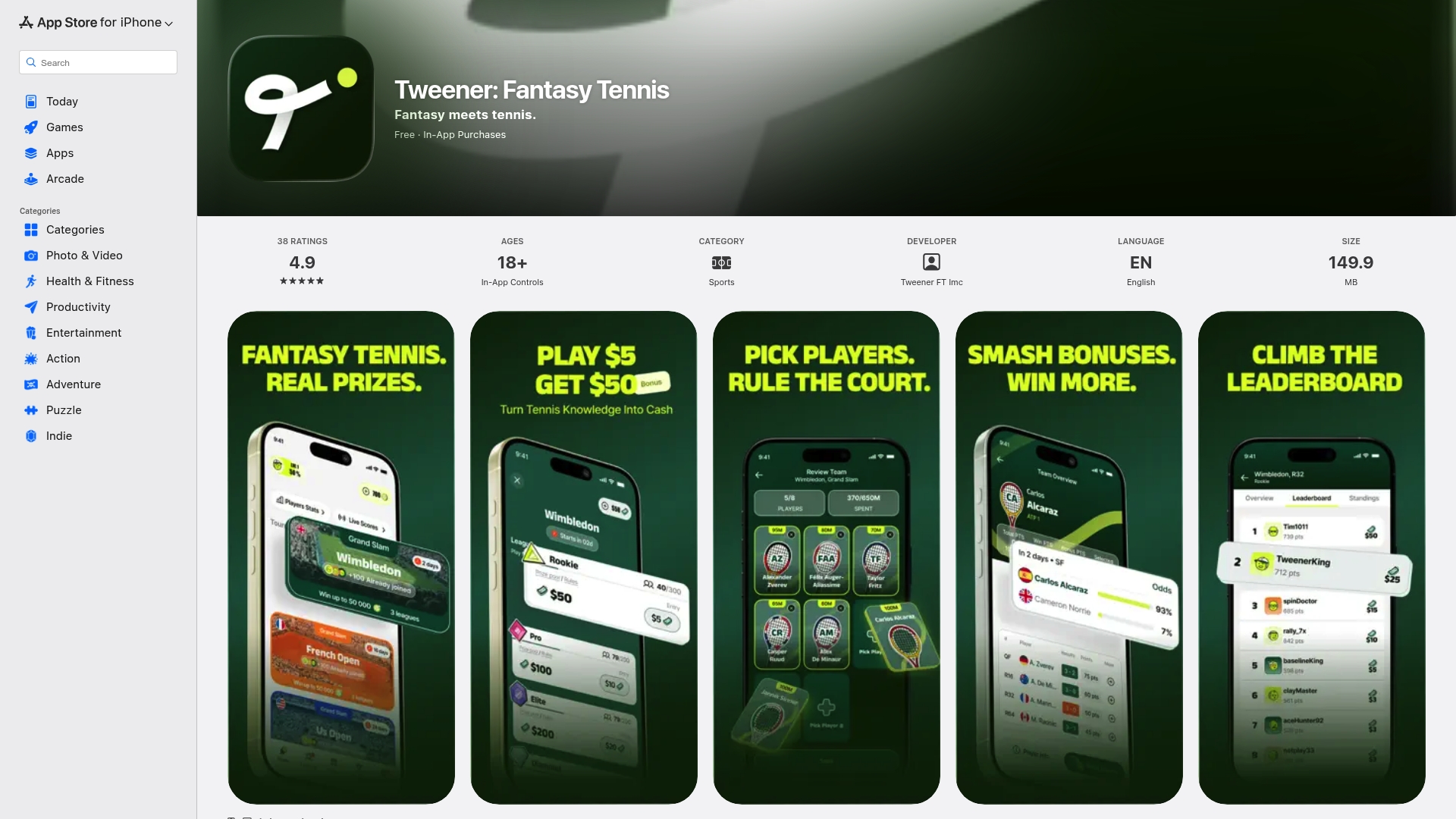
If you want to test one of these ideas yourself, the easiest starting point is a private league for the next Grand Slam. Set a coin-based prize for the top finisher, track who comes back for the next round, and see how your group responds to a leaderboard prize versus a straight bragging-rights format. Check how scoring and contest structures work on the Tweener game rules page, or head to Tweener to set up your first league before the next tournament starts.
Frequently Asked Questions
What are the most effective examples of user engagement rewards for a fantasy sports app?
Virtual coins, free-entry tickets, match-day power-ups, achievement badges, tiered leaderboard prizes, cosmetics, limited-time event badges, and gift-card redemptions cover the core mechanics that map to distinct player motivations, from instant gratification to long-term status signaling.
How often should a fantasy tennis app send reward-related push notifications?
Timing matters more than frequency. MPL's CTR gains of 20 to 30 percent came from sending fewer, better-timed pushes around lineup locks and match moments, not from increasing volume.
Do badges actually increase spending in fantasy sports apps?
Not directly. Research on gamified fantasy sports found badge acquisition rate had no significant relationship with in-app spending, though badges did raise overall platform interactivity and social comparison.
How do you avoid pay-to-win problems with in-app rewards?
Keep power-ups and cosmetic purchases separate from core scoring mechanics. A purchased boost should never outperform a well-researched player selection, and earnable coins should be able to unlock the same rewards as purchased currency, just more slowly.
What KPI should teams watch first when testing a new reward type?
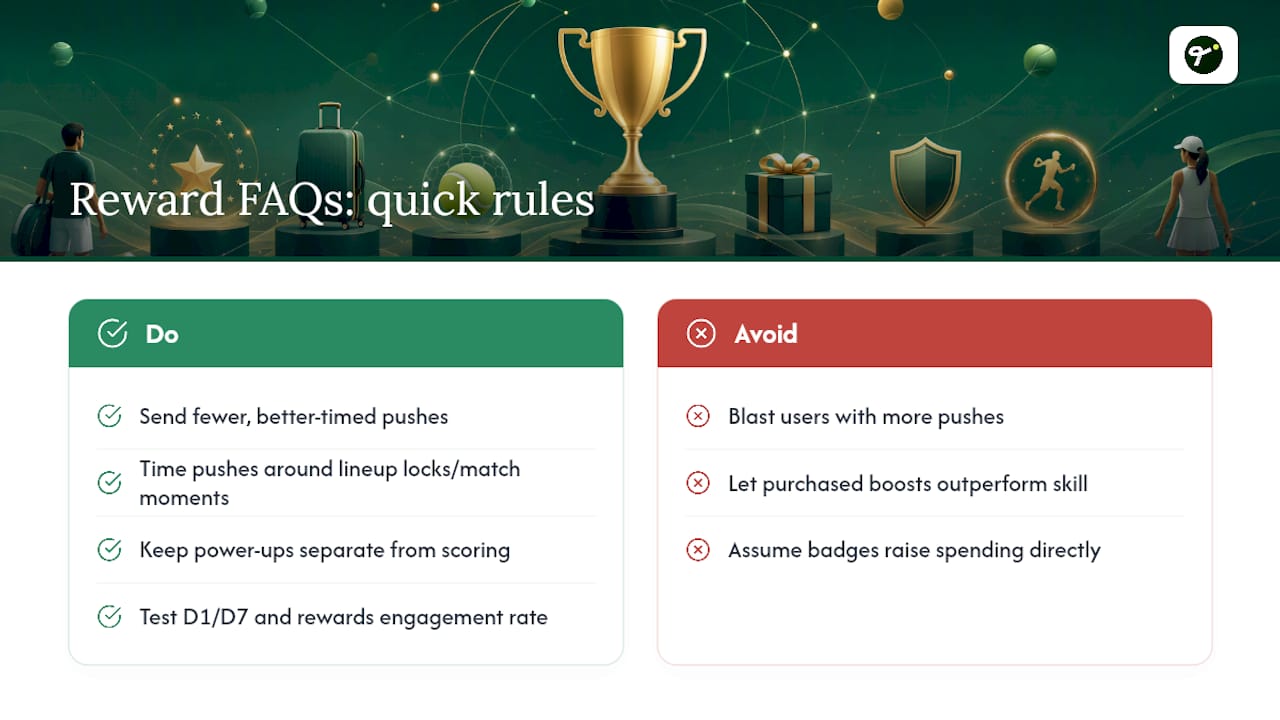
Start with D1/D7 retention and rewards engagement rate (the percentage of eligible players who actually claim the reward). Both signal whether a mechanic is landing before longer-term metrics like ARPDAU shift.
Sources
- Paying while playing: examining the influence of interaction with gamified elements in fantasy sports on in‑app spending
- Challenge accepted! or not: impact of artificial intelligence (AI)-based matchmaking on motivation to re-engage with fantasy sports applications
- How Mobile Premier League boosts engagement through ultra-fast push notifications and more — CleverTap case study
- User retention case studies — Pushwoosh
- Gamification in sports — LSPORTS